
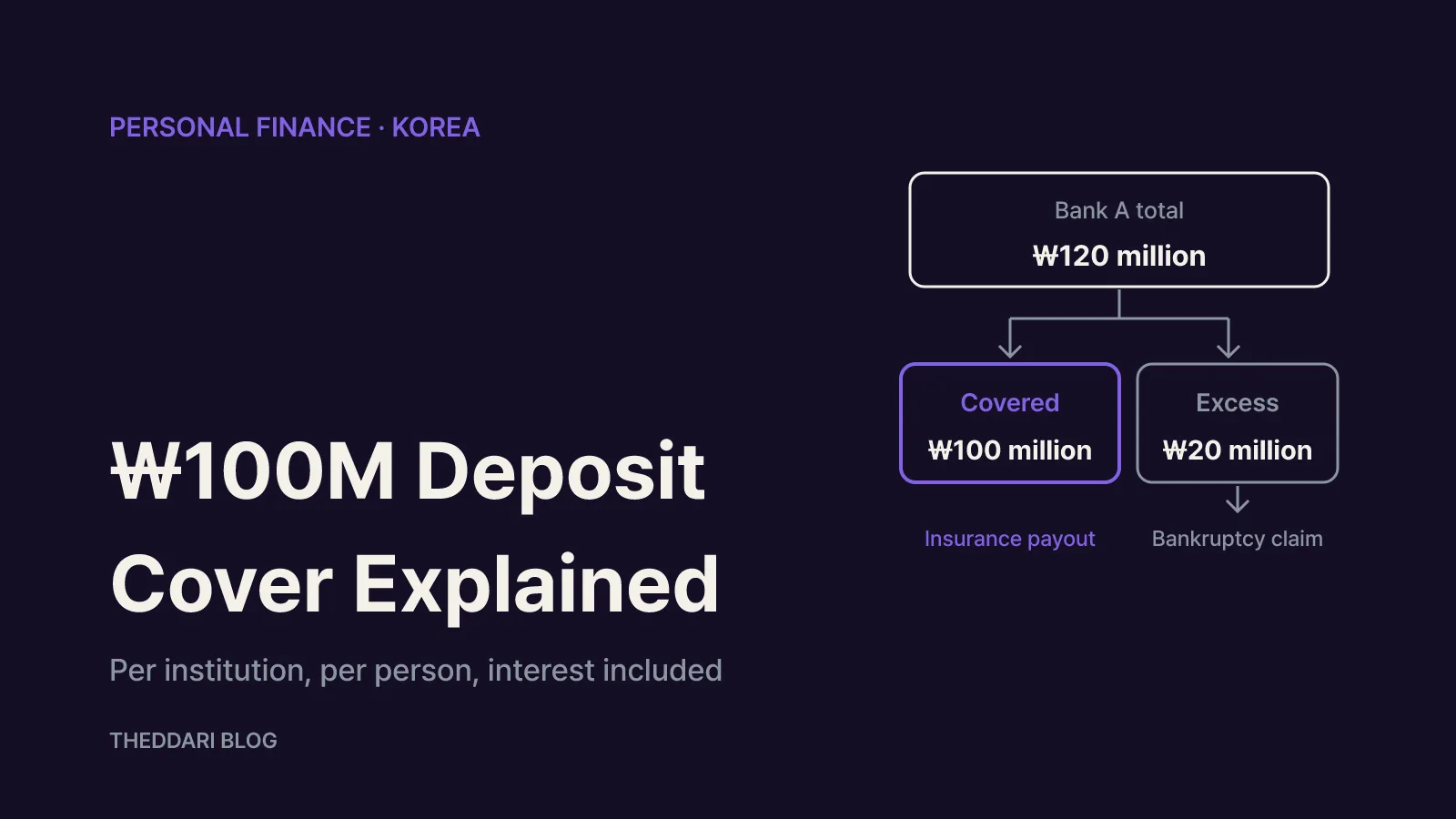
As of October 2026, deposit insurance in South Korea covers up to ₩100 million (often shortened to ₩100M) per depositor at each financial institution, with principal and interest counted together. The limit doubled from ₩50 million on September 1, 2025, and it applies automatically to deposits opened before that date as well (Financial Services Commission press release). If you hold savings in Korea, whether as a resident, an expat or a returning Korean, the headline number is only half the answer. What matters is which products count, how balances are aggregated and where separate limits apply. This guide works through those rules using the FSC announcement and the Korea Deposit Insurance Corporation (KDIC) FAQ.
The basic rules behind the ₩100 million limit
This was the first change to the limit since 2001, 24 years earlier. The Depositor Protection Act was amended in January 2025 so that the limit could be set by presidential decree, and six decrees were revised together and approved by the Cabinet on July 22, 2025, taking effect on September 1, 2025. The increase covers banks, savings banks, insurers and investment firms insured by the KDIC, and also the mutual finance sector, meaning credit unions, local agricultural and fisheries cooperatives, forestry cooperatives and Saemaul Geumgo community credit cooperatives.
You do not need to apply for anything. The KDIC states that the higher limit applies automatically to every customer holding protected deposits. It also warns about scams that use the increase as a pretext to ask for personal or credit information or to push people toward links in text messages. Treat any message asking you to "register" for the new limit as suspicious.
It also helps to be clear about when protection kicks in. Deposit insurance pays out when an institution cannot return deposits because of a business suspension, bankruptcy or a similar insured event under the Depositor Protection Act. It does not compensate for falling interest rates or for losses on investment products.
The unit of measurement is per institution, per depositor:
- All deposits and installment savings you hold at one institution are added together, principal plus eligible interest, and covered up to ₩100 million. In the KDIC's example, someone with accounts of ₩30 million, ₩40 million and ₩50 million at Bank A has ₩120 million in total, of which ₩100 million is covered.
- Money at different institutions is covered separately. With ₩90 million at Bank A and ₩80 million at Bank B, both balances are fully protected.
- Corporate deposits are also covered up to ₩100 million per company. Deposits held by the government, local governments, the Bank of Korea, the Financial Supervisory Service, the KDIC itself and insured financial institutions are excluded.
Which products are covered and which are not
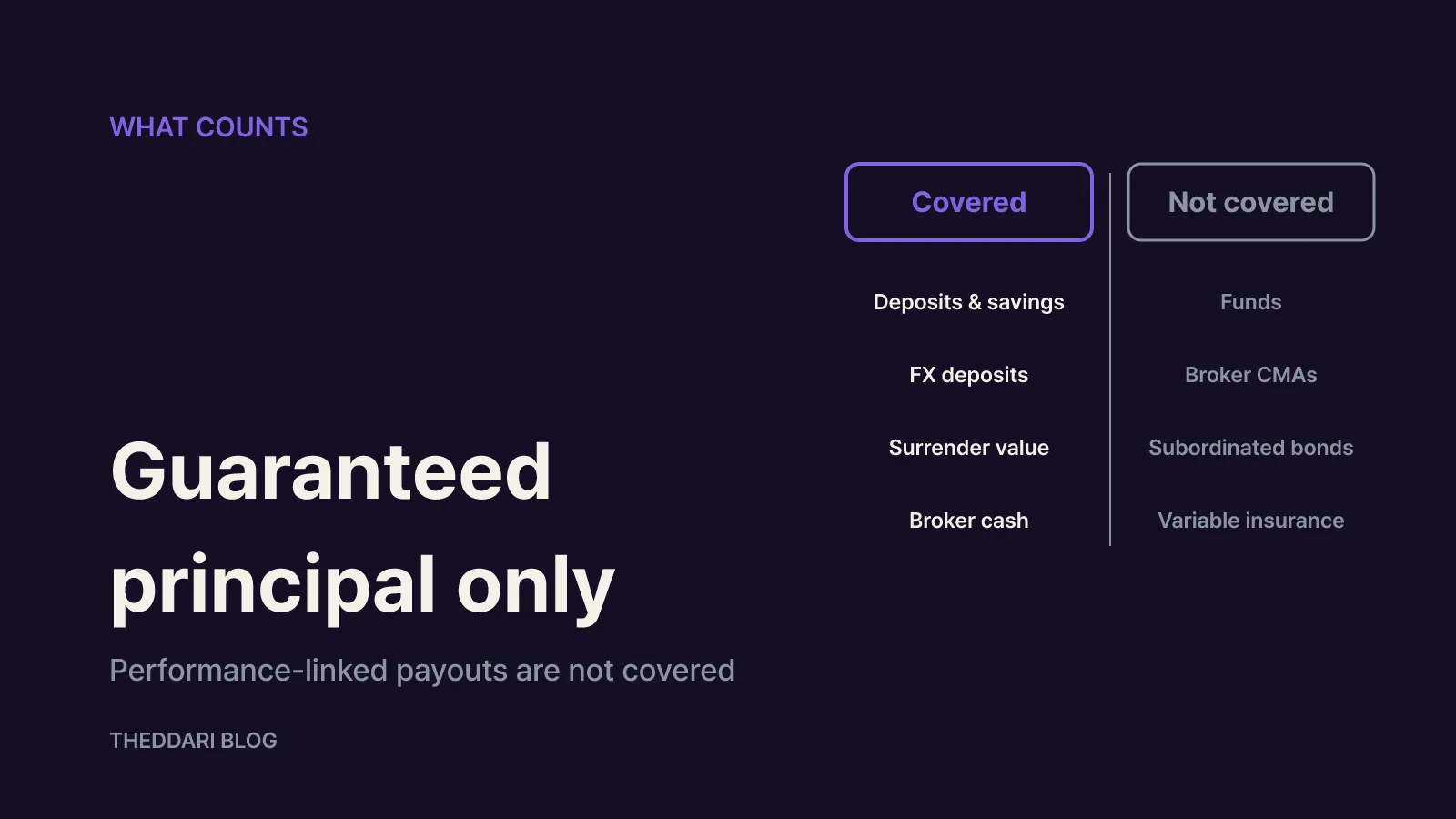
The KDIC protects products whose principal repayment is guaranteed when they are offered by an insured institution. Two products sold over the same bank counter can therefore be treated differently.
Covered products include:
- Deposits and installment savings at banks and savings banks
- The surrender value of insurance policies, including any policyholder dividend reserves
- Investor cash deposits left uninvested in a securities account
- Foreign currency deposits, converted to won at the institution's first telegraphic transfer buying rate on the payout announcement date, then covered up to ₩100 million
For insurance, if no insured event has occurred under the policy when the payout is made, the surrender value is covered up to ₩100 million. If a claim arose before the suspension but has not been paid, that unpaid claim is covered up to another ₩100 million, separately from the surrender value.
Products whose payout depends on investment performance are not covered. The KDIC lists funds and other financial investment products, performance-based products, securities-company CMAs, subordinated bonds and the main contract of variable insurance, apart from its minimum guarantees. A product labelled as an "account" can still be an investment, so check the deposit-protection notice in the product disclosure before assuming it is insured.
Defined-contribution (DC) retirement pensions, individual retirement pensions (IRP) and Individual Savings Accounts (ISA) are covered only for the portion held in protected products. In the KDIC's example, a DC pension of ₩150 million split into ₩70 million of deposits and ₩80 million in a mixed stock and bond fund has only the ₩70 million deposit portion protected.
Separate limits inside the same institution
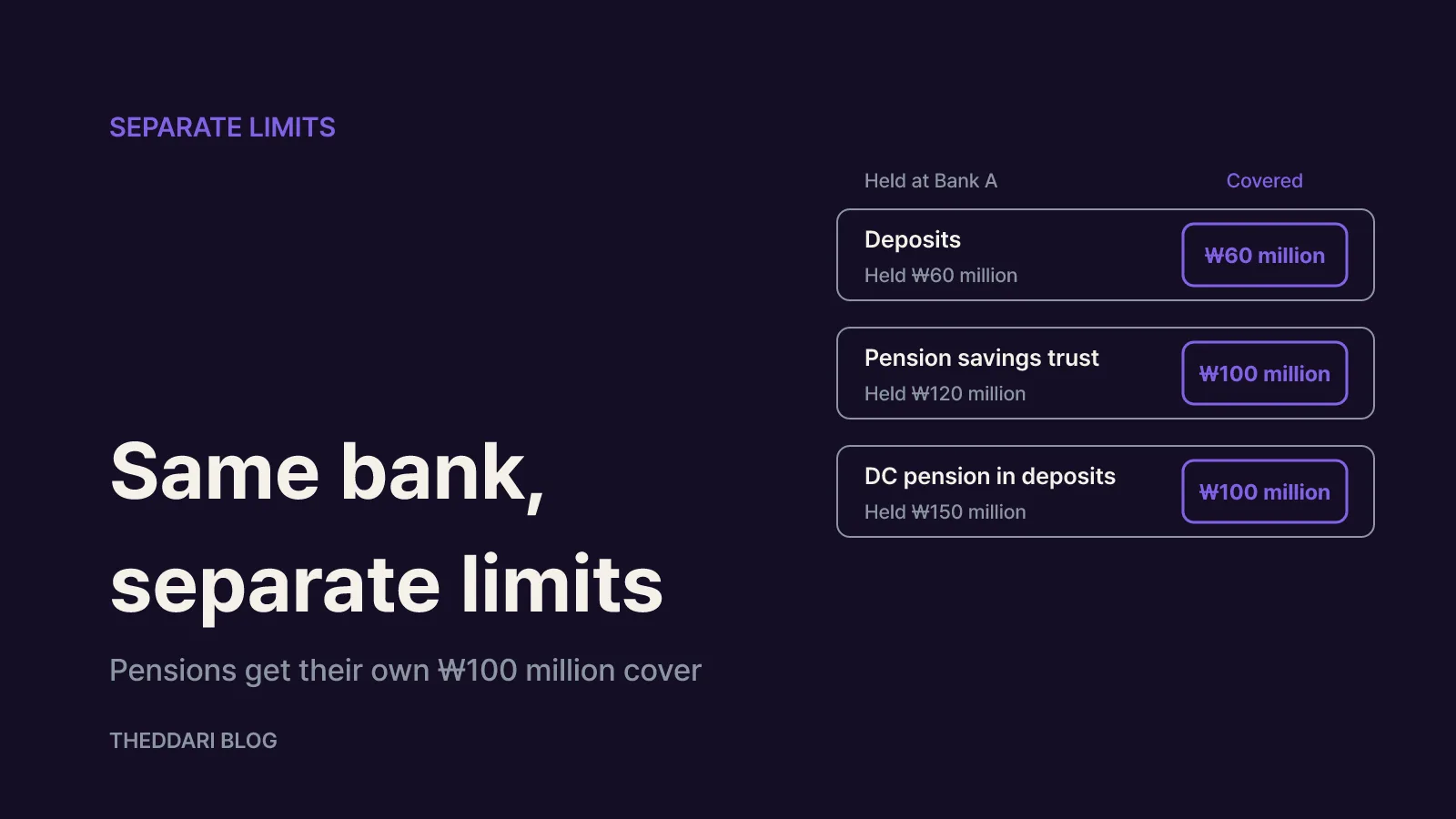
Some products sit outside your general deposit limit. Because they serve social-security purposes such as retirement income, the KDIC applies a separate limit of ₩100 million each to the following, even at the same institution:
- The protected-product portion of DC and IRP pensions and the SME retirement pension fund
- Pension savings trusts and pension savings insurance
- Unpaid insurance claims that arose before a business suspension
The KDIC's own example shows how this works. Someone with ₩60 million in deposits, ₩120 million in a pension savings trust and ₩150 million of DC pension money held in deposits, all at Bank A, is covered for ₩60 million, ₩100 million and ₩100 million respectively. The three are not squeezed into a single ₩100 million bucket.
The same example shows the ceiling on each bucket: ₩20 million of the pension trust and ₩50 million of the DC pension fall outside protection. Because the separate-limit list names pension savings trusts and insurance specifically, if you hold a pension savings product invested in funds, confirm its status directly with the provider.
Excess balances, interest, taxes and loans
Amounts above ₩100 million cannot be paid as deposit insurance. You can, however, file as a creditor in the institution's bankruptcy proceedings and may receive a partial distribution from the bankruptcy estate, which sells its assets and shares the proceeds pro rata among creditors. In the ₩120 million example, the ₩20 million excess follows this route, and the amount recovered is not fixed in advance.
Interest counts toward the limit, but it is calculated at the lower of your contract rate and a public rate set by the KDIC. For banks and savings banks the reference given is the average one-year time deposit rate at banks, so a high promotional rate may not be fully reflected in the insured amount.
The limit is pre-tax. Interest included in a payout is still subject to interest income tax and local income tax.
If you also owe money to the same institution, the loan is deducted first. With ₩150 million in deposits and a ₩30 million loan, the net ₩120 million is capped at ₩100 million. If you guaranteed someone else's loan, payment of an amount equal to that guarantee is withheld until the main borrower repays.
Mergers have a grace period. When insured institutions merge, the new, surviving and absorbed entities are each treated as separate institutions for one year from the merger registration date. After that, your balances are combined under one limit.
Who protects cooperatives and the post office
The KDIC insures banks (including licensed domestic branches of foreign banks, insurers and securities firms), life and non-life insurers, investment dealers and brokers, and mutual savings banks. Local agricultural and fisheries cooperatives, credit unions, Saemaul Geumgo, forestry cooperatives and the post office are protected under their own laws and funds, not by the KDIC. According to the FSC, the mutual finance sector's limit also rose to ₩100 million on September 1, 2025, but the paying body and procedure differ, so check the relevant central association if you hold large cooperative deposits.
A five-step check for your own savings
- Total by institution. Add principal and expected interest per institution, not per account.
- Label each product. Separate principal-guaranteed products from funds, CMAs and subordinated bonds.
- Pull out separate-limit products. List pension deposits, pension savings trusts and pension insurance in their own column.
- Check loans and guarantees. Recalculate net of any loan at the same institution.
- Flag anything above ₩100 million. Then decide whether to spread funds. The FSC said it is monitoring deposits moving toward higher-rate institutions after the increase, so weigh protection rules and institutional soundness alongside the rate.
To confirm a specific product, use the protected-product search on the KDIC website with the institution and product name.