
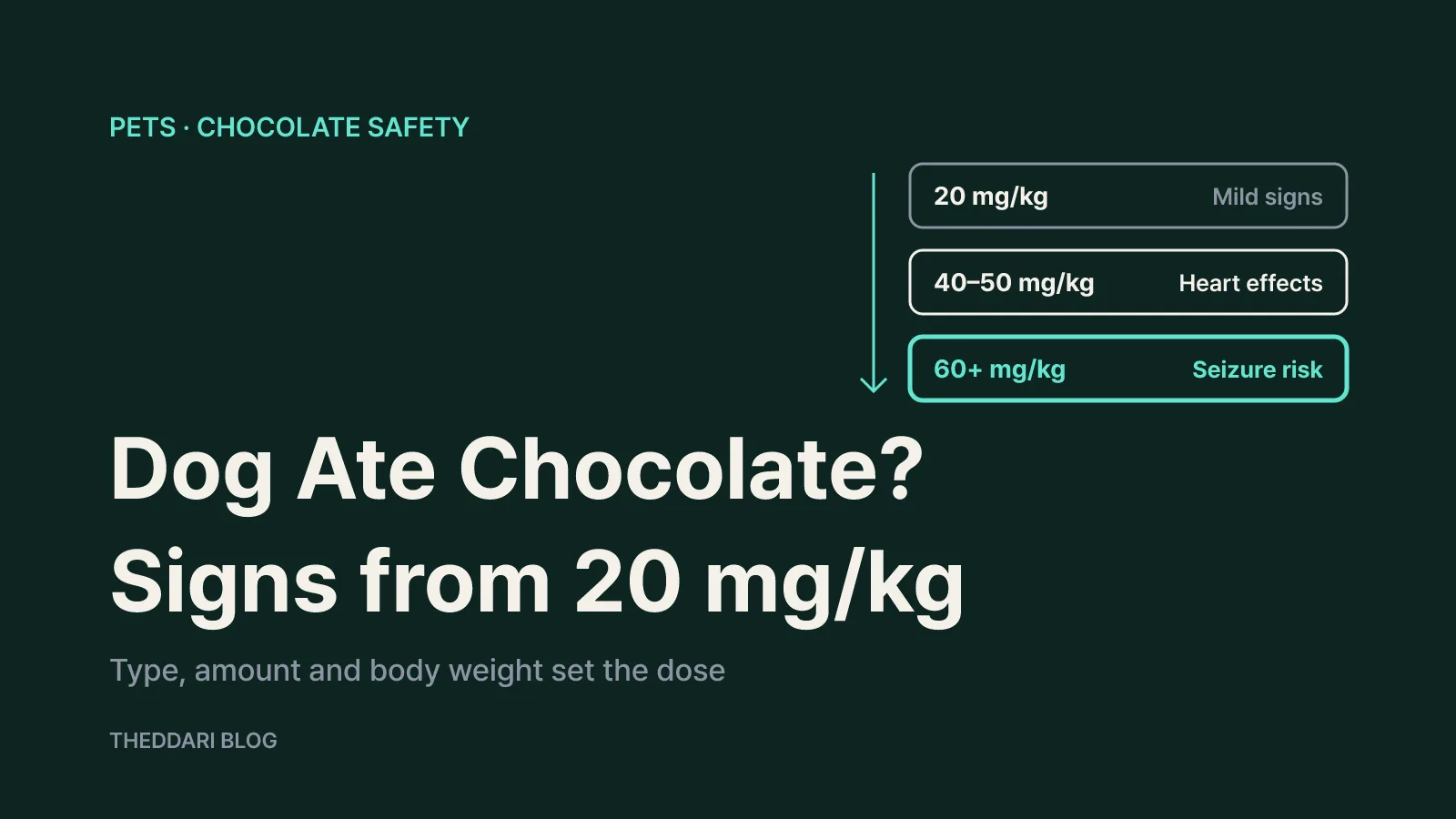
As of October 2026, the short answer is this: if your dog ate chocolate, find out what kind, how much and how much your dog weighs, then call your veterinarian or a pet poison hotline right away. The Merck Veterinary Manual explains that dogs may show mild signs such as vomiting, diarrhea and excessive thirst after about 20 mg of methylxanthines (theobromine plus caffeine) per kilogram of body weight, heart effects at 40–50 mg/kg, and seizures at 60 mg/kg or more. Dark chocolate and cocoa powder are far more concentrated than milk chocolate, and individual dogs vary in sensitivity, so a result below a threshold is not a reason to skip the call.
With Halloween on October 31 and holiday baking right behind it, this is the season when chocolate piles up at home. Below you will find a content table by chocolate type, a simple dose formula with worked examples, the information to have ready when you phone, the timeline of signs, and other treat ingredients that often come along with chocolate.
Check the methylxanthine content by chocolate type

Chocolate is dangerous to dogs because of methylxanthines from the cacao bean. The two that matter are theobromine and caffeine. According to Merck, chocolate contains 3–10 times more theobromine than caffeine, but both contribute to poisoning, so dose estimates use the combined methylxanthine figure.
Content varies between cocoa beans and brands, so treat these as general guidelines from Merck. The right-hand column is my own arithmetic from the same figures: roughly how much of each product delivers 20 mg/kg, the level linked to mild signs.
← Swipe to see more
| Chocolate type | Methylxanthines per gram | Amount reaching 20 mg/kg |
|---|---|---|
| Cocoa powder | 28.5 mg | about 0.7 g per kg |
| Unsweetened baker's chocolate | 15.5 mg | about 1.3 g per kg |
| 65% cacao bar | about 10.1 mg | about 2.0 g per kg |
| Semisweet and sweet dark | 5.3–5.6 mg | about 3.6–3.8 g per kg |
| Milk chocolate | 2.3 mg | about 8.7 g per kg |
| White chocolate | 0.04 mg | about 500 g per kg |
If you prefer ounces, Merck lists the same products at about 807 mg/oz for cocoa powder, 440 mg/oz for baker's chocolate, 150–160 mg/oz for semisweet and dark, and 64 mg/oz for milk chocolate. A cacao percentage on the label tells you how much unsweetened chocolate is in the bar, so Merck's example of a 65% bar works out to 15.5 × 0.65, or about 10.1 mg per gram. An 80% bar would be about 12.4 mg per gram by the same method.
White chocolate has so little methylxanthine that it rarely matters for the dose calculation, but it is still rich in fat and sugar. Merck notes that the high fat content of chocolate products can trigger pancreatitis in susceptible animals, so a large amount of any chocolate deserves a call.
Calculate the dose in mg per kg of body weight
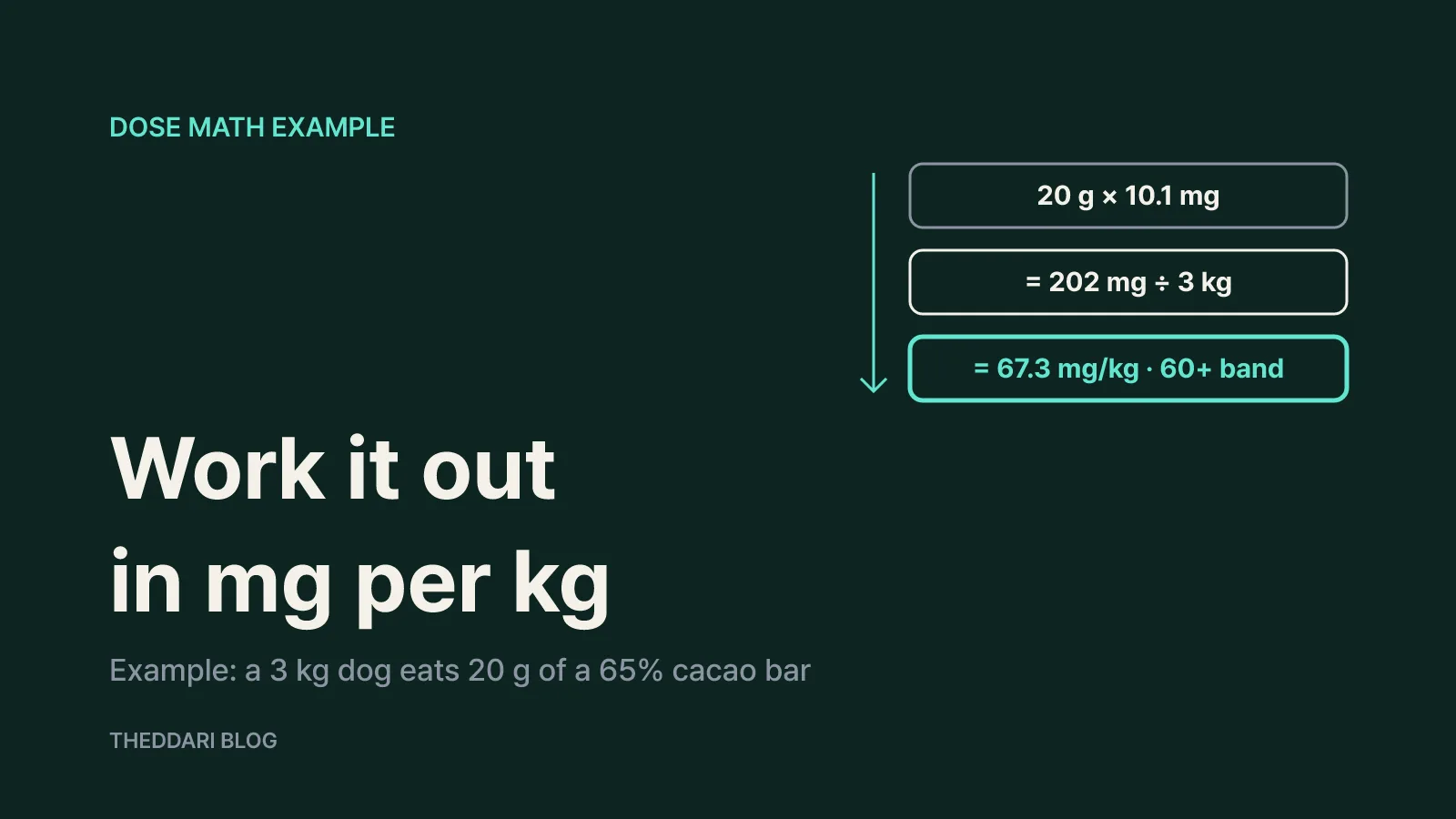
The formula is: grams eaten × mg per gram ÷ body weight in kg = dose in mg/kg. If you know your dog's weight in pounds, divide by 2.2 to get kilograms. Compare the result with Merck's bands of 20 mg/kg for mild signs, 40–50 mg/kg for heart effects and 60 mg/kg or more for seizures. Merck gives the oral LD50 as 100–200 mg/kg but stresses that severe signs and deaths can occur at much lower doses.
Three worked examples:
- A 3 kg (about 6.6 lb) dog eats 20 g (about 0.7 oz) of milk chocolate: 20 × 2.3 = 46 mg, and 46 ÷ 3 = about 15.3 mg/kg. That is under 20 but close enough, given individual sensitivity and fat content, that a vet should weigh in.
- The same 3 kg dog eats 20 g of a 65% cacao bar: 20 × 10.1 = 202 mg, and 202 ÷ 3 = about 67.3 mg/kg. That falls in the 60 mg/kg-plus seizure band and needs prompt veterinary care.
- A 10 kg (about 22 lb) dog eats 100 g (about 3.5 oz) of milk chocolate: 100 × 2.3 = 230 mg, and 230 ÷ 10 = 23 mg/kg, which is past the 20 mg/kg mark.
The first two cases involve the same dog and the same weight of chocolate, yet the dose differs more than fourfold. That is why the product name and grams eaten matter more than "a few pieces." Merck cites roughly 62 g of milk chocolate per kg (about 1 oz per lb) as potentially lethal; read that as a danger line, not a safe allowance.
When you cannot tell how much is gone, subtract what is left from the net weight on the wrapper. If the packaging is missing or it was a mixed box, I assume the darker chocolate and the larger amount. An overestimate can be corrected on the phone in seconds; an underestimate can cost time. The calculation helps you brief the clinic quickly, and the vet decides on treatment.
What to do the moment you find out
- Remove what is left so your dog, or any other pet, cannot eat more.
- Keep the wrapper. Photograph the product name, cacao percentage, net weight and full ingredient list, including anything like xylitol, raisins or macadamia nuts.
- Note the time of eating, or the last time you saw the chocolate intact.
- Confirm your dog's recent weight from vet records or a home scale.
- Call for advice. Phone your regular vet or an emergency clinic. In the United States, ASPCA Animal Poison Control answers 24 hours a day, 365 days a year at (888) 426-4435, and a consultation fee may apply.
Do not make your dog vomit on your own. Merck describes emesis as a veterinary decision for dogs that are still clinically normal after a recent exposure, for example within about 2 hours, using drugs and doses chosen by the vet. Avoid salt-water remedies in particular: the ASPCA warns that excessive salt can cause vomiting, diarrhea, tremors, seizures and even death. Merck also advises caution with activated charcoal after chocolate exposure because electrolyte problems such as high sodium have been reported. Your job at home is to gather facts and get professional advice fast.
Signs to watch over the next 6–12 hours and beyond
Merck says signs usually appear 6–12 hours after ingestion, so a dog that looks fine right away is not necessarily in the clear. Early signs include drinking a lot, vomiting, diarrhea, a swollen belly and restlessness. These can progress to hyperactivity, increased urination, wobbliness, stiffness, tremors and seizures.
The heart and breathing can be affected too: a racing or irregular heartbeat, rapid breathing, bluish gums, high body temperature, or sometimes a slow heartbeat and low blood pressure. Merck lists arrhythmias, hyperthermia and respiratory failure as the usual causes of death. Tremors, seizures or breathing trouble mean it is time to go, not to keep monitoring.
Plan for a long watch. Theobromine has a half-life of 17.5 hours in dogs, compared with 4.5 hours for caffeine, and Merck notes that severe cases can last up to 72 hours. Because fatty chocolate can lead to pancreatitis, keep an eye on appetite, vomiting and belly tenderness for several days.
There is no readily available test that confirms chocolate poisoning. Merck says diagnosis rests on the exposure history and clinical signs, which makes your wrapper photo and timeline the starting point of care.
Other Halloween treat ingredients to check
Seasonal candy often brings more than chocolate. From the ASPCA list of people foods to avoid, these overlap most with holiday treats:
- Xylitol, a sweetener in gum, candy, baked goods and toothpaste, can cause low blood sugar and, depending on the amount, liver damage that may develop within 12–24 hours. Check sugar-free chocolate carefully.
- Grapes and raisins can damage the kidneys, and chocolate-covered raisins combine two hazards.
- Macadamia nuts can cause weakness, wobbliness, vomiting, tremors and overheating in dogs, usually within 12 hours, with recovery typically in 24–72 hours.
- Other nuts such as almonds, pecans and walnuts are high in fat and can cause stomach upset and possibly pancreatitis.
- Coffee and caffeine belong to the same methylxanthine group, so mocha or espresso chocolate adds to the dose.
Habits that prevent chocolate accidents
Dogs find treats by smell and will swallow wrappers, so judge "out of reach" by your dog's habits rather than your eye level.
- Store chocolate in closed cupboards, not on coffee tables or low shelves.
- Check handbags, backpacks and coat pockets left on the floor.
- Ask children and guests to keep trick-or-treat bags and gift boxes off the floor.
- Use a lidded trash can, because wrappers carry chocolate residue.
- Save your vet, the nearest emergency clinic and your dog's latest weight in your phone so the calculation and the call take a minute.
Dogs are the most common cases, but Merck notes that many species are susceptible. If a cat or another pet eats chocolate, gather the same details and call for advice.