
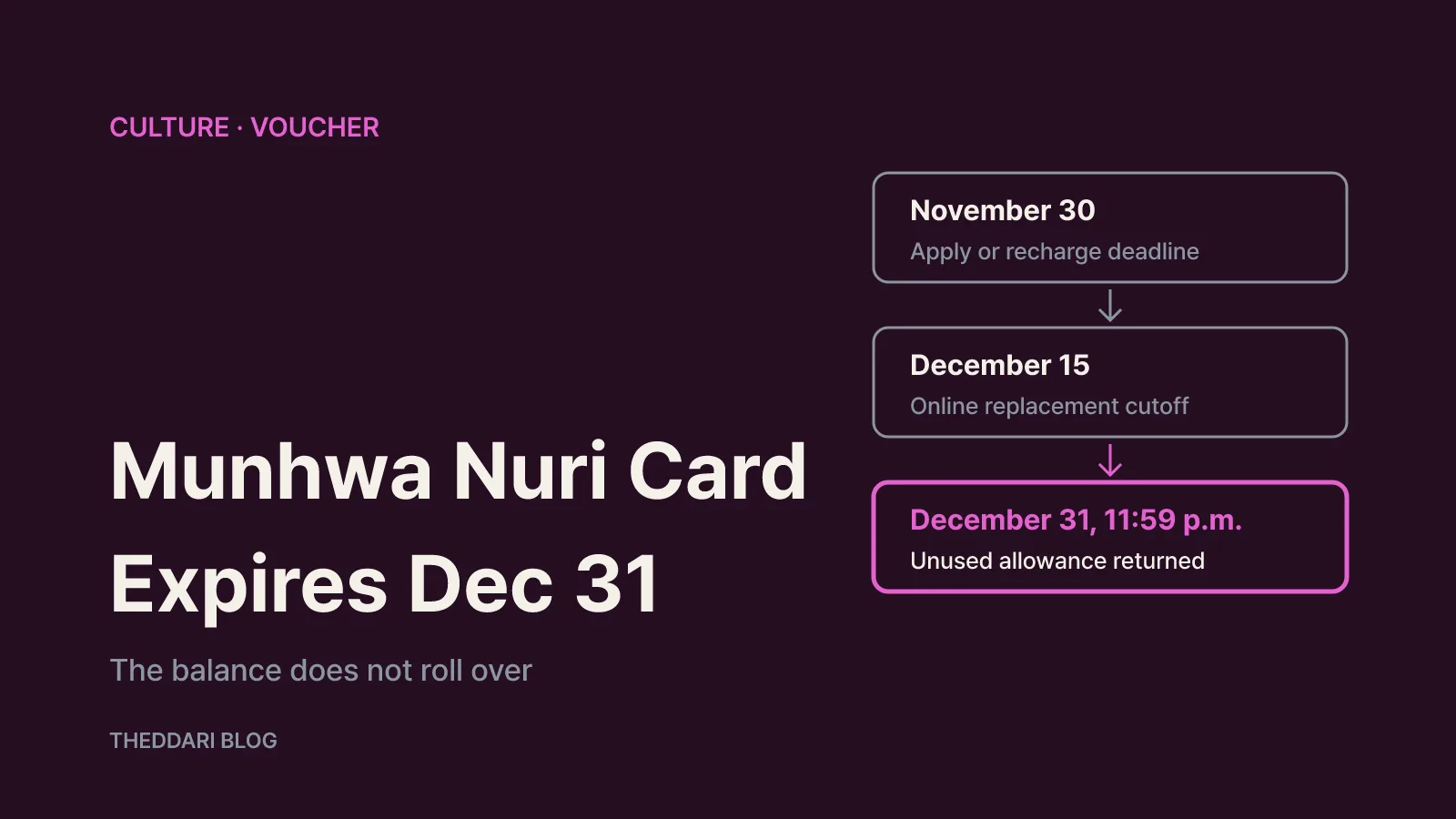
As of October 2026, the Munhwa Nuri Card allowance, Korea's integrated culture voucher for low-income residents, can only be spent until 11:59 p.m. on Thursday, December 31, 2026. Whatever is left after that is returned to the national treasury. It does not roll over into 2027 and cannot be exchanged for cash (Munhwa Nuri Card usage guide). If you have not yet been issued a card or recharged it for this year, the application deadline is Monday, November 30. The safest plan is to check your balance now, decide whether to combine household cards, and finish spending before late December, because a refund that lands after December 31 is lost.
This guide is based on the Ministry of Culture, Sports and Tourism (MCST) program page and the 2026 notices on the official Munhwa Nuri website run by Arts Council Korea. Discounts and merchant lists can differ by region, so confirm a specific merchant in the site's search before you pay.
What the 2026 card gives you and the dates that matter
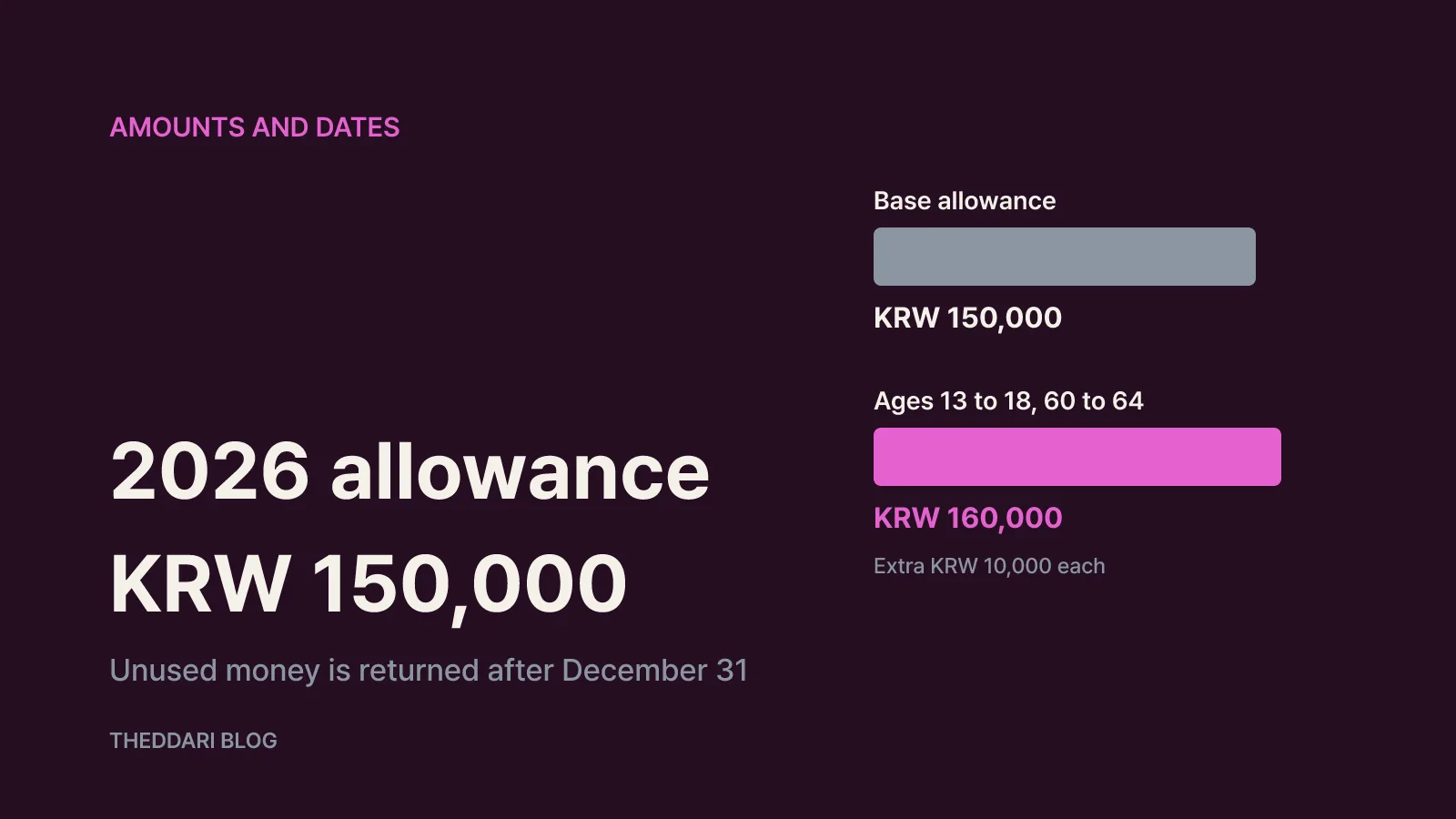
The Munhwa Nuri Card supports cultural, domestic travel and sports activities for National Basic Livelihood Security recipients and the near-poor (chasangwi) group aged six or older, meaning people born on or before December 31, 2020. For 2026 the allowance is KRW 150,000 per person per year. Teenagers aged 13 to 18 (born 2008 to 2013) and people aged 60 to 64 (born 1962 to 1966) receive an extra KRW 10,000, for KRW 160,000 in total (MCST program page). The ministry notes that if the budget for the extra amount runs out, only the base KRW 150,000 is paid, and if the base budget runs out, new cards and recharges can stop.
Three dates matter for the rest of the year:
- November 30 (Monday): the last day to apply for a new card or a 2026 recharge at a community service center, on the website or in the mobile app. The online and in-person deadlines are the same.
- December 15 (Tuesday): the last day to request an online replacement for a lost or damaged card whose number starts with 9463-17. Those cards cannot be reissued at a community service center.
- December 31 (Thursday), 11:59 p.m.: the 2026 allowance stops working and any unused amount is returned.
Some cardholders did not need to apply at all this year. In 2026, people who had spent at least KRW 30,000 on their card in 2025 and still qualified were recharged automatically (About the Munhwa Nuri Card). People who spent less than that, or who never completed receipt registration after getting a card by mail, were among those excluded. The rule for 2027 had not been announced as of October 2026, so treat this year's rule as a reference point rather than a promise.
Check your balance and combine household cards
Start by checking what is left. Your balance and transaction history are available at any time on the Munhwa Nuri website (www.mnuri.kr) and in the official app (Korea.kr policy briefing). The Munhwa Nuri support center (1544-3412) answers on weekdays from 9 a.m. to noon and from 1 p.m. to 6 p.m., excluding public holidays, so do not count on reaching it during the last weekend of December.
If several people in one household hold cards, the government allowances can be pooled onto a single representative card. Only members of the same household on the resident registration qualify, and cards held by residents of social welfare facilities or by foreign household members cannot be combined. You can apply at a community service center with the merge form, or online: tick the card merge consent under the password and personal information menu, then choose a representative card under the household balance merge menu. Processing takes one day from the application.
Keep the limits in mind before you merge:
- A merged card cannot be split again within the same program year.
- Only the government allowance is merged; money you loaded yourself stays where it is.
- You can still top up the merged card with your own money.
- Cards in the name of a minor, meaning anyone born on or after January 1, 2008, cannot pay for accommodation such as hotels, motels, resorts or booking platforms. Theme parks, water parks, exhibitions and hot springs located inside hotels and resorts may be blocked too. If the pooled money is meant for a family trip, choose an adult's card as the representative card.
Where the card works and where it does not
Payments only go through at registered online and offline merchants. The permitted categories are broad (usage guide):
- Culture: books, used books, e-books, comics, newspapers and magazines; albums, music content and instruments; cinema and video content including OTT streaming services; cable and satellite TV; performances; museum and gallery exhibitions and artworks; crafts and stationery; photo studios; local festivals, workshops, online hobby classes and hanbok rental.
- Travel: rail including KTX and SRT, intercity and express buses, domestic airlines, ferries, car rental, domestic travel agencies, sights such as national parks, science museums and cable cars, recreational forests and campsites, zoos and botanical gardens, licensed hot springs, theme parks including kids cafes and escape rooms, and accommodation.
- Sports: professional sports and esports tickets, official club merchandise, sporting goods and bicycles, and facilities such as swimming pools, gyms, yoga, Pilates and bowling.
Excluded items include groceries, restaurants and cafes, all clothing and shoes including sportswear, household goods and electronics, gift certificates such as culture or book vouchers, and anything overseas, from international flights to foreign hotels and theme park tickets. Bookstores inside multi-product supermarkets or department stores, and websites that are not designated Munhwa Nuri online merchants, will also decline the card. Converting the balance into cash at a merchant that cannot take the card is not allowed.
For December spending, purchases that are consumed immediately carry the least risk: a book or e-book, a same-day cinema ticket, or a video service that is registered as a merchant. Seated events with a fixed date, such as year-end concerts or professional games, are worth booking only when you are certain you will attend. You can check whether a particular streaming service or ticketing site is a merchant by searching its name in the online merchant list on the website.
How a December cancellation can wipe out your balance
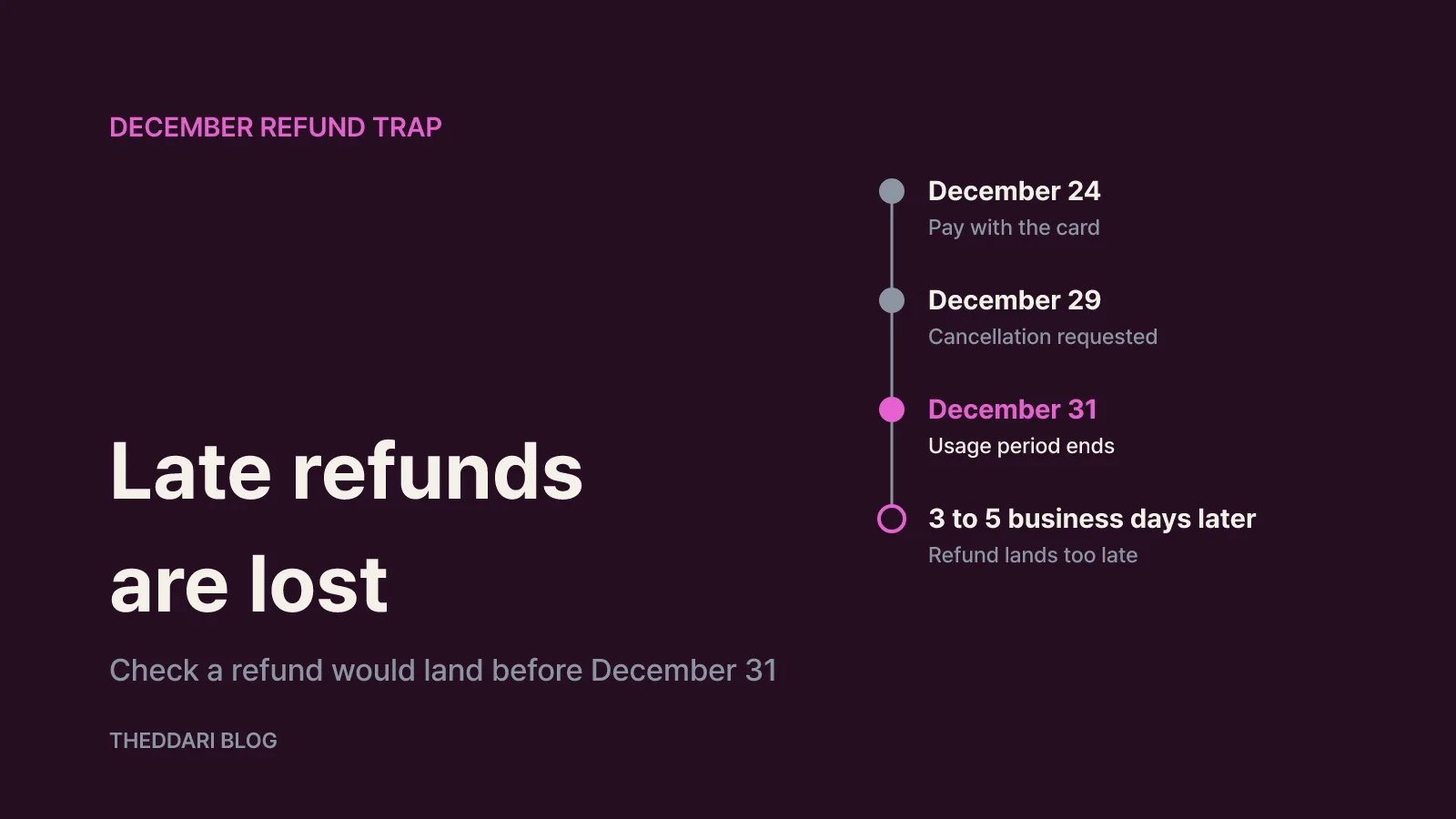
Refund timing is the main trap. A same-day cancellation is refunded the same day at most merchants, but transport purchases such as trains and intercity buses are not refunded on the same day. Other cancellations take roughly three to ten business days, depending on the merchant. If the refund arrives after December 31, the money cannot be used and is returned to the treasury (usage guide).
The official site gives an example. Pay on December 24, cancel on December 29, and the cancellation is approved three to five business days later, after the usage period has ended, so the allowance is lost. Partial cancellations and exchanges carry the same risk.
The same applies to anything you book for 2027 with 2026 money, including performances, train or express bus tickets, accommodation, tour products and sports tickets. If you cancel such a booking on or after January 1, 2027, the refund goes back to the treasury instead of your card. Rail and bus bookings can also carry cancellation fees. The website states that refund periods follow merchant and card issuer policies, which Arts Council Korea cannot shorten or adjust. The practical test for any December purchase is simple: would a cancellation still be refunded before the year ends?
Applying before November 30
If you have not been issued or recharged a card for 2026, apply by November 30. There are four routes (MCST program page):
- Community service center: submit the application form, and once your eligibility is verified you collect the card on site.
- Website or app with delivery by mail: after the eligibility check and identity verification, the card arrives by registered mail about three to five days after the application is complete.
- Website or app with NongHyup branch pickup: collect the card with ID about two hours after applying. This works for new cards only, not replacements, and the ministry advises calling the branch first to confirm it has blank cards in stock.
- Phone ARS recharge (1544-3412): available to people aged 14 or older who hold a card valid into 2027 or later and a mobile phone in their own name. Residents of welfare facilities cannot use it, and among budget MVNO plans only those on the LG U+ network work.
If your card came by mail, complete the receipt registration step on the website. In 2026, mailed cards without receipt registration were excluded from automatic recharge. Applying in mid-November rather than on the last day leaves room for delivery and registration before your December plans.
A year-end checklist
- Check your balance on the website or app.
- Merge household cards early if you plan one large family purchase, using an adult's card and allowing one day for processing.
- Book dated events only when the plan is firm, and think twice before booking anything for 2027.
- Finish with immediate purchases such as books, e-books or a cinema ticket.
- Avoid cancelling anything after Christmas.
Once the allowance is used up, keep the card. You can top it up with your own money through the virtual account printed at the bottom of the front of the card between 9 a.m. and 10 p.m., from KRW 100 per deposit up to a held balance of KRW 300,000, with an annual cumulative spending limit of KRW 2 million, and keep using merchant discounts. Unlike the government allowance, money you load yourself does not vanish on December 31; it stays usable until the expiry date printed on the card. For a refund of self-loaded money, call the NH NongHyup Card center (1644-4000) if you hold a NongHyup account, or visit a NongHyup branch with ID if you do not.