
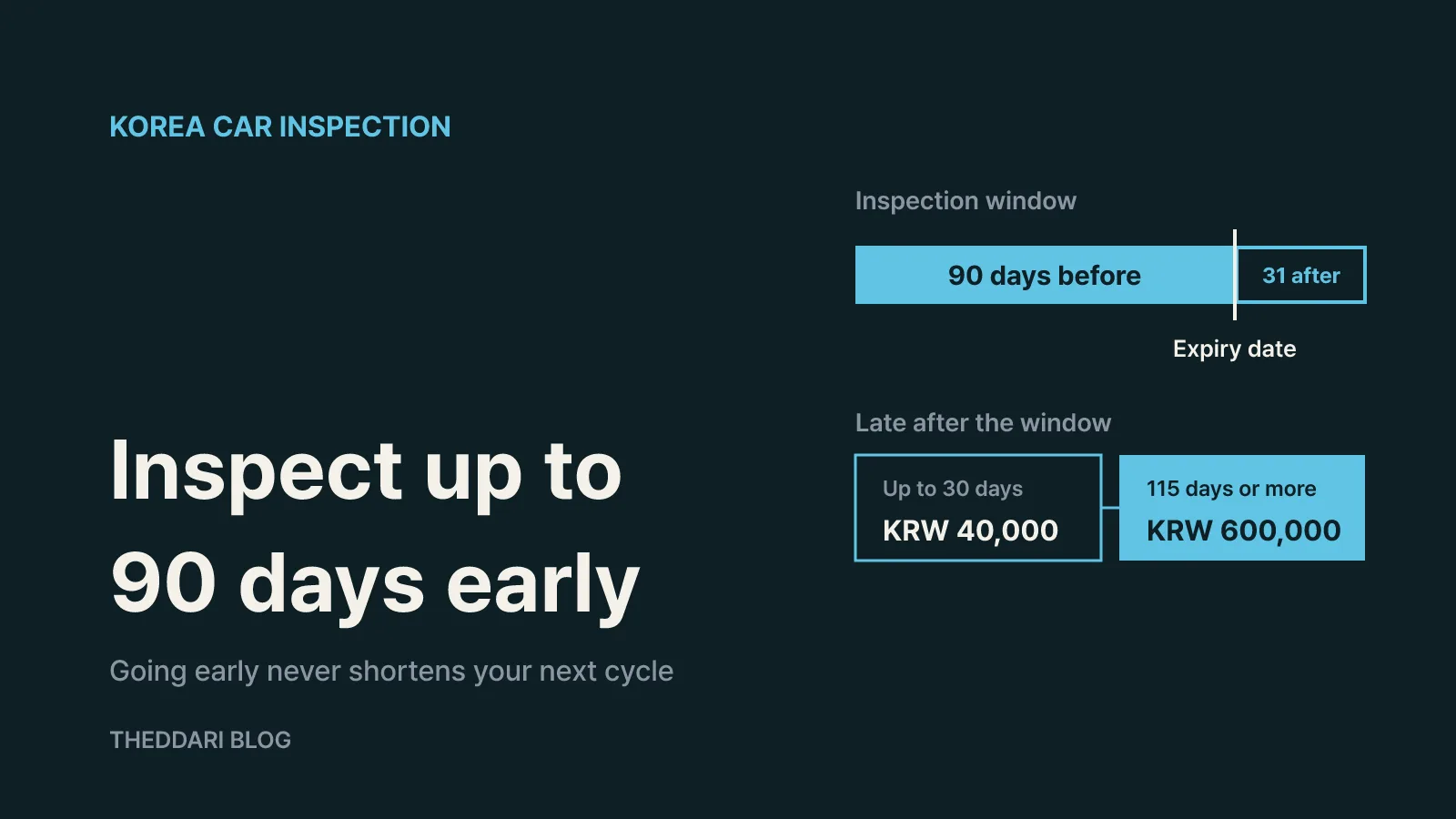
As of October 2026, a car registered in South Korea can take its periodic safety inspection (정기검사) at any point from 90 days before to 31 days after the inspection expiry date. If the car passes inside that window, the law treats it as inspected on the expiry date itself, so going three months early does not shorten your next cycle. Miss the window and the local government issues a fine: KRW 40,000 for a delay of up to 30 days, an extra KRW 20,000 for every further three days, and a flat KRW 600,000 once the delay reaches 115 days (Easylaw, Ministry of Government Legislation; Korea Transportation Safety Authority).
This guide is written for drivers in Korea, including foreign residents who own or lease a car there. It covers the rules in the Enforcement Rule of the Motor Vehicle Management Act and the public guidance of KOTSA (TS 한국교통안전공단), the agency that runs most inspection centers. Rules for other countries, such as US state inspections or the UK MOT, are different and are not covered here.
The inspection window runs from 90 days before to 31 days after expiry
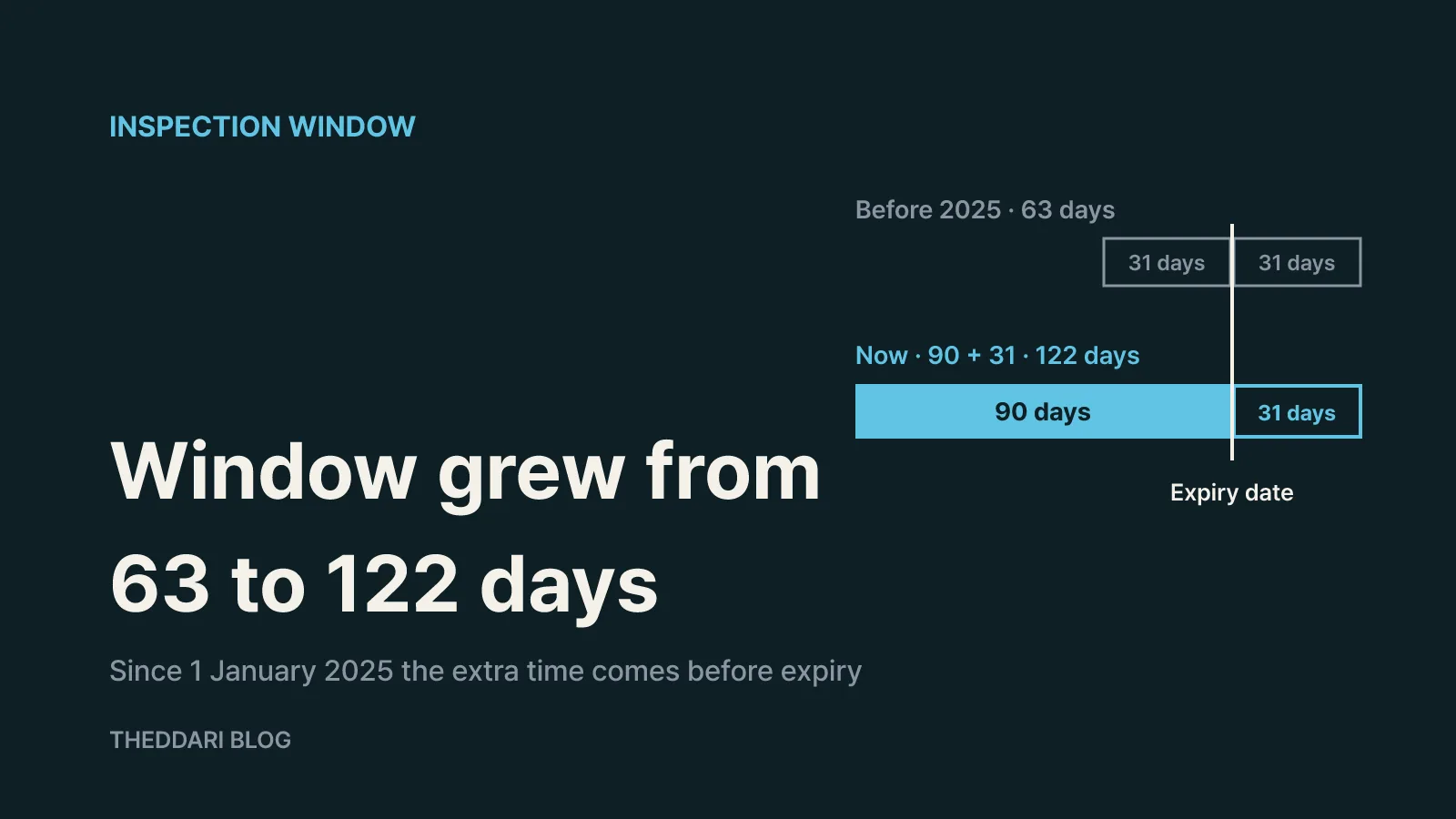
Article 77(2) of the Enforcement Rule sets the periodic inspection period as the 90 days before the expiry date through the 31 days after it. If your validity was formally extended or deferred, the extended date is the reference point. Until the end of 2024 the window was only 31 days on either side, a total of 63 days; from 1 January 2025 it widened to 122 days (Korea.kr policy briefing).
Think of the long front section as booking time and the short back section as a safety buffer. Passing in the last 31 days still avoids a fine, but if the car fails there, the re-inspection deadline follows almost immediately and leaves little time for repairs.
One exception matters for used-car buyers. If ownership changes after the expiry date has already passed, the new owner must complete the inspection within 31 days of the transfer registration (Article 77(3)). Check the expiry date before buying a used car.
How to find your car's cycle and expiry date
The cycle depends on vehicle type, commercial or private use, and age. Under Annex 15-2 of the Enforcement Rule, as summarized by Easylaw and the KOTSA FAQ, the most common cases are:
- Private passenger cars: every 2 years. For a new car treated as having passed its initial inspection, the first validity period is 5 years.
- Commercial passenger cars (such as taxis): every year, with a 2-year first period for new cars.
- Private light and small vans or trucks: every 2 years up to 4 years of age, then every year.
- Private medium and large trucks: every year up to 5 years of age, then every 6 months.
- Trailers: follow the private passenger car rule.
The first inspection for new private passenger cars moved from 4 to 5 years in a December 2024 amendment. Some summary pages still mention 4 years, so treat the validity field on your vehicle registration certificate or the result on the Cyber Inspection Center as the deciding source for your own car. The first period counts from the new registration date; later periods count from the day after the previous inspection.
KOTSA also offers an inspection-period reminder service by phone message or email. Signing up and booking on the day the reminder arrives is the simplest way not to miss the window.
Why an early inspection does not cost you time
Many owners assume that an early inspection pulls the next due date forward. It does not. Article 77(2) says a pass within the window counts as an inspection on the expiry date, and Article 74(3) says the next validity period then starts the day after the previous expiry date. A private car that passes 80 days early still gets its next expiry exactly two years after the original one.
The catch is inspecting before the window opens. A test more than 90 days before expiry falls outside the period, so the next cycle counts from the inspection date instead and the re-inspection deadline is calculated differently. Check the eligible dates on the booking screen first.
Booking, documents and fees
KOTSA centers work on reservations made through the Cyber Inspection Center or the call center at 1577-0990. Designated private repair shops can also carry out the periodic inspection. You need proof of mandatory insurance, but if the center can confirm it electronically, that requirement is treated as met.
KOTSA's published fees, including VAT, are below (KOTSA fee guide). Passenger cars, including vans for up to 10 people, are charged at the small-vehicle rate.
- Periodic inspection: light KRW 17,000, small KRW 23,000, medium KRW 26,500, large KRW 29,000
- Comprehensive inspection, load test: light KRW 48,000, small KRW 54,000, medium KRW 56,000, large KRW 65,000
- Comprehensive inspection, no-load test: light KRW 34,000, small KRW 39,000, medium KRW 45,000, large KRW 49,000
The comprehensive inspection (종합검사) replaces the periodic one for cars registered in areas with precision emissions testing and for certain diesel vehicles. Private shops may charge different amounts, so ask before booking.
KOTSA centers also discount fees for private vehicles: 50% or 30% for cars with a disability parking permit (severe or mild), 80% for national merit and single-parent family vehicles, 100% for basic livelihood recipients (with some exclusions), and 30% for parents of three or more children aged 18 or under. Discounts are not combined.
Deadlines after a failed inspection
A failed car receives a diagnostic report listing the reasons. Re-inspection must normally be requested within 10 days after the end of the inspection period. If the original test was taken before the window opened or after it closed, the deadline is 10 days from the date of the report. Re-inspection within that period is free.
The KOTSA FAQ states that re-inspection deadlines cannot be extended. If you miss the deadline or fail again, the car is treated as not inspected and can be fined.
For minor defects such as a damaged plate, worn tires, a broken window or faulty indicator, plate, tail or brake lights, you can submit a photo showing the repair and the plate online instead of driving back. The same applies to an unrepaired fire-risk recall left open for 18 months after the remedy start date.
How much is the fine if you miss the window?
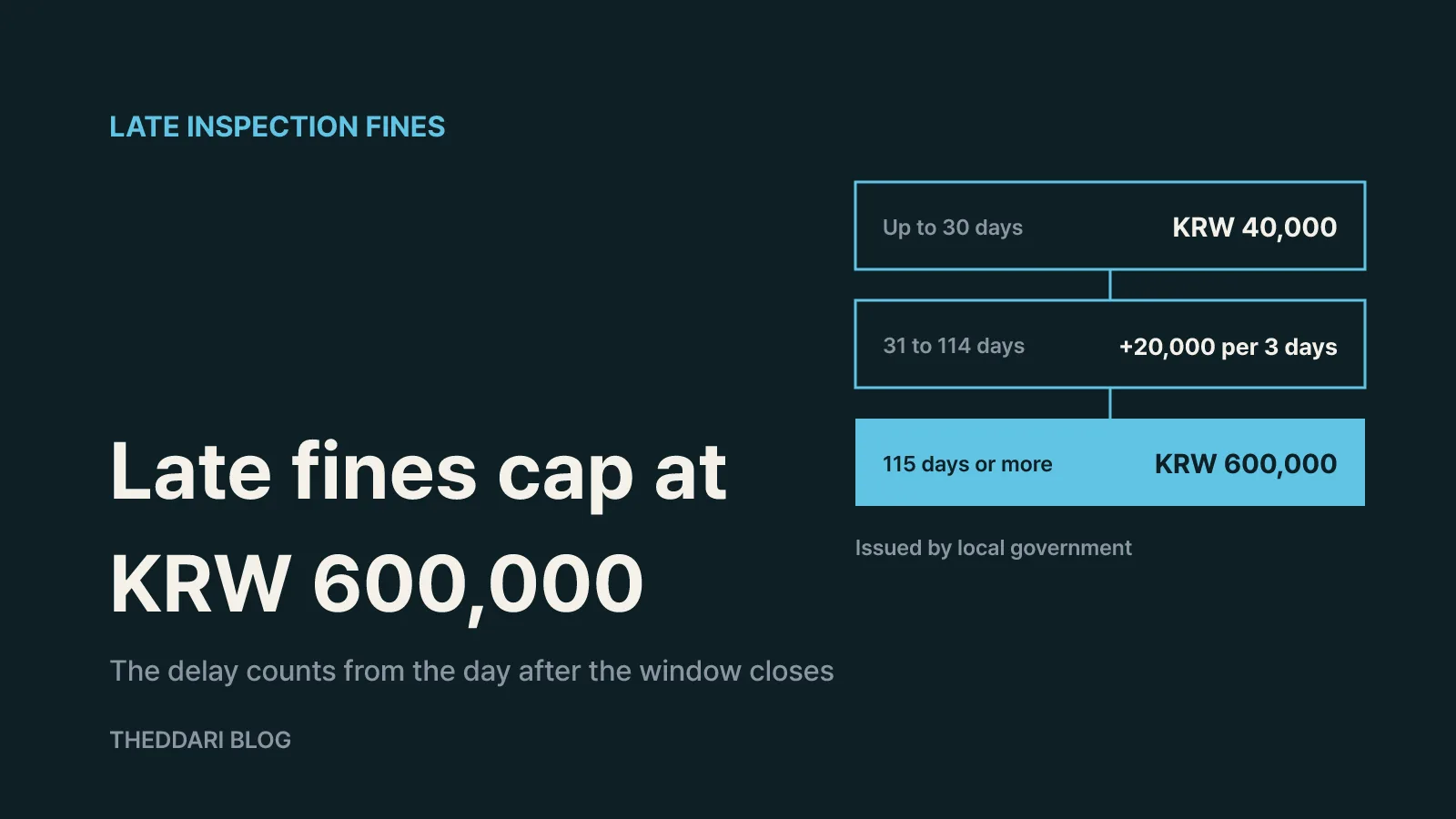
Fines are set by Annex 2 of the Enforcement Decree and imposed by the local government where the car is registered. KOTSA does not handle fine notices.
- Up to 30 days late: KRW 40,000
- 31 to 114 days late: KRW 40,000 plus KRW 20,000 for every three days beyond the first 30
- 115 days or more: KRW 600,000
The delay counts from the day after the window closes, which is 31 days after expiry. If you passed inside the window and still received a notice, contact the local government with your inspection date. Beyond the fine, authorities can order an inspection, impound the license plates, and order the car off the road if an inspection order is ignored for a year or more.
Extensions when you cannot get the car inspected
If theft, an accident, seizure or a long repair prevents an inspection, you can apply for an extension or deferral. Submit the application form with your registration certificate and supporting documents, such as an accident report and repair certificate, to the local vehicle registration office, generally before the expiry date. For certain legal reasons, such as impounded plates or a suspension order, the period is extended automatically until the reason ends, and the inspection is then due within 31 days.
The practical rule is simple: book when the reminder arrives and use the 90-day front window. You lose nothing by going early, and you keep time for repairs if the car fails.