
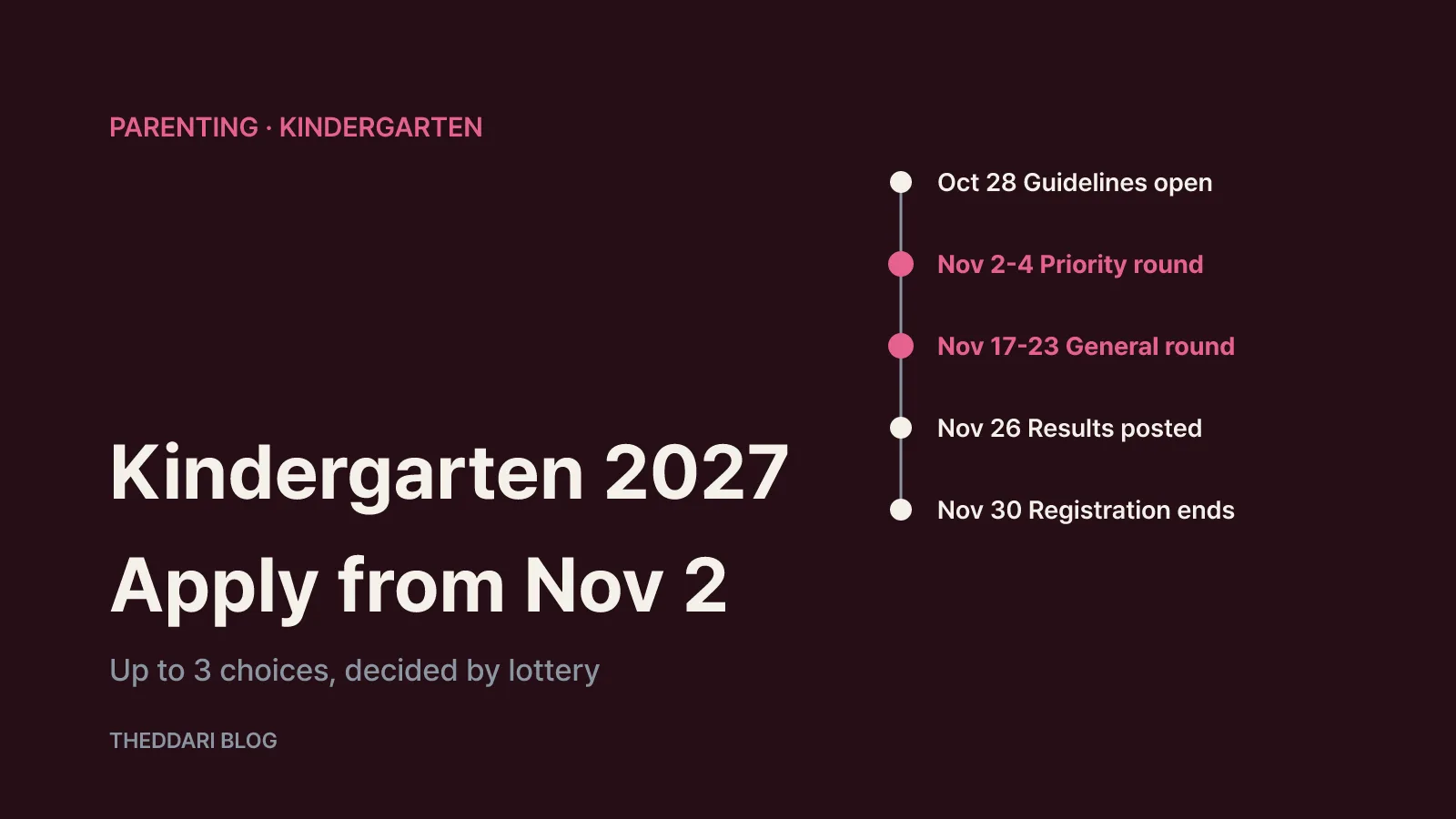
As of October 2026, applications for public and private kindergartens in South Korea for the 2027 school year (starting March 2027) are made online through the kindergarten admission menu of the Childinfo integrated portal (enter.childinfo.go.kr), the service many parents still know by its old name, "First School" (처음학교로). Each kindergarten's admission guidelines go live at 9 a.m. on Wednesday, October 28. The priority round runs November 2–4 and the general round runs November 17–23. A child may apply to up to three kindergartens in total, and places are allocated by a computer lottery after applications close, not on a first-come basis.
This guide is written for parents living in Korea, including foreign residents whose children will attend a Korean kindergarten. It combines the Ministry of Education announcement, a Seoul district education office notice and the plans already published by several provincial education offices. Rules that vary by kindergarten, such as lower priority tiers, after-school care and bus routes, must always be checked in the specific kindergarten's guidelines.
Key dates for the 2027 kindergarten admission cycle
According to the Seoul Jungbu District Office of Education, the priority round accepts applications from November 2 to 4, announces results on November 9, and selected children must register on November 10 or 11. The general round accepts applications from November 17 to 23, publishes lottery results on November 26 and holds registration from November 27 to 30. Seoul extended the priority application window from two days last year to three days this year.
← Swipe to see more
| Stage | Dates (2026 unless noted) |
|---|---|
| Portal sign-up | Any time |
| Child registration, favorites, guidelines | From Oct 28, 9:00 a.m. |
| Priority round applications | Nov 2, 9:00 a.m. to Nov 4, 6:00 p.m. |
| Priority results | Nov 9 |
| Priority registration | Nov 10–11 |
| General round applications | Nov 17, 9:00 a.m. to Nov 23, 6:00 p.m. |
| General results | Nov 26 |
| General registration | Nov 27–30 |
| Waitlist period | Dec 1–31 |
| Additional recruitment | Dec 1 to Feb 12, 2027 |
The provinces that published plans first, including Seoul, Gyeonggi, Incheon and Daejeon, share the same application and registration dates. Results are posted at 3 p.m., and applications close at 6 p.m. on the final day. Some regions accepted late-night applications last year, so do not rely on that habit. If you live in a region whose plan you have not yet seen, confirm the dates in your provincial education office's notice; Gangwon, for example, ends additional recruitment earlier.
Before you apply: account, child registration and favorites
In 2024 the government merged daycare enrollment and kindergarten admission into a single portal, and for the 2027 cycle the Ministry of Education has simplified the process further. Three changes matter to parents:
- Advance alerts. Parents of children aged 0 to 5 receive schedule and search information through the government's welfare membership mobile alerts. Not receiving an alert does not affect eligibility, so track the dates yourself.
- Favorites list. You can save daycare centers and kindergartens to one list and apply directly from it. The ministry's sequence is sign-up (any time), child registration (from October 28), saving favorites (from October 28) and applying (from November 2). Saving a kindergarten is not an application and does not reserve a place.
- Linked public records. Child details can be imported from family records, and eligibility documents such as the family relationship certificate can be checked or submitted online through the public MyData service. Fourteen kindergarten-related documents are covered. Anything that cannot be verified online must still be submitted as the guidelines instruct.
Practical preparation before October 28: create the parent account, shortlist four to six kindergartens within a realistic commute, note whether each is public or private, its after-school hours and bus availability, and, if your child already attends a kindergarten and will stay, confirm that the kindergarten has registered the child as a continuing student.
Who qualifies for the priority round
The priority round is only for eligible children. Under the standard admission guidelines, tier 1 is legally defined low-income households (selected at 100% within capacity), tier 2 is families of national merit (veterans' benefit) recipients and tier 3 is families of North Korean defectors. Tiers 2 and 3 are set by the director using at least 3% of capacity per age group as a guide. Continuing students and children with special education placements are treated as top priority.
Tier 4 and below differ by kindergarten. Typical examples are twins, siblings of current students, families with two or more children, multicultural families and parents with disabilities; Seoul allows up to ten tiers. Dual-income status is not part of the standard priority list; it usually applies to separate after-school programme selection. If you meet more than one condition, apply under the highest one.
Document checks close at 6 p.m. on November 6 for the priority round and November 25 for the general round. False or late documents can cancel a selection. In the priority round each kindergarten runs its own draw, so a child can be selected by several but registers at only one; there is no waitlist; and once registered, a child cannot enter the general round unless the registration is withdrawn.
How the general round lottery works
The general round is for children who were not eligible for, or not selected in, the priority round. Families can apply to up to three kindergartens, public or private, and the system runs a random draw after the deadline. Continuing students may add two others.
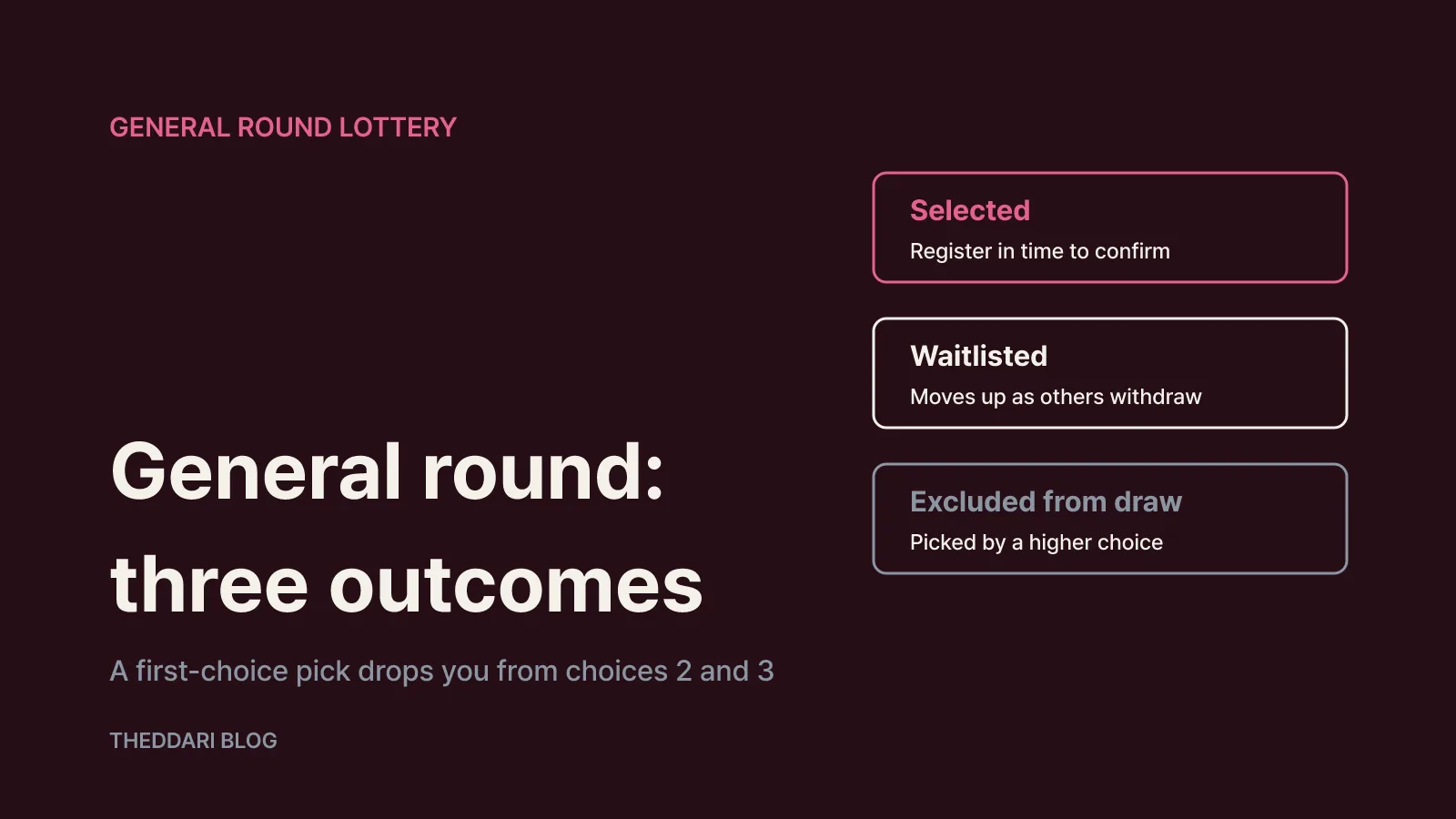
A duplicate-selection limit applies: if your first choice selects your child, the second and third choices drop them from their draws. Each result is one of three:
- Selected: a place is offered and must be confirmed by registering in time.
- Waitlisted: not selected, but holding a queue number that moves up when others withdraw.
- Excluded from draw: not a rejection; the child was already selected by a higher choice.
Because fewer selected children withdraw under this rule, waitlists move more slowly, which makes your first choice the most important decision. If you apply in the priority round, check the automatic transfer option, which moves an unsuccessful priority application into the general round. It may not work if the priority round filled every place for that age, so log in during the general window to confirm. Twins can be entered as a group, but at the capacity cut-off one may be selected and the other not.
Choosing your first choice and avoiding common mistakes
Timing does not matter as long as you apply within the window; the guidelines even suggest avoiding 9–10 a.m. on day one and checking results after 4 p.m. When ranking, ask whether the commute, bus route and after-school closing time fit your family; whether a sibling or multi-child tier gives you priority; and how many places each age group offers. Put realistic alternatives in second and third place.
Common mistakes include missing the 6 p.m. deadline, forgetting to click register after being selected (which counts as withdrawal), trying to re-enter the general round after registering in the priority round, and downloading unofficial apps; applications are made on the portal website. Parents who cannot apply online can apply in person at the kindergarten, and Seoul allows mixing in-person and online choices.
If no place is offered: waitlist and additional recruitment
Waitlist numbers remain valid until December 31. If a waitlisted child is selected, registration must be completed within two days including the selection day, or the place lapses. Queue positions update once a day, so check daily. From December 1 to February 12, 2027, kindergartens that did not fill up run their own additional recruitment, and the portal's vacancy menu lists open places.
Provincial plans treat practices such as favoring open-day attendees, a particular daycare center or staff acquaintances as unfair admission; parents can raise concerns with the district education office. For system problems contact the Edu Call Center, and for admission criteria contact the kindergarten.