
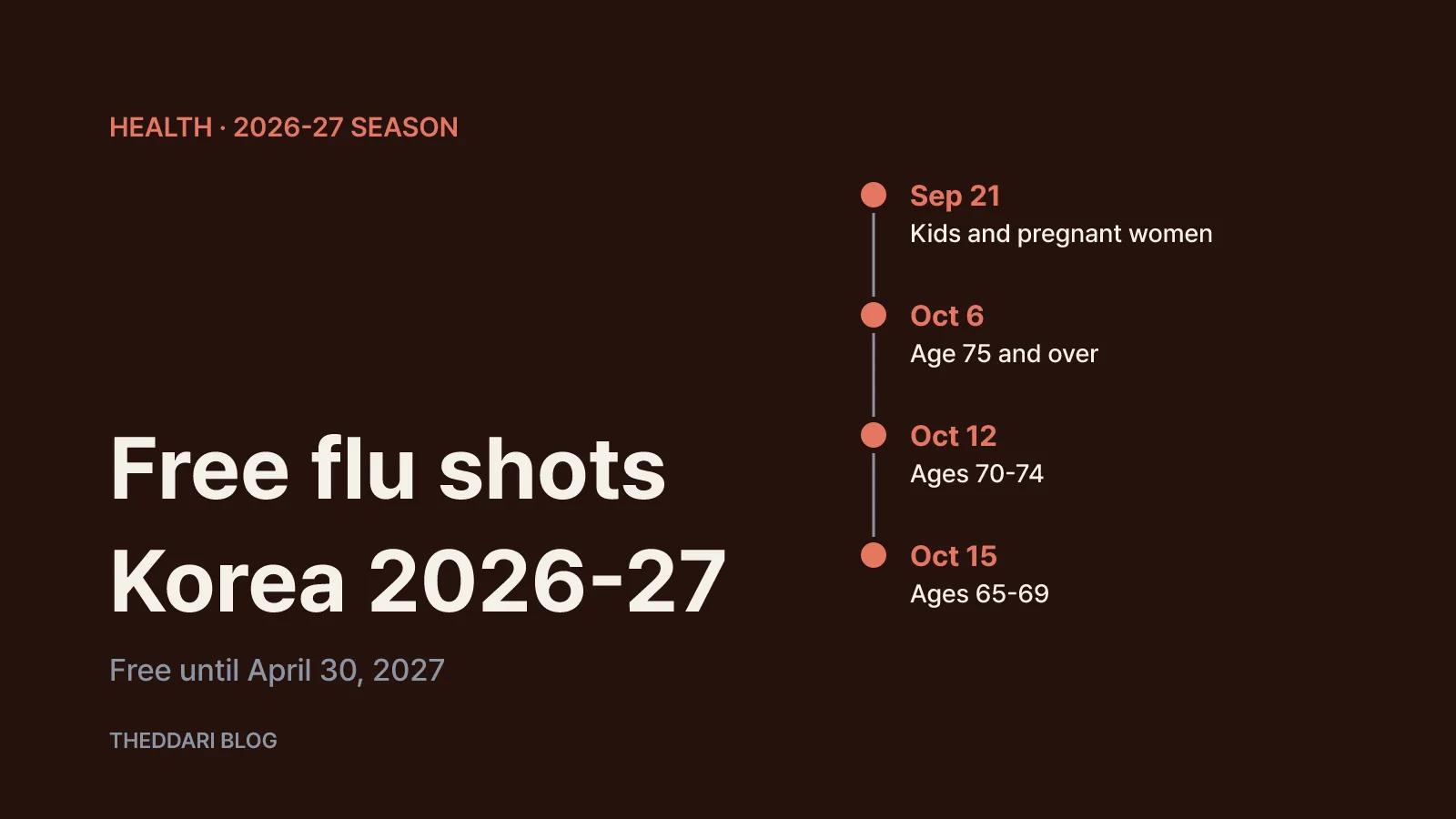
As of October 2026, Korea's free seasonal flu vaccination for the 2026-27 season is open to children aged 6 months to 14 years, pregnant women and adults aged 65 and over, and it runs until April 30, 2027. You can get the shot at any designated clinic or public health center (bogeonso) in the country, regardless of your registered address. Because flu activity started earlier than usual this year, the Korea Disease Control and Prevention Agency (KDCA) moved the start dates forward, and since the 65-69 age group opened on October 15, every eligible group can now be vaccinated. Vaccine supply is tighter than in previous years, according to the KDCA's September 16 announcement, so call the clinic before you go.
This guide is based on three KDCA press releases and the program page on the KDCA's Vaccination Helper site (nip.kdca.go.kr), all read directly. Your doctor at the pre-vaccination check makes the final call on timing and number of doses for your situation.
Who qualifies for the free flu shot in 2026-27
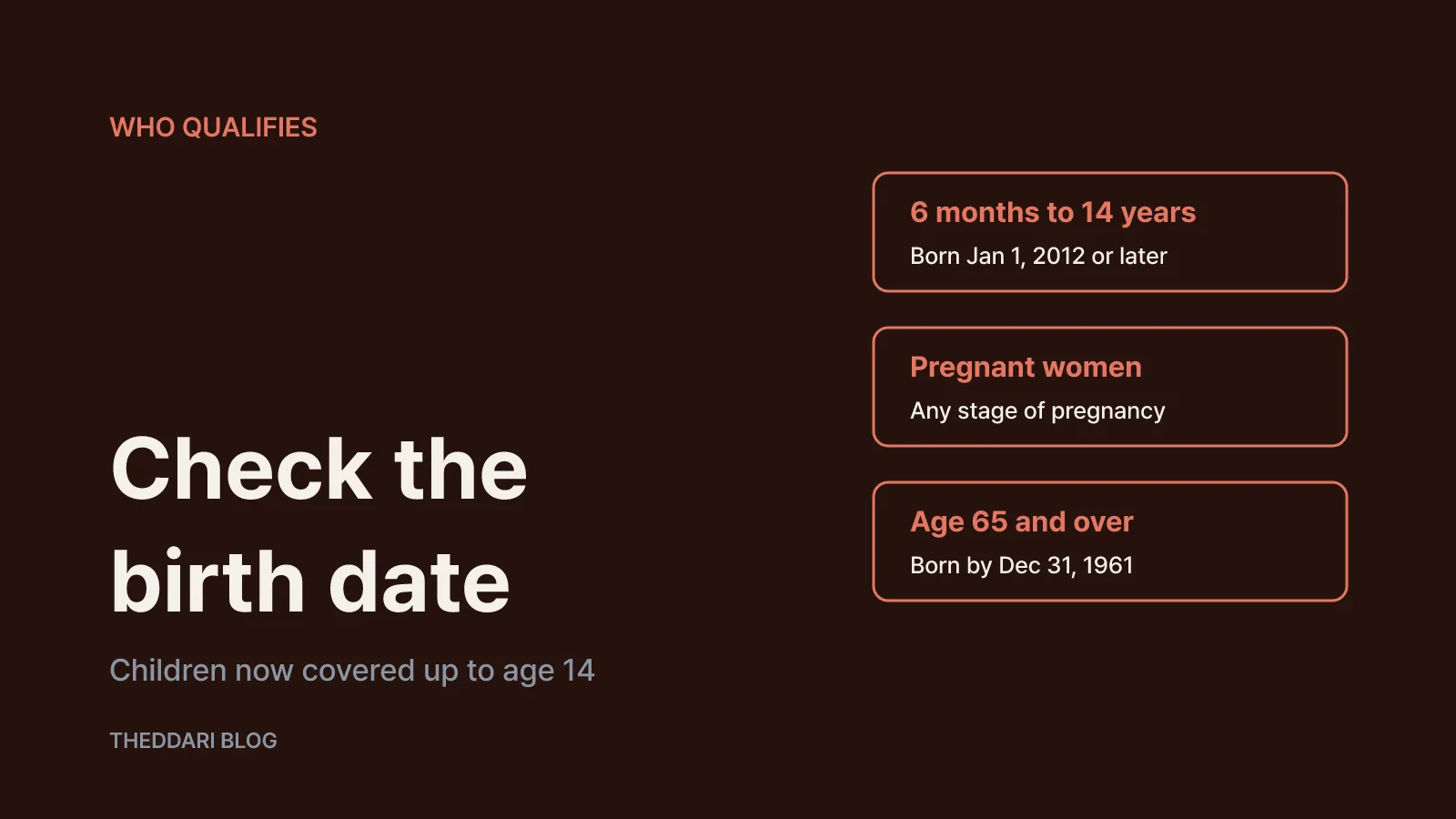
Eligibility is defined by date of birth, so check the date rather than counting years. The Vaccination Helper program page lists three groups:
- Children: 6 months to 14 years old, meaning born between January 1, 2012 and August 31, 2026. If the birth date on the resident registration differs from the actual birth date, the actual date is used.
- Pregnant women: any stage of pregnancy, as long as the pregnancy is confirmed with a document such as a maternal health handbook or a pregnancy confirmation letter.
- Older adults: aged 65 and over, meaning born on or before December 31, 1961, based on the birth year in the resident registration.
The biggest change this season is the age cap for children. According to the KDCA's August 25 release, the program previously covered children up to age 13 and now covers them up to 14 (the second year of middle school in Korea). The goal is to slow spread among school-age children and strengthen community protection.
Older adults and pregnant women get one dose of an inactivated trivalent vaccine every season, regardless of past shots. The 2026-27 vaccine is trivalent and contains all the strains recommended by the World Health Organization (WHO), so last year's shot does not cover this season.
Revised start dates: what changed from the original plan
The schedule announced in August was revised on September 16, so older news stories and posters may show the wrong dates. The KDCA issued a flu advisory on September 11, consulted its expert immunization committee on September 12, and then moved the start dates earlier. Every group's window ends on April 30, 2027.
- All children and pregnant women: from September 21, 2026. Originally, children needing only one dose were to start on September 28.
- Age 75 and over (born on or before Dec 31, 1951): from October 6, instead of October 12.
- Ages 70-74 (born Jan 1, 1952 to Dec 31, 1956): from October 12, instead of October 15.
- Ages 65-69 (born Jan 1, 1957 to Dec 31, 1961): from October 15, instead of October 19.
People at high risk, such as those who are immunocompromised, could be vaccinated from October 6 after talking with their doctor, regardless of age group. Long-term care hospitals and nursing facilities start as soon as vaccine arrives.
The KDCA's surveillance data explain why. In week 36 of 2026, the rate of influenza-like illness was highest among 7-12 year olds at 75.1, followed by 1-6 year olds at 49.8. Adults 65 and over had a low rate of 8.8 but made up 60.0% of hospitalized flu patients. In short, the virus spreads fastest among children, while older adults are the most likely to end up in hospital.
Two doses for some children under 9
Most children need one dose, but some need two. Under the program rules, children aged 6 months to under 9 years get two doses if:
- this is their first flu vaccination, or their vaccination history is unknown, or
- they had received only one flu shot in total by June 30, 2026.
Everyone else in the children's group gets one dose. If your child was vaccinated abroad, bring that record so the doctor can decide quickly. The doctor will also tell you when to come back for the second dose. Children who need two doses should start early, because a late first dose pushes the second one later too. As of 6 p.m. on October 1, 1.143 million children (23.1%) and 76,000 pregnant women had already been vaccinated, the KDCA reported.
What to bring and how to find a clinic
About 23,000 designated clinics take part nationwide, plus public health centers and their branch offices. To find one, go to nip.kdca.go.kr, open the designated clinic search under vaccination management, choose children, older adults or pregnant women, and select your region. The site is in Korean, so a translation tool helps.
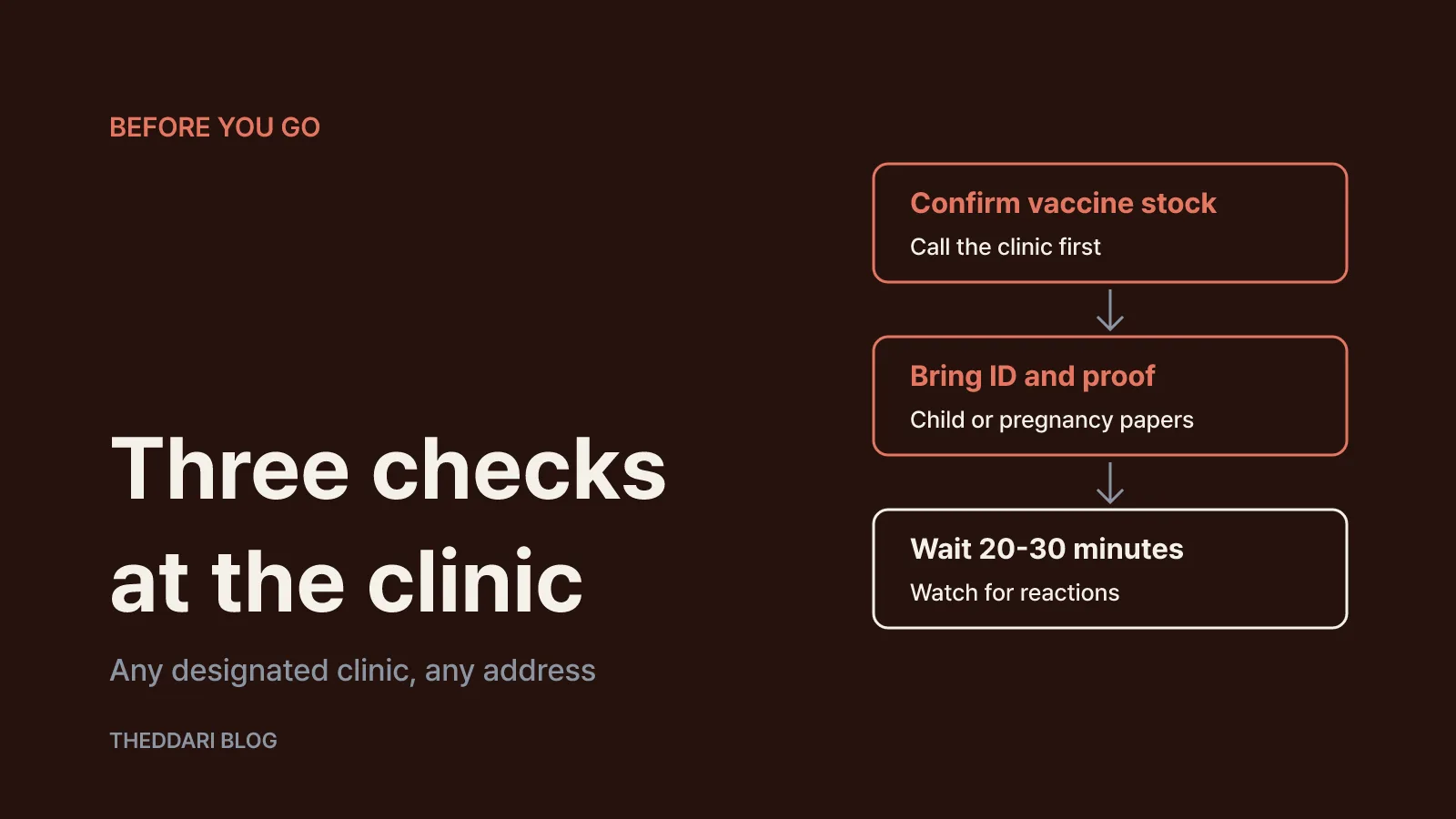
Before you go:
- Call ahead to confirm the clinic has vaccine today. Deliveries are staggered, so availability differs from clinic to clinic. The KDCA specifically asks people to check first.
- Bring ID and proof of eligibility. Adults bring an ID card; for children, a resident registration certificate or national health insurance card; for pregnancy, a maternal health handbook or pregnancy confirmation.
- Plan to stay 20-30 minutes after the shot so staff can watch for any reaction, then rest for the remainder of the day.
The KDCA notices used for this guide do not set out separate rules for foreign residents. If you have a residence card, bring it; if you are unsure whether you qualify, call your local public health center or the KDCA call center at 1339 before visiting. If you have a fever or feel unwell on the day, tell the doctor during the screening and discuss whether to wait.
Vaccine supply and getting a COVID-19 shot at the same visit
Supply is tighter this year. All three strains in the WHO's 2026-27 Northern Hemisphere recommendation changed (A/H1N1, A/H3N2 and B/Victoria), and lower production yields cut Korea's total domestic production and imports by about 4 million doses compared with last year, the KDCA said. The agency secured about 12.33 million doses for the national program and about 370,000 extra doses for the private market, but described private supply as less comfortable than usual. If one clinic has run out, try another or a public health center rather than waiting until near the April 30 deadline.
Adults 65 and over can also get the free COVID-19 vaccine. COVID-19 shots started on October 12 for age 70 and over and on October 15 for ages 65-69; immunocompromised people aged 12 and over and residents of certain care facilities could start on October 12, according to the October 2 release. A clinic that stocks both vaccines can give them at the same visit if the doctor agrees. For older adults, 8.89 million flu doses and 4.84 million COVID-19 doses are being shipped in line with the schedule.
If you are not eligible, and after your shot
People aged 15 to 64 who are not pregnant are outside the free program and pay at a clinic. Prices and stock vary by clinic, and private supply is limited this season, so phone first. Your local public health center can tell you whether any local support applies to you.
During flu season, the KDCA also recommends washing hands with soap under running water for at least 30 seconds, covering coughs with a tissue or sleeve, wearing a mask when you have respiratory symptoms and ventilating rooms often. High-risk people, including adults 65 and over, should see a doctor early if they develop a fever or respiratory symptoms. For questions, contact your local public health center, the KDCA call center (1339) or the KDCA vaccination management division (043-719-8396). Dates can change with flu activity and supply, so check nip.kdca.go.kr again just before your visit.