
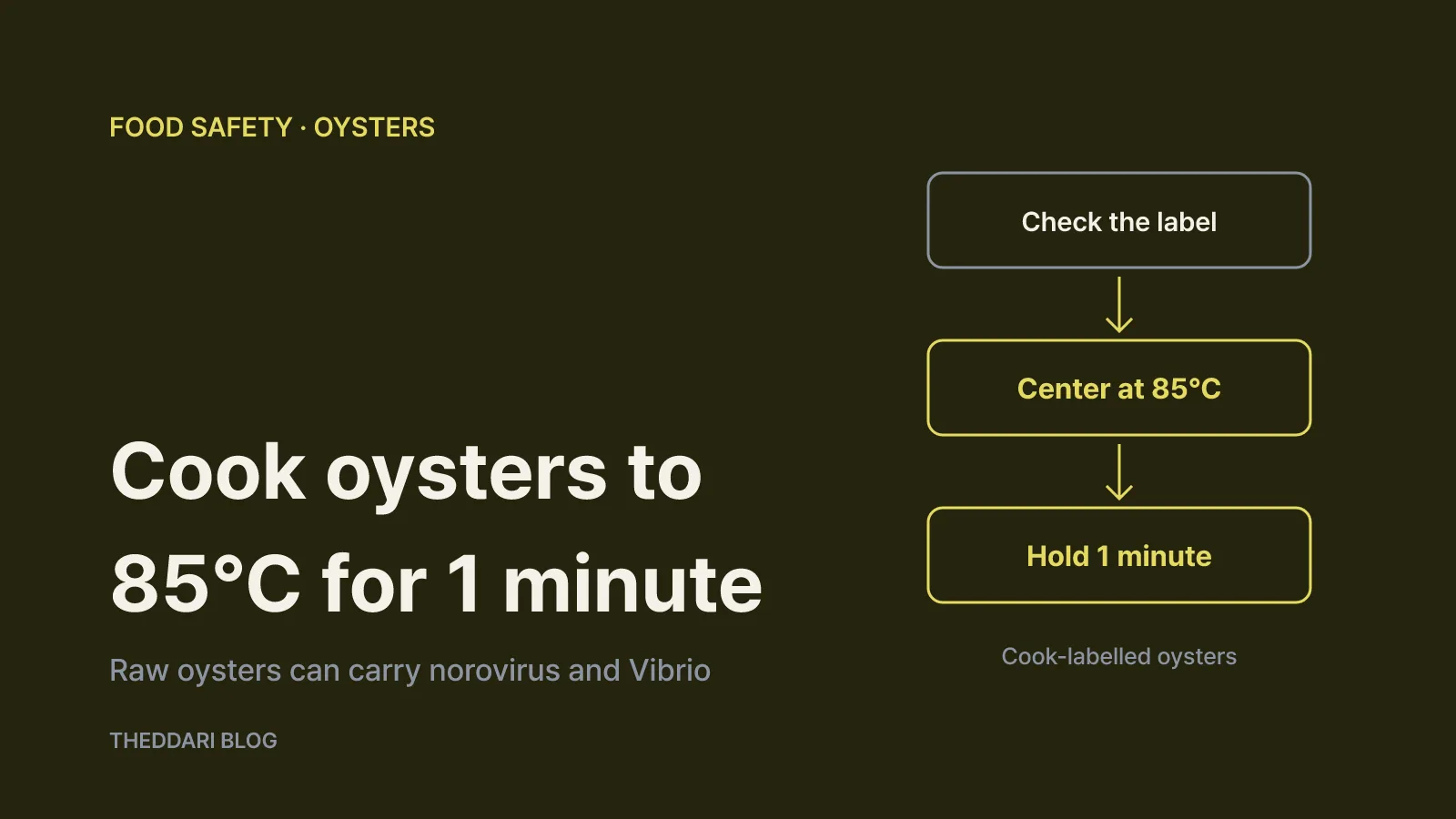
As of October 2026, the short answer is that raw oysters always carry some risk, and cooking them thoroughly is the reliable way to reduce it. The US Centers for Disease Control and Prevention (CDC) advises people not to eat raw or undercooked oysters, and Korea's Ministry of Food and Drug Safety (MFDS) tells consumers that oysters labelled for cooking must be heated until the center reaches 85°C (185°F) for at least one minute, according to its winter norovirus advisory. This guide explains why oysters are a common cause of food poisoning, how long to boil, steam, fry or bake them, how to stop raw oyster juices from spreading around your kitchen, and who should avoid raw oysters altogether.
Why raw oysters can make you sick
Two very different germs explain most of the concern. The first is norovirus. The MFDS describes it as highly infectious and able to survive at low temperatures, which is why outbreaks in Korea cluster between November and April. Typical symptoms are vomiting and diarrhea, sometimes with chills or fever. The agency names uncooked shellfish as the main food-related source of norovirus infection. Norovirus also spreads from person to person through contaminated hands, vomit and feces, and through contaminated water, including groundwater.
The Korean figures show how much the risk rises in oyster season. In its February 2024 advisory, the MFDS reported 191 suspected norovirus food poisoning reports for 2023, up 57 from 2022. Over roughly three months, from November 2023 to January 2024, Korea's consumer injury surveillance system (CISS) received 385 reports of gastrointestinal illness after people ate raw oysters and similar foods, about 2.5 times the 155-report average for the same period in the previous three years.
The second concern is Vibrio, a group of bacteria. The CDC says most people with a Vibrio infection got it by eating raw or undercooked shellfish, especially oysters. Vibrio live naturally in coastal waters and can concentrate inside the oysters that grow there. So a fresh, clean-smelling oyster is not proof of safety: you cannot see, smell or taste either germ.
Cold storage does not solve the problem either. Refrigeration slows bacterial growth, but the MFDS specifically notes that norovirus survives at low temperatures. Heat is what makes the difference.
Read the label: raw-eating versus cook-before-eating oysters
In Korea, packaged oysters may carry a use label. The MFDS says that if the package says the oysters are for cooking (가열조리용) or are to be eaten cooked (익혀 먹는), they must be heated to a core temperature of 85°C for at least one minute before eating. Treat that label as an instruction, not a serving suggestion. Oysters marked for cooking should not go into a raw salad or be eaten straight from the bag with dipping sauce.
A practical approach to labels anywhere:
- Look for any wording that tells you whether the oysters are intended to be eaten raw or cooked.
- If there is no label, or the oysters were repacked at the counter, ask the seller. If you cannot confirm the intended use, cook them.
- Keep the original packaging at home so oysters bought for cooking do not get mixed up with anything else.
- Remember that a raw-eating label is not a guarantee. The MFDS still recommends cooking over eating oysters raw to prevent norovirus.
How to cook oysters safely: times and temperatures
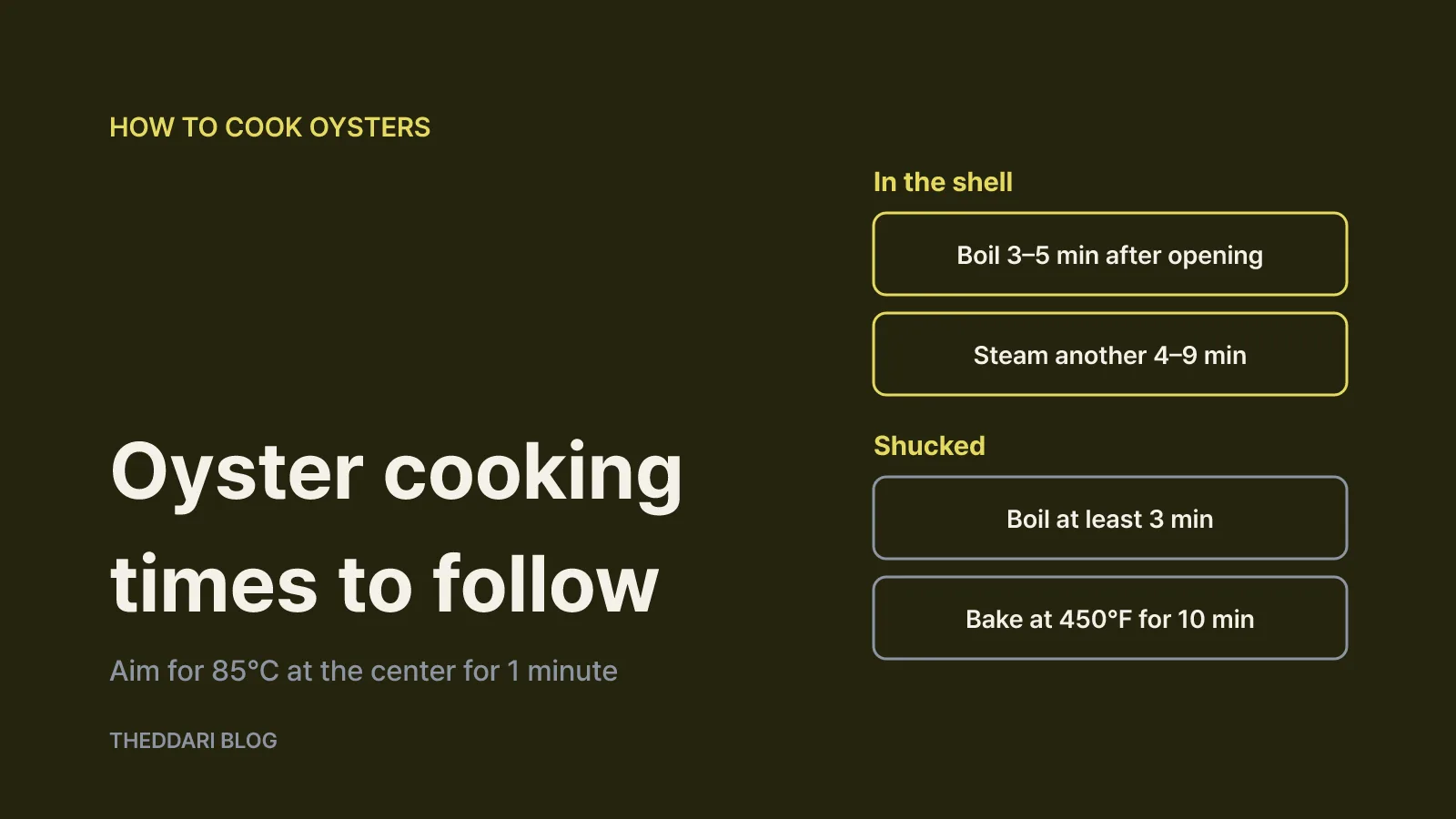
The Korean benchmark is simple to remember: the thickest part of the oyster should reach at least 85°C (185°F) and stay there for at least one minute. If you own an instant-read thermometer, check the largest oyster in the batch.
If you do not have a thermometer, the CDC gives clear time-based methods.
Oysters in the shell
- Throw away any oysters whose shells are already open before cooking.
- Boil until the shells open, then keep boiling for another 3 to 5 minutes.
- Or place them in a steamer that is already steaming and cook for another 4 to 9 minutes.
- Eat only the oysters that open during cooking, and discard any that do not open fully.
Shucked oysters
- Boil for at least 3 minutes.
- Fry in oil at 375°F (about 190°C) for at least 3 minutes.
- Broil 3 inches from the heat for 3 minutes.
- Bake at 450°F (about 232°C) for 10 minutes.
A few kitchen habits help these numbers work in real life. In soups and stews, start timing only after the liquid returns to a full boil, and add cold oysters in batches so the pot does not cool down too much. For battered or pan-fried oysters, keep the coating thin and cut very large oysters in half so the center cooks through. Lemon juice, hot sauce or alcohol add flavor but are not presented by either agency as a substitute for heat. When reheating leftovers, heat them until they are hot all the way through, and refrigerate cooked leftovers promptly after cooling.
Prevent cross-contamination in the kitchen
Cooking the oysters properly does not help if their juices end up on food you eat raw. The CDC advises keeping raw seafood, its drippings and its juices away from other foods and washing your hands with soap and water every time you handle raw shellfish. People at higher risk should wear protective gloves when handling raw seafood.
In practice:
- Store oyster packs on a low refrigerator shelf, in a bowl or tray, away from salad vegetables, fruit and cooked dishes.
- Use a separate bowl, colander and cutting board for oysters, and wash them with detergent before using them for anything else.
- Wash your hands with soap under running water for at least 30 seconds, the length the MFDS recommends, after touching raw oysters.
- Wash or swap dishcloths and sponges that have touched oyster liquid.
The MFDS also asks anyone with vomiting or diarrhea not to prepare food for others, since norovirus spreads easily between people. If someone in the household is unwell, let someone else cook.
Who should not eat raw oysters, and what to do if you get sick
The CDC says prevention steps matter most for people with underlying medical conditions, especially liver disease. Vibrio vulnificus infection can be severe enough to require intensive care or limb amputation, and about 1 in 5 people with this infection die, sometimes within a day or two of becoming ill. If you or someone you are cooking for has liver disease or a weakened immune system, choose cooked oyster dishes only.
Young children deserve extra care too. The MFDS reported 55 suspected norovirus food poisoning reports from daycare centers and kindergartens between January and April 2023, about 2.3 times the number in the same period a year earlier. It advises facilities to disinfect door handles and other shared surfaces regularly, to avoid droplet exposure when cleaning up vomit, and to keep children with symptoms at home.
If vomiting, diarrhea or stomach pain starts after eating oysters:
- Stay out of the kitchen until your symptoms have passed.
- Wash your hands with soap under running water for at least 30 seconds after using the toilet or cleaning up vomit.
- Clean and disinfect surfaces that vomit has touched, taking care not to spread droplets.
- Seek medical care if symptoms are severe or persistent, and promptly if someone with liver disease becomes ill after eating raw seafood.
A quick oyster safety checklist
- Buying: check whether the pack is labelled for raw eating or for cooking. If unclear, plan to cook.
- Carrying home: keep oysters separate from other groceries and refrigerate them on a low shelf in a container.
- Prepping: use dedicated tools and wash hands with soap for 30 seconds or more afterwards.
- Sorting shells: discard oysters that are open before cooking and any that stay closed after cooking.
- Cooking: aim for 85°C (185°F) at the center for at least one minute, or follow the CDC boiling, steaming, frying, broiling and baking times.
- Serving: give people with liver disease or weakened immunity cooked oysters only.
- If sick: stop cooking for others and follow hand-washing and clean-up steps.
Oysters are worth enjoying in season. The safest way to do that is to read the label, cook them all the way through and keep their juices away from everything else on the plate.