
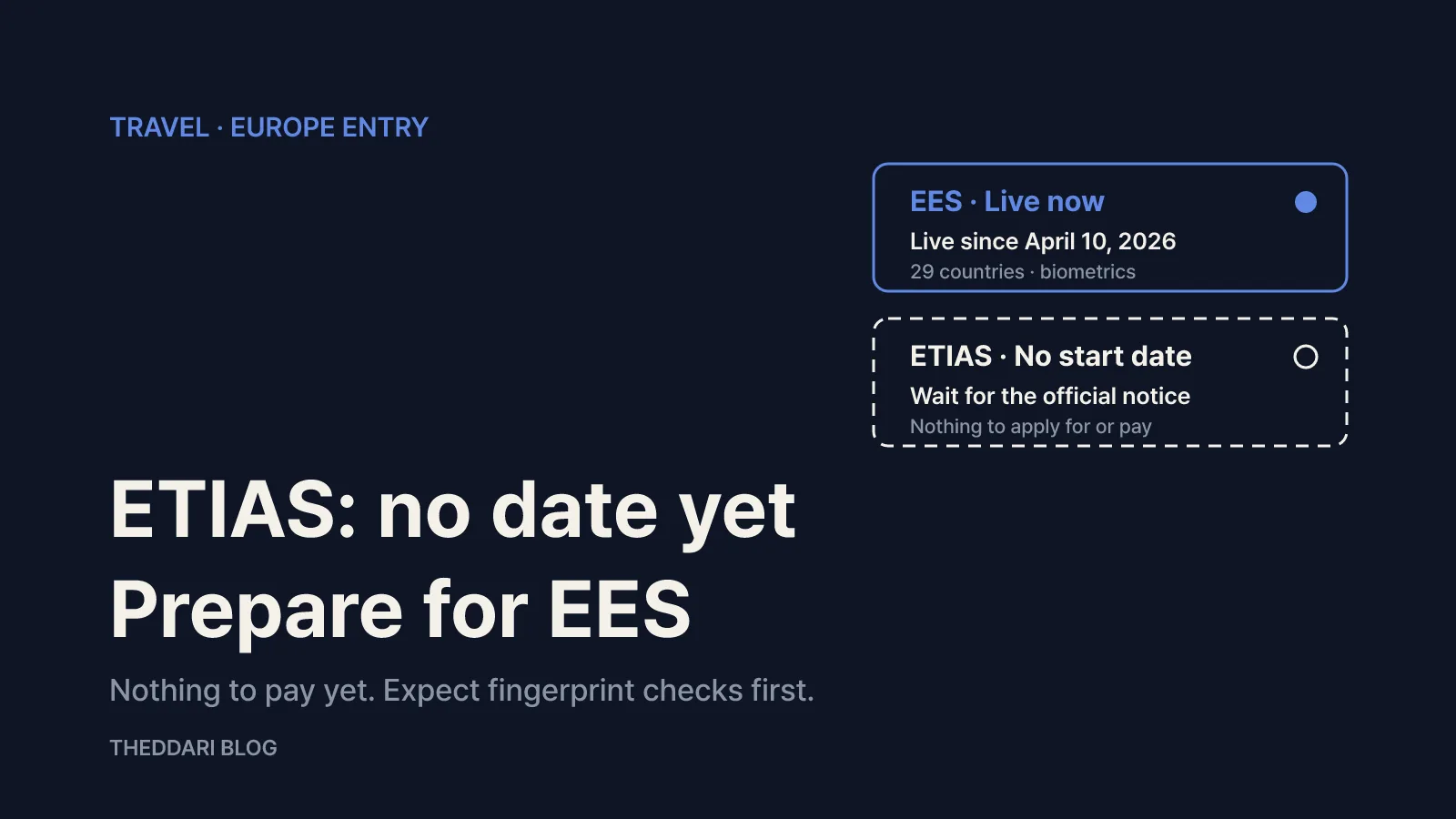
As of October 2026, you do not need ETIAS for a trip to Europe, because the system is not running and has no official start date. No one can legally sell you an ETIAS authorization today. What has changed at the border is the Entry/Exit System (EES), which records your fingerprints and a facial image the first time you cross into a participating country. This guide explains where ETIAS stands, why even an announced date would not make it mandatory overnight, what to expect from EES, and how to avoid paying a copycat website.
Where ETIAS stands right now
ETIAS, the European Travel Information and Authorisation System, is an online travel authorization for people who can visit Europe without a visa. It is not a visa, but once it starts you will need an approval before boarding. Travelers from visa-exempt countries such as the United States, the United Kingdom, Canada and Australia are in scope.
The timetable keeps moving. According to SchengenVisaInfo's October 19, 2026 report, the EU's Directorate-General for Migration and Home Affairs said in March 2025 that ETIAS would launch in the last quarter of 2026. In July 2026, that wording disappeared from the official website without a press release, and no replacement date had been published as of October 19, 2026. The Commission's ETIAS page now says only that the system is not in operation, that no applications are being collected, and that the start date will be announced several months before launch. ABTA, the UK travel trade body, told its annual convention on October 13, 2026 that there is no official launch date.
The EU has not given an official reason. ETIAS depends on EES, and reporting from July linked the slip to the strain of the EES rollout and to unfinished technical work on ETIAS itself. For travelers, the practical answer is short: there is nothing to apply for and nothing to pay.
The rules themselves are settled even though the date is not. Once ETIAS begins, visitors from 59 visa-exempt countries and territories will need it for short stays in 30 European countries, meaning the 29 Schengen states plus Cyprus. The fee will be €20, with no fee for applicants under 18 or aged 70 and over. An approval will be valid for three years or until your passport expires, whichever comes first, and most applications are expected to be decided within minutes. Because validity is tied to your passport, anyone with a passport close to expiry should think about renewal timing before applying later on.
Why an announced date would not mean instant enforcement
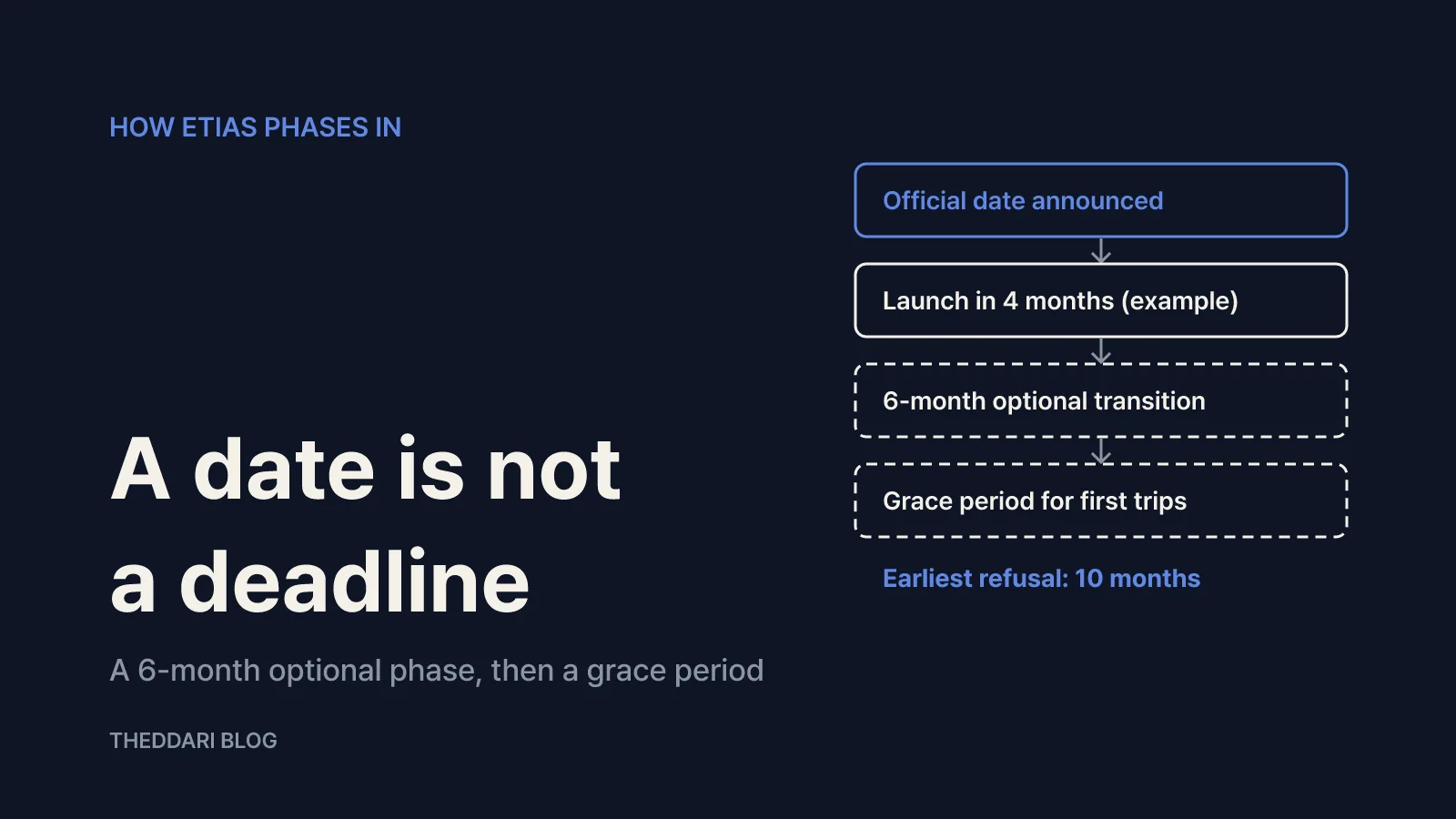
Even after a launch date is published, travelers will not be turned away on day one. The ETIAS Regulation sets a six-month transitional period during which ETIAS is optional, and the Commission can extend it. After that comes a grace period: if your first trip falls after the transitional period ends, you can still enter without an ETIAS.
SchengenVisaInfo offers a simple worked example. Suppose the Commission announced today that ETIAS will open in four months. Add the six-month transitional period, and the earliest a regular visitor could be refused for lacking ETIAS is ten months after that announcement. Any extension pushes that later.
So if you are flying this winter, there is no reason to change plans or prepare extra paperwork for ETIAS. If your trip is a year or more away, simply check periodically whether an official date has been announced. Once it is, you will have months to apply through the official EU website or app.
What has actually changed at the border: EES
The Entry/Exit System replaces passport stamps with a digital record of each entry and exit. It rolled out gradually from October 12, 2025 and became fully operational on April 10, 2026. In other words, ETIAS is not live, but EES already applies to you. The rollout brought long queues at some airports, and the law allowed countries to pause the fingerprint step at congested crossings until early September 2026.
EES covers 29 countries: the 27 EU member states except Ireland and Cyprus, plus Switzerland, Norway, Iceland and Liechtenstein, as listed in a travel-safety notice from South Korea's foreign ministry. It applies to non-EU nationals on short stays of up to 90 days, whether they hold a short-stay visa or travel visa-free. Nationals of EES countries, family members of EU citizens who hold a residence card, and holders of residence permits or long-stay visas can be exempt under specific conditions. Students and posted workers on long-stay visas should confirm their status with the relevant country's official guidance.
One detail trips people up. ETIAS is planned for 30 countries including Cyprus, while EES runs in 29 countries without Cyprus. Ireland is in neither system, and neither is the United Kingdom, so trips that combine the Schengen area with Ireland or Great Britain involve separate entry rules.
Your first EES crossing: what happens and how to prepare
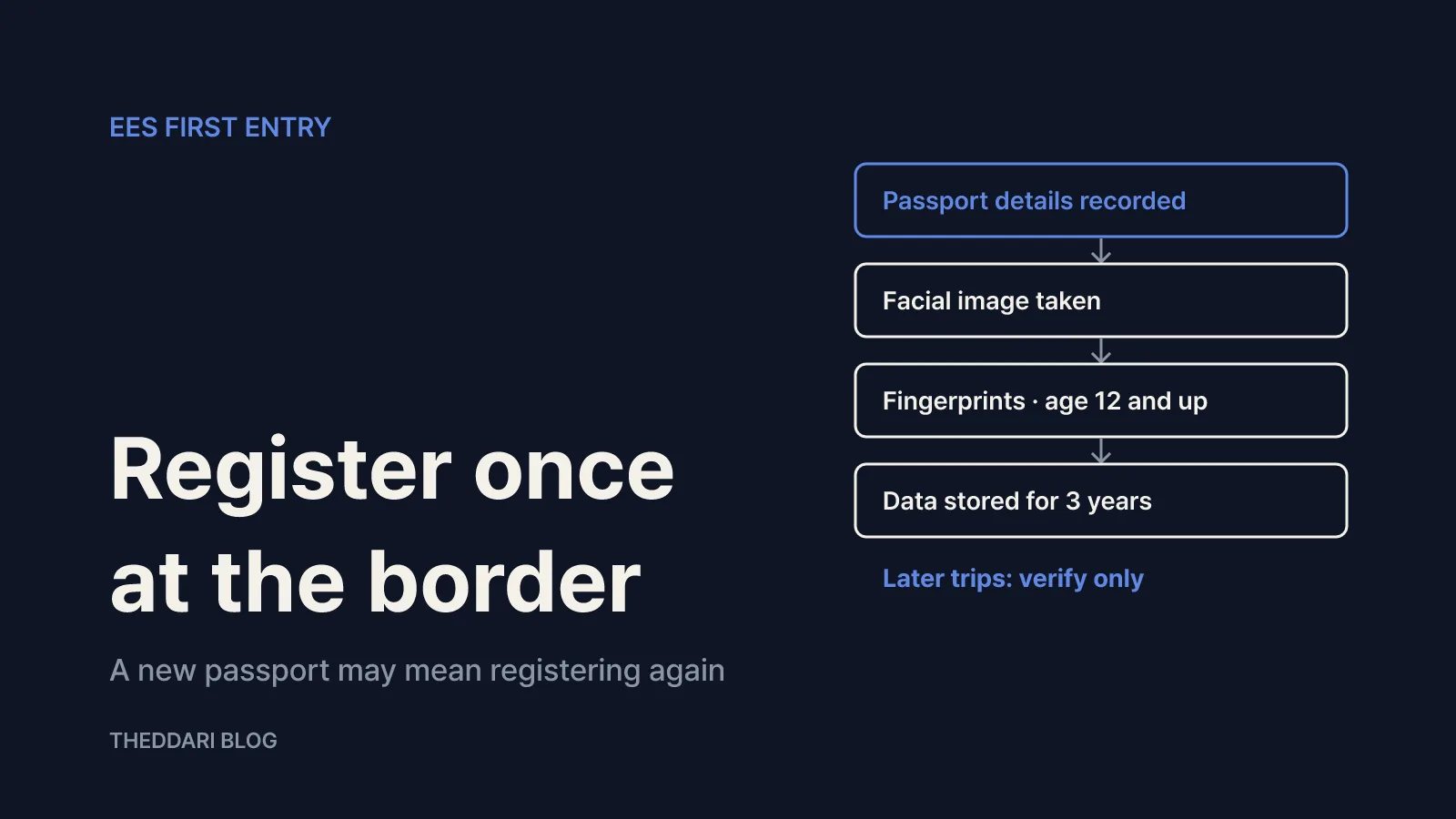
The first time you cross a participating border after EES began, your passport details and biometrics (a fingerprint scan and a facial image) are registered electronically. On later crossings, officers only verify your fingerprints and photo against the stored record. Where self-service kiosks are installed, you can enter part of the data yourself, which shortens the time at the officer's desk.
The record includes:
- name, date of birth and nationality
- passport number and issuing country
- a facial image and fingerprints (fingerprints for travelers aged 12 and over)
- dates and places of entry and exit
- any refusal of entry
The data is stored for three years. If you return within that period and nothing has changed, such as a passport renewal, you do not need to register again, and the three-year clock restarts from your re-entry. The data can be accessed by border, visa and immigration authorities, law enforcement bodies such as Europol, and carriers, among others.
Practical steps follow from this. Allow extra connection time if your first Schengen airport is also where you change planes, because registration takes longer than a stamp. Expect to register again after getting a new passport. Tell children what to expect: those under 12 skip fingerprints but still go through the other steps. And since every entry and exit is now logged electronically, keep your own count of days if you are touring several countries, so you stay within the 90-day short-stay limit.
How to spot websites charging for ETIAS
Timing is the clearest test. ETIAS is not accepting applications, so any site taking an ETIAS application or payment today is not official. When the system does open, the only channels will be the official EU website and the official app, and the official fee will be €20.
If a search ad promises fast ETIAS approval, check the address first: official EU guidance is published on addresses ending in europa.eu. A charge above €20, or any fee for someone under 18 or 70 and older, signals an agency markup. If you have already paid such a site, keep the receipt and contact your card issuer. If you uploaded a passport scan, watch for follow-up emails and messages that try to exploit it.
The same logic applies to EES. Registration happens at the border, so there is no paid pre-departure EES application to buy.
Pre-trip checklist
Work through these steps once your Europe trip is booked:
- Confirm whether the countries you will enter are among the 29 EES states. If so, plan extra time for fingerprint and photo registration on your first crossing.
- Check official europa.eu guidance for an ETIAS start date. As of October 2026, none has been announced.
- If a date appears, work out whether your travel falls inside the transitional period or after it.
- Check your passport expiry and whether you recently renewed. Both EES re-registration and future ETIAS validity are tied to the passport.
- If you travel with children, note that the fingerprint rule starts at age 12.
- If you hold a long-stay visa or residence permit, verify any EES exemption with the destination country.
In short, the job right now is preparing for your first EES registration, not applying for ETIAS. You can wait for an official announcement before doing anything about ETIAS.