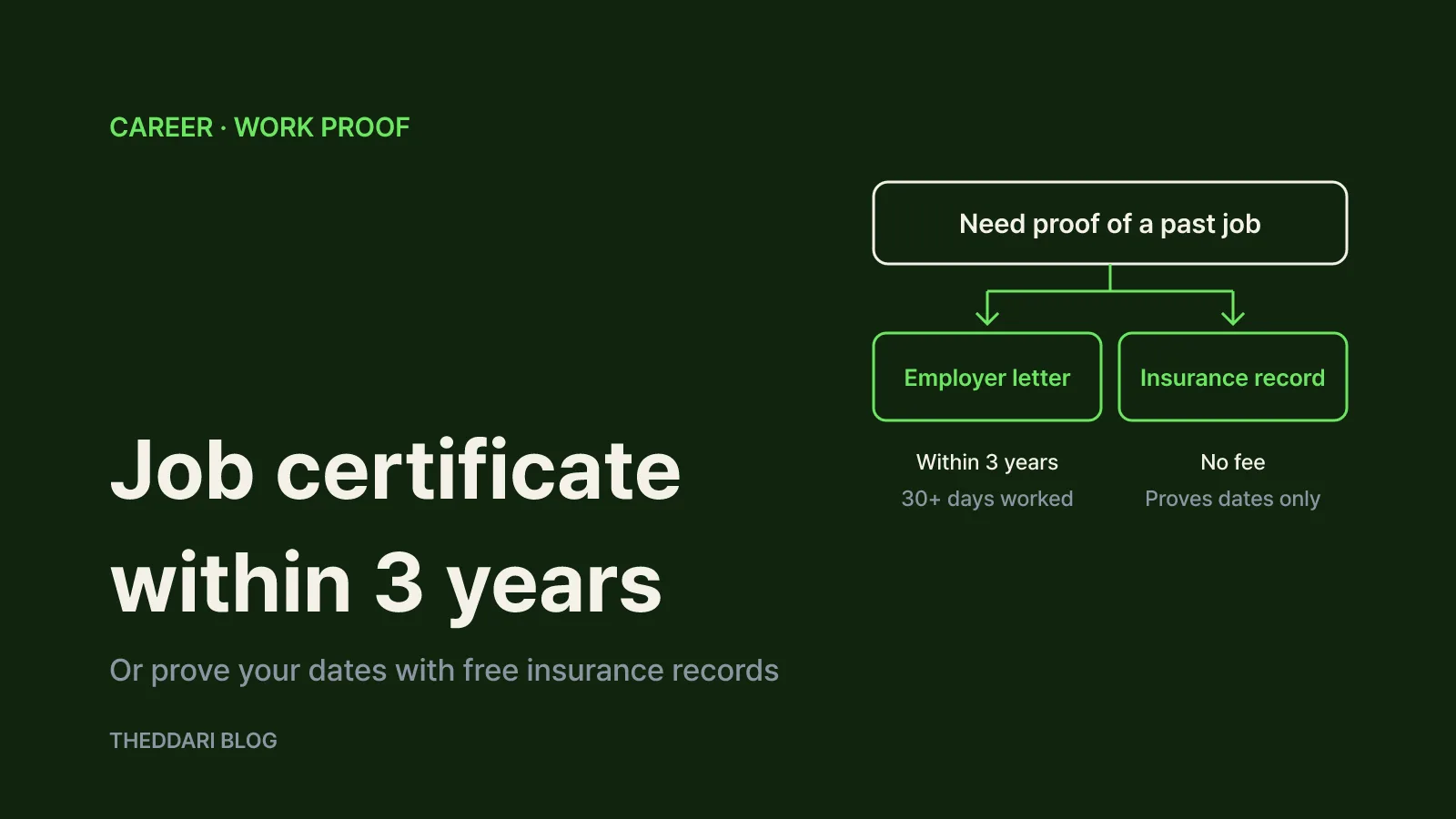
As of October 2026, if you worked for an employer in South Korea and now need proof of that job, you have two practical routes. First, Korean labor law gives you a right to request a certificate of employment (called a sayong jeungmyeongseo, often labelled 경력증명서 by companies) from your former employer, provided you worked continuously for at least 30 days and you ask within three years of leaving. The employer must issue it promptly and truthfully. Second, if the company is unresponsive or you only need to prove dates of employment, you can download free public records based on your employment insurance history. The catch is that those public records rarely show your job title or duties, so check what the recipient actually wants before choosing.
Your legal right to a certificate of employment
Issuing this document is a legal duty, not a favor. Article 39(1) of the Labor Standards Act, as summarized by the government's Easy Law information service, says that even after a worker has left, the employer must immediately issue a certificate stating the facts about the period of employment, type of work, position, wages and other necessary matters when the worker requests one. Article 39(2) adds that the certificate may contain only the items the worker asked for. In practice, that means you can ask the employer to leave out things such as the reason you resigned.
The eligibility conditions sit in the Enforcement Decree. In a Ministry of Employment and Labor online counseling answer, the ministry explains that under Article 19 of the Enforcement Decree, a worker who has been employed continuously for 30 days or more may make the request, and the deadline is three years after leaving. The same answer notes that current employees can request it too, so you do not have to wait until your last day to ask.
The three-year window lines up with how long employers must keep records. According to Easy Law, employers must keep the employee register and key documents such as employment contracts, wage ledgers and records on hiring, dismissal and resignation for three years (Article 42 of the Act and Article 22(1) of the Decree). After three years, your statutory right to demand the certificate ends. A company can still choose to issue one, but at that point you are asking, not enforcing.
An employer that ignores the duty can face an administrative fine of up to 5 million won (Article 116(2)2). The ministry's answer also cites an administrative interpretation stating that the type of work should be described as fully as possible where the worker's requested details are factual. If your next employer cares about what you actually did, that gives you a basis to ask for specific duties rather than a one-line entry.
What each document can and cannot prove
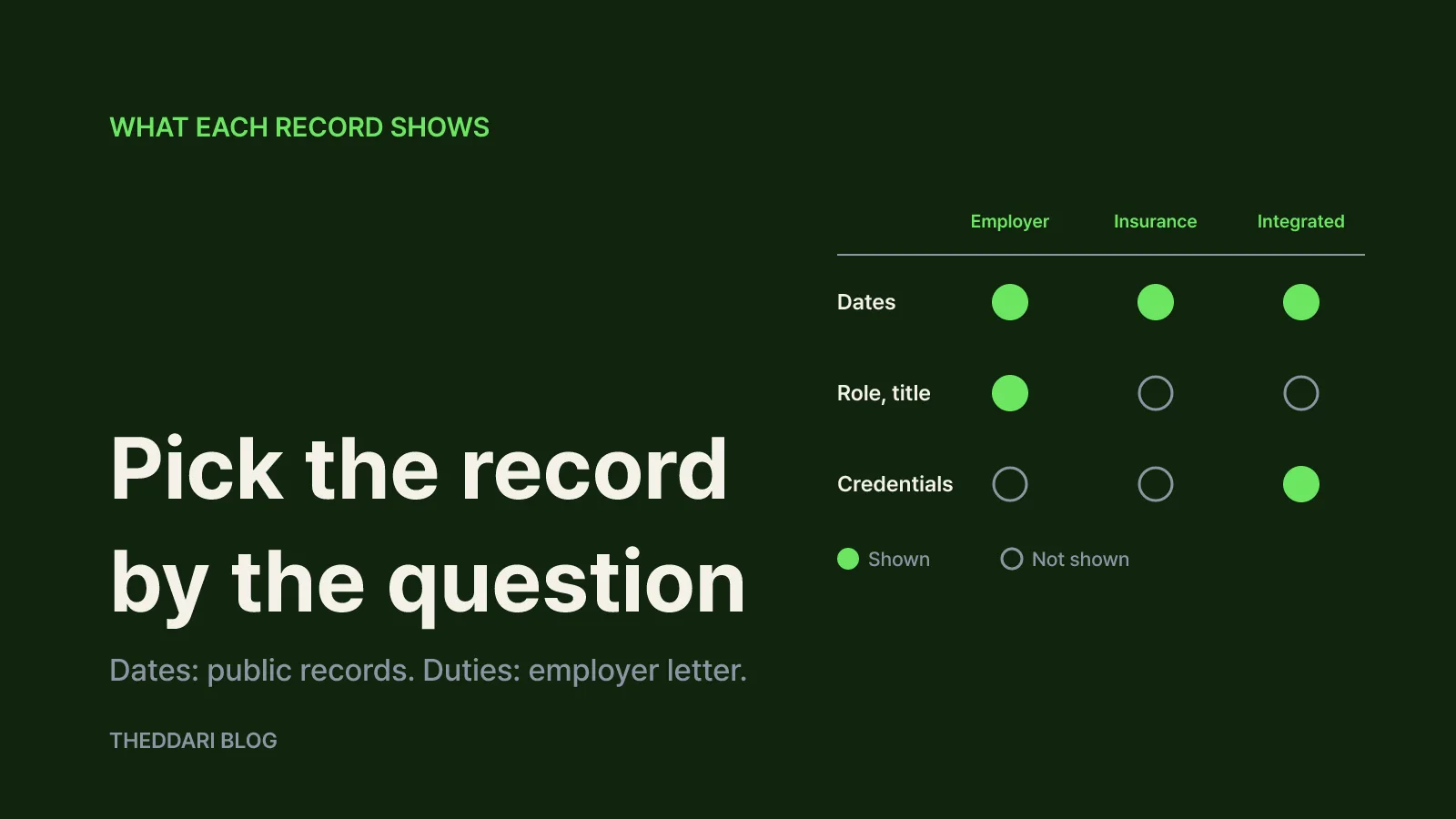
Not every "proof of employment" covers the same ground, so match the document to the question the recipient is asking.
- Employer-issued certificate. It can cover any of the items you request: dates, type of work, position and wages. This is the strongest evidence when a recruiter or licensing body evaluates job-specific experience.
- Employment insurance history statement (고용보험 자격이력내역서). This shows your employment insurance coverage history, which is commonly used to confirm where and when you were insured as a worker. You can get it yourself without contacting the company. It does not show periods when you were not covered by employment insurance, and it does not describe your role.
- Integrated Career Certificate (통합경력증명서). Issued through Work24, it pulls several data sources into one document. According to Work24, the career section links employment insurance data, sole-proprietor business registration data, military officer service records and overseas work experience, alongside qualifications, education and training records. Note that Work24 lists eligibility as holders of Korean nationality, so foreign nationals should plan on the employer certificate or the employment insurance statement instead.
If the recipient only needs to verify dates, a public record is often enough. If they need to verify your duties or title, you will usually need the employer's certificate. When a job posting simply says "certificate of employment," ask the hiring team whether a public record is acceptable before you submit.
How to get the employment insurance history statement
According to the Government24 service page for employment and industrial accident insurance certificates, the worker or an authorized representative may apply, and there is no fee. You can apply online, in person, by fax, by post or at an unmanned issuing kiosk. The online channel is the Korea Workers' Compensation and Welfare Service (COMWEL) Total Service site at total.comwel.or.kr.
The same service issues several related records: the employment insurance history statement for workers, a daily-worker employment record, a single-workplace coverage confirmation, the equivalent industrial accident insurance records and a benefit payment confirmation. Pick the one that matches your situation. For example, use the daily-worker record if you worked day-labor contracts, or the single-workplace confirmation if you only want to show one employer.
In-person requests at a COMWEL regional office are listed as processed immediately (within three working hours). Bring your ID. A representative needs your ID, their own ID and a letter of authorization from you.
Using the Integrated Career Certificate
For Korean nationals, the Integrated Career Certificate is free and is issued from Work24: log in, go to My Page (individual), open the service history menu and request the certificate. Keep three quirks in mind:
- The occupation shown is the one your employer reported when it first enrolled you in employment insurance. Work24 says later transfers or role changes are not reflected and are not grounds for correction. If the original report itself was wrong, you can request a correction through COMWEL's Total Service.
- If a recent qualification or training course is missing, use the "update information" button to refresh the linked data; qualification data can take time to appear.
- Military qualifications and officer service records become printable from 9 a.m. the day after you apply and are kept for only one week.
If your former employer will not respond
Start by making the request in writing, by text or email, listing your name, dates of employment, the items you want included and how you would like to receive the certificate. Mention that you are requesting it under Article 39 of the Labor Standards Act and ask only for the items you need. If you are on a deadline, offer the recipient a public record first and ask whether you can supply the employer's certificate later.
If the employer still refuses, the ministry advises filing a petition with the regional employment and labor office that has jurisdiction over the workplace, so that a labor inspector can step in. Separately, Article 40 of the Act prohibits anyone from creating blacklists or sharing secret signals to obstruct a worker's re-employment; Easy Law notes that violations carry up to five years in prison or a fine of up to 50 million won. Mention any such conduct in your petition.
Quick checklist before you submit
- Confirm whether the recipient needs dates only or duties and title as well.
- Check that you worked at least 30 continuous days and are within three years of leaving.
- Remember that uninsured periods will not appear in employment insurance records.
- Choose the correct record type (regular or daily worker) when downloading from COMWEL.
- Check whether the recipient requires a recently issued document.
The simplest habit is to request the employer certificate when you leave each job, then download public records whenever a new application needs them.