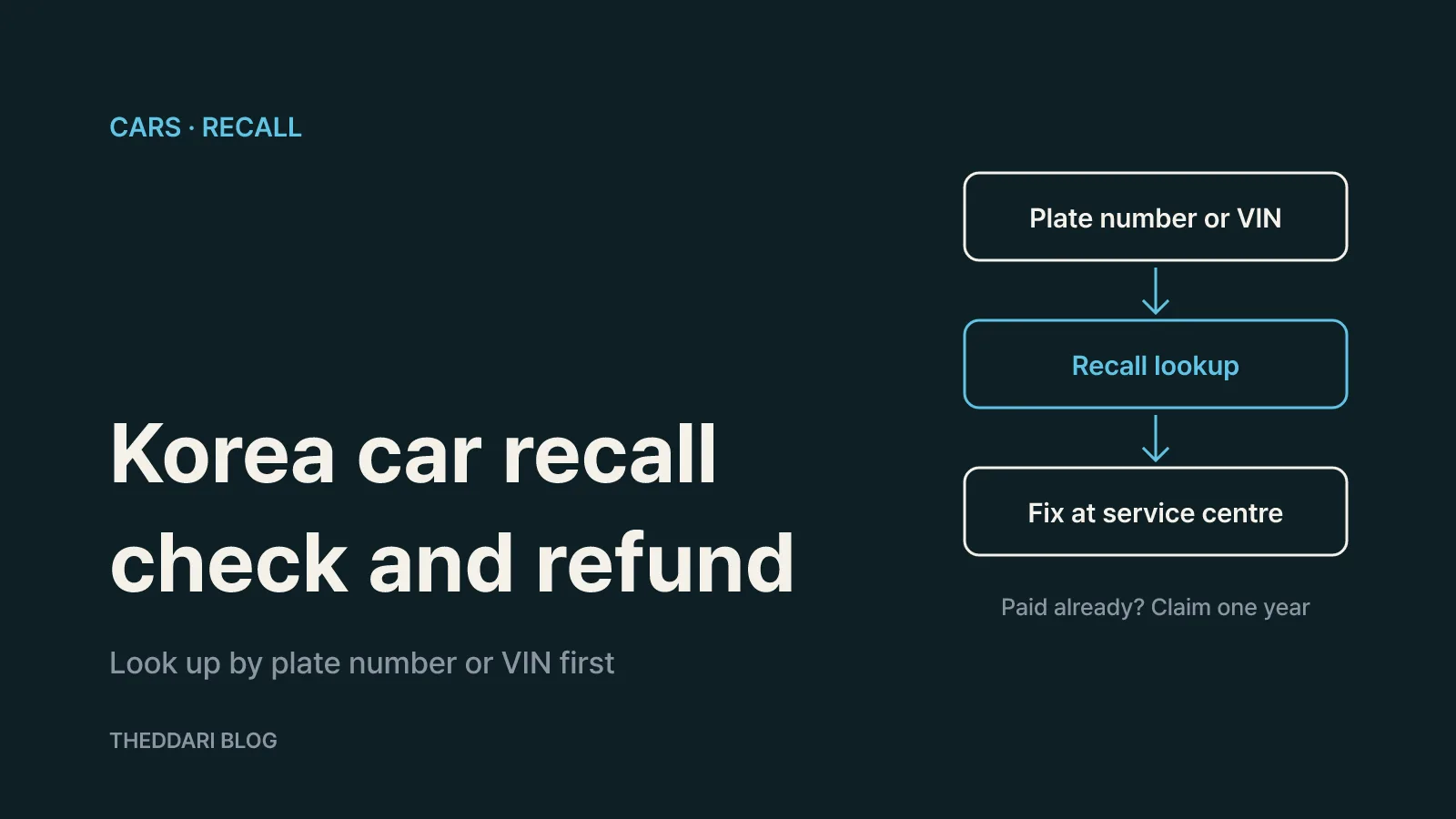
As of October 2026, the quickest way to find out whether a car registered in South Korea is subject to a safety recall is the government-run Car Recall Center, operated by the Korea Transportation Safety Authority (KOTSA) under the Ministry of Land, Infrastructure and Transport. You enter either the vehicle registration (plate) number or the vehicle identification number (VIN) and the site tells you whether the car is covered and whether the fix has been recorded. If you already paid out of pocket to repair the same defect before the recall began, Korean law lets you claim back costs paid during the one year before the recall from the manufacturer (Car Recall Center FAQ).
This guide is written for drivers in Korea, including expats and people buying a used car there. It covers the lookup itself, how to read the result, the paperwork for a reimbursement claim and how to report a defect that has not been recalled yet. The rules described here are Korean rules; recall systems in the US, UK or elsewhere work differently.
How to run a recall lookup
The lookup lives under the Recall Information → Recall Target Check menu of the Car Recall Center. KOTSA's own recall and free repair information page links to the same service, and the Ministry of Government Legislation's Easy Law guide points owners to the same place.
- Open the Car Recall Center and go to the recall target check page.
- Enter either the registration number shown on your plate or the VIN printed on the vehicle registration certificate.
- Read whether the car is a recall target and whether corrective action has been recorded.
- If it is covered, note the recall description and manufacturer, then book an appointment with an authorised service centre.
Timing matters. The center states that outside business hours (weekdays 09:00 to 18:00) the service may be limited, for example because vehicle data cannot be retrieved. A failed search on a Saturday night does not mean your car is clear, so try again on a weekday.
If the plate has changed or the car has been re-registered, run a second search with the VIN and compare. Recalls are often limited to particular production periods or parts batches, so owners of the same model can get different answers. Treat forum posts saying a model has been recalled as a prompt to check, not as an answer.
Reading the result: repair status runs a quarter behind
The result shows two separate things: whether the car is a recall target, and whether the remedy has been completed. The second item has a built-in delay. According to the center, repair status is based on the recall progress that manufacturers report to the ministry every quarter under the Motor Vehicle Management Act, so you can only see completion status up to the previous quarter.
In practice, a car fixed at a dealer this quarter may still show as unrepaired. Keep the work order from the service centre as proof until the next report is reflected. If you are buying a used car and the seller says every recall has been done, ask for the work orders as well as checking the screen.
The center also notes that recalls issued by the Ministry of Environment are not covered by the repair status service. For emissions-related campaigns, confirm completion directly with the manufacturer.
To browse all active campaigns rather than a single car, use the Recall Status menu. KOTSA explains that it lists recalls from their start date and can be searched by manufacturer, model name and posting date, which is useful when researching a model before you buy.
Missed the letter or bought the car used?
When a recall is decided, notice goes out through several channels. The center's FAQ says the ministry issues a press release, the manufacturer publishes the recall in a national daily newspaper and owners are notified by post. The Easy Law guide adds that manufacturers must draw up a corrective action plan within 30 days of becoming aware of a defect, notify owners by post or text message and publish a notice in at least one nationally distributed daily paper.
Post goes to the registered address, so letters can be missed after a move or shortly after a change of ownership. A simple habit works better than waiting for mail:
- Before signing for a used car, ask the seller for the plate number and check recall status.
- Right after the title transfer, search again and contact a service centre about any open recall.
- Before seasonal maintenance or a periodic inspection, search once more.
- When a news story mentions your model, verify it against your own vehicle.
Both the Car Recall Center and the KOTSA site also list a Recall Alert sign-up menu if you prefer reminders.
Manufacturers face serious penalties for ignoring recall duties. According to Easy Law, failing to carry out a recall can lead to a penalty surcharge of up to 3/100 of the related vehicle or parts sales, or up to 10 years in prison or a fine of up to 100 million won. For owners, the takeaway is that a covered repair should be done at the manufacturer's expense.
Paid for the repair before the recall? Claim one year of costs
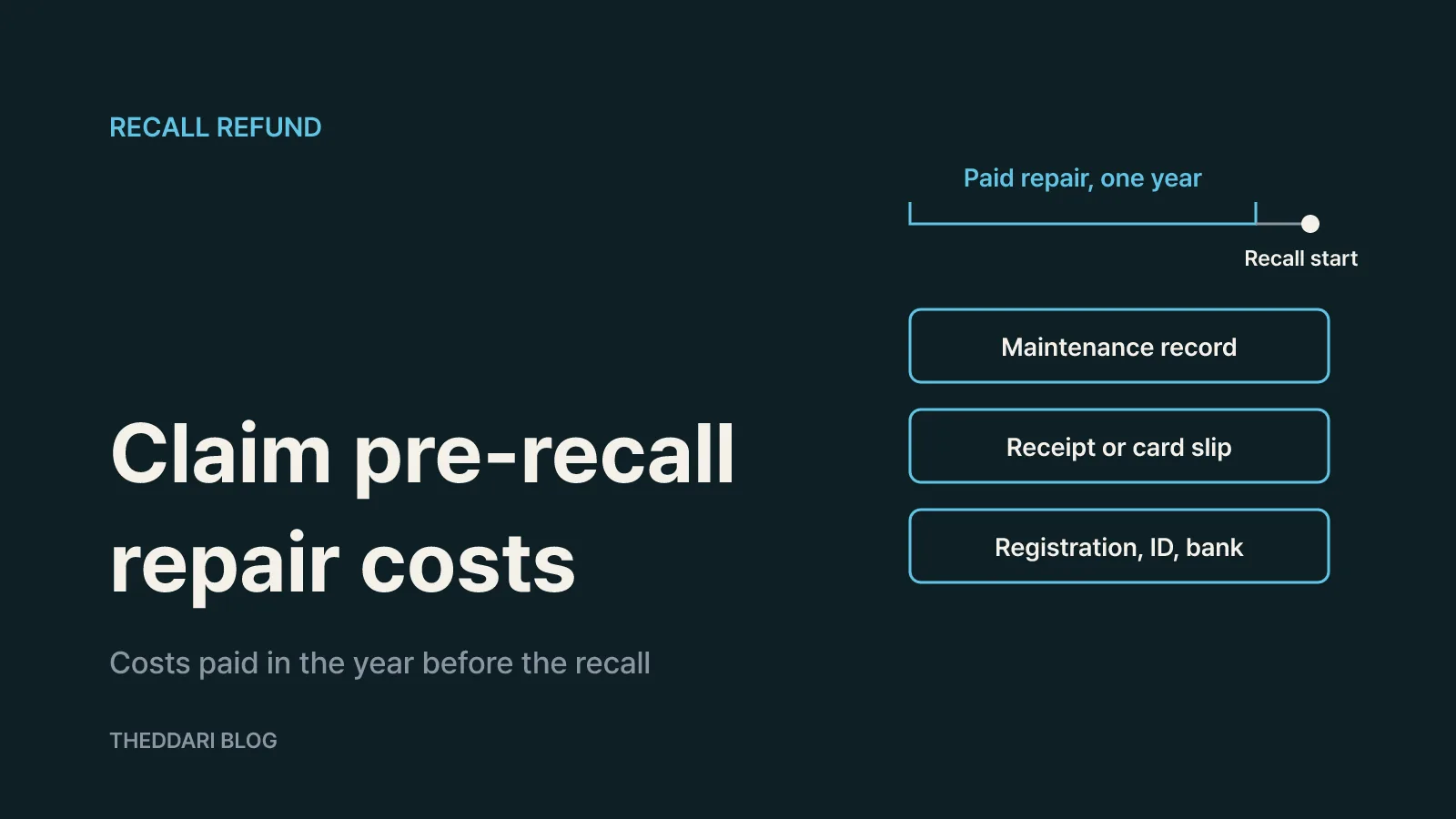
Many owners discover a recall after they have already paid to replace the faulty part. Korea's recall reimbursement system, based on Article 31-2 of the Motor Vehicle Management Act and introduced in March 2009, requires the manufacturer to compensate owners who fixed the defect at their own expense before the official remedy. The claim covers costs paid during the one year before the recall began and is filed with the manufacturer, not with the government.
The Car Recall Center lists three groups of documents:
- Vehicle inspection and maintenance record, the official form (Annex Form 89-2) that a repair shop issues describing the work. If you did not receive one, ask the shop that did the repair.
- Tax invoice or receipt, which includes a credit card sales slip.
- Vehicle registration certificate, the owner's ID and a copy of the bank account where the money should be paid.
Before filing, compare the recall description with the work on your record; a record that names the part and the job clearly makes the match easier to prove. Then check that the repair date falls within one year before the recall start date. Finally, ask the manufacturer's customer centre how it accepts claims, because submission methods can differ between brands. Keeping every repair record, even as a phone photo, is the easiest way to be ready for a future claim.
Reporting a defect that has not been recalled
If the same fault keeps coming back and there is no recall, you can file a defect report on the Car Recall Center site by entering your details, vehicle information and a description of the problem, or call the defect report line at 080-357-2500.
A report does not trigger an immediate investigation. The center analyses reports periodically, looking for the same symptom across the same model, and says it cannot reply to every report individually, although investigators may call you to confirm details. Include dates, driving conditions, warning lights and maintenance history.
Investigations take two forms, both run by the Korea Automobile Testing and Research Institute: a self-certification compliance check against safety standards and a safety defect investigation. Findings go to a 20-member defect review committee, followed by a hearing before any recall order. In practice, most recalls are voluntary actions by manufacturers.
Recalls, free inspections and refunds use different channels
- Recall (defect correction): the manufacturer repairs, replaces or refunds to prevent harm from a safety defect.
- Free inspection and repair campaigns: KOTSA lists manufacturer-provided free inspections separately from recalls, so check the free inspection menu even when a recall search comes back empty.
- Product liability: compensation after a defect has already caused injury or property damage.
- New car replacement or refund: handled through the new car replacement and refund service, while individual disputes over repairs can go to the Korea Consumer Agency on 1372.
The short version: look up the car by plate number or VIN, get the remedy at a service centre if it is covered, claim costs paid within one year before the recall with the right paperwork, and report repeat faults to 080-357-2500. Remember that completion status only reflects the previous quarter.