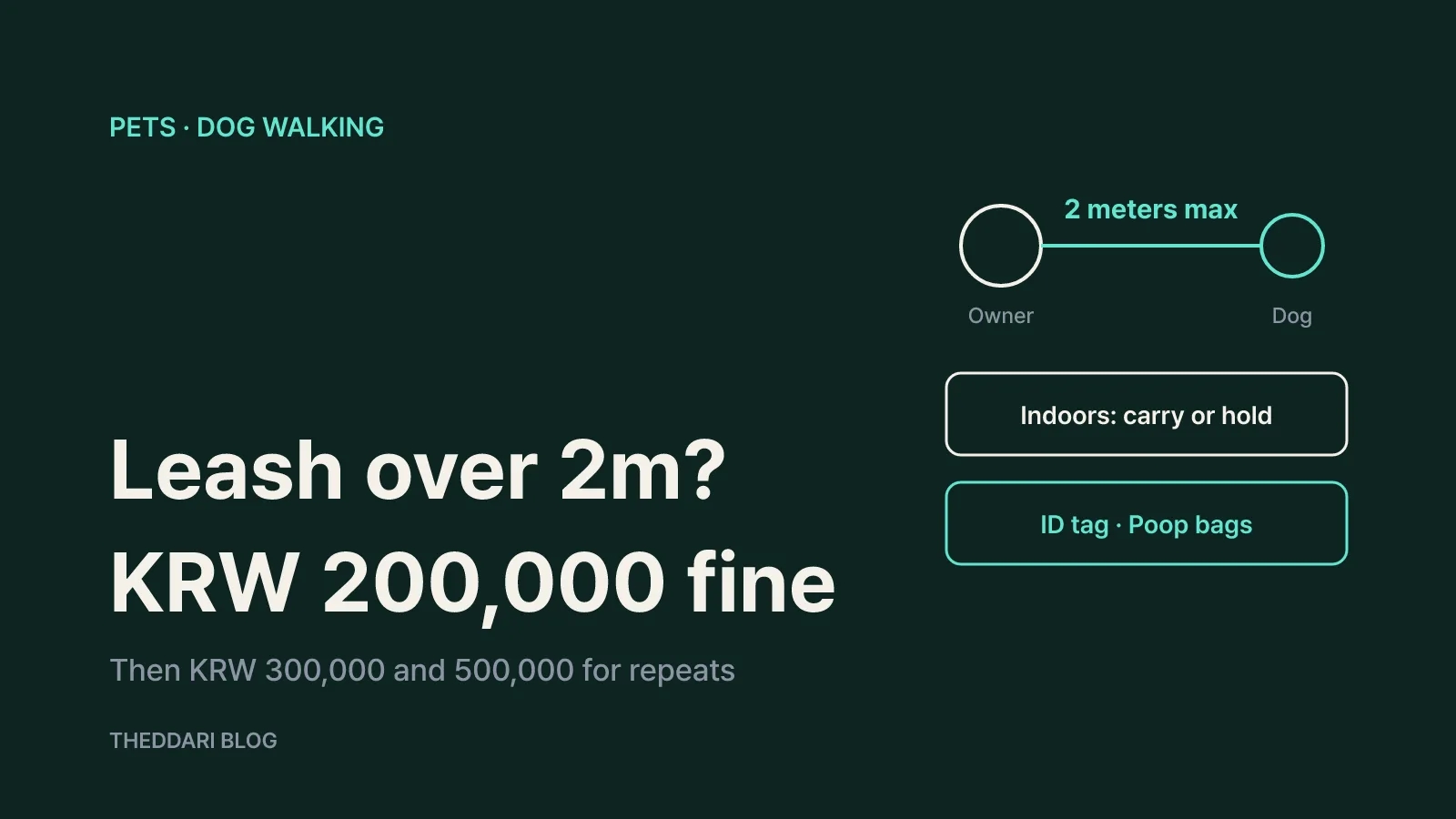
As of October 2026, anyone walking a dog in South Korea must use a leash or harness no longer than 2 meters (about 6.5 feet) or carry the dog in a carrier. A first violation can bring a fine of KRW 200,000, rising to KRW 300,000 for a second and KRW 500,000 for a third or later offense, according to Ministry of Agriculture, Food and Rural Affairs guidance published on Korea.kr. The leash rule sits alongside three other walking duties: an ID tag, prompt waste pickup and tighter control inside apartment buildings. Each has its own fine. This guide explains what counts as compliance, where the exceptions are, and what to pack before you head out.
What the 2-meter leash rule actually requires
When a dog leaves home with its owner or caretaker, it must wear a leash or harness, or travel in a carrier. The National Institute of Animal Science (NIAS) describes the purpose as keeping the leash at a length that lets you control the dog effectively without putting other people at risk. The 2-meter cap turns that principle into a number you can measure: your dog should stay within easy reach of your hand.
Retractable leashes are the most common question. Seodaemun District's guidance states that a longer leash still complies if you hold it at 2 meters or less. In practice, lock the cord at a short length on shared paths, and do not let it run out fully in a park, even when the park looks empty. People, bikes and other dogs can appear around a corner in seconds.
Carriers count as a safety measure too, and Seodaemun's guidance specifies a carrier with a locking mechanism. If your bag has an open top that a small dog can climb out of, clip a leash on as well.
There is one exemption. A puppy under 3 months old that you carry in your arms does not need a leash. Once the puppy is on the ground, treat the normal rule as applying, so bring a leash anyway. Owners are also expected to make sure the dog never leaves home on its own without someone responsible for it.
These walking rules are framed around dogs. Under the same ministry guidance, dogs aged 2 months or older must be registered with the local district office or an authorized registration agent such as a veterinary clinic. Cats are not covered by the leash fines described here, but a lockable carrier remains the safest way to take a cat outdoors.
Fines by offense: first, second and third
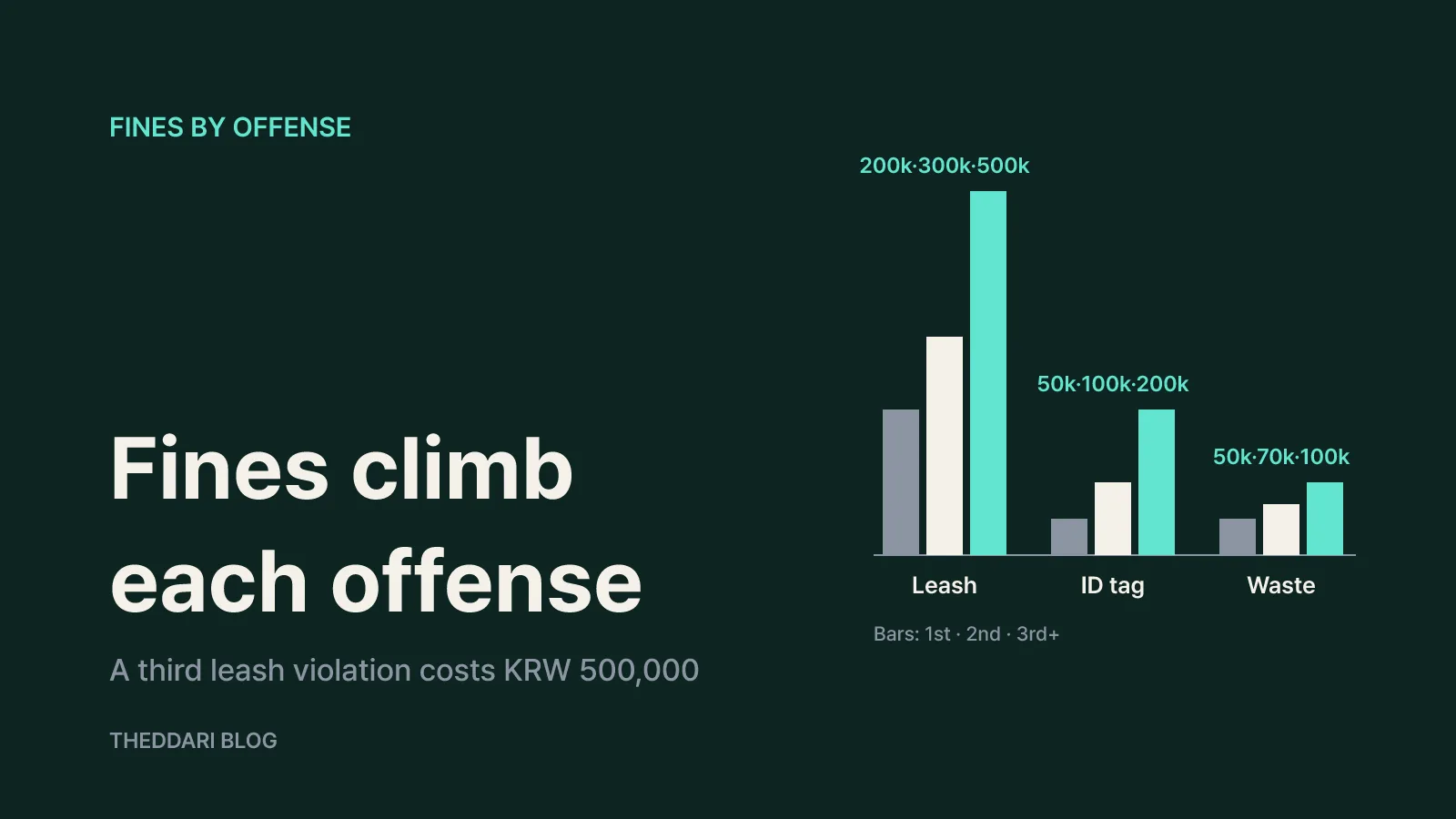
Fines increase with repeat violations. The ministry guidance lists the following amounts:
← Swipe to see more
| Violation | 1st | 2nd | 3rd or later |
|---|---|---|---|
| Leash or harness safety measure missing | KRW 200,000 | KRW 300,000 | KRW 500,000 |
| No ID tag | KRW 50,000 | KRW 100,000 | KRW 200,000 |
| Waste not picked up | KRW 50,000 | KRW 70,000 | KRW 100,000 |
| Dog not registered | KRW 200,000 | KRW 400,000 | KRW 600,000 |
| Dangerous breed without leash and muzzle | KRW 1,000,000 | KRW 2,000,000 | KRW 3,000,000 |
In shorthand, that is 200k, 300k and 500k won for leash violations; 50k, 100k and 200k won for ID tags; and 50k, 70k and 100k won for waste. Each item is listed as a separate violation, so walking a dog with neither a leash nor a tag means breaking two duties at once.
The consequences can go beyond a fine. Seodaemun's guidance notes that failing to take safety measures such as a leash and causing injury to a person can lead to up to 2 years in prison or a fine of up to KRW 20 million, and causing death can lead to up to 3 years or KRW 30 million. The 2-meter rule is a legal safety duty, not just etiquette.
Elevators and hallways: hold the dog close
If you live in an apartment or an officetel, the rules start at your front door. The ministry guidance says that in shared indoor spaces such as elevators in apartment buildings and quasi-residential buildings, you must either carry your dog or hold the leash right at the collar. Quasi-residential buildings include dormitories, multi-unit lodging facilities, senior housing and officetels.
Inside these buildings, the standard is not "within 2 meters" but "unable to move around." Seodaemun's guidance says to pick the dog up or grip the leash at the neck so it cannot wander. An elevator is cramped, and you never know who is waiting when the doors open. A loose leash lets a dog approach a stranger's legs or get caught in the closing doors.
A practical routine looks like this: leash up before opening your front door, carry small dogs in the elevator and stairwell, keep larger dogs pressed to your side with your hand just above the collar clip, and let the leash out to 2 meters only once you are outside the building.
Urine rules tighten indoors as well. According to NIAS, urine must be cleaned up immediately when it lands in indoor shared spaces such as elevators and stairs, or on benches and platforms where people sit or lie down. Keep tissues or wet wipes in your walking bag for exactly this moment.
ID tags and waste bags belong in the same pocket
An ID tag must show the owner's name, phone number and the dog's registration number. NIAS stresses that the tag is required on outings whether or not the dog has an implanted microchip. A chip needs a scanner; a tag lets the person who finds your dog call you on the spot. NIAS also notes that an untagged dog found roaming may be treated as abandoned and taken to an animal shelter.
If you move or change your phone number, update the tag at the same time. Seodaemun's guidance reminds owners that changes to the owner, address or contact details also require a registration update with the district, so handling both on the same day keeps them in sync.
Pick up feces immediately, wherever they land. NIAS recommends carrying a water bottle to rinse spots where your dog urinates, and the ministry refers to this as "manner water," to be packed alongside poop bags.
Stricter rules for designated dangerous breeds
Korea designates five breeds and their mixes as dangerous dogs: Tosa, American Pit Bull Terrier, American Staffordshire Terrier, Staffordshire Bull Terrier and Rottweiler. Once such a dog is 3 months or older, it needs both a leash and a muzzle outdoors. The muzzle must effectively block bites while still letting the dog breathe, regulate its body temperature and drink water.
Seodaemun's guidance adds that these dogs may not use a harness in place of a collar leash, and may not enter daycare centers, kindergartens, elementary and special schools, elderly and disability welfare facilities, children's parks or playgrounds. A sturdy, lockable crate that the dog cannot escape, with a door, lock and walls that do not break easily on impact, exempts it from the leash and muzzle requirement.
Dangerous-breed owners must also carry liability insurance and complete 3 hours of mandatory training every year; new owners must finish it within 6 months of acquiring the dog. Skipping the training means fines of KRW 1,000,000, 2,000,000 and 3,000,000 for successive violations, and missing insurance can cost up to KRW 3,000,000 depending on the number of days uninsured.
A one-minute checklist before every walk
- Leash: clip it on and, if it is retractable, lock it at 2 meters or less.
- ID tag: check that your name, phone number and registration number are legible.
- Bags and water: carry poop bags, a water bottle for urine spots and tissues.
- Shared spaces: carry the dog or hold the leash at the collar in elevators and stairwells.
- Destination: national, provincial and county parks may restrict pets, so check the park authority's notice first. National and public arboretums do not admit pets, except assistance dogs for people with disabilities.
Make these five steps a habit and walking fines become almost irrelevant. A short leash is also the simplest way to stop a sudden dash toward traffic or another dog.