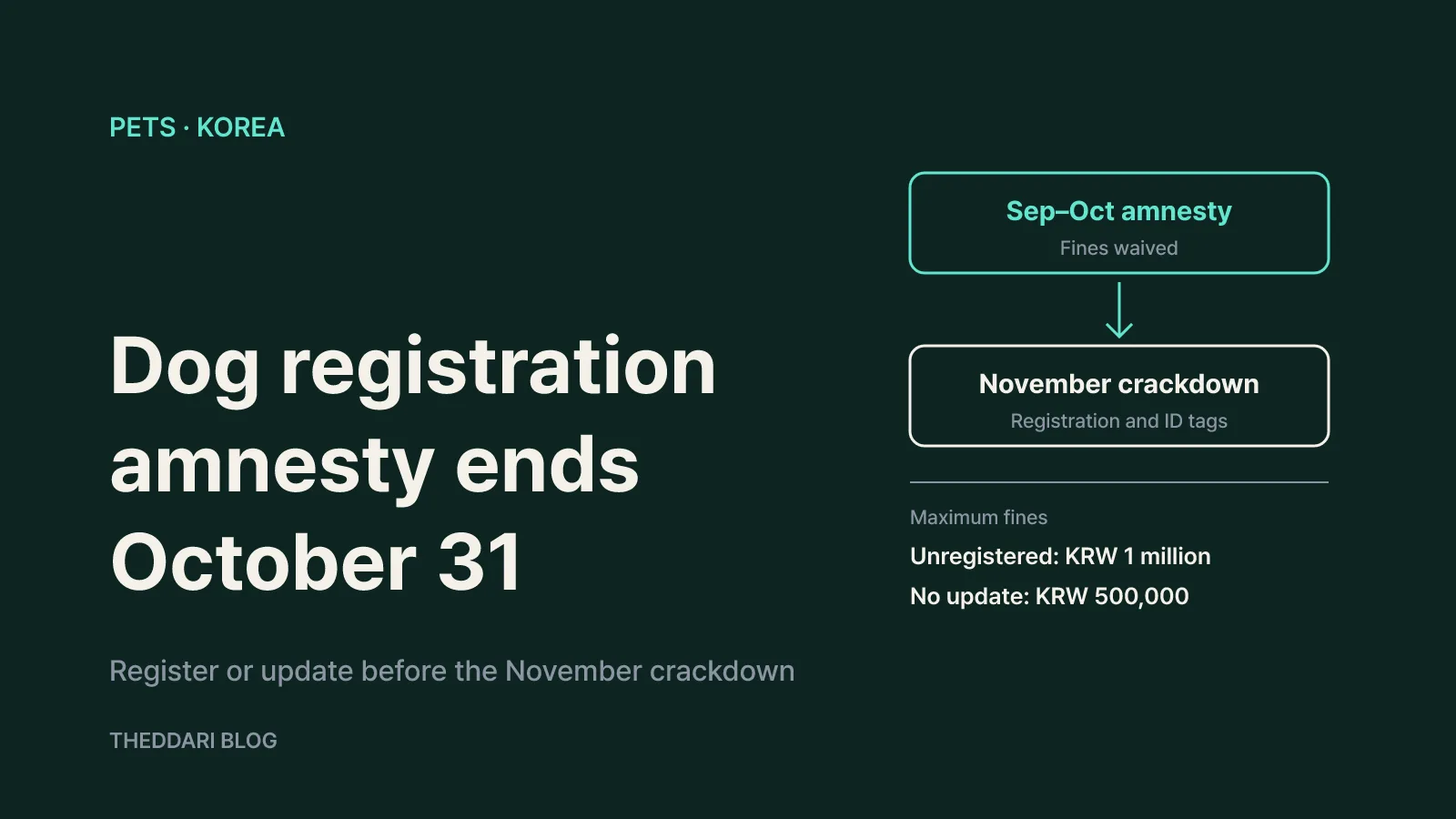
As of October 2026, if you keep a dog in South Korea and have never registered it, or you moved, changed your phone number or took over a dog from someone else without updating the record, the cheapest moment to fix it is before October 31. The Ministry of Agriculture, Food and Rural Affairs (MAFRA) is running its "second 2026 voluntary animal registration period" across September and October. Owners who register or file an update during this window are exempt from the fine that would otherwise apply. Once it closes, MAFRA and local governments plan a month-long crackdown in November at parks and apartment complexes, checking registration, updates and leash and ID tag compliance (MAFRA press release).
This guide covers the Korean rules only. It explains who must register, how the microchip and external tag options differ, the step-by-step process, the update deadlines people miss and the fine schedule. Whether an implant suits your particular dog is a conversation to have with the registering veterinary clinic.
The 2026 amnesty window and November crackdown
Korea split this year's amnesty into two rounds. The first ran from May to June; the second, now under way, runs from September through October. The rule is the same for both: an owner who was unregistered or who failed to report a change can come forward during the window and have the fine waived (MAFRA).
The important detail is that enforcement starts immediately afterwards. MAFRA says November inspections will focus on places dogs visit often, such as parks and apartment grounds. Inspectors will look not only at whether a dog is registered but also at whether the owner has reported changes and whether the dog wears a leash and an ID tag outdoors. A dog registered years ago at an old address can still be a problem.
Expect clinics to get busy in the final week. An implant may need an appointment, and even the external tag option requires you to bring the dog in person, so booking this week is safer than counting on the last weekend of October. Call ahead to confirm opening hours on the final day.
Who must register: dogs two months and older
Under Korea's Animal Protection Act, registration is mandatory for dogs aged two months or older kept as companions, whether they live in a house or elsewhere. Owners register with the mayor, county head or district head responsible for their address (National Institute of Animal Science).
There is also a deadline outside the amnesty. The National Institute of Animal Science (NIAS) states that the application must be filed within 30 days of acquiring the dog or of the dog becoming eligible, meaning the day it turns two months old. If you adopt a puppy at around two months, plan to register it within its first month at home.
Cats are not covered by the mandate. Seoul's guidance notes that cat owners may opt in using the implant method if they wish (Seoul Metropolitan Government).
You do not need to register in the district where you officially live. According to the national system's FAQ, the district office that receives the application processes it and issues the certificate even for residents of other areas, so a clinic near your office works (Animal Protection Management System FAQ).
Microchip implant vs external tag: cost and trade-offs
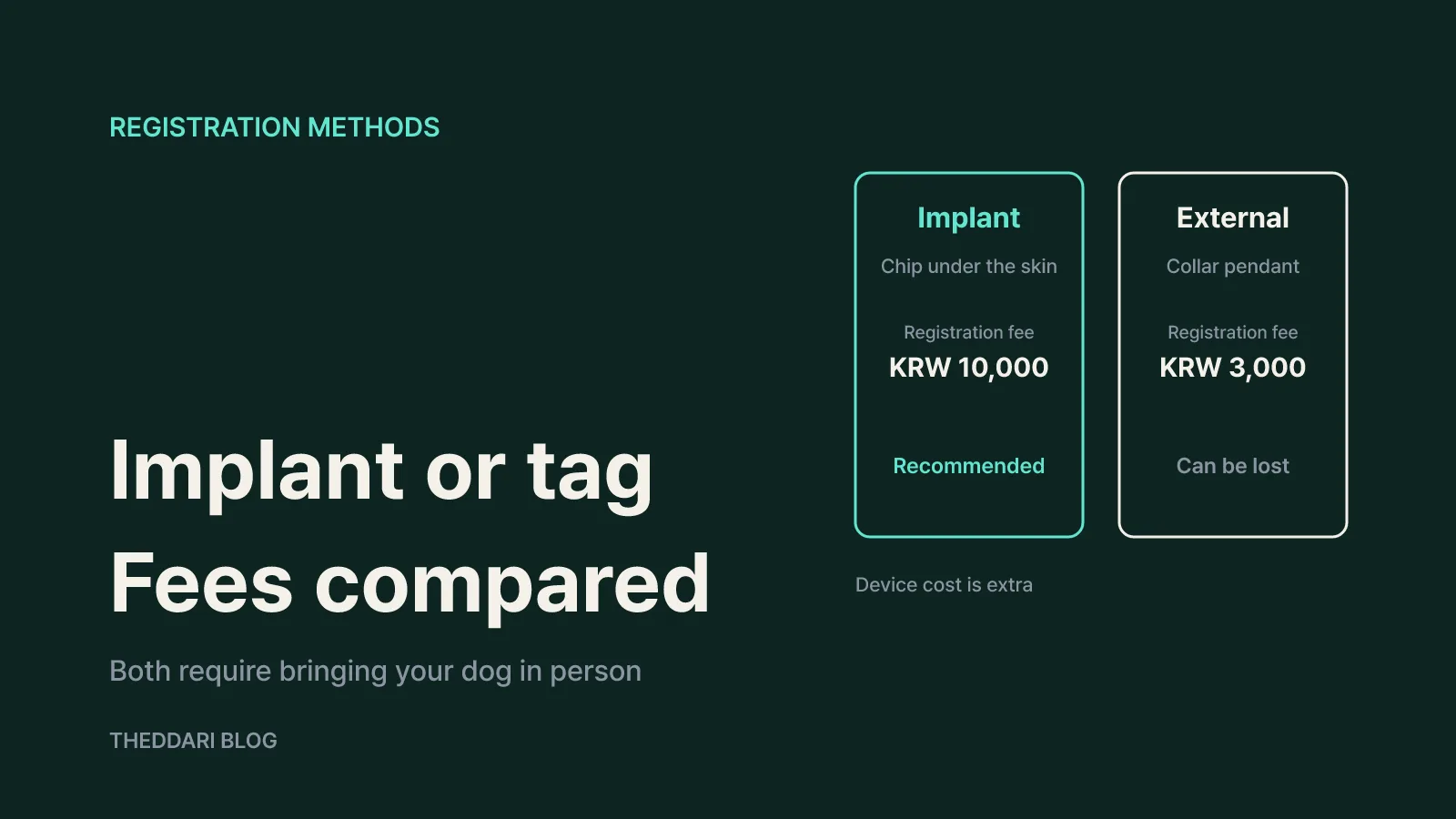
You choose one of two methods. An implant places a rice-grain-sized RFID microchip under the skin. An external device is a pendant on the collar with the chip inside. Both MAFRA and Seoul recommend the implant, because external devices can be lost or damaged.
The cost has two parts: an administrative fee plus the device itself. The national FAQ lists the fees for a new registration:
← Swipe to see more
| Item | Registration fee | Device |
|---|---|---|
| Implanted RFID chip | KRW 10,000 | Bought or brought by the owner |
| External RFID device or registration tag | KRW 3,000 | Bought or brought by the owner |
| Updates (new owner, address, phone, lost, deceased) | Free | Not applicable |
Device and procedure prices vary between clinics, so ask for the total including the fee and whether the clinic supplies the chip.
Two cautions apply to the external option. First, you still have to bring the dog to the registration agent, because the device must be fitted before the certificate is issued. Second, if the pendant is lost or broken you need a replacement, and that counts as a change you must report within 30 days.
If your dog was chipped abroad or years ago, check the number format. Korean registration uses the 15-digit international standard RFID number. The FAQ says chips that do not follow this format cannot be entered in the national system and the dog would need a compliant chip from an authorised agent.
How to register, step by step
- Find an agent: use the "registration agency search" on the national Animal Protection Management System (animal.go.kr) to locate a nearby clinic.
- Book: for an implant, confirm the appointment and total price; for an external device, confirm stock.
- Visit with your dog: bring ID and complete the application with owner details (name, address, phone) and dog details (name, sex, neuter status, breed, coat colour).
- Fit the device: the chip is implanted or the external device is attached.
- Receive the certificate: once the district office processes the record, a registration certificate is issued.
The certificate comes from the district office for your registered address and may arrive by post or through the clinic. You can also log in to animal.go.kr and print it yourself. After registering, check the record. If the breed or sex is wrong, ask your local animal protection officer to correct it.
Update deadlines: 10 days and 30 days
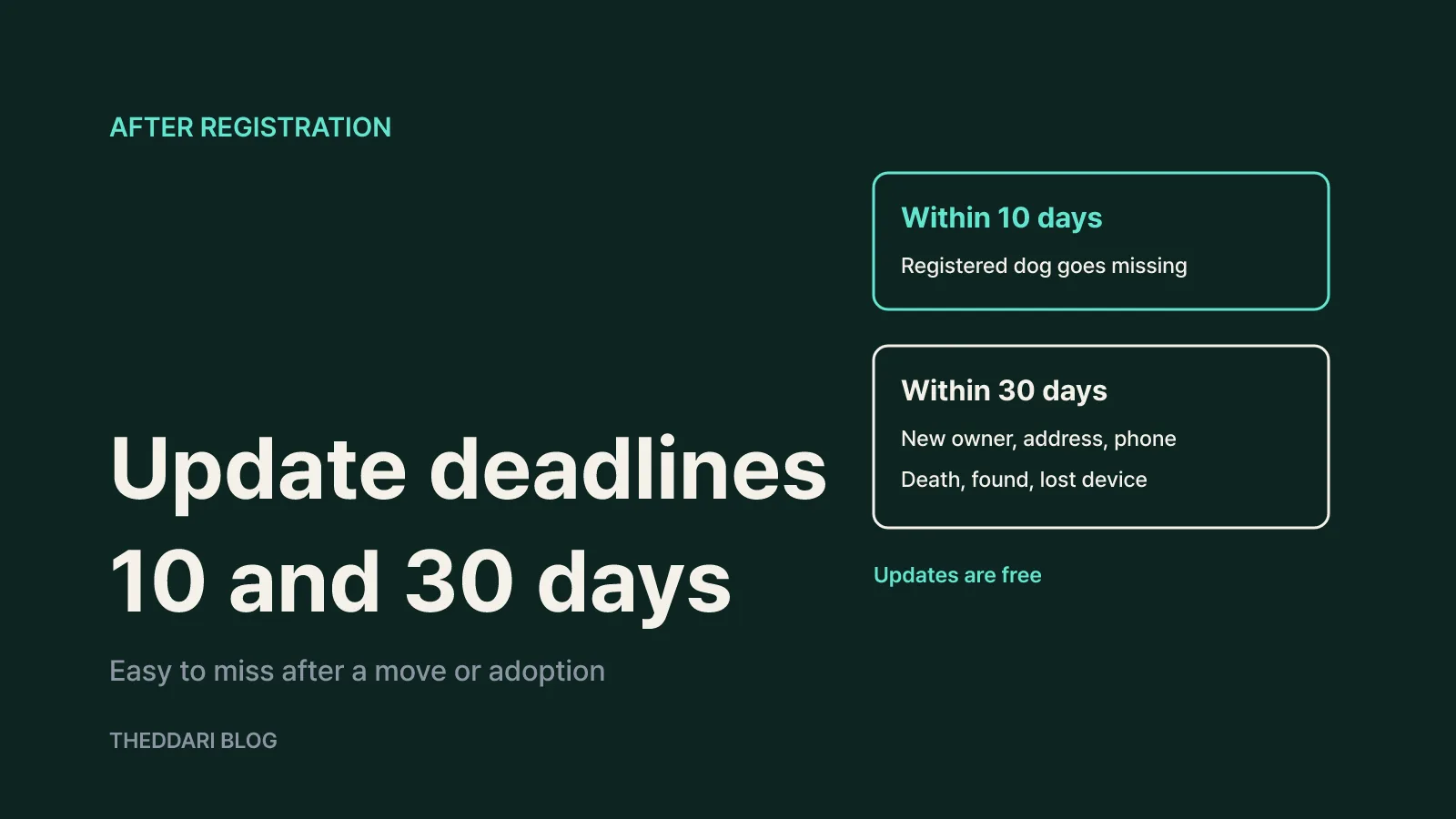
Updates are where registered owners slip up most often. Seoul's guidance sets two deadlines (Seoul):
- Within 10 days: your registered dog goes missing.
- Within 30 days: ownership changes; the owner's name, address, phone number or resident registration number changes; key details about the dog change; a lost dog is found; an external device is lost or damaged; or the dog will no longer live in Korea.
NIAS also lists the dog's death and a lost or unusable chip as reasons to file a change.
There are three ways to file:
- animal.go.kr: sign up in the owner's name, then update the record. For an address change, enter your 13-digit resident number under member information, confirm the dog is linked, then use the online address change on the home page. Phone changes, lost, found and death reports are also possible; a lost report needs an explanation, and a death report needs the date, place and cause. Ownership transfers are not possible here.
- Gov24 (gov.kr): Seoul says it offers an ownership transfer function, and the record updates only after both the previous and new owner file.
- In person: at a registration agent or the district office.
Updates are free.
Fines and the rules inspectors also check
Under the Animal Protection Act, failing to register can lead to a fine of up to KRW 1 million, and failing to report a change up to KRW 500,000 (MAFRA). Seoul publishes this tiered schedule:
← Swipe to see more
| Violation | 1st | 2nd | 3rd |
|---|---|---|---|
| Not registered | KRW 200,000 | KRW 400,000 | KRW 600,000 |
| Change not reported | KRW 100,000 | KRW 200,000 | KRW 400,000 |
November inspections also cover outdoor rules. NIAS summarises them: a leash or other safety measure, an ID tag showing the dog's name and the owner's contact details, and prompt clean-up of waste. Letting a dog leave home without its owner can bring a fine of up to KRW 500,000 (NIAS).
A microchip does not replace the ID tag. The chip can only be read with a scanner, so keep a tag with your name and number on the collar for walks.
Checklist before October 31
- Check status: use "registration check" on animal.go.kr.
- If unregistered, book a clinic: choose implant or external and ask for the total price.
- If registered, review the record: make sure the address, phone and owner match reality.
- File changes online: address and phone on animal.go.kr, ownership on Gov24 or in person.
- Pack for walks: leash, ID tag and waste bags.
Registration helps you avoid a fine, but as MAFRA puts it, it is also the fastest way to get a lost dog home. The amnesty is a low-cost chance to fix an overdue record, so check yours before October 31.