
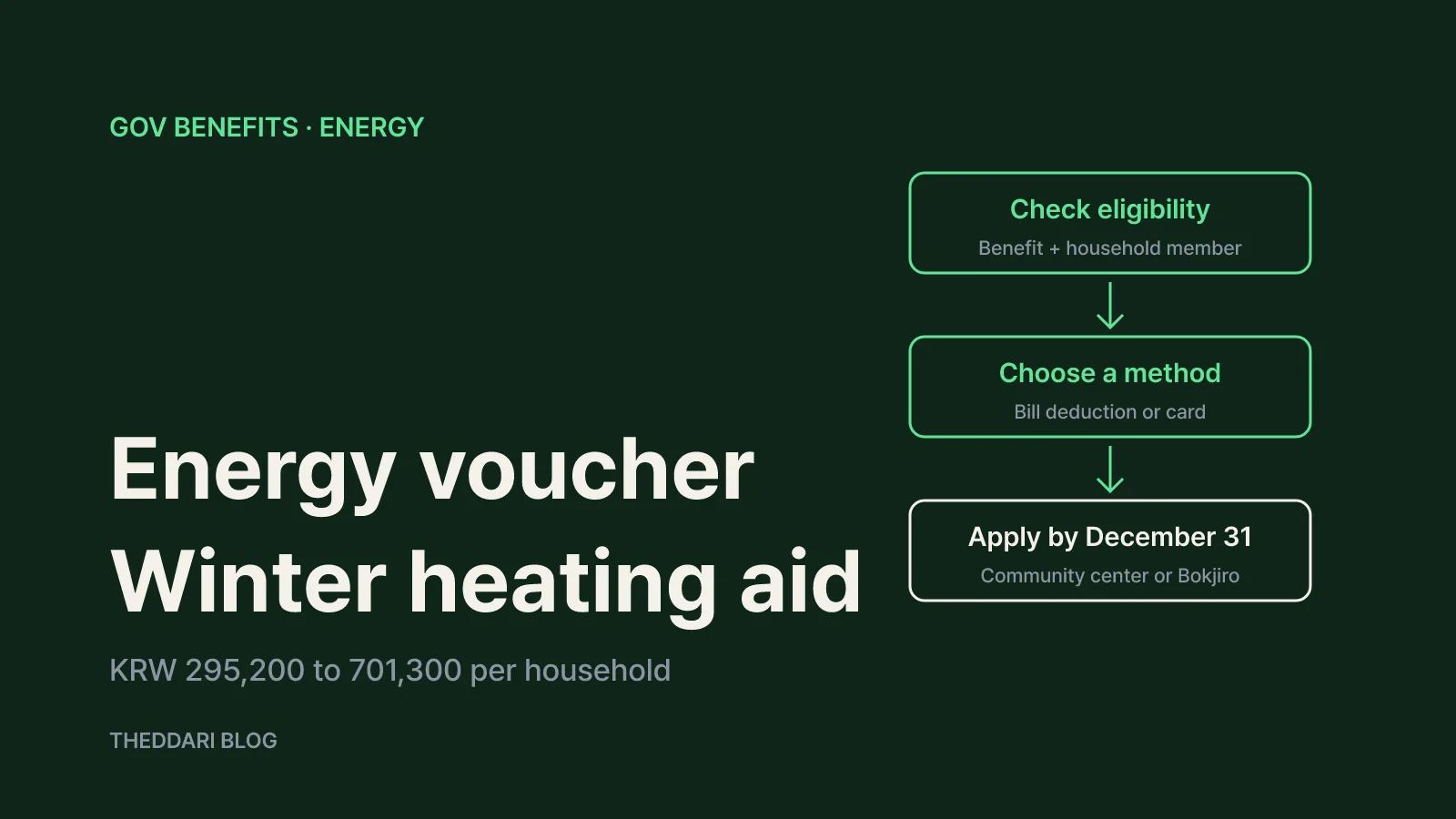
As of October 2026, the winter period of South Korea's energy voucher (에너지바우처) is already under way. Bill deductions started on October 1, purchases with the physical National Happiness Card started on October 3, and both run until May 31, 2027. Households that have not yet applied can still do so until December 31, 2026 at their local community service center or through the Bokjiro welfare portal. The 2026 amounts are KRW 295,200 for a one-person household, KRW 407,500 for two people, KRW 532,700 for three and KRW 701,300 for four or more (Energy Voucher portal).
This guide is for residents of Korea, including foreign residents and family members helping an older relative, who want to understand the program in plain English. It is based on the official pages of the Energy Voucher portal operated by the Korea Energy Agency and the agency's press release of September 30, 2026. Final eligibility is decided by the city, county or district office using resident registration and benefit records, so treat the checks below as a way to see whether an application is worth making.
Who qualifies: you need to meet both tests
The voucher goes to households that satisfy both an income test and a household-member test (eligibility rules). Meeting only one is not enough.
The income test is narrow. The applicant must be a recipient under the National Basic Livelihood Security Act, receiving at least one of the four benefits: livelihood, medical, housing or education. Being on a low income without one of these benefits does not satisfy the test for the standard voucher.
The household-member test is met if the recipient or anyone listed on the same resident registration record falls into one of these groups:
- Older adults: born on or before December 31, 1961
- Young children: born on or after January 1, 2019, aged seven or under and not yet in school
- People with disabilities registered under the Act on Welfare of Persons with Disabilities
- Pregnant women, or women within six months of giving birth
- People with severe, rare or severe intractable diseases designated by the Minister of Health and Welfare
- Single-parent families eligible under the Single-Parent Family Support Act
- Child-headed households, including children in foster care
- Multi-child households with a parent and at least two of that parent's children under 19
There are exclusions. A household is not eligible if every member receives benefits while living in a care facility under Article 32 of the Act. During winter the voucher also cannot be combined with certain other heating support: emergency welfare winter fuel payments for October 2026 to March 2027, the 2026 briquette (yeontan) coupon from the Korea Mine Rehabilitation and Mineral Resources Corporation, or the 2026 briquette-conversion energy voucher.
How much you get and when you can use it
The amount depends on the number of people on the household's resident registration record. It is an annual total, not a monthly payment.
← Swipe to see more
| Household size | 2026 total | If you take other winter support |
|---|---|---|
| 1 person | KRW 295,200 | KRW 40,700 |
| 2 people | KRW 407,500 | KRW 58,800 |
| 3 people | KRW 532,700 | KRW 75,800 |
| 4 or more | KRW 701,300 | KRW 102,000 |
The right-hand column applies to households that chose briquette coupons, the briquette-conversion voucher or emergency fuel support instead; that smaller amount can only be used in summer. The portal also states that the voucher is not counted as income when a recipient's benefits are assessed.
The usage period runs from July 1, 2026 to May 31, 2027. Summer use (July 1 to September 30) was limited to electricity bill deductions. Because the total is not split by season, whatever was left after summer carries over to winter heating (Korea Energy Agency press release). Bill deductions only apply to bills issued within the usage period, so a balance will not be deducted from a bill issued after May 31, 2027. You can check the remaining balance on the portal's balance inquiry page or by calling the helpline at 1600-3190.
Bill deduction or National Happiness Card: which to choose
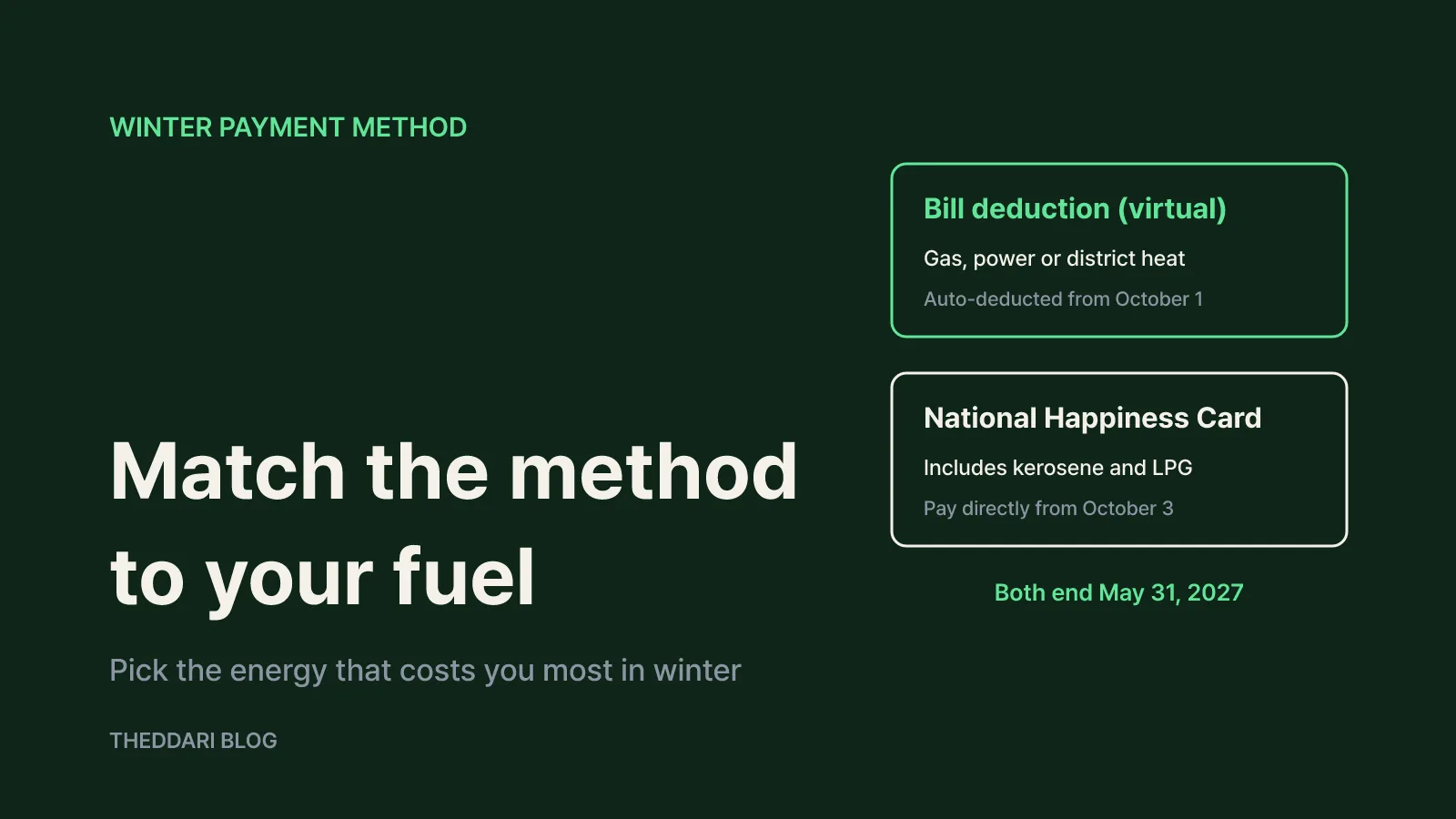
For winter you pick one of two methods. The official guidance is to choose the energy source that costs your household the most in winter (application notes).
Bill deduction (virtual card) suits homes heated mainly by city gas, electricity or district heating. You choose one of those three. Bring a recent bill for that energy source when you apply, and the voucher is deducted automatically from the following month's bill. There is no card to carry, but the deduction only works once the energy supplier has registered it and a bill has been issued (usage guide).
National Happiness Card (physical card) can be used for electricity, city gas, kerosene, LPG and briquettes. If your home uses a kerosene boiler, LPG or briquettes, this is the method you need, because those fuels are not covered by bill deduction. After your voucher application is approved, you get the card from a bank or card company and pay directly:
- Kerosene, LPG and briquettes: buy from a participating retailer near you; delivery charges can be included in the payment.
- Electricity: call KEPCO on 123 and pay by card.
- City gas: pay at the supplier's office, by phone, online or by automatic payment. Accepted methods and card brands vary by company, so check before you pay.
The card is issued by BC Card, Lotte Card, Samsung Card, KB Kookmin Card, Shinhan Card and Hyundai Card. Each company has its own branches and linked bank accounts for debit versions; for a BC debit card, for instance, you need an account at the issuing bank. The card cannot be used at bank counters or utility payment kiosks, and it must not be lent to anyone else.
You can switch between the physical and virtual card at your community service center until May 31, 2027. Switching from the voucher to a different winter program closed on June 26, 2026.
How to apply and what to bring
Applications are open from June 15 to December 31, 2026 through three routes (application guide):
- In person at the community service center (eup, myeon or dong office) for your registered address, either yourself or through a representative.
- Online via Bokjiro (www.bokjiro.go.kr); a caseworker then processes it in the government welfare system.
- Ex officio: a public official can apply on your behalf after getting your verbal or written consent by phone or in person.
If you received the voucher last year, nothing about your address or household has changed and you still qualify, you are enrolled automatically. If you moved or the number of household members changed, you must apply again. Changes during the support period also require notifying the center and reapplying.
Bring the energy voucher application form, which is completed at the center. For bill deduction, add your most recent paid electricity, city gas or district heating bill; apartment residents bring their management fee bill. A representative needs a letter of authorization from the recipient and their own ID. Eligible representatives are household members on the same registration record or relatives (blood relatives within the eighth degree and in-laws within the fourth). People who find it hard to visit can get help from care workers, disability support assistants or volunteers.
Note the short processing breaks. Applications were paused on October 1 and 2, and will pause again for two to three days in late December while points are generated (application and usage periods). Applying by mid-December avoids that risk.
Easy-to-miss checks this October
Spend any 2025 kerosene and LPG prepaid card balance by October 25. Households that received an extra KRW 197,000 under the 2025 kerosene and LPG expansion program must use the remaining balance by October 25, 2026, after which it expires (press release). That prepaid card is separate from your 2026 voucher, so check both balances.
Report a larger household. An increase in household size can be reported until May 31, 2027, which may move you into a higher amount band. Reporting a decrease was only possible until June 26.
Confirm your energy source and customer number. If you changed boilers or moved, the energy source on file may no longer match how you heat your home. Contact details, address, housing type, energy source, customer number and supplier can be updated until May 31, 2027. If a deduction does not appear on your bill, check the customer number first.
Ask about home visits. The Korea Energy Agency says it is expanding its outreach service, in which postal carriers and social workers visit households that have not used their vouchers, from 59,000 to 122,000 households (budget basis). If a relative struggles to use the card, the community service center can help arrange support.
In short: confirm one qualifying benefit and one qualifying household member, choose the method that matches your main winter fuel, and finish your application before the late-December pause. For questions, call the Energy Voucher helpline at 1600-3190.