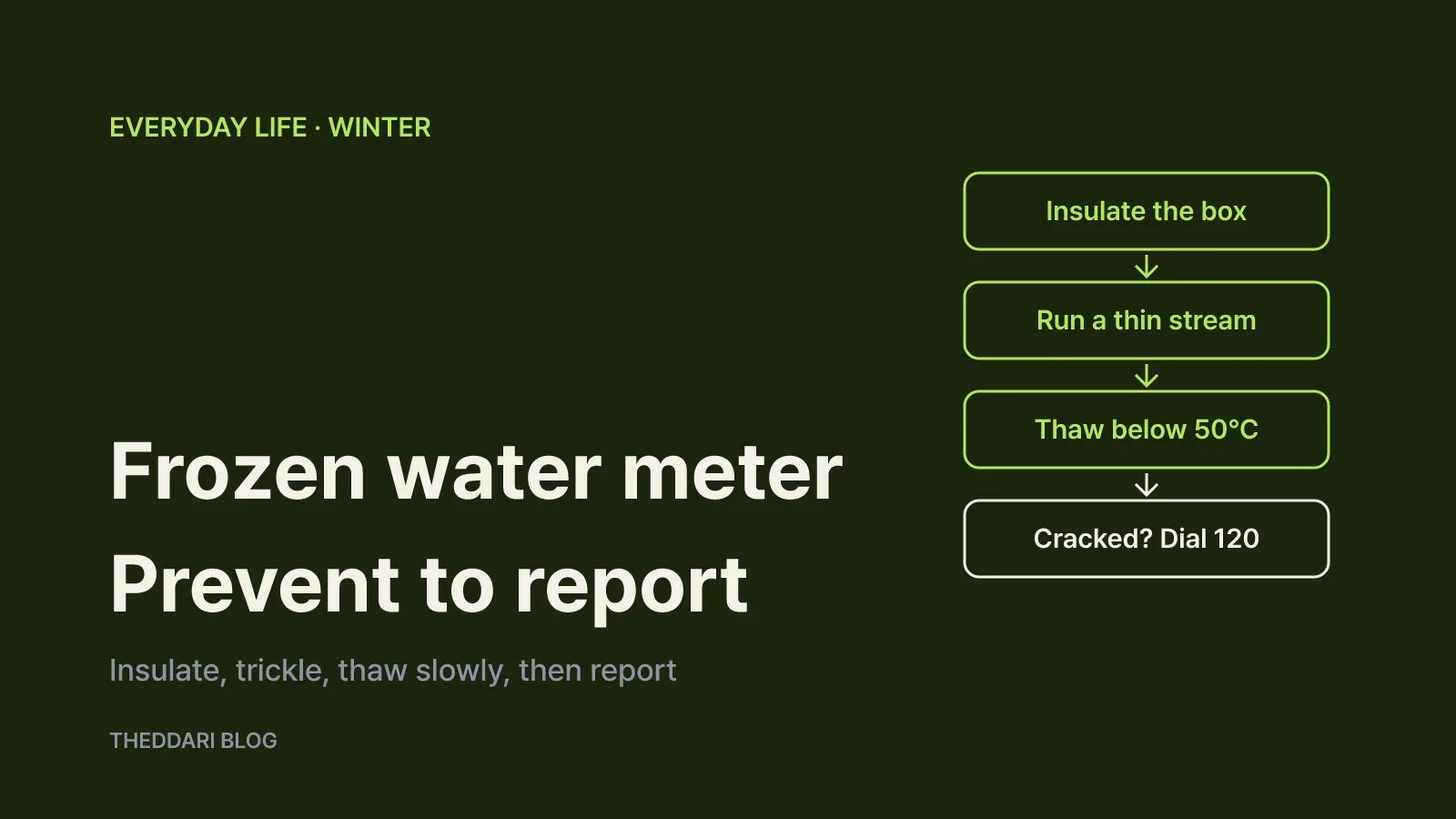
As of October 2026, the short answer for anyone living in a Korean apartment or villa is this: insulate the water meter box before the first cold snap, let a thin stream of water run when lows stay deep below freezing, thaw a frozen meter slowly with water under 50°C, and report a cracked meter instead of fixing it yourself. In Seoul you can report by dialing 120 or calling your district waterworks office. Replacement costs are set by each city's water ordinance, so I'll separate what Seoul, Incheon and Bucheon actually publish.
This guide is built from the official pages I read directly: Seoul Arisu Headquarters' December 2025 freeze-prevention notice, Seoul City's January 2026 update, Incheon Waterworks' burst-meter reporting page and Bucheon City's winter guide. If you live elsewhere in Korea, the waterworks office printed on your water bill has the final say.
Seoul's four-level freeze forecast
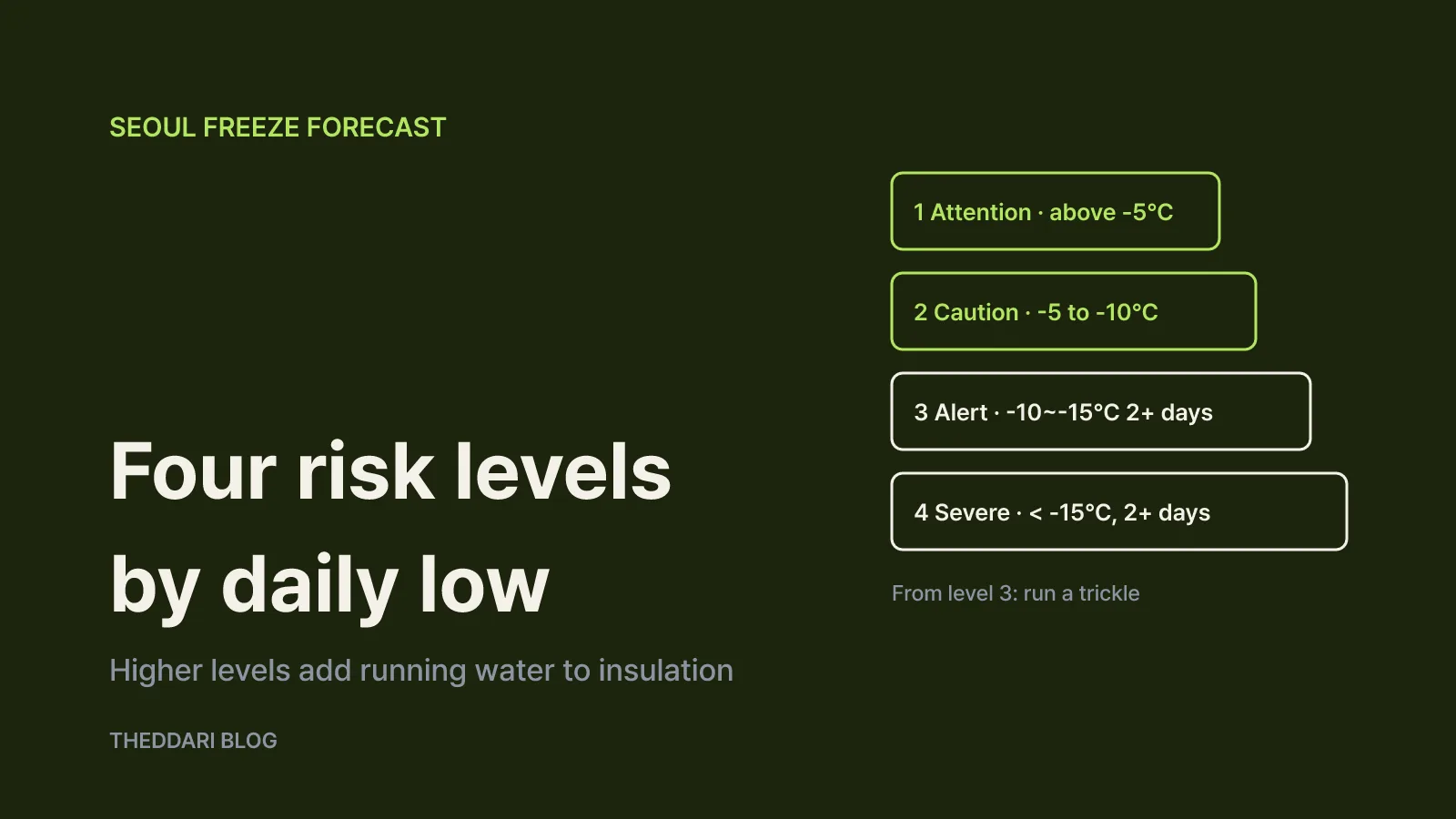
Seoul's water authority rates freeze risk by the day's minimum temperature. The levels below come from its notice posted on December 3, 2025.
← Swipe to see more
| Level | Daily low | What residents should do |
|---|---|---|
| 1 – Attention | Above -5°C | Stuff the meter box with old clothes or batting, seal the lid with plastic, wrap exposed pipes and bathroom plumbing |
| 2 – Caution | -5°C to -10°C | Recheck insulation on the meter, exposed pipes and bathroom |
| 3 – Alert | -10°C to -15°C for 2+ days | If you'll be away for a long time, leave a tap trickling even if insulated |
| 4 – Severe | Below -15°C for 2+ days | Leave a tap trickling even for short absences, such as going out briefly or overnight |
The pattern is simple: insulation is enough at levels 1 and 2, but from level 3 onward the goal is to stop water from sitting still in the pipes. In its January 2026 update, Seoul said it runs a situation room on the same four levels and switches to 24-hour emergency operation once lows drop below -10°C. Last winter's program ran until March 15. I haven't yet seen an official schedule for the coming winter, so check the Arisu news board from November. Seoul also singled out corridor-style apartments without windbreak windows and construction sites as high-risk, because their meter boxes face outside air directly.
Insulate the meter box in four steps
Do this while it's still above freezing. Seoul's prevention guide lists four steps:
- Seal the gaps. Close holes where pipes pass through the meter box so cold air can't get in.
- Fill the box. Pack it with bubble wrap or old clothes.
- Cover the lid. Lay insulation over the lid and seal a wide area with a plastic cover.
- Plan the trickle. Decide which tap you'll open slightly when a cold snap arrives.
Bucheon adds a few checks: make sure there's no leak or standing water inside the box, replace broken polystyrene inserts, and put batting, rags or old blankets inside plastic bags so they don't get wet. Wrap any exposed outdoor pipe as well. In apartment buildings the meter box is often in a hallway or stairwell, so keeping shared windows and entrance doors closed helps. If you rent, agree with your landlord or building management on who handles insulation before winter.
How much water to run, and how to thaw safely
When a cold spell lasts two days or more, keep water moving. Seoul's January 2026 notice describes about one paper cup every two minutes. Earlier detailed guidance from the same authority gives temperature-based targets: enough to fill a disposable paper cup within 45 seconds at 0 to -10°C, and within 33 seconds at -10 to -15°C. Either way, think of a thin, unbroken thread of water, slightly stronger as it gets colder. Catch it in a bucket and reuse it for laundry or cleaning.
If nothing comes out, the meter or pipe may be frozen. Bucheon's checklist:
- Open an indoor tap first.
- Try turning the valve handle next to the meter. If it won't move, suspect a frozen pipe.
- Thaw with a hair dryer, or start with lukewarm water and gradually move to warmer water.
- Don't let hot water hit the meter directly.
Both Seoul and Bucheon warn that water at 50°C or hotter can break the meter; Seoul also suggests wrapping it in a warm, damp towel. Skip boiling water, torches and heaters. Once it's thawed, put the insulation back so it doesn't happen again.
How to report a burst meter
If the glass face of the meter is cracked or bulging, treat it as a burst meter and report it rather than removing or replacing it yourself. Seoul warns that leaving it can lead to further damage or leaks.
In Seoul you have three routes: dial 120 (Dasan Call Center), call your district waterworks office, or use the Arisu cyber customer center website under online civil service → water meter replacement request. District offices: Jungbu (Jongno, Jung, Yongsan, Seongbuk) 02-3146-2000; Seobu (Eunpyeong, Seodaemun, Mapo) 02-3146-3500; Dongbu (Seongdong, Gwangjin, Jungnang, Dongdaemun) 02-3146-2600; Bukbu (Nowon, Gangbuk, Dobong) 02-3146-3200; Gangseo (Yangcheon, Gangseo, Guro) 02-3146-3800; Nambu (Gwanak, Dongjak, Yeongdeungpo, Geumcheon) 02-3146-4400; Gangnam (Seocho, Gangnam) 02-3146-4700; Gangdong (Songpa, Gangdong) 02-3146-5000.
In Incheon, you apply by phone or in person through the call center (032-120) or your waterworks office. The stated processing time is immediate and there's no application fee. Because a burst meter can't be read accurately, the bill is settled on your average use over three normal months. Only meters managed by the waterworks office qualify, and the office notes that repairs may be delayed when many meters burst at once.
Who pays for the replacement?
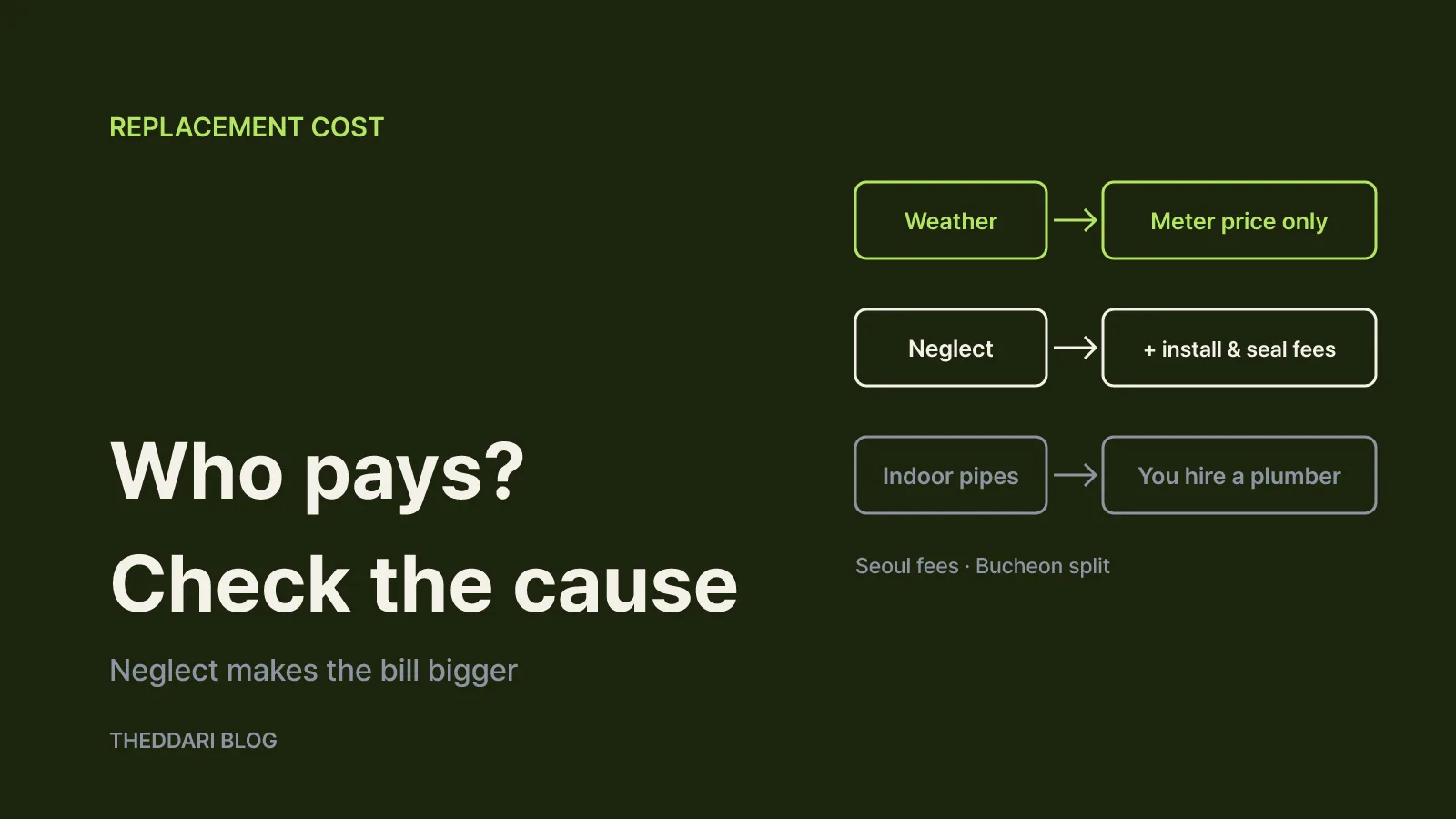
Cost depends on the cause and on which section of pipe froze.
Seoul has applied this rule since October 7, 2021: weather-related damage is charged the meter price only, while damage caused by neglect is charged the meter price plus installation and seal fees. That's a practical reason to insulate the box and keep a photo of it.
Bucheon publishes actual prices. Per its page last updated in July 2025, a 13 mm meter costs 27,110 won and a 20 mm meter 29,270 won, added to the next month's water bill. Bucheon also splits responsibility: the city's waterworks facilities division (032-625-3321) handles outdoor facilities up to and including the meter, but pipes on the household side after the meter are the resident's job, using a private plumber.
Incheon charges no application fee but imposes a fine when a meter is deliberately damaged or lost.
In short, the waterworks office replaces the meter, indoor pipes are generally yours, and neglect raises the bill. How tenants and landlords split the cost is a lease matter, not a water-ordinance matter.
Pre-winter checklist
- Save your local waterworks office number (in Seoul, 120 also works).
- Check the meter box for standing water or wet insulation.
- Seal gaps, bag the insulation, fill the box and cover the lid with plastic.
- Wrap exposed pipes and bathroom plumbing.
- If you'll travel during a level 3 or 4 cold snap, plan to leave a tap trickling.
- Keep a hair dryer and towels ready, and make sure everyone at home knows not to use water at 50°C or hotter.
- If you rent, confirm with your landlord or building management who handles the meter box.
Most burst meters start with cold air in the box and water that stops moving. Handle those two, and if the glass still cracks, report it quickly to avoid leaks and billing disputes.