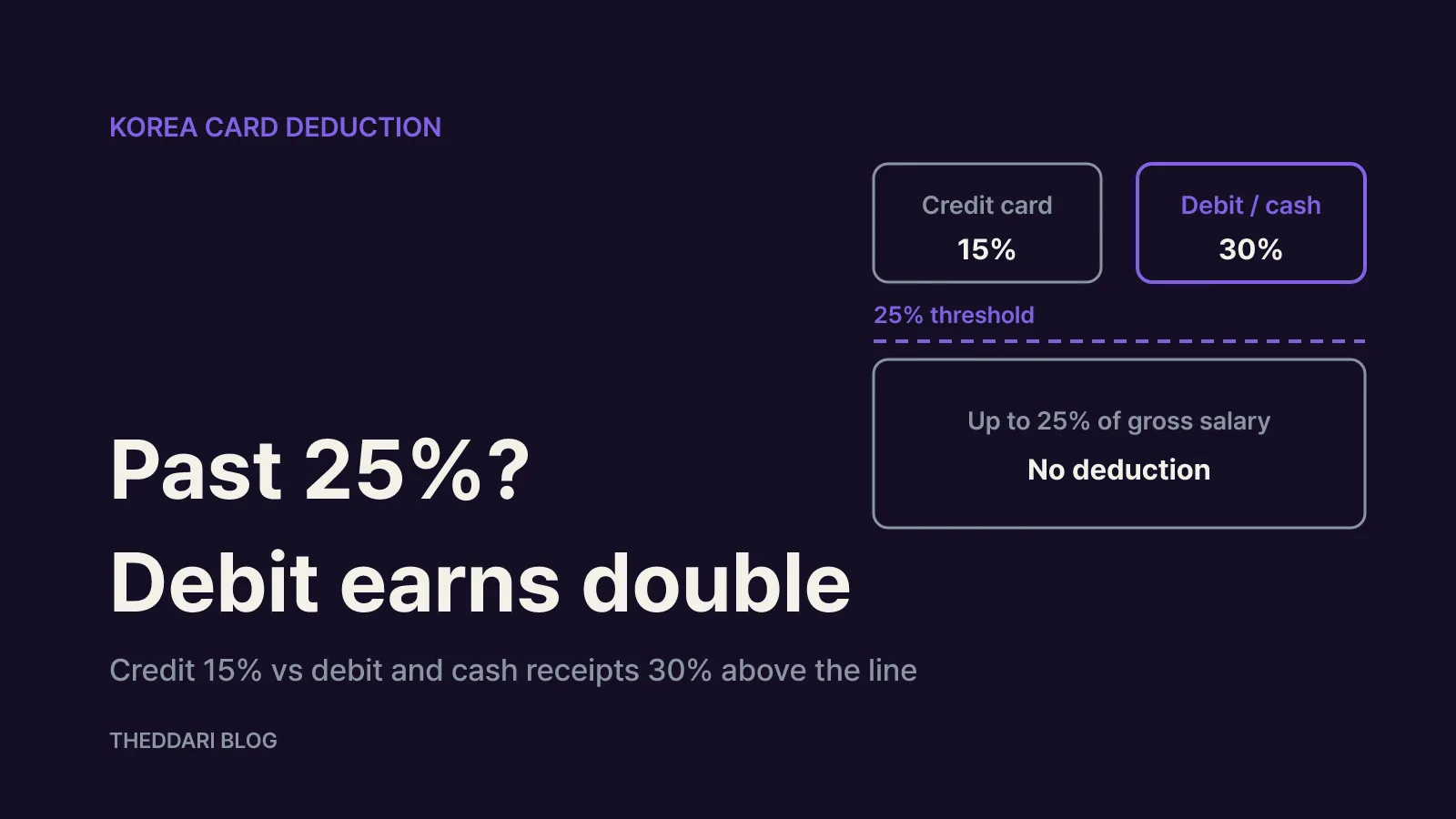
As of October 2026, the short answer for salaried workers in Korea is this: if your combined credit card, debit card and cash receipt spending for the year has already passed 25% of your gross salary, paying the rest of this year's everyday expenses by debit card or cash receipt doubles the deduction you earn. Each ₩1 million spent on a credit card adds ₩150,000 to your deduction base, while the same amount on a debit card or with a cash receipt adds ₩300,000. If you are still below the 25% line, the payment method does not matter yet. If you have already hit your annual cap, ordinary spending no longer adds anything regardless of how you pay.
This guide is based on the National Tax Service (NTS) consumer deduction page and the statutory text of Article 126-2 of the Restriction of Special Taxation Act. It applies to resident employees with wage income in Korea, including foreign residents who are taxed as residents, and covers spending in calendar year 2026, which is settled in the year-end tax settlement in early 2027. Daily workers are excluded.
How the 25% minimum spending threshold works
The card deduction is not calculated on everything you spend. It only applies to the portion above 25% of your gross salary, which the law calls the minimum spending amount. With a gross salary of ₩50 million, the threshold is ₩12.5 million. Credit card, debit card, cash receipt, traditional market and public transport spending are added together, and the deduction only starts once the total passes ₩12.5 million. Gross salary here means taxable wages after non-taxable allowances, so your withholding receipt or payslip is the most reliable reference.
The detail that confuses most people is which payment method is used to fill that threshold. The statutory formula treats the threshold as filled first by credit card spending, the method with the lowest rate. If your credit card spending exceeds the threshold, the entire threshold is subtracted at 15%. If it does not, the remainder is filled with debit card and cash receipt spending at 30%, and only then with traditional market and public transport spending at 40%. In practice, using a debit card early in the year does not waste its higher rate on simply reaching the threshold.
Here is a quick example. Someone earning ₩50 million spends ₩8 million on a credit card and ₩7 million on a debit card. Of the ₩15 million total, the ₩12.5 million threshold is filled by the full ₩8 million of credit card spending plus ₩4.5 million of debit spending. The remaining ₩2.5 million above the line is all debit card spending, so it is deducted at 30%, giving a deduction of ₩750,000. The order in which you paid during the year is irrelevant; only annual totals by method count.
Deduction rates and the 2026 limits
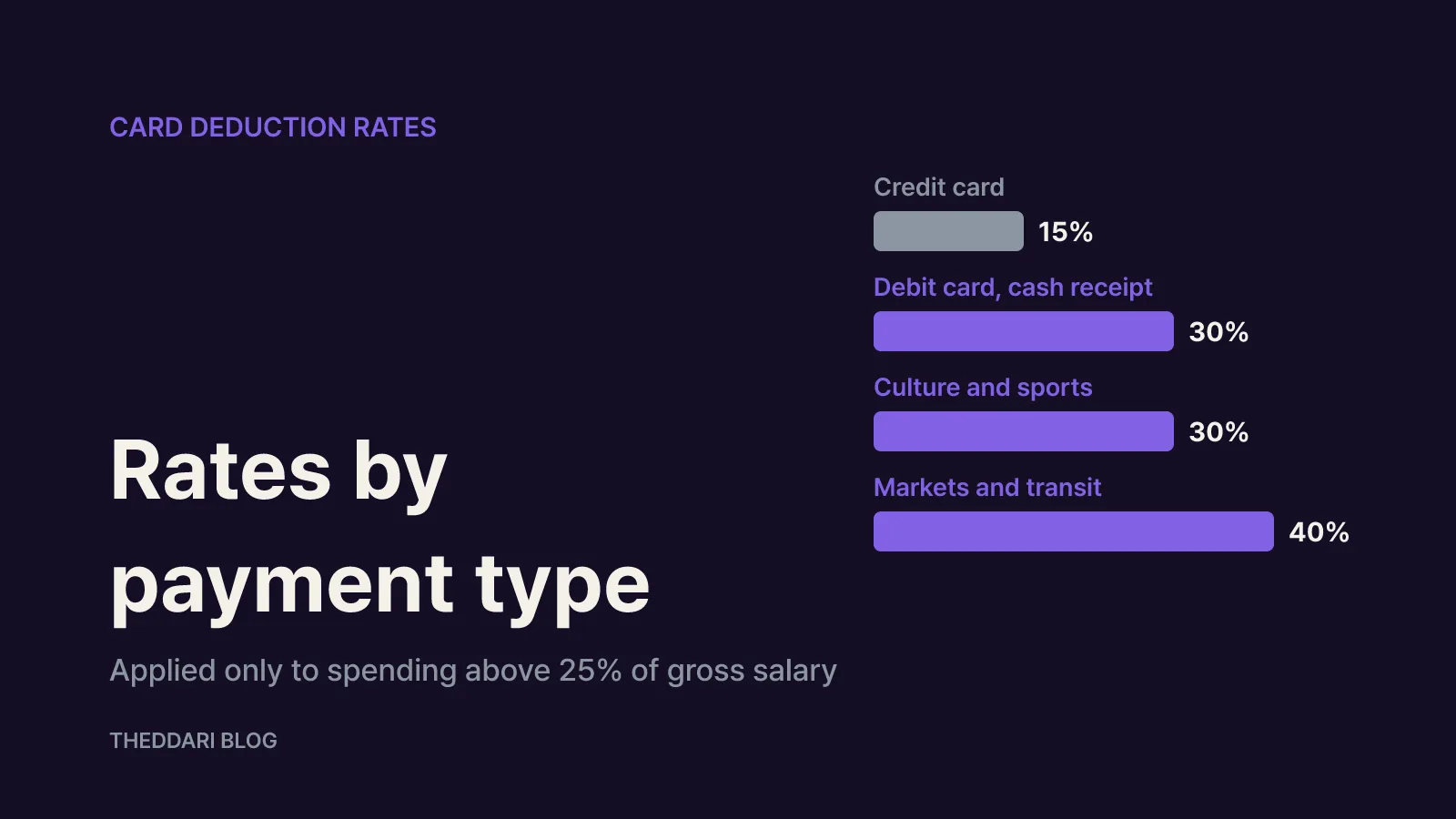
Rates depend on both the payment method and where the money was spent.
← Swipe to see more
| Category | Rate | Notes |
|---|---|---|
| Credit card | 15% | General merchants |
| Debit card, prepaid card in your name, cash receipt | 30% | General merchants |
| Books, newspapers, performances, museums, galleries, cinemas, swimming pools, gyms | 30% | Separate category only if gross salary is ₩70 million or less |
| Traditional markets | 40% | Any eligible payment method |
| Public transport | 40% | Any eligible payment method |
Swimming pool and gym facility fees were added for spending from July 1, 2025. Lesson fees and membership costs that are not directly tied to using the facility are excluded, and when facility fees cannot be separated from other charges, only 50% of the total counts. Workers earning over ₩70 million do not get the separate 30% culture and sports category; those purchases are deducted at the rate of whichever payment method was used.
From 2026 spending onward, the basic limit rises with the number of children. The government announcement on Korea.kr confirmed the change took effect on January 1, 2026, and the amended statute extends the deduction to spending through December 31, 2028.
← Swipe to see more
| Basic limit | Gross salary ₩70M or less | Gross salary over ₩70M |
|---|---|---|
| No children | ₩3.0 million | ₩2.5 million |
| One child | ₩3.5 million | ₩2.75 million |
| Two or more children | ₩4.0 million | ₩3.0 million |
If your calculated deduction exceeds the basic limit, an additional deduction may apply. You receive the smaller of the excess amount and the combined deduction from traditional market and public transport spending (plus culture and sports spending if your gross salary is ₩70 million or less). That additional amount is capped at ₩3 million for gross salaries of ₩70 million or less and ₩2 million above that. The extra deduction for year-on-year spending growth applied only to 2024 spending and does not apply to 2026.
Deciding whether to switch payment methods for November and December
Step 1: Total your spending so far by method. Use your card issuers' annual statements and your cash receipt history to separate credit card, debit card, cash receipt, traditional market and public transport spending. Remove overseas purchases and other excluded items.
Step 2: Compare against 25% of your gross salary. Estimate this year's gross salary, take 25%, and add your expected spending for the rest of the year. If you will not pass the threshold, switching payment methods produces no deduction, and the card's own discounts or points are the more relevant factor.
Step 3: Check how much room remains under your limit. If you are above the threshold, estimate your deduction so far and compare it with your limit. While there is room, every ₩1 million shifted from credit to debit adds an extra ₩150,000 to your deduction. Once the limit is full, the method used for ordinary spending no longer matters, and only traditional market, public transport and culture spending can add more within the additional cap.
A full-year example: a worker with a ₩50 million gross salary and no children spends ₩15 million on credit cards, ₩6 million on a debit card and ₩1 million on public transport.
- Credit card: ₩15M × 15% = ₩2.25M
- Debit card: ₩6M × 30% = ₩1.8M
- Public transport: ₩1M × 40% = ₩0.4M
- Less threshold: ₩12.5M × 15% = ₩1.875M (credit spending exceeds the threshold)
- Deduction: ₩2.575 million, within the ₩3 million limit
Had the same ₩6 million been charged to a credit card instead, the deduction would be ₩21M × 15% + ₩0.4M − ₩1.875M = ₩1.675 million, a gap of ₩900,000. A deduction reduces taxable income rather than tax directly, so the actual saving depends on your bracket. Under the NTS income tax rate table, taxable income between ₩14 million and ₩50 million is taxed at 15%, so a ₩900,000 deduction gap in that bracket means roughly ₩135,000 less national income tax, with local income tax calculated separately. Weigh that against any credit card rewards or monthly spending requirements you might lose by switching.
Spending that does not count, and family members' cards
The statute excludes several types of spending from the card total:
- Overseas spending, which is left out of the annual total entirely, including for the 25% threshold.
- Business or corporate expenses, even when paid with a personal card.
- Car purchases, although a portion of the price of qualifying used cars is included.
- Fake or abnormal transactions that disguise a sale or service that never took place.
- Other items set by presidential decree, which appear as excluded in the NTS simplified year-end data.
Spending by a spouse and by lineal ascendants and descendants (including a spouse's parents) who meet the decree's conditions can be included in the worker's deduction. Siblings are not covered by the statute. Dual-income couples should check which partner can claim each family member when the simplified data opens next year.
Year-end checklist
- Estimate this year's gross salary and calculate 25% of it.
- Split your spending since January by credit card, debit card, cash receipt, traditional market and public transport.
- Check whether credit card spending alone already exceeds 25%; if so, remaining everyday spending earns more on debit or cash receipts.
- Confirm your 2026 basic limit based on salary band and number of children.
- If the limit is full, check remaining room for traditional market, transport and culture spending.
- Remove overseas purchases, car purchases and business expenses from your totals.
- Compare the extra deduction with the rewards you would give up by moving away from a credit card.
The switch only makes sense for money you were going to spend anyway. Spending more to chase the deduction costs far more than the tax it saves.