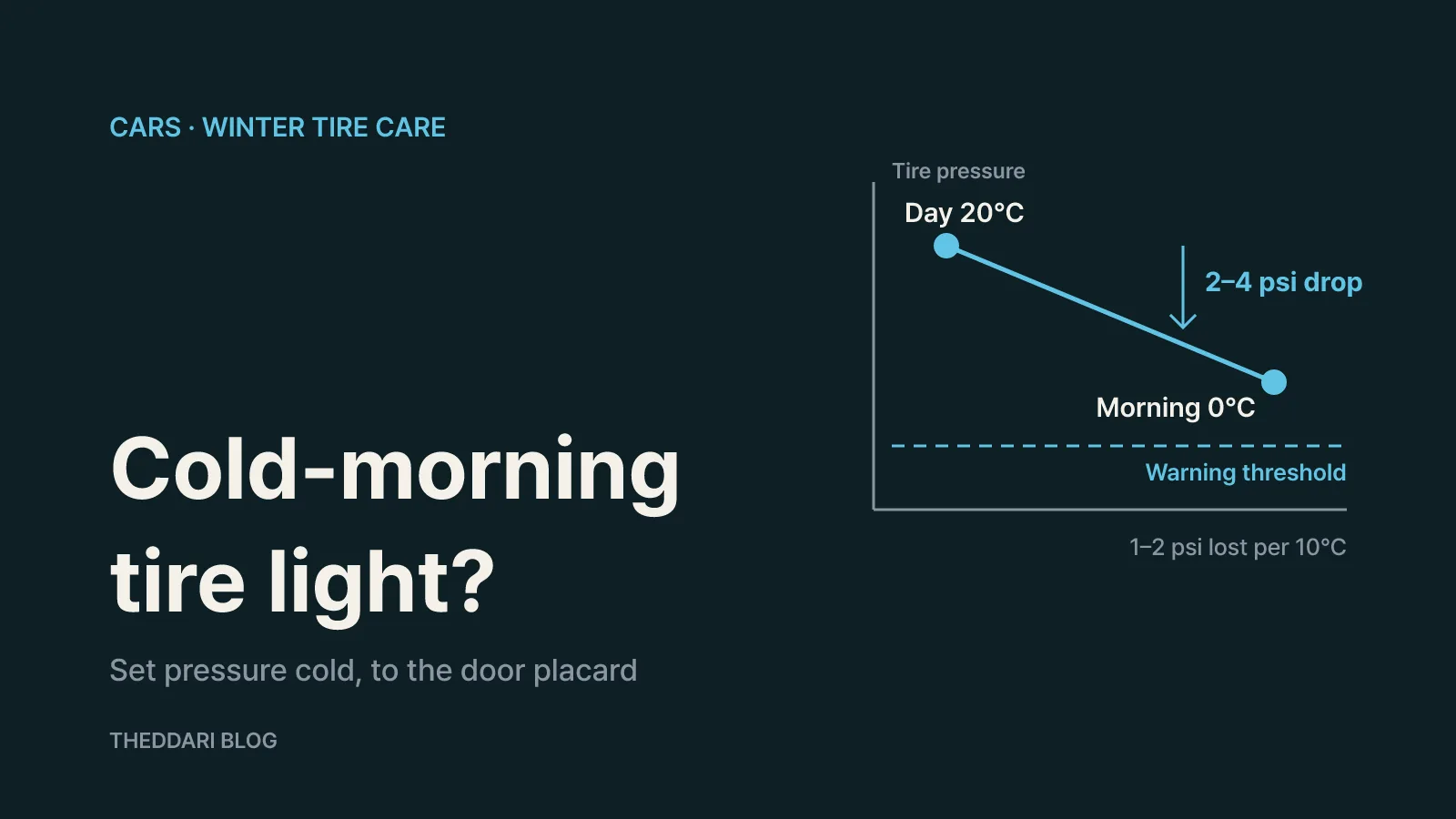
As of October 2026, manufacturer manuals and tire-maker guidance agree on the most common reason a tire pressure light comes on during a cold morning: the air inside the tire contracts as the temperature falls, and the pressure slips below the warning threshold. Continental's winter tire pressure guide puts the loss at 1–2 psi (0.07–0.14 bar) for every 10°C drop, which is an 18°F swing. Hyundai and Kia owner's manuals both state that a low-pressure warning can appear in cold weather even after the tires were set correctly, and that this does not mean the system is faulty.
That does not mean you can ignore it. The light is reporting a real shortfall. The fix is to inspect the tires and then inflate them, while cold, to the pressure printed on your vehicle's tire placard. Below is how to read the two kinds of warning, what to do the moment the light appears, how to take an accurate cold reading, and what to check if the light keeps returning.
How much pressure do tires lose when it gets cold?
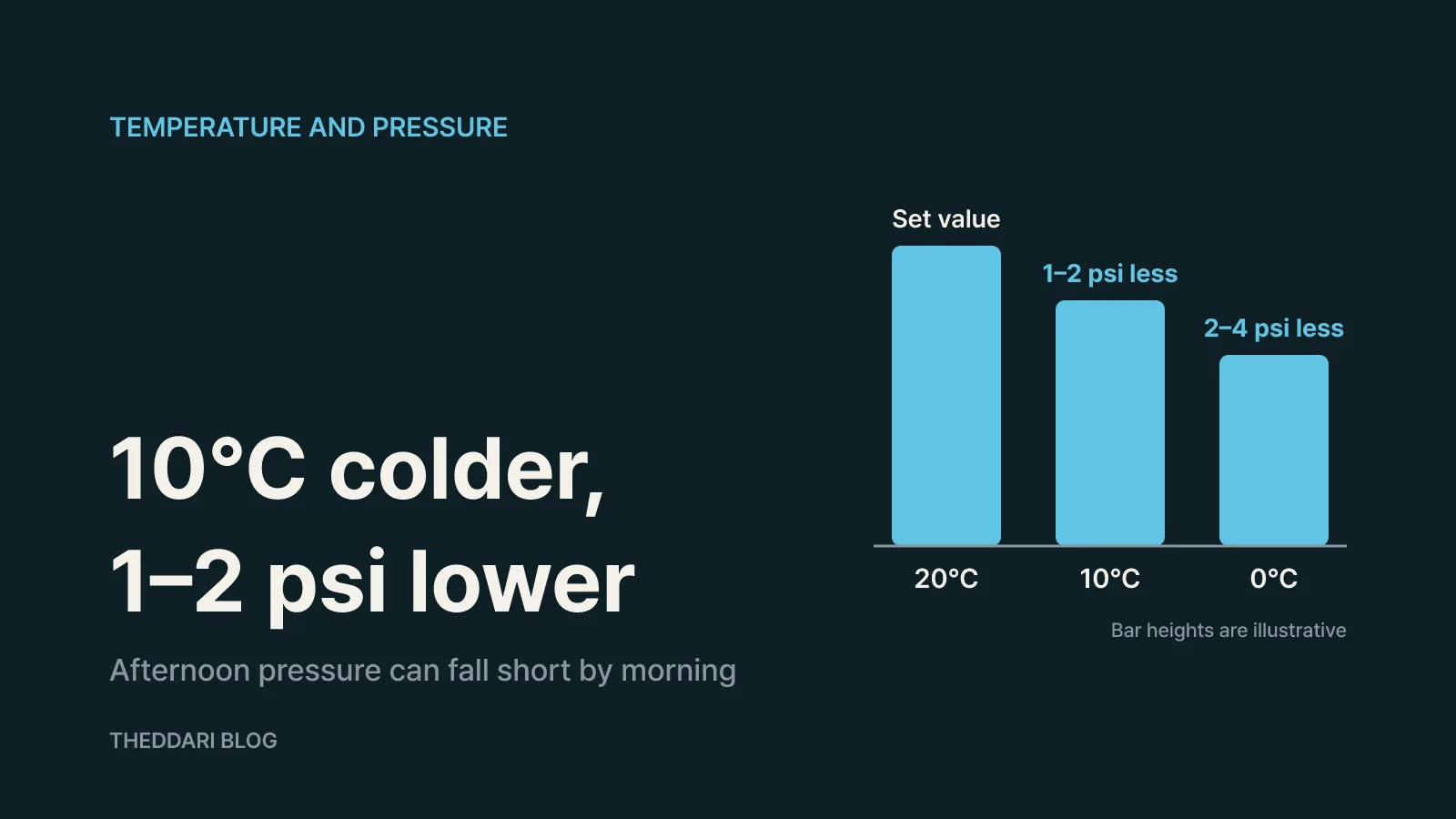
Air pressure inside a sealed tire tracks temperature. Using Continental's figure of 1–2 psi per 10°C, a tire set on a 20°C (68°F) autumn afternoon can read 2–4 psi lower on a 0°C (32°F) morning. Late October and November bring wide day-night temperature swings, so a tire that looked fine at lunchtime can dip below the line overnight.
Add the slow, natural seepage every tire has, and the odds of a warning go up further. Continental also notes that pressure falls further as you climb to higher altitude, so a winter drive into the mountains is a good reason to check before you leave.
Many drivers notice that the light switches off after a few miles. Driving warms the tires, the pressure rises, and the reading clears the threshold again. The underlying problem remains: the next cold morning will bring the light back, and in between you are driving on tires below the recommended pressure. Hyundai's manual warns that continued driving on under-inflated tires can cause overheating and damage, shorten tire life, reduce handling, braking performance and fuel economy, and make the vehicle less stable.
Solid light or flashing light: what each one means
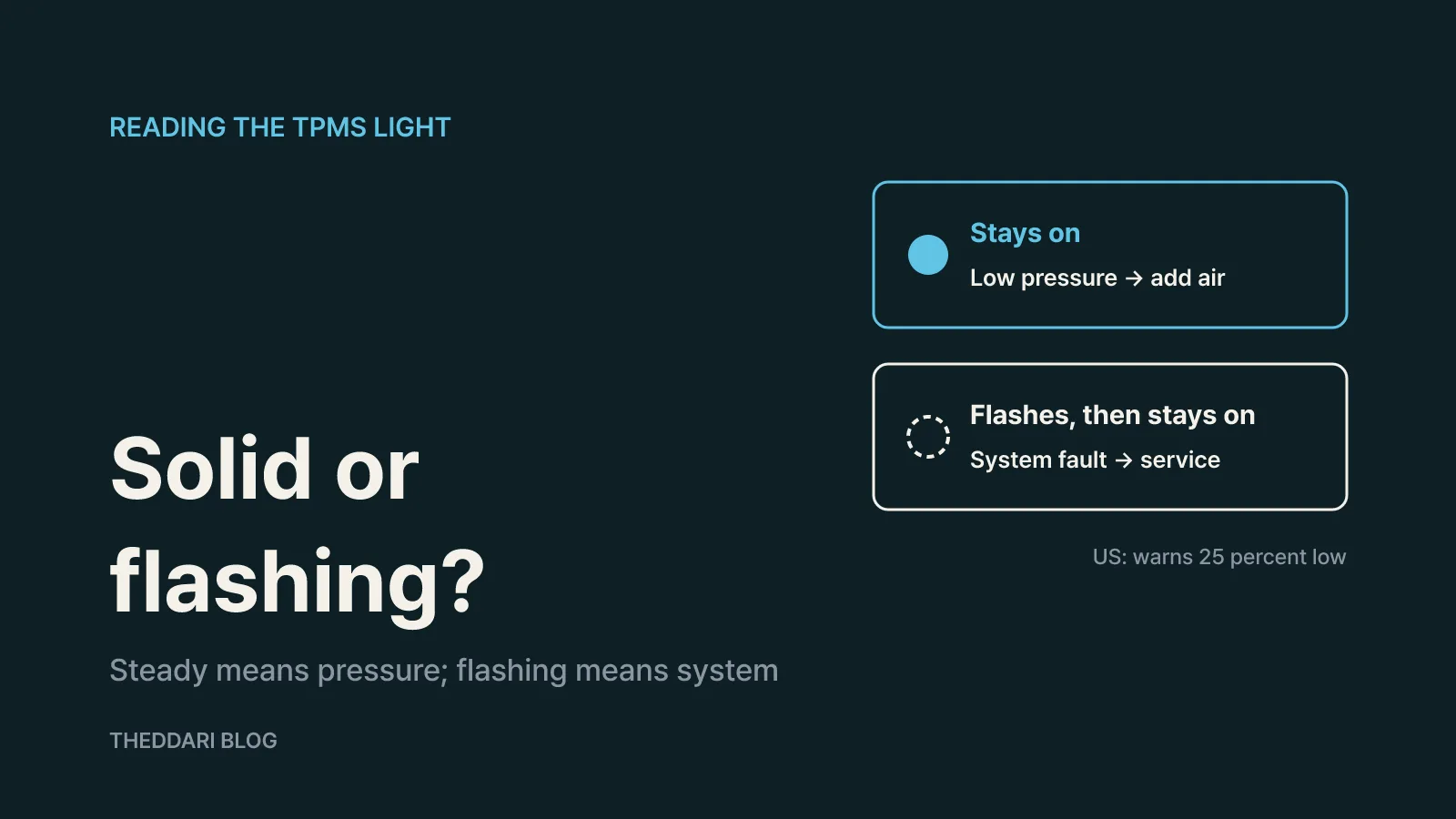
The dashboard can show two different conditions, and they call for different responses. Based on the Hyundai owner's manual TPMS section:
- Low-pressure light stays on steadily. The system has detected a tire that is significantly under-inflated. Many vehicles also show which wheel and its current pressure. This is a cue to add air.
- TPMS light flashes, then stays on. This points to a fault in the monitoring system itself, not the tire pressure. The vehicle needs a service check. If a system fault occurs while a low tire is already displayed, the light flashes and the individual tire indication disappears.
In the United States, Federal Motor Vehicle Safety Standard No. 138 (49 CFR 571.138) requires the low-pressure telltale to illuminate within 20 minutes once a tire falls 25 percent below the manufacturer's recommended cold inflation pressure (or a minimum table value, whichever is higher). On a car with a 36 psi placard, that works out to roughly 27 psi. In other words, by the time the light comes on, the tire is already well short of where it should be. The same standard specifies that a combined low-pressure and malfunction light must flash for 60 to 90 seconds and then stay lit when the system detects a fault, which matches the flashing-means-fault guidance in the Korean manuals. Each manufacturer sets its own trigger point within the rules that apply where the car is sold, so your owner's manual is the final word.
One more detail: the pressure shown on the instrument cluster can differ from a handheld gauge. Hyundai and Kia both note this, and both say readings only appear one to two minutes after you start driving. When you add air, trust a gauge reading taken on cold tires.
What to do right after the light comes on
If the low-pressure light is on steadily:
- Slow down and avoid sharp steering. This is the first instruction in both the Hyundai and Kia manuals.
- Pull over somewhere safe and look at all four tires. Check for one that is visibly sagging, a nail or debris in the tread, or sidewall damage.
- If nothing looks wrong, drive gently to the nearest air pump or shop and measure. Compare each reading with the placard and add the missing pressure.
- If the light stays on after inflating, get it inspected. Kia's manual says a light that remains lit after adjustment warrants a service visit.
Keep in mind that, according to Hyundai, TPMS cannot instantly detect sudden damage from a nail or road debris. If the car feels unstable while driving, ease off the accelerator and move slowly to a safe spot regardless of what the dashboard shows.
If your car carries a tire mobility kit (sealant plus compressor) instead of a spare, Hyundai's manual limits it to small punctures in the tread. Do not use it on sidewall damage or holes 4 mm or larger. After a sealant repair, the manual says to stay at or below 80 km/h (about 50 mph) and reach a service center within 200 km (about 124 miles). It also advises against running the compressor for more than 10 minutes at a time and against using the kit below −30°C. Those figures come from that model's manual, so check the instructions printed on your own kit.
How to set cold tire pressure correctly
The goal is simple: set the pressure when the tires are cold, using the number on the vehicle, not the tire.
The recommended pressure is on the tire information label on the driver's door pillar (the B-pillar) and in the tire and wheel specifications of the owner's manual. Continental notes that some vehicles place it inside the fuel filler door or on the door frame. Some cars specify different front and rear pressures, so read the whole label. The number molded into the tire sidewall is a maximum rating tied to the tire, not the pressure your car needs.
Hyundai and Kia define a cold tire as one that has been parked for at least three hours, or has been driven no more than 1.6 km (1 mile). A reading at home before your morning drive, or at a gas station just down the road, is the most accurate. After a longer drive, warm tires read higher than their true cold value. If you let air out to match the placard while they are warm, they will be under-inflated once they cool, so recheck later instead.
A practical sequence:
- Measure all four tires with a gauge and write the numbers down.
- Add air to any tire below the placard figure.
- Release a little air from any tire above it by pressing the valve core briefly.
- Refit the valve caps, then confirm the cluster readings and that the light goes out after you drive off.
Kia points out that air pumps have their own measurement error, so the pump display and the point at which the warning clears may not match exactly. If the light persists, try a second gauge. Watch the units as well: labels and pumps may use psi, kPa or bar, and Hyundai lets you switch the cluster display between all three in the infotainment settings.
If the light keeps coming back or will not go out
When the pressure is correct but the warning persists, Hyundai's manual lists several common causes:
- A spare tire is fitted. The spare wheel has no pressure sensor, so the TPMS light comes on within about 10 minutes of driving. It clears a few minutes after a sensor-equipped wheel goes back on.
- Winter wheels without sensors. Aftermarket wheels may not include sensors, and each road wheel needs one for accurate detection. Take care not to lose or damage sensors during seasonal tire swaps.
- Snow chains are installed. The light may flash and then stay on.
- Radio interference. Driving near transmitter towers or using add-on electronics such as chargers or remote starters can trigger the light.
- Sealant residue. After a sealant repair, clean the sensor and wheel promptly, since residue can set off the warning.
If none of these apply and the same tire keeps losing air, a slow puncture or a valve problem is likely. Have that wheel inspected.
A winter tire pressure routine
Continental recommends checking pressure every two weeks in cold weather. The owner's-manual statement required by FMVSS 138 asks drivers to check every tire, including the spare, monthly and when cold. Combining the two, monthly is a sensible baseline and every two weeks makes sense once winter swings set in.
- Check before a long trip when the temperature is changing sharply, as Hyundai and Kia both advise.
- Pair a pressure check with refueling so it becomes a habit.
- Look over tread wear and sidewalls while you are at it.
- Treat TPMS as a backup. Both manuals stress not relying on it alone.
To sum up: a cold-morning tire light usually comes from falling temperatures, but it still means your pressure is low. A steady light means add air; a flashing light means have the system checked. Set the pressure on cold tires to the placard value and recheck every couple of weeks through winter.