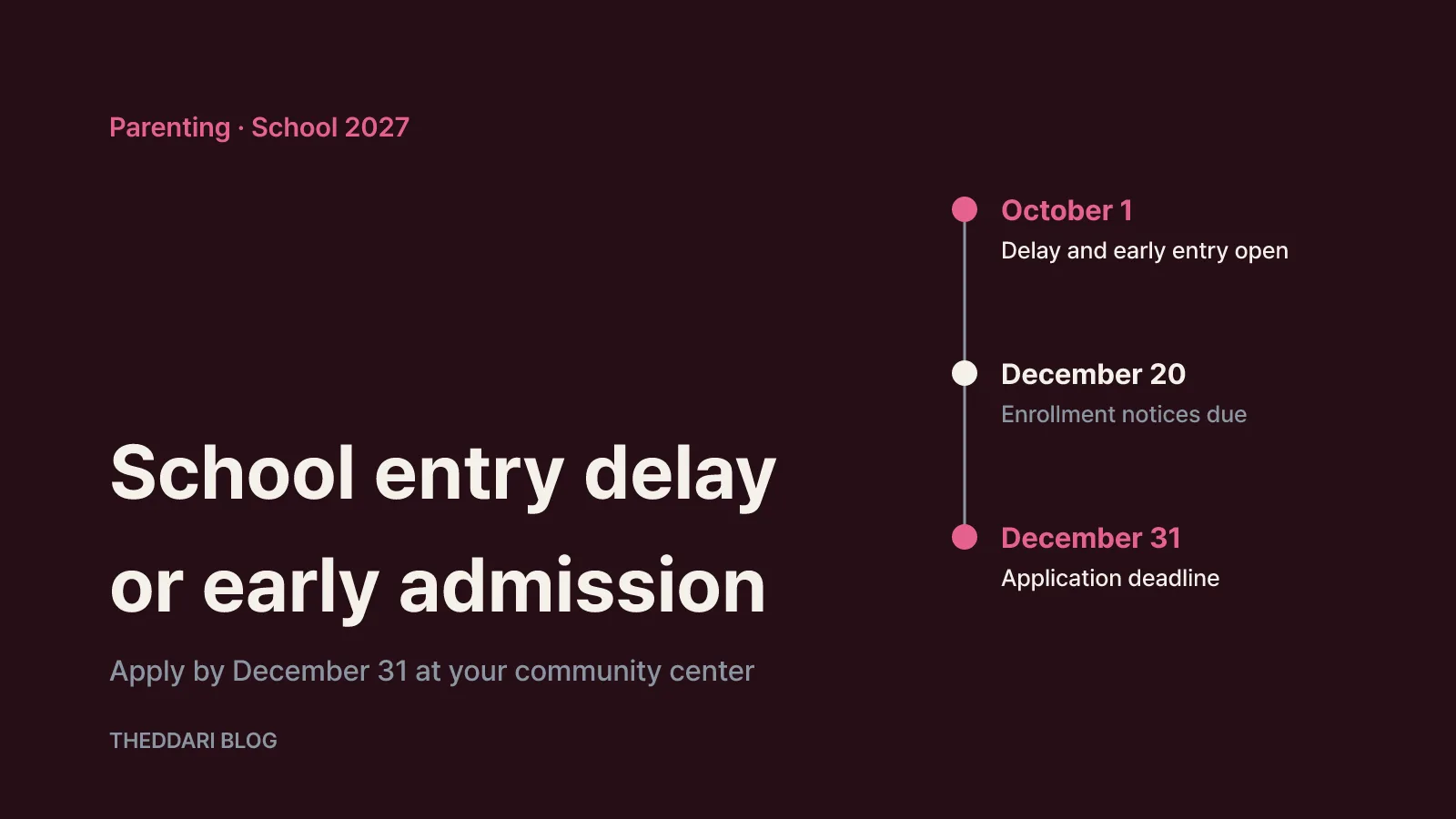
As of October 2026, here is the short answer for families in South Korea: children born between January 1 and December 31, 2020 are scheduled to start elementary school in March 2027. A parent or guardian can move that start date by exactly one year. To delay entry (2020-born children) or request early admission (2021-born children), you file a form at the community service center (haengjeong-bokji-senteo) for your child's registered address between October 1 and December 31, 2026. No committee reviews the request: it is confirmed by the guardian's choice, and it can be used only once. After December 31 that window closes, and the only remaining route to postpone school is a deferral filed with the school itself, which requires a stated reason and a committee review.
This guide cross-checks three public notices: the Guri-Namyangju Office of Education elementary admission guide, the Uijeongbu Office of Education enrollment procedure page and the Suyeong-gu Office (Busan) elementary admission page. All three describe the same national timetable under Korea's Elementary and Secondary Education Act and its Enforcement Decree. Forms and what to bring can vary slightly by local office, so a quick phone call before you visit is worthwhile. Foreign-resident families whose children are registered at a Korean address should check with their local center how these steps apply to them.
Which option applies to your child's birth year
Korean elementary school entry is based on the calendar year of birth, not a cut-off month. The Suyeong-gu page lists the cohorts plainly: the 2026 school year takes children born in 2019, the 2027 school year takes 2020-born children, and the 2028 school year takes 2021-born children. Applying the one-year flexibility gives the following choices for autumn 2026.
← Swipe to see more
| Birth year | If you do nothing | Option this year | If you apply |
|---|---|---|---|
| 2020 | Starts March 2027 | Delay entry | Starts March 2028 |
| 2021 | Starts March 2028 | Early admission | Starts March 2027 |
| 2022 or later | Normal cohort | None this year | — |
The Guri-Namyangju office defines eligibility as children living in the district on October 1, 2026 who were born in 2021 (early admission) or 2020 (delay). In practice, the center that handles your request is the one for your child's registered address, so if you move after October 1, confirm with the new office.
The flexibility is one year in either direction. Suyeong-gu describes it as an application "within a one-year range." You cannot start a 2021-born child two years early, and you cannot push a 2020-born child to 2029 through this route.
Why do families consider delaying? Because the cohort spans a full calendar year, a child born in January 2020 will be 7 years and 2 months old in March 2027, while a child born in December 2020 will be 6 years and 3 months, a simple calculation that shows almost a year of difference within one class. Birth month alone should not decide it, though. Development, daily routines and childcare arrangements matter just as much, and we come back to them below.
Key dates from October 1 to December 31
For parents, school entry can feel far away, but the administrative process has already started. Combining the three notices gives this sequence:
- October 1: reference date. Local offices survey every school-age child living in the area, and applications for early admission or delay open.
- By October 31: the local office compiles the school-age children register and makes it available for guardians to review for at least 10 days. Guri-Namyangju notes the register is updated promptly if a child moves in or out after October 1.
- By November 30: the district education office sets the next year's entry date and school zones and notifies local offices.
- By December 10: national and private elementary schools send their list of admitted students, chosen through their own application and lottery, to local offices.
- By December 20: the local office sends guardians the school enrollment notice naming the assigned school and entry date. Uijeongbu says notices go out between December 1 and December 20 and that guardians can also issue the notice themselves through the Gov24 website.
- December 31: deadline for early admission and delay applications.
- January–February: each school holds a preliminary orientation. Dates differ by school, so follow the one printed on your notice.
One useful detail: the application window stays open for roughly ten days after enrollment notices arrive. You can see which school your child is assigned to before making a final call. The flip side is that the deadline falls in the year-end holiday period, when offices have fewer working days, so aiming for mid-December is safer. To preview your school zone, Guri-Namyangju points parents to the school zone lookup service at schoolzone.emac.kr.
How to apply at the community service center
The application itself is short. A guardian submits either an early admission form or a delay form at the community service center for the child's registered address. Uijeongbu stresses that requests are "processed immediately without a separate approval procedure," so guardians should decide carefully, and Guri-Namyangju adds that the choice is confirmed by the parent and "only possible once."
Once the form is accepted, an early-admission child is added to this year's register and a delayed child is removed from it. The delayed child then reappears on the following year's register; Suyeong-gu's eligibility note explicitly includes children who did not enroll the previous year because of a delay.
Before you go:
- Find the right office. It is based on the child's registered address. If a move is coming, think about the timing of your move-in report.
- Call ahead. Bring your own ID and ask whether the child must come along or whether any extra documents are needed, since practice varies by office.
- Keep the receipt. It helps if you move or need to follow up.
- Check the result in December. A delayed child should not receive a 2027 notice; an early-admission child should.
Missed December 31? Deferral goes through the school
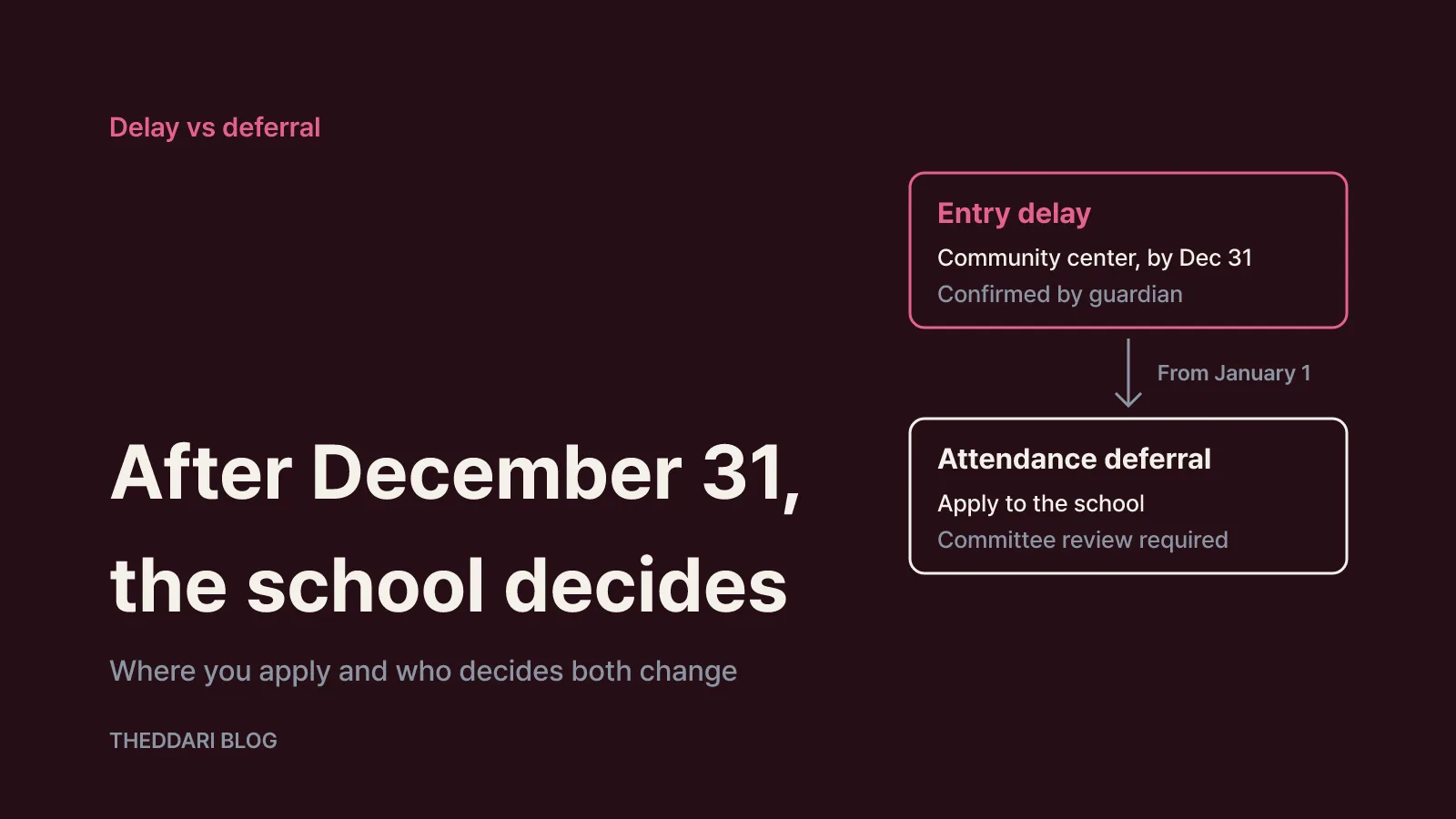
If you miss the window, or circumstances change close to entry, the remaining route is a deferral of compulsory attendance. According to Suyeong-gu, guardians apply to the assigned school between January 1 of the entry year and the start of school, citing reasons such as illness or developmental condition. The compulsory education management committee reviews it and the principal decides.
← Swipe to see more
| Entry delay | Attendance deferral | |
|---|---|---|
| When | Oct 1–Dec 31 of the prior year | Jan 1 of entry year until school starts |
| Where | Community service center | Assigned school |
| Decision | Confirmed by guardian | Committee review, principal decides |
| Needed | Application form | Form plus a reason such as illness |
The difference matters. A plan to "think it over and decide in January" means moving from a simple form to a reviewed request. And because Uijeongbu limits entry delay to once per child, a child who has already been delayed can only be postponed again through deferral. If you are at that stage, contacting the assigned school's administration office first is the fastest way to learn what they need.
Questions to discuss before deciding
There is no universal rule for the right start date. Talking through these points as a family makes the decision more concrete:
- Daily routines: Can your child sit through a structured activity, use the toilet independently and keep track of belongings?
- Health and development: If your child is in treatment or developmental counseling, have you asked that professional's view?
- Childcare gap: Delaying means another year of kindergarten or daycare. Have you confirmed a place and class arrangement?
- Siblings and friends: Do siblings' or close friends' start dates affect the choice?
- Moving plans: A move around entry time can change the assigned school.
The same questions apply to early admission. A child born in December 2021 who starts early would be 5 years and 3 months old in March 2027, more than a year younger than many classmates.
Moves, private schools and other special cases
Moving house: Both Guri-Namyangju and Uijeongbu say the register follows the child's latest address until entry. Even after receiving a notice, reporting your move-in at the new office leads to a new school assignment. If you already applied for delay or early admission, mention it when you report the move.
National or private schools: These run their own recruitment notices, applications and lotteries and send admitted-student lists to local offices by December 10. That process is separate from public school assignment, so follow the school's own announcements.
No notice by December 20: Contact your community service center, and check whether you can issue the notice yourself on Gov24, as Uijeongbu describes.
In short: parents of 2020-born children decide on delay, and parents of 2021-born children decide on early admission, before December 31. If you do nothing, your child simply starts with the normal cohort, and all you need to watch is the December enrollment notice and the January–February orientation date.