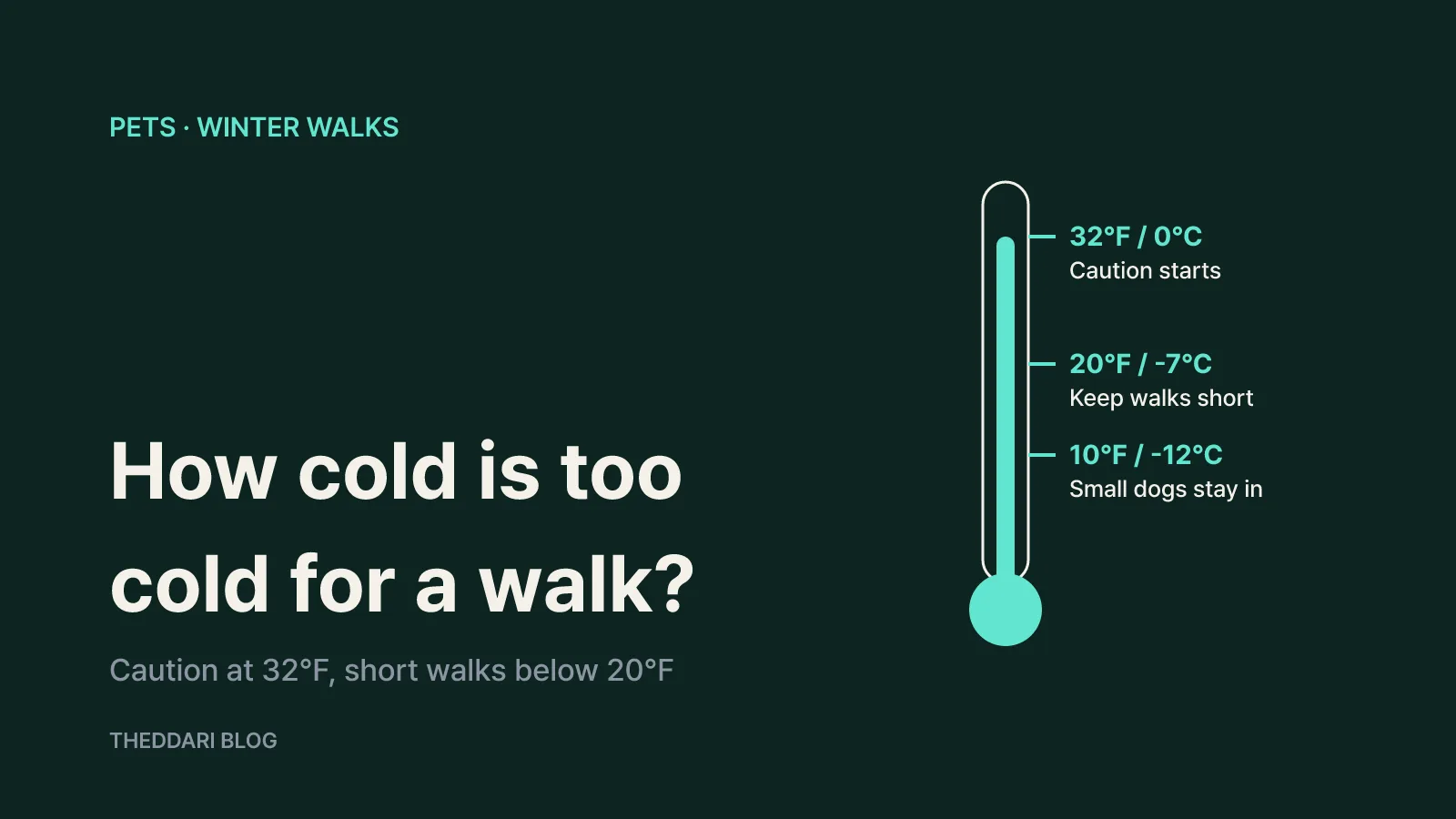
As of October 2026, the veterinary guidance we reviewed points to a simple starting rule for winter dog walks: be cautious once the temperature drops below 32°F (0°C), and avoid long outings below 20°F (about -7°C). A primary care veterinarian at MSPCA-Angell explains that below 20°F the potential for frostbite and hypothermia really sets in when a dog stays outside for a long time (MSPCA-Angell). Those numbers are a starting point, not a universal safety line. Size, coat, age, health and how used to the cold your dog is all change how long the same temperature is tolerable. Below you will find temperature bands, time limits by dog type, what to do before and after a walk, and the warning signs of hypothermia and frostbite.
How cold is too cold for a dog walk: the 32°F and 20°F lines
Two numbers come up again and again. The first is freezing, 32°F (0°C). MSPCA-Angell says caution starts there, and that walks of up to half an hour are fine while the weather stays above freezing. The second is 20°F (about -7°C). Below it, prolonged exposure raises the risk of frostbite and hypothermia, and even 25 to 30 minutes in freezing weather can affect the limbs and tail of an older dog, a dog with health problems or a small, thin-coated dog.
When the thermometer reads below 0°F (about -18°C), MSPCA-Angell's advice is to let the dog out to do its business and bring it back inside as soon as possible. The American Animal Hospital Association (AAHA) similarly recommends short, frequent walks instead of long outings in extreme cold (AAHA).
The forecast high is not the whole story. Wind and a wet coat make the same temperature harder on a dog. The American Kennel Club notes that wet or damp areas are more vulnerable to frostbite, so dry your dog before heading out (AKC). Cornell's Riney Canine Health Center puts it plainly: if it is too cold for you, it is likely too cold for your dog (Cornell). A practical way to read the guidance:
- Above 32°F (0°C): most healthy adult dogs can walk normally; put a coat on small or short-coated dogs and watch their reaction.
- 32°F to 20°F (0°C to about -7°C): shorten walks and split them into several short trips. Small and senior dogs switch to bathroom breaks.
- Below 20°F (about -7°C): no long stays outside. Small or thin-coated dogs get brief bathroom trips only.
- Below 10°F (about -12°C): small, cold-sensitive breeds should not spend time outdoors.
The last line comes from a veterinarian-written Hill's article, covered next.
Winter walk time limits by size, coat and age
Cornell lists the dogs most at risk: small dogs, puppies (which cannot properly regulate body temperature and carry little fat), short or thin-coated breeds, and older, underweight or sick dogs. Dogs that are not conditioned to cold, such as those from a warmer climate or caught by a sudden cold snap, are also less prepared. MSPCA-Angell adds that puppies cannot regulate their temperature during their first four months, and that small dogs lose heat faster because of their larger surface-area-to-volume ratio.
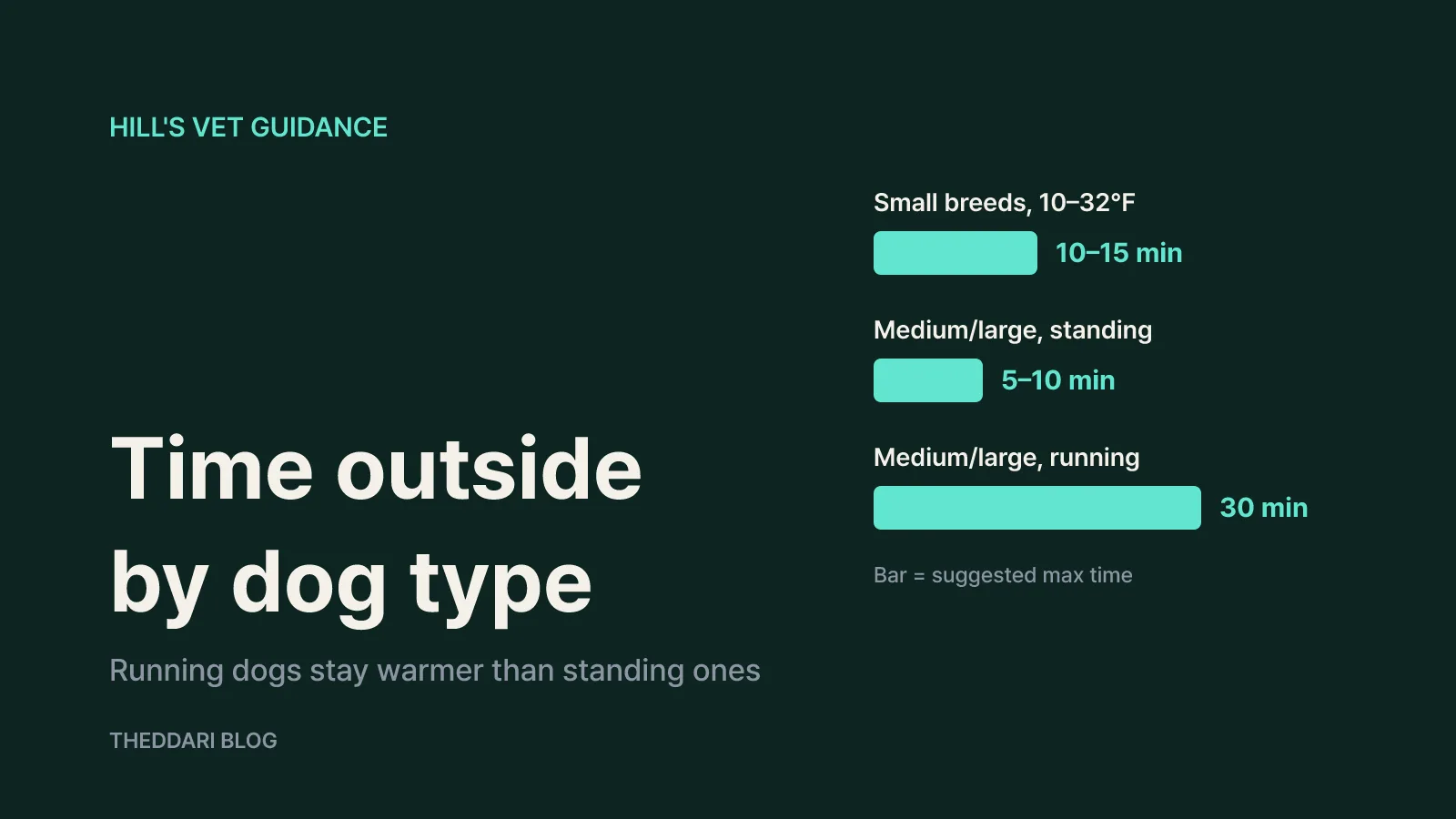
Veterinarian Sarah Wooten, writing for Hill's, gives concrete time limits by group (Hill's):
← Swipe to see more
| Group | Example breeds | Temperature | Suggested limit |
|---|---|---|---|
| Small warm-weather breeds | Chihuahua, Yorkie, Italian greyhound | 10–32°F (about -12°C to 0°C) | 10–15 minutes |
| Small warm-weather breeds | Same | Below 10°F (about -12°C) | No time outdoors |
| Medium and large warm-weather breeds | Dalmatian, boxer, Rottweiler, border collie | Down to 0°F (about -18°C) | Up to 30 minutes while exercising hard |
| Same group standing still | Potty breaks, waiting | Cold days | 5–10 minutes without a coat |
| Arctic breeds | Malamute, husky, Keeshond, Saint Bernard | Below freezing | Longer, if acclimated and given insulated, windproof shelter and unfrozen water |
The key detail is the difference between moving and standing. A dog running in the snow makes its own heat; the same dog waiting while you chat with a neighbor cools quickly. AAHA suggests carrying small, senior or short-coated dogs outside briefly for bathroom breaks to cut exposure. Even Arctic breeds are not immune: Cornell stresses that every dog is susceptible to cold, and dogs living mostly outdoors need prior acclimation, unfrozen water and a dry, raised, wind-protected insulated shelter.
Before the walk: coats, a dry dog and a safe route
Match the coat to the dog. Hill's says short-haired breeds benefit from a coat below freezing unless they are exercising hard, and long-haired dogs that are small, young, old, thin or shivering should wear one too. Medium and large dogs with a double coat, like Labradors, usually do not need one unless they are standing around. AAHA recommends a coat that covers the chest and back without restricting movement, introduced gradually. Cornell notes that fuller coverage also reduces snowballs on the belly and chest.
Keep the dog dry and the fur long enough. Head out only after a bath or rain once the coat is fully dry (AKC), and avoid clipping fur too short in winter (Cornell). AKC also warns that clothing should never be used on an unattended dog or as a substitute for proper care.
Scout the route. MSPCA-Angell suggests skipping streets with jagged ice or heavy rock salt. Cornell warns against walking on frozen ponds or lakes, recommends booties or shoveled paths for dogs with arthritis, and suggests a front-clip harness instead of a retractable leash for dogs that pull on ice. For dark mornings and evenings, wear reflective gear and carry a flashlight. Keep microchip details current, since snow can cover the scents a lost dog uses to find home, and never leave a dog alone in a car, which can get as cold as a refrigerator.
After the walk: paw care, de-icers and antifreeze
Paws take the most damage. Ice and road salt can crack or cut pads, and snowballs between the toes are uncomfortable (Cornell). MSPCA-Angell notes that salt granules in broken skin make things worse. A simple routine once you are back home:
- Wipe paws, legs and belly with a warm, damp cloth (AAHA, Cornell).
- Work out snowballs, ice and debris between the toes.
- Dry thoroughly, then apply a pet-safe paw balm. Cornell and MSPCA-Angell also mention petroleum jelly or barrier wax.
- Check pads for redness, cracks or limping.
Booties offer the best protection; MSPCA-Angell recommends practicing indoors with high-value treats first.
Wiping matters because dogs lick their feet. Cornell explains that salt and other de-icers irritate paws and, if swallowed, can cause ulceration or irritation in the mouth and digestive tract. Antifreeze containing ethylene glycol can be deadly to pets, and AAHA warns its sweet smell attracts them. Clean up spills around vehicles immediately, keep containers sealed, and see a veterinarian right away if your dog may have swallowed any.
Signs of hypothermia and frostbite, and what to do
Cornell's early warning signs that a dog is not tolerating the cold are shivering, whining or barking, a tucked tail or hunched posture, lifting paws off the ground, reluctance to walk and sudden anxiety. Any of these means it is time to get somewhere warm and dry.
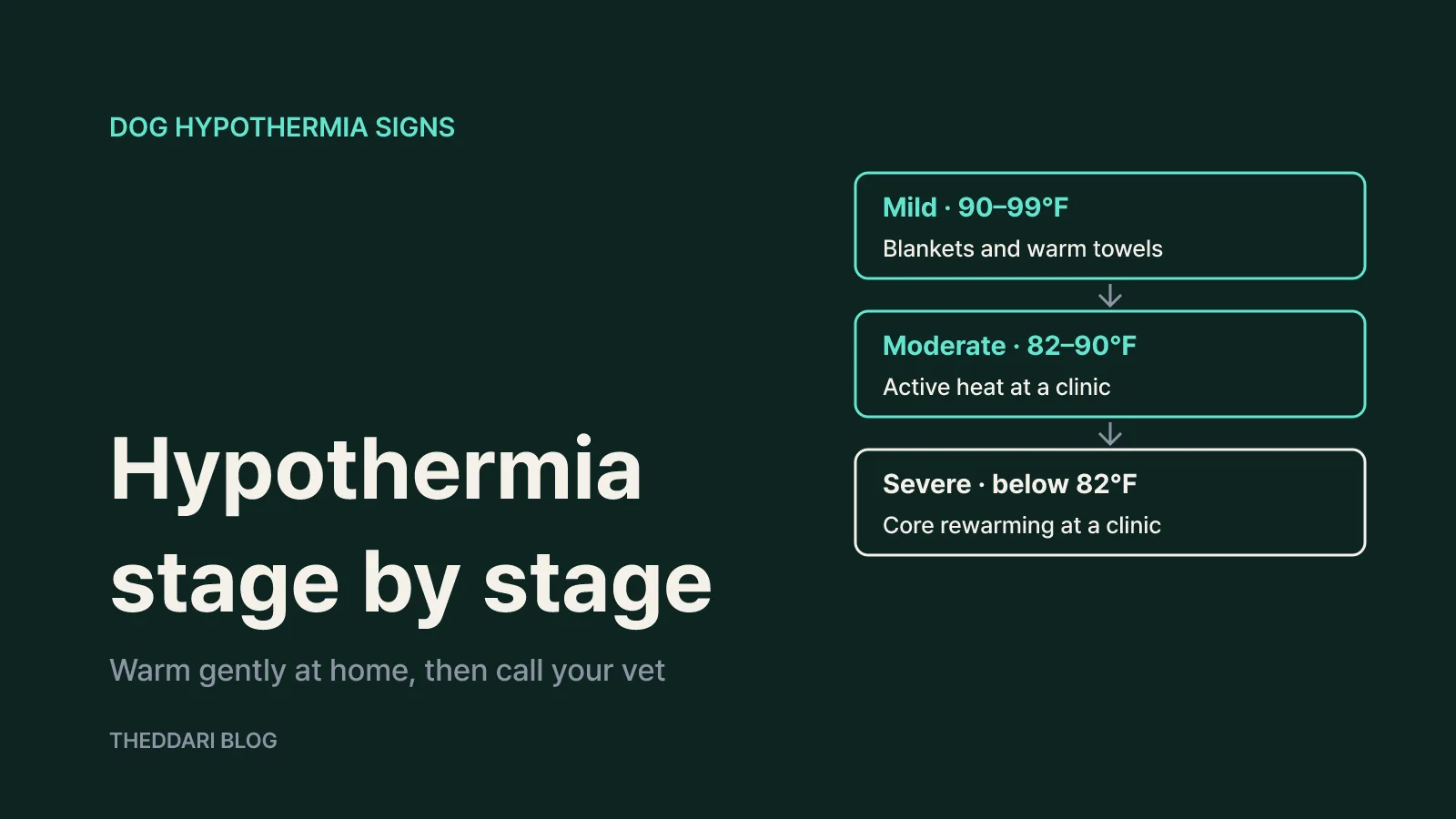
AKC defines mild hypothermia as a body temperature of 90–99°F (about 32.2–37.2°C), moderate as 82–90°F (about 27.8–32.2°C) and severe as below 82°F (about 27.8°C). MSPCA-Angell describes normal dog temperature as about 101–102.5°F and places hypothermia below 95°F, so thresholds vary slightly between sources. The direction of change matters more than one reading: AKC describes a heart rate and breathing that first speed up and then become slow and shallow, along with sluggishness, paleness, dilated pupils and loss of consciousness. AAHA separates early signs (shivering, weakness, pale or cool skin) from advanced ones (lethargy, confusion, slow breathing, slow heart rate).
MSPCA-Angell suggests counting heartbeats at the side of the chest for 15 seconds and multiplying by four. A healthy dog runs about 60–140 beats per minute; a pulse that was fast and is now slowing can be an early sign of hypothermia.
What to do at home:
- Bring your dog inside and keep movement to a minimum (AKC).
- Wrap them in warm blankets or towels fresh from the dryer (Hill's, AAHA).
- Warm, not hot, water bottles wrapped in towels can help; avoid heating pads, which can burn and worsen shock (AAHA, MSPCA-Angell).
- Call your veterinarian right away; moderate and severe cases need active rewarming at a clinic (AKC).
Frostbite shows up on the ears, tail, paws and nose as skin discoloration, swelling and pain when touched (AAHA); Hill's points to the webbing between the toes and ear tips. Warm the area gently with warm water, pat dry and never rub. Because the extent of frostbite can take a few days to become clear (Cornell), recheck those spots for several days after a long cold exposure.
Indoor exercise for the coldest days
Shorter walks can leave energy to burn. AAHA and MSPCA-Angell suggest treat scavenger hunts, puzzle toys, hide and seek, short training sessions and simple obstacle courses built from cushions and chairs. Break treats into small pieces so the daily total does not creep up. Cornell notes that many dogs exercise less in winter and may need fewer calories, and recommends stocking several days of food, water and medication refills before a major storm.
The bottom line: use 32°F (0°C) and 20°F (about -7°C) as reference points, cut time further for small, senior and very young dogs, and let your dog's signals decide when the walk is over.