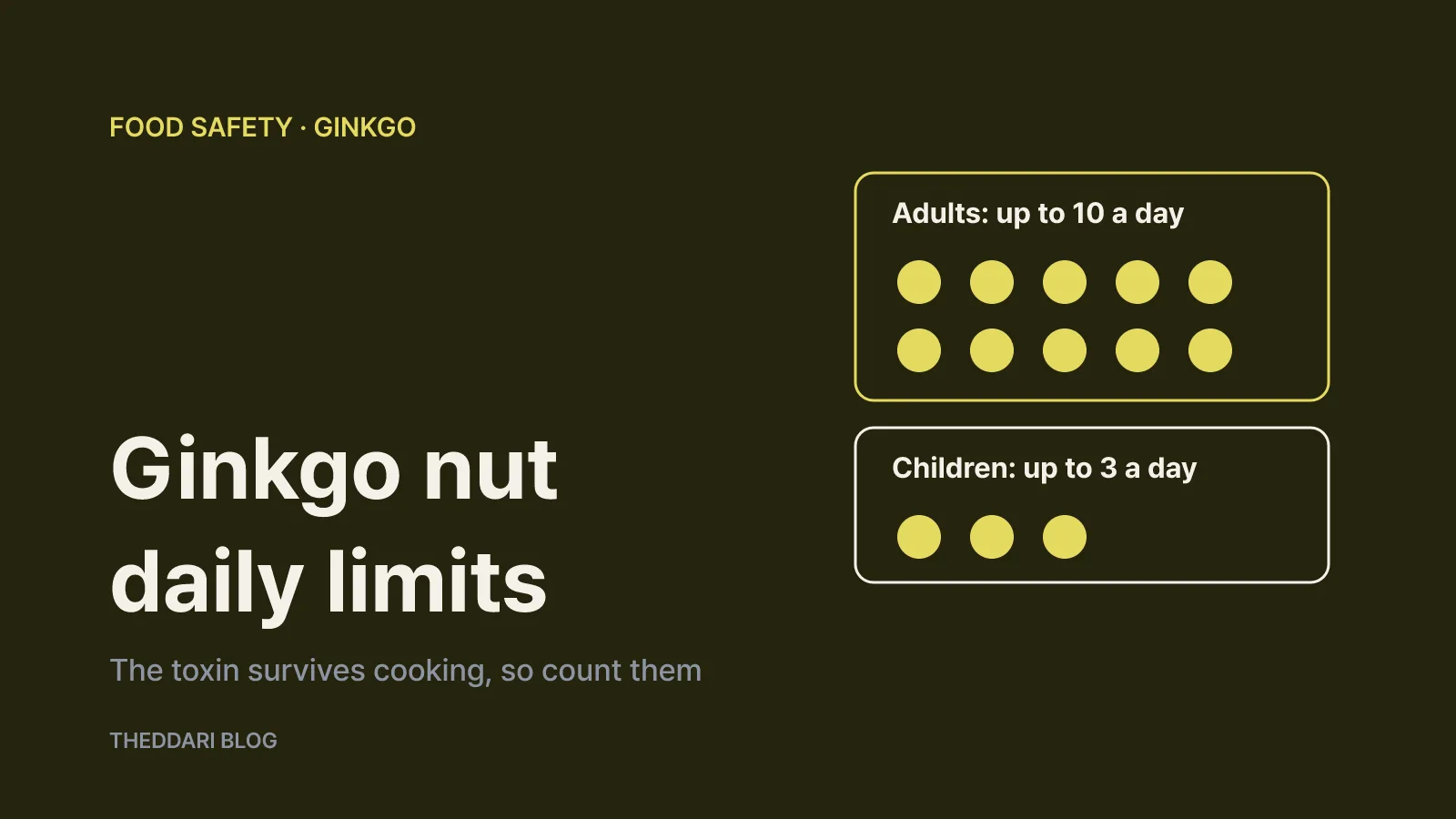
As of October 2026, the clearest numeric guidance on ginkgo nuts comes from South Korea's Ministry of Food and Drug Safety (MFDS): always cook them, and keep intake to no more than 10 nuts a day for adults and 3 a day for children. An MFDS official repeated this advice in a 2023 radio interview with YTN, explaining that the seeds contain natural toxins — cyanogenic glycosides and 4'-O-methylpyridoxine — that can cause vomiting and abdominal pain and, in serious cases, stiffening and seizures. Hong Kong's Centre for Food Safety (CFS) goes further and simply tells consumers to limit intake to "a few" cooked seeds per day.
Ginkgo nuts (also sold as ginkgo seeds, gingko nuts, eunhaeng in Korean or ginnan in Japanese) turn up in autumn markets, Asian grocery stores and dishes such as congee, chawanmushi, Korean ginseng chicken soup and roasted bar snacks. They are easy to eat by the handful, and that is exactly the habit that leads to trouble. This guide covers the daily limit, why cooking does not make them harmless, how poisoning presents, and practical preparation and storage steps.
The daily limit: 10 cooked nuts for adults, 3 for children
The MFDS figures refer to cooked nuts. Raw or under-ripe nuts should not be eaten at all. Older Korean press coverage sometimes quoted the children's figure as "2 to 3 nuts"; either way, the message is that a child should get only a couple.
Treat 10 as a ceiling, not a target. The CFS notes that no health-based guidance value has been set for ginkgotoxin by international bodies such as the Joint FAO/WHO Expert Committee on Food Additives (JECFA), and that acute poisoning has been reported after eating as few as 10 cooked seeds at one time. That is why Hong Kong's advice avoids a fixed number and asks children, older adults and people in poor health to be especially careful.
Simple ways to stay under the limit:
- Count the nuts onto a plate instead of eating from the bag.
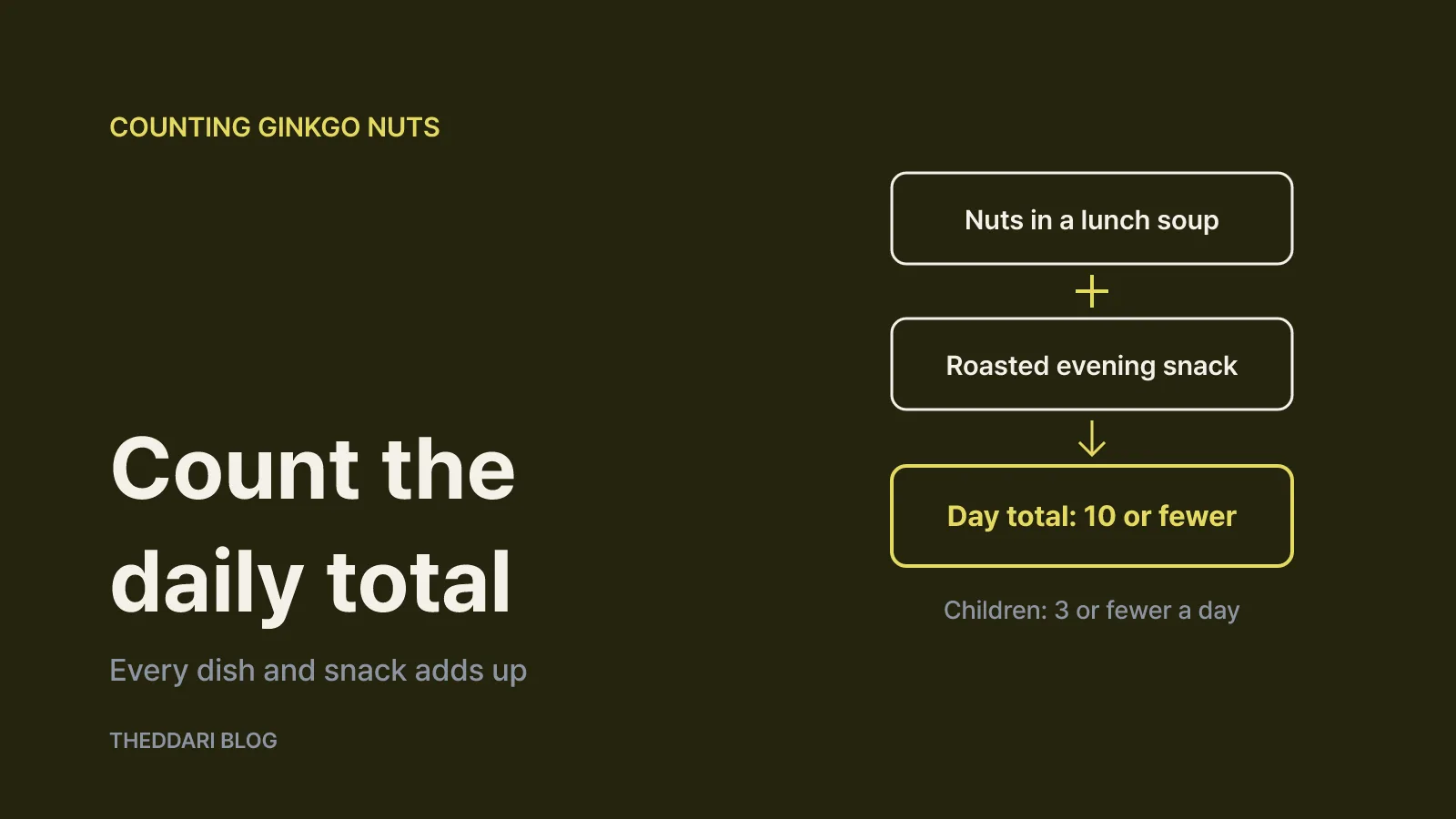
- Add up the whole day. Nuts in a lunchtime soup and a roasted snack in the evening count toward the same total.
- Portion a child's share separately and store the rest out of reach.
- On days you eat a dish that already contains several ginkgo nuts, skip them as a snack.
Why cooking reduces but does not remove the toxin
Ginkgo seeds contain two main groups of concern. One is cyanogenic glycosides such as amygdalin. The other is 4'-O-methylpyridoxine (MPN), often called ginkgotoxin, along with a glucoside form of it.
MPN looks chemically similar to vitamin B6. According to the CFS and a review by researchers at the US National Center for Toxicological Research, it interferes with the activation of vitamin B6 in the body. Active vitamin B6 is needed to make GABA, a calming neurotransmitter, from glutamate. When that step is disrupted, GABA falls while glutamate rises, and this imbalance is thought to trigger the seizures seen in ginkgo poisoning. The review reports MPN concentrations of 170–404 ppm in ginkgo seeds.
The CFS states that MPN is relatively heat-stable, so cooking cannot completely destroy it. Heating does help by inactivating some heat-sensitive toxins such as the cyanogenic glycosides, and unripe or uncooked seeds are reported to be more toxic. In short, cooking is required, and portion control still applies after cooking.
Ginkgo leaf extract supplements are a separate subject. The same review notes that leaves contain only small amounts of MPN. The limits in this article apply to the nuts you roast, boil or add to food.
Poisoning symptoms can start 1 to 12 hours later
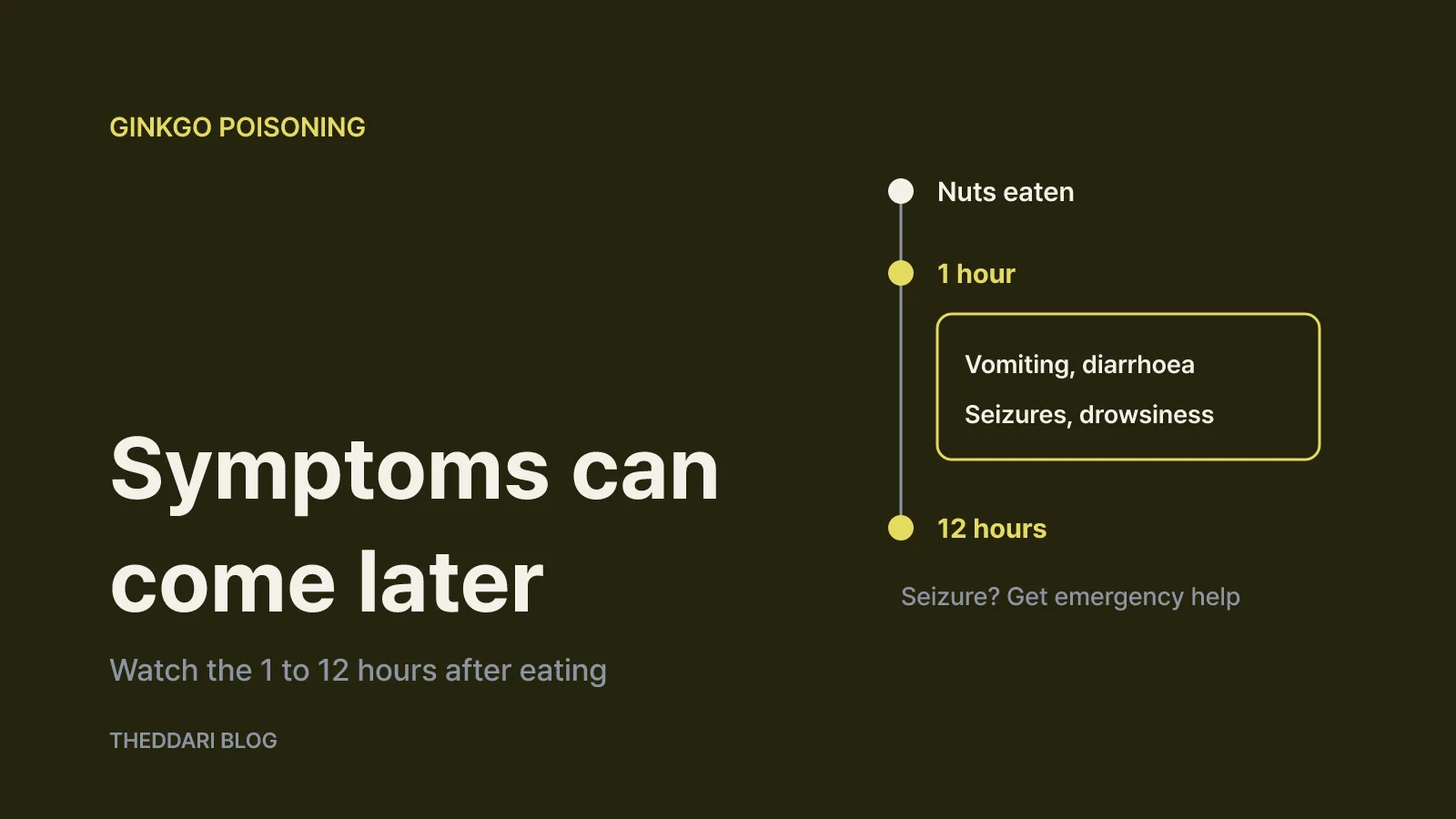
The CFS lists nausea, vomiting, diarrhoea, abdominal pain, confusion and convulsions as common symptoms, usually beginning 1 to 12 hours after eating. Feeling fine right after a meal does not rule anything out; some people eat ginkgo nuts in the evening and fall ill overnight.
Published cases show how wide that window is:
- A 36-year-old woman in Japan vomited repeatedly and had generalised convulsions 4 hours after eating 70–80 microwaved nuts (cited in the NCTR review).
- A 2-year-old girl developed vomiting and diarrhoea 7 hours after eating 50–60 roasted seeds and had a seizure without fever about 9 hours after eating.
- A 51-year-old woman in Korea ate about 1 kg of nuts in an hour and had a tonic-clonic seizure roughly half a day later, with low blood vitamin B6.
- A 2011 Korean hospital report, summarised by the Hankook Ilbo, describes a 58-year-old man who had been eating 4–5 roadside nuts per meal and then ate about 200 in one evening. He vomited, lost consciousness overnight and regained it four days after receiving pyridoxine (a form of vitamin B6), leaving hospital on day 10.
- In June 2023 Hong Kong reported a suspected case in a 57-year-old man who had dizziness, nausea, vomiting, headache and a racing heart after eating about 50 seeds in a soup.
Children are especially susceptible. The CFS warns that severe cases can lead to loss of consciousness and death. The review records 22 deaths among 170 historical cases in Japan (about 13%), none since 1969, and says most patients recover without lasting effects. It identifies vitamin B6 given by clinicians as the most effective treatment. That is a hospital decision, not something to replace with an over-the-counter supplement at home.
How to prepare and store ginkgo nuts
A fresh ginkgo seed has a soft, foul-smelling outer flesh, a hard white shell, a thin papery skin and the edible yellow-green kernel. A practical sequence:
- Remove the flesh wearing gloves, rubbing it off under water. The review mentions unpublished data finding MPN in the fruit pulp too, so discard it.
- Crack the shell gently with pliers or the back of a knife so it does not burst when heated.
- Cook thoroughly by tossing in an oiled pan or microwaving in a paper bag, then peel off the thin skin. Make sure the kernels are evenly cooked through; reheat any that look raw.
- Count out the day's portion after cooking.
For storage, the MFDS official advised that unshelled nuts be kept somewhere dry and well ventilated, or in the refrigerator, while shelled nuts go into an airtight container in the freezer and are eaten as soon as practical. Freezing them in portions of 10 or fewer makes the daily limit easy to follow.
If you gather nuts from street trees, you rarely know how long they have been on the ground or what they were exposed to, and the 58-year-old man above had been eating roadside nuts for days. Whether foraged or bought, the rule is the same: cook them, count them and stay under the daily ceiling.
When to get medical help right away
The CFS advises anyone who feels unwell after eating ginkgo seeds to seek medical attention immediately; it notes there is no specific antidote and treatment focuses on the symptoms. Get help promptly if:
- A child has eaten more than a couple of nuts, or you do not know how many, even without symptoms.
- Vomiting, diarrhoea, abdominal pain or dizziness appear within 12 hours of eating them.
- There is trembling, stiffness, a seizure or reduced consciousness — call your local emergency number.
- An older adult or someone in poor health has eaten a large amount.
Tell the clinician that ginkgo nuts were eaten, along with the time, the approximate number and whether they were raw or cooked. In several published cases the cause was only identified after doctors learned about the nuts.
Bottom line
Ginkgo nuts are a traditional food, not a forbidden one, but because the main toxin survives cooking, the amount matters more than the recipe. Cook them, cap adults at 10 a day and children at 3, and treat vomiting or convulsions within 1 to 12 hours of eating as a reason to get care.