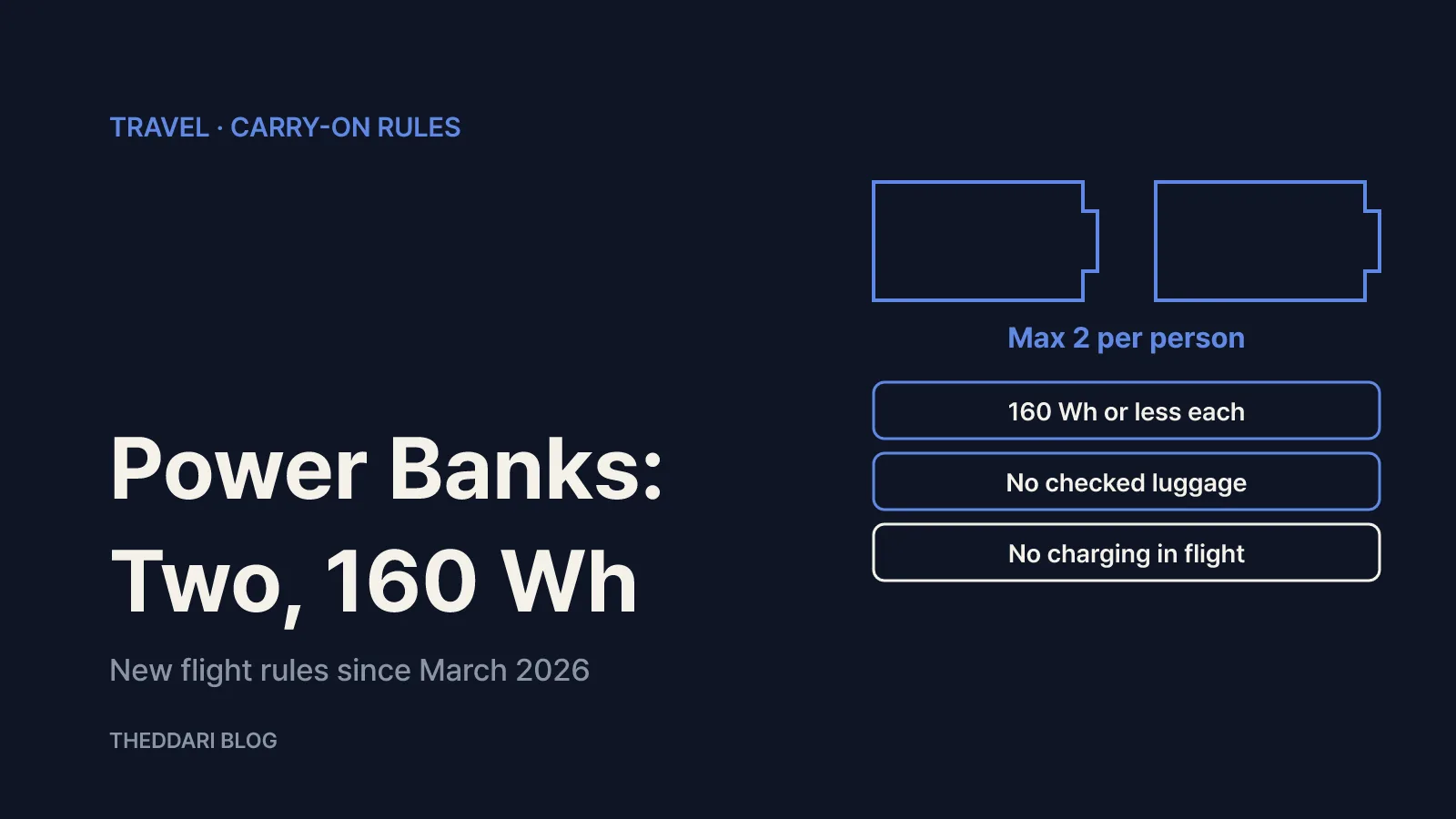
As of October 2026, the short answer is this: you can bring no more than two power banks per person on a passenger flight, they must travel in your carry-on bag, never in checked luggage, and you must not recharge a power bank on board. Power banks up to 100 Wh need no approval, those above 100 Wh and up to 160 Wh need the airline's approval, and anything above 160 Wh is not accepted. The two-bank cap is new: the International Civil Aviation Organization (ICAO) added it to its dangerous goods Technical Instructions with effect from 27 March 2026, as summarised by the UK Civil Aviation Authority.
If you last checked the rules a year or two ago, the biggest surprise is that small power banks no longer escape a quantity limit. This guide covers what changed, how to work out the watt-hour rating from the mAh number on the label, what you cannot do in the cabin, and a packing routine that avoids trouble at security or the gate.
What changed for power banks in 2026
ICAO's addendum to the 2025-2026 Technical Instructions (Doc 9284) separated power banks from other spare batteries and gave them their own rules. According to the UK CAA's summary, power banks carried by passengers and crew for personal use:
- must be carried in carry-on baggage;
- must be individually protected against short circuits when not in use;
- must not be recharged on board the aircraft;
- should not be used to charge other portable electronic devices on board; and
- are limited to a maximum of two per person.
The existing capacity limits still apply on top of the new count limit: up to 100 Wh without operator approval, more than 100 Wh but not more than 160 Wh with approval. The two-bank limit counts power banks regardless of size, so three small 10,000 mAh packs are now one too many.
The change grew out of a push by South Korea after an Air Busan aircraft was destroyed by a cabin fire in January 2025. Korea's transport ministry announced on 8 April 2026 that the ICAO Council had approved the measures on 27 March and that Korean airports and airlines would apply them from 20 April 2026. Before that date, Korea's national rule allowed up to five power banks of 100 Wh or less per passenger.
One nuance matters if you fly different carriers. In the ICAO text, using a power bank to charge your phone is a recommendation ("should not"), while recharging the power bank itself is a firm prohibition. Korean authorities and Korean airlines go further and ban both. Airlines everywhere may set stricter rules than the international minimum, so the simplest habit is to treat any in-flight power bank use as off-limits.
How to convert mAh to Wh and check your power bank
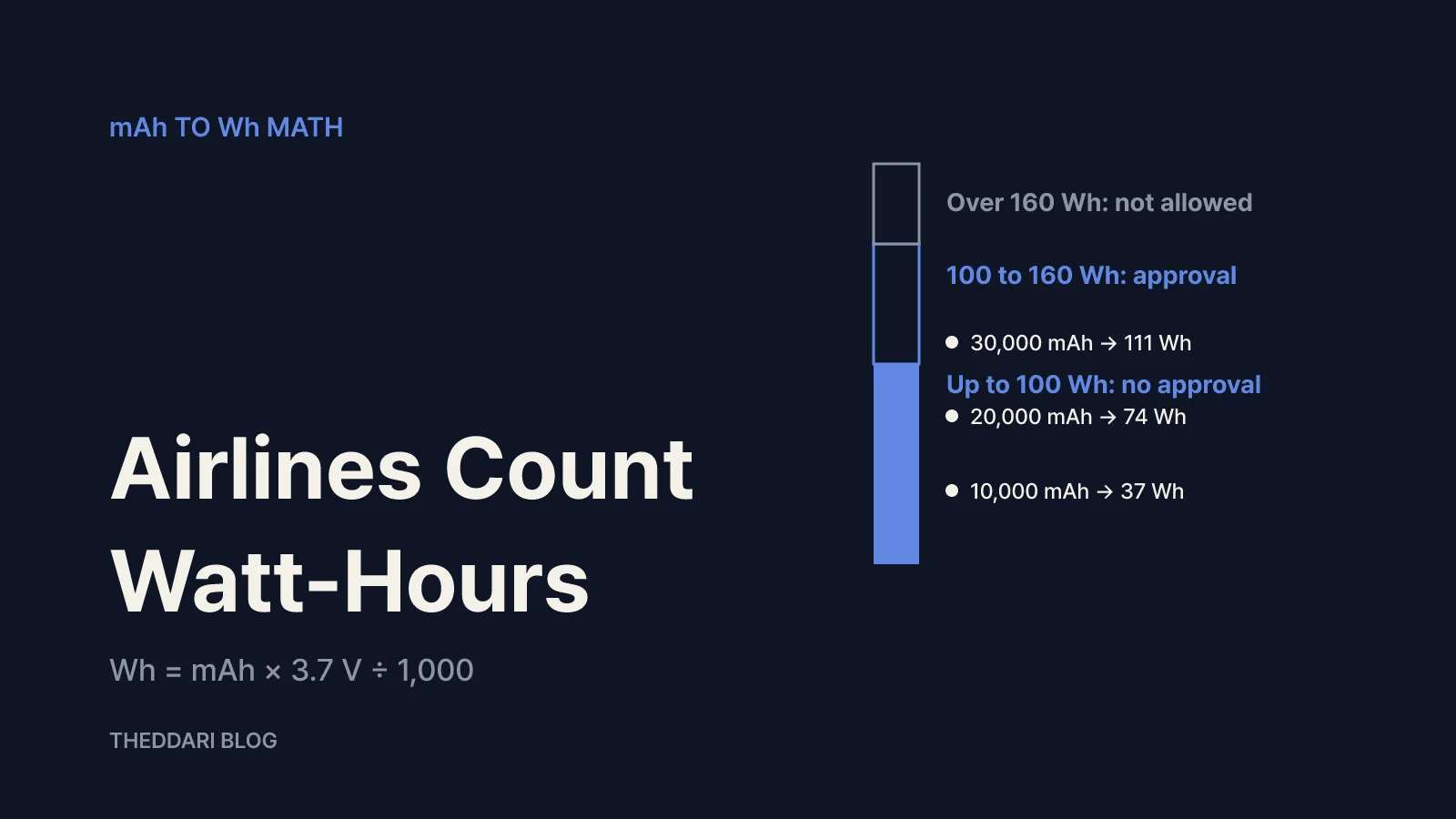
Airline limits are written in watt-hours (Wh), but most power banks advertise milliamp-hours (mAh). If the label prints a Wh figure, use it directly. If it only shows mAh, convert it:
Wh = mAh × rated voltage (V) ÷ 1,000
Use the cell's rated voltage, usually printed as 3.6 V or 3.7 V, not the 5 V USB output. Plugging in 5 V inflates the result and can make a compliant battery look oversized. At 3.7 V the common sizes work out like this:
← Swipe to see more
| Label capacity | Calculation at 3.7 V | What it means |
|---|---|---|
| 10,000 mAh | 10,000 × 3.7 ÷ 1,000 = 37 Wh | No approval needed |
| 20,000 mAh | 20,000 × 3.7 ÷ 1,000 = 74 Wh | No approval needed |
| 27,000 mAh | 27,000 × 3.7 ÷ 1,000 ≈ 100 Wh | Borderline; check the printed Wh |
| 30,000 mAh | 30,000 × 3.7 ÷ 1,000 = 111 Wh | Airline approval required |
| 43,000 mAh | 43,000 × 3.7 ÷ 1,000 ≈ 160 Wh | Borderline; approval required |
Korea's ministry uses the same rough equivalents, describing 100 Wh as about 27,000 mAh and 160 Wh as about 43,000 mAh. The same 30,000 mAh pack rated at 3.6 V comes out at 108 Wh, so anything near a threshold deserves a close look at the actual label. If the label is worn off, security staff have no way to confirm the rating, and the item may be refused.
If you need a pack above 100 Wh, contact the airline before travel and ask how it handles approvals. Some carriers count large power banks and large spare batteries together: Air Seoul's notice (in Korean), for example, allows a combined total of two items in the 100 to 160 Wh range, with approval. Photographers and drone pilots should do this arithmetic before packing.
What you cannot do with a power bank in the cabin
Once on board, three habits now cause problems:
- Recharging the power bank from a seat USB port or socket. This is prohibited under the ICAO rule.
- Charging your phone or tablet from the power bank. Discouraged internationally and banned outright on Korean airlines.
- Leaving it in the overhead bin. Korean carriers, including Air Seoul, require power banks to stay on your person or in the seat pocket.
The logic is about reaction time. The IATA traveler guidance explains that batteries stay out of the hold because crew cannot act immediately if one overheats there; a bag in a closed overhead bin creates a similar blind spot. You can usually still charge a phone by plugging it directly into seat power where the aircraft has it; Air Seoul says this is possible on some of its aircraft.
If a device or power bank becomes hot, swells, or starts smoking, tell the cabin crew straight away. IATA advises against trying to cool or move it yourself. If your phone slips down beside the seat, do not adjust the seat to reach it; call a crew member, because a crushed battery can overheat.
A packing checklist before you leave for the airport
Run through these steps the night before departure:
- Count per person. The limit is two per passenger, so split a family's power banks across travelers instead of packing four in one bag.
- Read the label. Find the Wh figure, or the mAh and rated voltage, and compare it with the 100 Wh and 160 Wh thresholds.
- Protect the terminals. Keep each pack in its original retail packaging, tape over exposed contacts, or place each one in its own plastic bag or protective pouch.
- Put them in your cabin bag. Never in checked luggage. Phones, laptops, and cameras also belong in the cabin.
- Leave damaged packs at home. IATA says swollen, punctured, or damaged batteries can be unstable and should not travel.
- Plan for gate checks. If your carry-on is taken at the gate and sent to the hold, remove every power bank and battery-powered device first. Keeping power banks in a small personal bag makes this easy.
Smart luggage follows a related rule. IATA says bags with built-in lithium batteries are acceptable only if the battery can be removed, and the removed battery must travel in the cabin.
Where airlines and countries may still differ
The international baseline is now aligned, but a few details vary. Approval procedures for 100 to 160 Wh packs differ by airline, and some ask for advance notice. Korea's ministry noted that countries such as Japan, Singapore and Hong Kong had already introduced their own stricter measures, so check both the carrier and the departure airport. On itineraries with a connection, pack to the strictest rule along the route so you do not lose a battery at a transfer screening.
The rules fit on a sticky note: two or fewer, 160 Wh or less, carry-on only, terminals protected, no charging in flight. If your pack sits near a limit or you carry specialist batteries, get the airline's answer in writing before you fly.