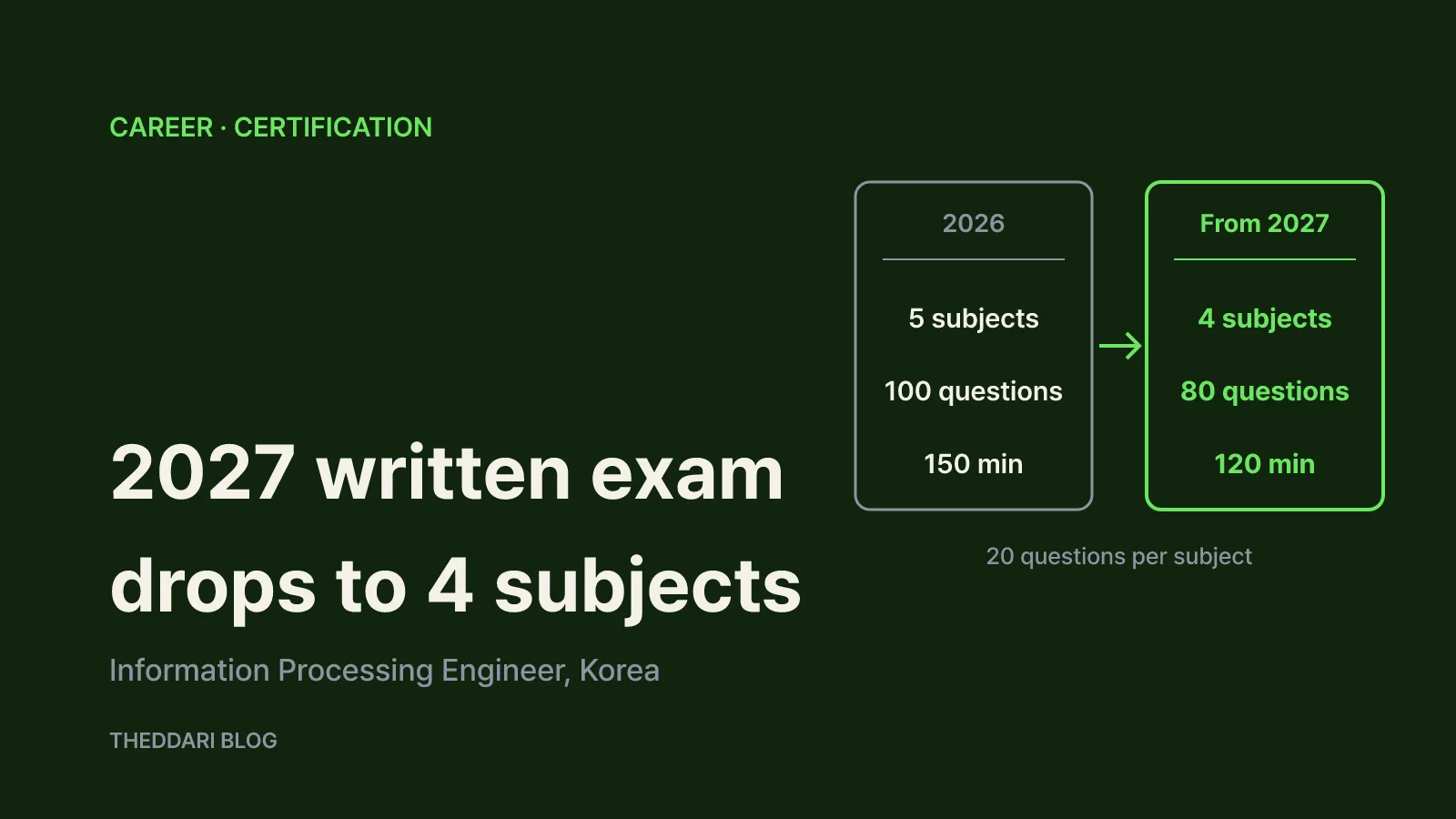
As of November 2026, the short answer is this: from January 1, 2027, the written test for Korea's Information Processing Engineer (정보처리기사, Jeongbo Cheori Gisa) has 4 subjects, 80 multiple-choice questions and a 2-hour time limit. Until the end of 2026 it is 5 subjects, 100 questions and 2 hours 30 minutes. Each subject still carries 20 questions. The subject called "Software Design" disappears as a name, but its content moves into the new first subject, "Software Development", so it does not leave the syllabus. The practical exam format and the pass marks stay the same.
The legal basis is an amendment to the Enforcement Rule of the National Technical Qualifications Act (Ministry of Employment and Labor Ordinance No. 483), promulgated on September 7, 2026 and taking effect on January 1, 2027. According to the official statement of reasons on the Korea Law Information Center, the amendment reorganizes the test subjects of 37 qualification categories to reflect changes in industry and creates new categories such as the Building Structure Engineer and Robot System Integration qualifications. The Information Processing Engineer is one of the categories whose written subjects change, which matters to anyone in Korea aiming at an IT job, a public-sector IT role or a graduate programme that recognizes national technical qualifications.
The numbers: 100 to 80 questions, 150 to 120 minutes
The Human Resources Development Service of Korea (HRD Korea), which runs the exam through its Q-Net portal, has published a new exam syllabus (출제기준) that applies from January 1, 2027 to December 31, 2029. Comparing it with the current one-year syllabus for 2026 gives the following picture. The comparison below follows a side-by-side review of both Q-Net syllabus documents by IT Edu.
← Swipe to see more
| Item | 2026 syllabus | 2027–2029 syllabus |
|---|---|---|
| Valid period | Jan 1–Dec 31, 2026 | Jan 1, 2027–Dec 31, 2029 |
| Format | Multiple choice | Multiple choice |
| Subjects | 5 | 4 |
| Questions | 100 | 80 |
| Time | 2 h 30 min | 2 h |
| Questions per subject | 20 | 20 |
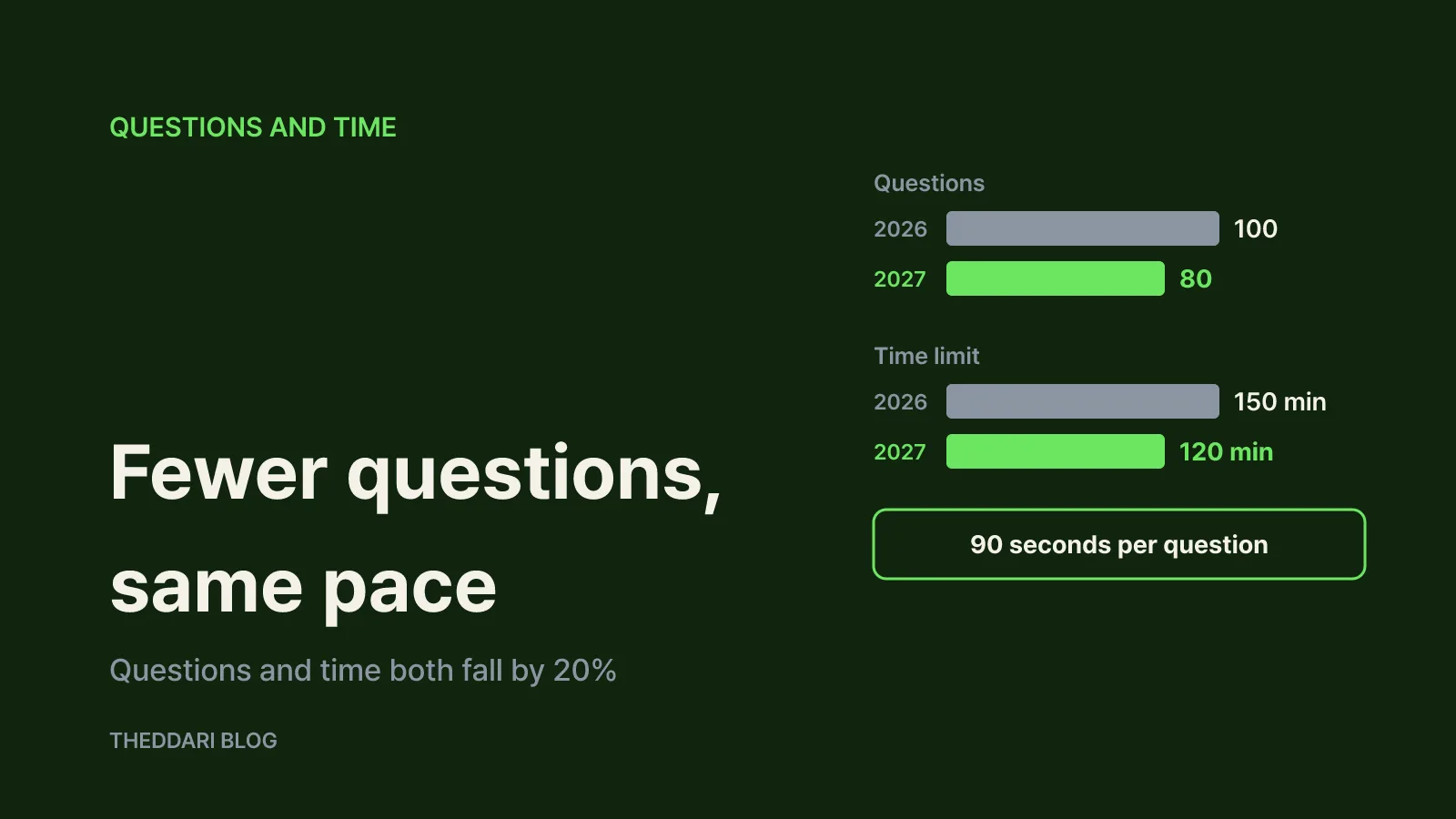
Both the number of questions and the time limit fall by 20%, so the average time per question does not change. 150 minutes divided by 100 questions is 90 seconds, and 120 minutes divided by 80 questions is also 90 seconds. A shorter paper does not mean you have to work faster, and there is no official evidence that it is easier either. The syllabus defines scope only; HRD Korea does not publish how many questions come from each item or how difficult they will be.
The job definition in the syllabus has also been rewritten. The current version describes the role as designing, implementing and testing software functions. The new version describes developing and deploying software and improving system performance through information-system management. Design is now treated as part of the development flow rather than a separate block, and the subject list reflects that.
Where did the Software Design subject go?
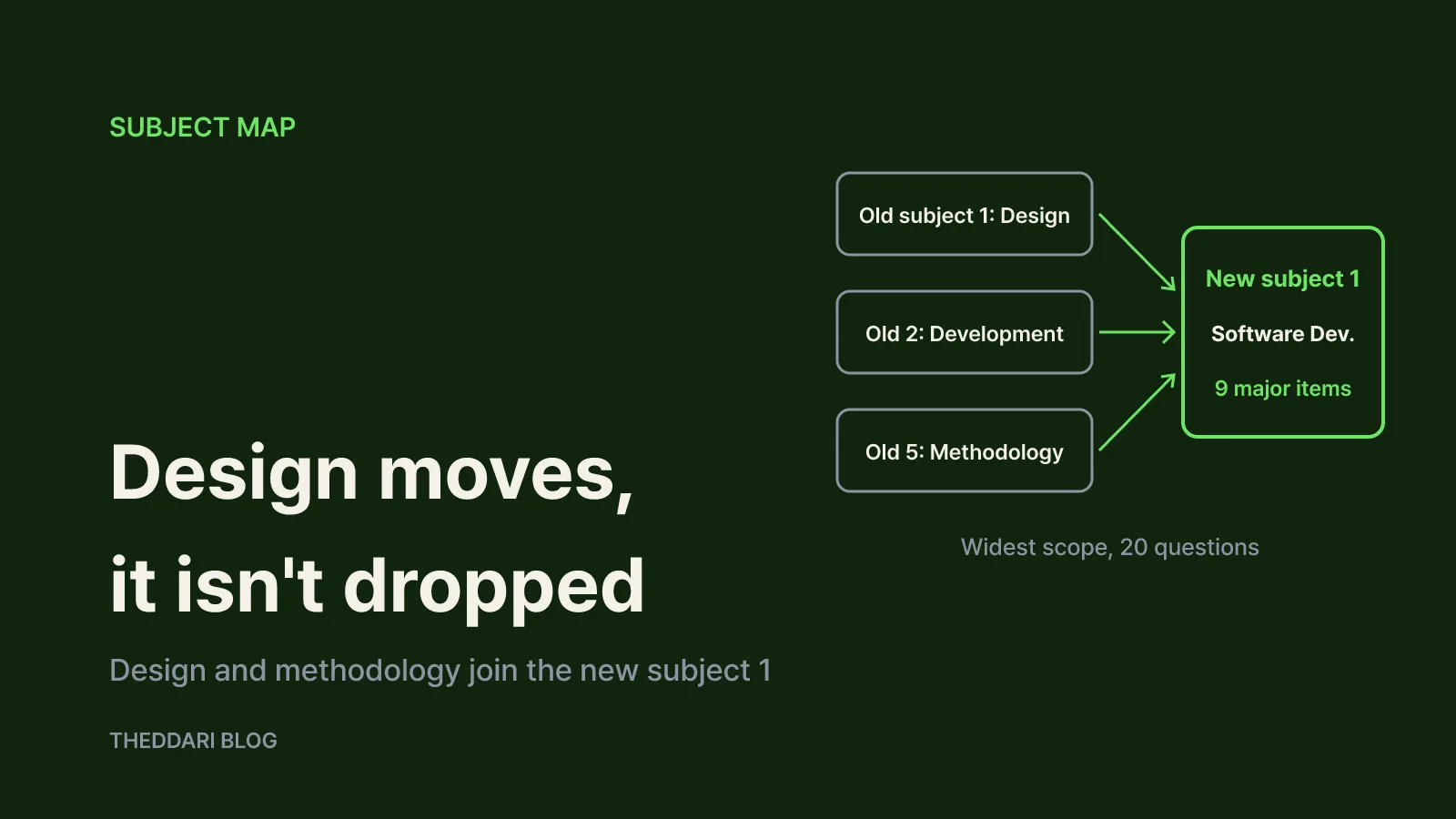
The new first subject, Software Development, now has nine major items. The first four come straight from today's Software Design subject:
- Requirements analysis: requirements techniques, UML, Agile, modelling, analysis automation and requirements management tools
- Screen (UI) design: UI standards and guidelines, storyboards, emotional engineering, UI design tools
- Application design: design modelling, software architecture, reuse, modularity, coupling, cohesion, object orientation, design patterns
- Interface design: requirements engineering, system architecture, data specification, error handling, middleware
- Using software development methodologies: life-cycle models, methodologies, cost estimation models, tailoring, development frameworks
- Integration: unit modules and unit tests, IDEs, collaboration and configuration management tools
- Packaging: packaging, deployment and monitoring tools, DRM, manuals, international quality characteristics, version control, build automation
- Application test management: test cases, levels and scenarios, defect management, test automation, algorithms, code optimization
- Interface implementation: interface security, integration testing, design artefacts, interface specifications
Item 5 is easy to miss. Methodology topics such as life-cycle and cost estimation models currently open the fifth subject, Information System Management. From 2027 they sit inside Software Development. The new first subject therefore covers far more ground than the other three while still carrying only 20 questions, so it is sensible to give it a bigger share of your study time.
One sub-item has gone. The current requirements section includes "analysis of the existing system" (platform functions and performance, operating systems, networks, DBMS and business convergence analysis). In the 2027 syllabus the requirements section keeps only "requirements confirmation" and "analysis model confirmation". If you are short of time, that is a candidate for lower priority.
The other three subjects, the practical exam and pass marks
The remaining subjects are Database Construction (SQL application, SQL use, logical database design, physical database design, data conversion), Programming Language Use (server program implementation, programming language use, basic application software technology) and Information System Management (IT project system management, secure software development, system security). The last one loses the methodology item that moved to subject 1.
The practical exam does not change. In the 2027–2029 syllabus it is still "Information Processing Practice", a written short-answer test lasting 2 hours 30 minutes.
Pass marks are set by law, not by the syllabus. Article 20 of the Enforcement Decree of the National Technical Qualifications Act requires Engineer-grade candidates to score at least 40 out of 100 in every subject and an average of at least 60 on the written test, and at least 60 out of 100 on the practical test. The amendment does not touch this. What changes is that one fewer subject is available to lift your average, so a plan that writes off a weak subject and relies on the others becomes riskier.
What to do depending on when you sit the exam
All three regular Engineer written sessions for 2026 are finished. Only the third practical session (October 24 to November 13, 2026) and its final results on December 18 remain. In 2026 the fees were 19,400 won for the written test and 22,600 won for the practical.
- Already passed the written test? Under Article 21 of the same Decree, you are exempt from the written test for two years from the date you passed. If fewer than two examinations are held in that period, you are also exempt from the next written test. Inside that window you only sit the practical, which keeps its current format. Check your exact pass date in your Q-Net account and count the practical sessions you have left.
- Sitting the written test for the first time in 2027? You will take the new 4-subject, 80-question paper. Session dates for 2027 appear on Q-Net's annual national technical qualification schedule once the yearly plan is announced. For reference, the first 2026 Engineer written registration opened on January 12, 2026, so watch Q-Net notices around the turn of the year.
- Just starting out? With no regular 2026 written sessions left, you will in practice be studying for the new syllabus. If you buy a new textbook, check that it states it follows the 2027 syllabus.
How to reuse old textbooks and past papers
You do not need to throw away a 5-subject textbook. Regroup it by major item name rather than subject number.
- Download "정보처리기사 (2027.1.1~2029.12.31)" from Q-Net's syllabus library (Customer Support, Resources, 출제기준) and copy the four subjects' major and minor items onto one page.
- Mark each chapter in your textbook with its new subject and item number. Label the methodology chapter of the old fifth subject as "new subject 1".
- Flag chapters with no match in the new syllabus, such as existing-system analysis, and push them to the end if time runs short.
- Sort past questions by major item, not by old subject. When you build a mock test, mix 20 questions per subject and practise finishing 80 questions in 120 minutes.
- Track scores per subject so you notice any subject hovering near the 40-point cut-off and fix it before chasing a higher average.
Finally, an item appearing in the syllabus says nothing about how many questions it will produce. Rather than guessing weights and skipping whole sections, read through the full new syllabus once and then drill your weak items. Before you register, reread the session notice on Q-Net to confirm dates and fees.