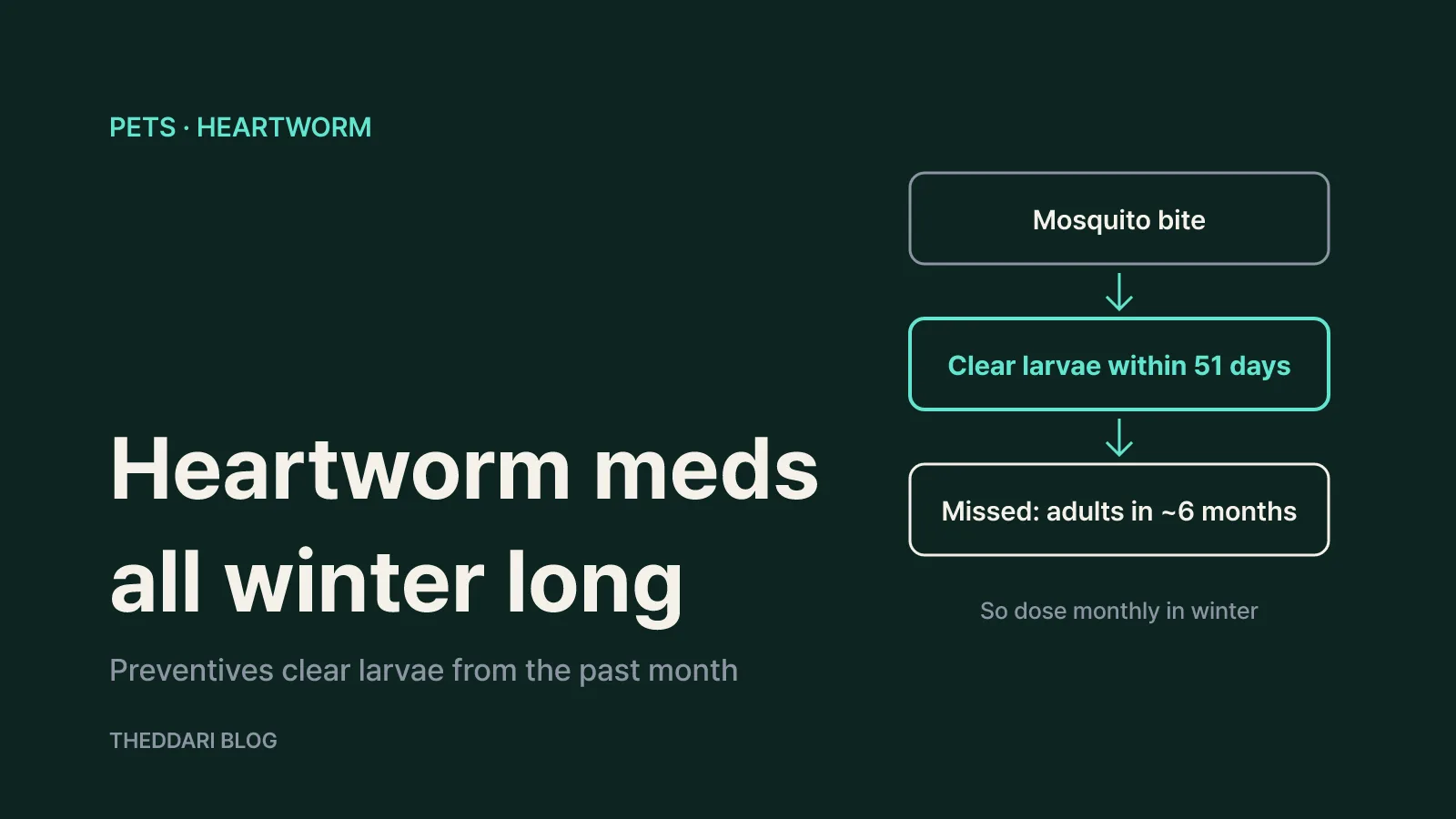
As of November 2026, the short answer is yes: keep giving your dog heartworm medicine through the winter. The American Heartworm Society (AHS) asks owners to "Think 12" — give a preventive 12 months a year and have your pet tested every 12 months (AHS Heartworm Basics). The reason is simple once you know how the drugs work. A heartworm preventive is not a vaccine that shields your dog for the month ahead. It clears larvae that already got in during the previous month, so stopping the moment mosquitoes disappear leaves the last bites of the season untreated. If you have already paused for a few months, the safe sequence is to talk to your vet, test before restarting, and retest six months later.
This guide answers the two questions owners ask most once the weather turns: "I haven't seen a mosquito in weeks — can I stop?" and "I skipped a couple of months — can I just pick up where I left off?" It draws on the AHS owner and veterinary guidance, plus a column from the Korean Animal Pharmacy Association that explains the same pharmacology. Your dog's product and dose depend on body weight, so the specifics belong with your veterinarian.
Why winter doses matter: preventives clear the past month
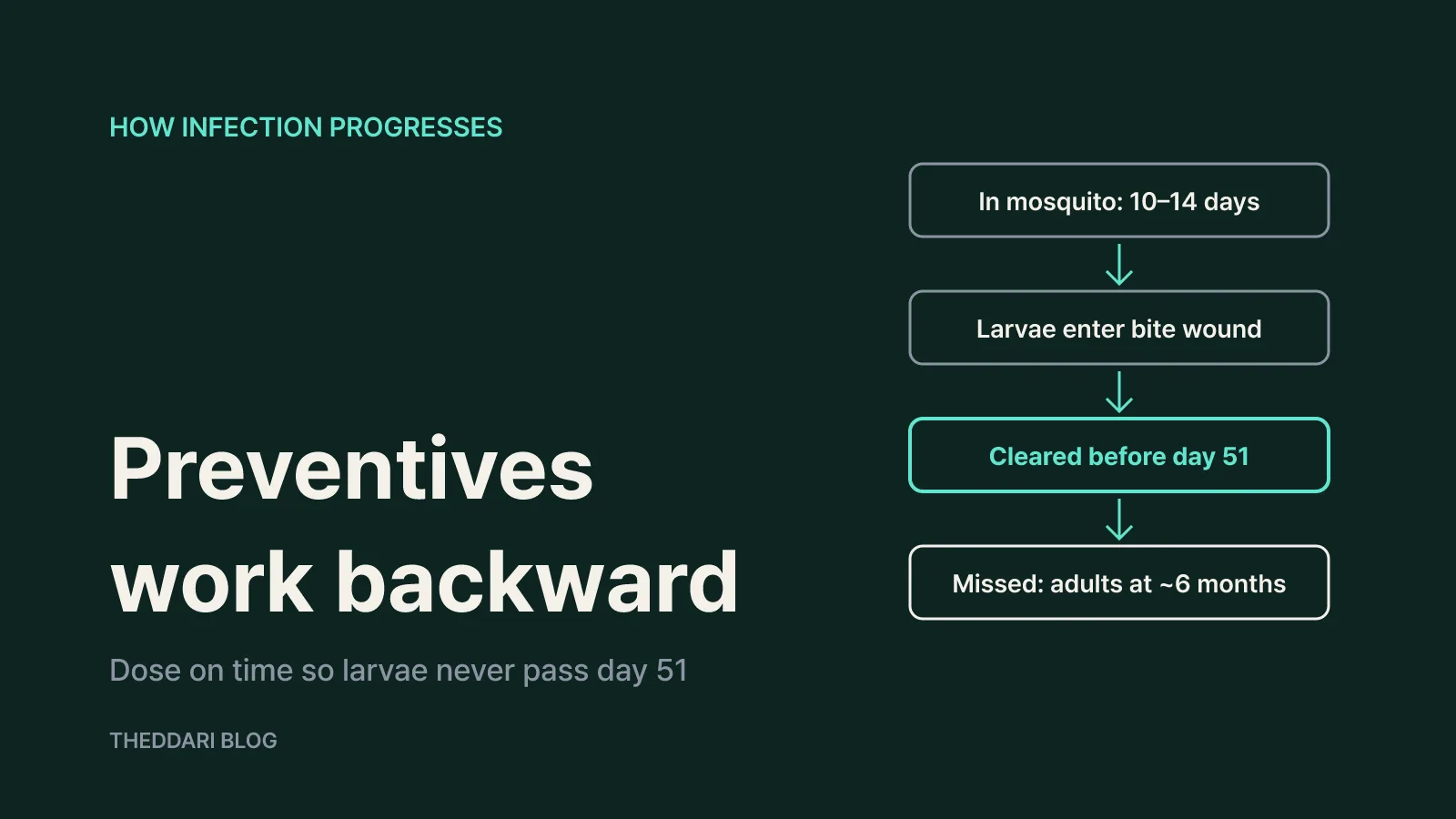
According to the AHS page on heartworm prevention for dogs, preventives work by treating heartworms that already infected the pet within the past month or longer. Chewables, topical spot-ons and the injectable all target the larval stages only. None of them kill adult worms.
The heartworm timeline explains why timing is so strict:
- A mosquito picks up microscopic baby worms (microfilariae) from an infected animal. Inside the mosquito they mature into infective larvae over 10 to 14 days.
- When that mosquito bites your dog, the larvae enter through the bite wound.
- In as little as 51 days, the larvae can molt into a juvenile stage that preventives cannot reliably eliminate.
- After roughly 6 months, they become sexually mature adults. Adult heartworms can live 5 to 7 years in dogs and 2 to 3 years in cats.
All of those figures come from AHS Heartworm Basics. That 51-day window is why AHS insists on giving monthly products monthly and the injectable every 6 or 12 months, on schedule. A late dose can let larvae slip past the stage where the drug works.
The Korean Animal Pharmacy Association column makes the same point from the drug side. Ivermectin, a common oral ingredient, peaks in the blood 3 to 5 hours after a dose and has a half-life of about 1.8 days, so it does not linger. The column describes the drug as effective against larvae up to roughly 30 days after infection and concludes that a 30-day interval is the safest schedule.
In practical terms, if your dog was bitten on a warm afternoon at the end of November, it is the December dose that clears those larvae. Stopping when you stop seeing mosquitoes means skipping exactly the dose that covers the final weeks of the season.
Why risk doesn't drop to zero when mosquitoes vanish
Seasonal dosing is not a baseless idea. The AHS Q&A Can YOU Outsmart a Mosquito? traces it to a 1995 model that assumed larvae need roughly 57°F (about 14°C) to develop inside a mosquito and that mosquitoes live about 30 days. Using weather station data, the model estimated a heartworm season as short as three months near the Canadian border.
AHS lists three problems with relying on that model:
- Mosquitoes vary. Some important vector species live and breed for up to 3 months. The Asian tiger mosquito (Aedes albopictus) is an urban species that adapts to colder weather, and some species overwinter. Larval development inside the mosquito may pause in the cold but resumes quickly when it warms up.
- Weather stations read cold. In a study run from November 2015 to April 2016 at 15 U.S. locations, sheltered spots such as unheated garages and house foundations averaged 8 to 17°F warmer than locations similar to the official stations.
- Cities create heat islands. Buildings and parking lots hold daytime heat, creating microclimates where mosquitoes survive longer.
AHS also notes that infected mosquitoes come indoors, so indoor dogs are at risk too. Transmission does fall in winter, but the risk may never reach zero, and if it does, the timing is nearly impossible to predict. That uncertainty is the core of the year-round recommendation. AHS adds that dogs have been diagnosed with heartworm in every U.S. state, and it recommends year-round prevention even for cold northern states and dry desert regions.
The Korean pharmacy column offers a compromise for owners who are reluctant to dose all year: an adult dog with a reliable monthly history could pause during the two coldest months and resume in the third, with a heartworm test advised if the break stretches past three months. Even that column names year-round dosing as the first choice, and a planned pause only works if you never forget the restart date.
Already stopped for the winter? Test, restart, retest at 6 months
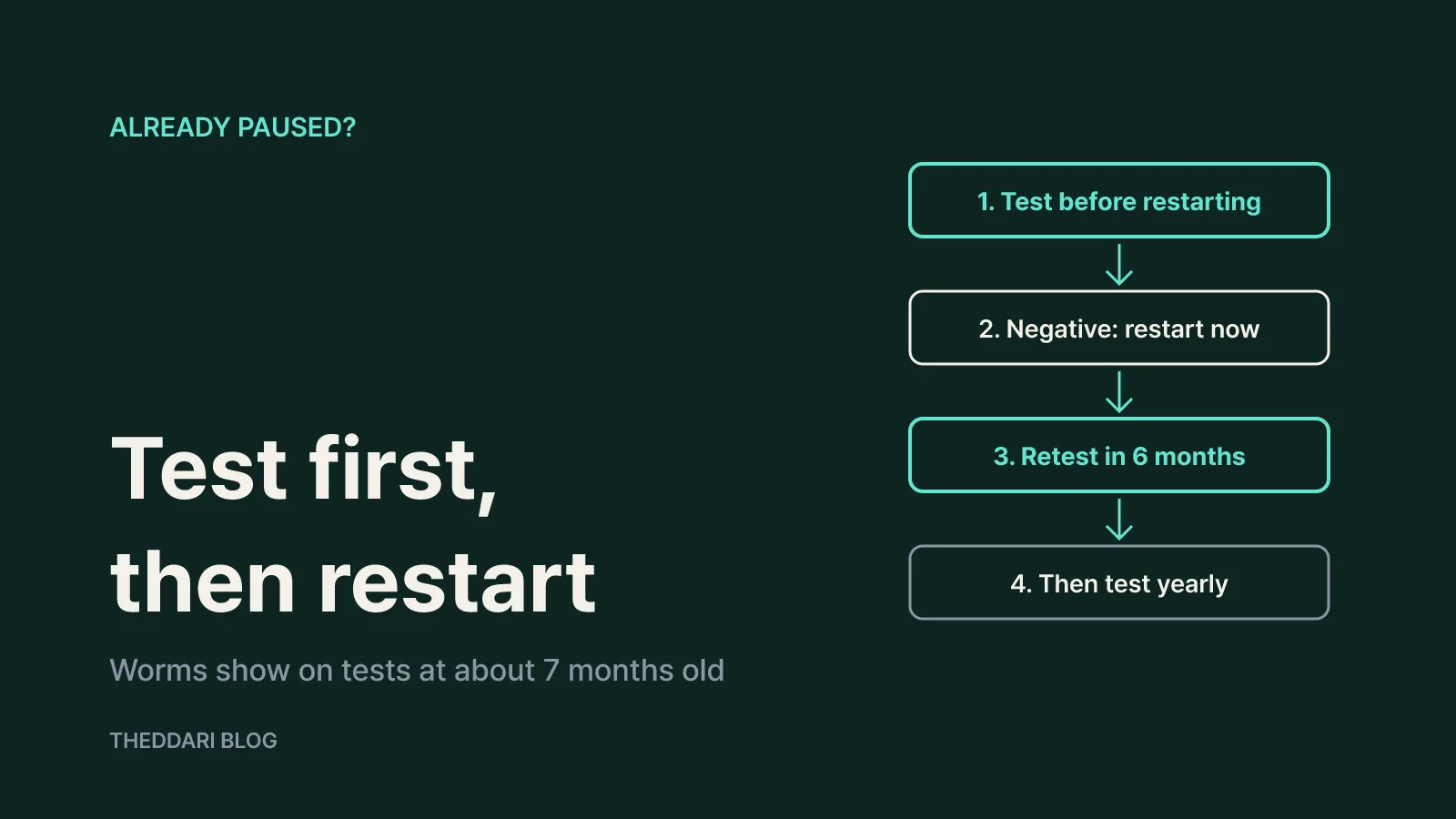
If you have already skipped doses, do not simply open the box and carry on. For a dog that missed two months, AHS says to consult your veterinarian, restart monthly prevention immediately, and retest six months later, because heartworms must be about 7 months old before a test can detect them (AHS Heartworm Basics).
Testing before restarting matters for safety as well. AHS explains that vets test before prescribing because giving a preventive to a dog that already has adult worms can cause rare but potentially severe reactions. The AHS screening article adds that a dog infected less than six months before testing will likely come back negative on both antigen and microfilaria tests. A negative result today means "nothing detected yet," not "definitely clear."
A simple restart plan:
- Find the last dose date from the box, your calendar or a receipt, and tell your vet.
- Test before restarting. Since 2016, AHS has recommended pairing an antigen test with a microfilaria test.
- Restart right away if negative, at the dose for your dog's current weight, on a fixed day each month.
- Retest in 6 months to catch any infection picked up during the gap.
- Return to annual testing once the second test is also negative.
If a test is positive, AHS says the diagnosis should be confirmed with a different test and exercise restricted right away, because physical exertion speeds up damage to the heart and lungs. Treatment centers on an injectable drug (melarsomine) given at the clinic and months of strict rest, which is far more costly and difficult than prevention.
Testing schedule by age and history
← Swipe to see more
| Situation | Starting prevention | Testing |
|---|---|---|
| Puppy under 7 months | No test needed first; start no later than 8 weeks | 6 months after first visit, again 6 months later, then yearly |
| Dog 7 months or older, no prevention history | Test first | At 6 and 12 months, then yearly |
| Adopted dog, unknown history | Test first | Retest 6 months after the first test; yearly if negative |
| Dog already on year-round prevention | Keep going | Once a year |
Puppies can start without a test because an infection takes at least six months to show up. Dosing is by weight, not age, and a fast-growing puppy can jump to the next weight band within weeks, so AHS suggests weighing at every visit and buying one or two doses at a time when a change is coming.
Even dogs on perfect year-round prevention need the annual test. AHS points to dogs that spit out or vomit a pill when no one is watching, topical doses that rub or rinse off, and, less commonly, resistant heartworms. In an AHS survey of U.S. veterinarians, only 72% of canine patients were screened annually.
Cats and indoor pets
Cats get heartworm too, but the disease looks different. Cats are atypical hosts, most worms never reach adulthood, and infected cats typically carry just one to three adults. Even immature worms can cause heartworm associated respiratory disease (HARD). Signs include coughing, asthma-like attacks, periodic vomiting, poor appetite and weight loss, and in some cats the first sign is sudden collapse. The drug used to treat dogs cannot be used in cats and there is no approved feline treatment, which is why AHS calls prevention the only way to protect cats. Cats are screened with both antigen and antibody tests before starting prevention.
A monthly checklist that survives winter
- Pick a fixed day such as the 1st of the month and set a repeating phone reminder.
- Watch after dosing for a few minutes; if your dog vomits the pill, ask your vet whether to redose.
- Check bathing rules on topical products so the dose is not washed away.
- Re-weigh growing or changing dogs to stay in the right dose band.
- Skip expired products; AHS says their safety and effectiveness cannot be predicted.
- Avoid "natural" heartworm preventives; AHS says only FDA-proven products should be used.
- Track injectable dates for the 6-month or 12-month shot.
- Bundle the annual test with vaccinations or a wellness visit.
Many preventives also cover intestinal worms, and some cover fleas or ticks, so dosing through winter keeps that protection going as well.