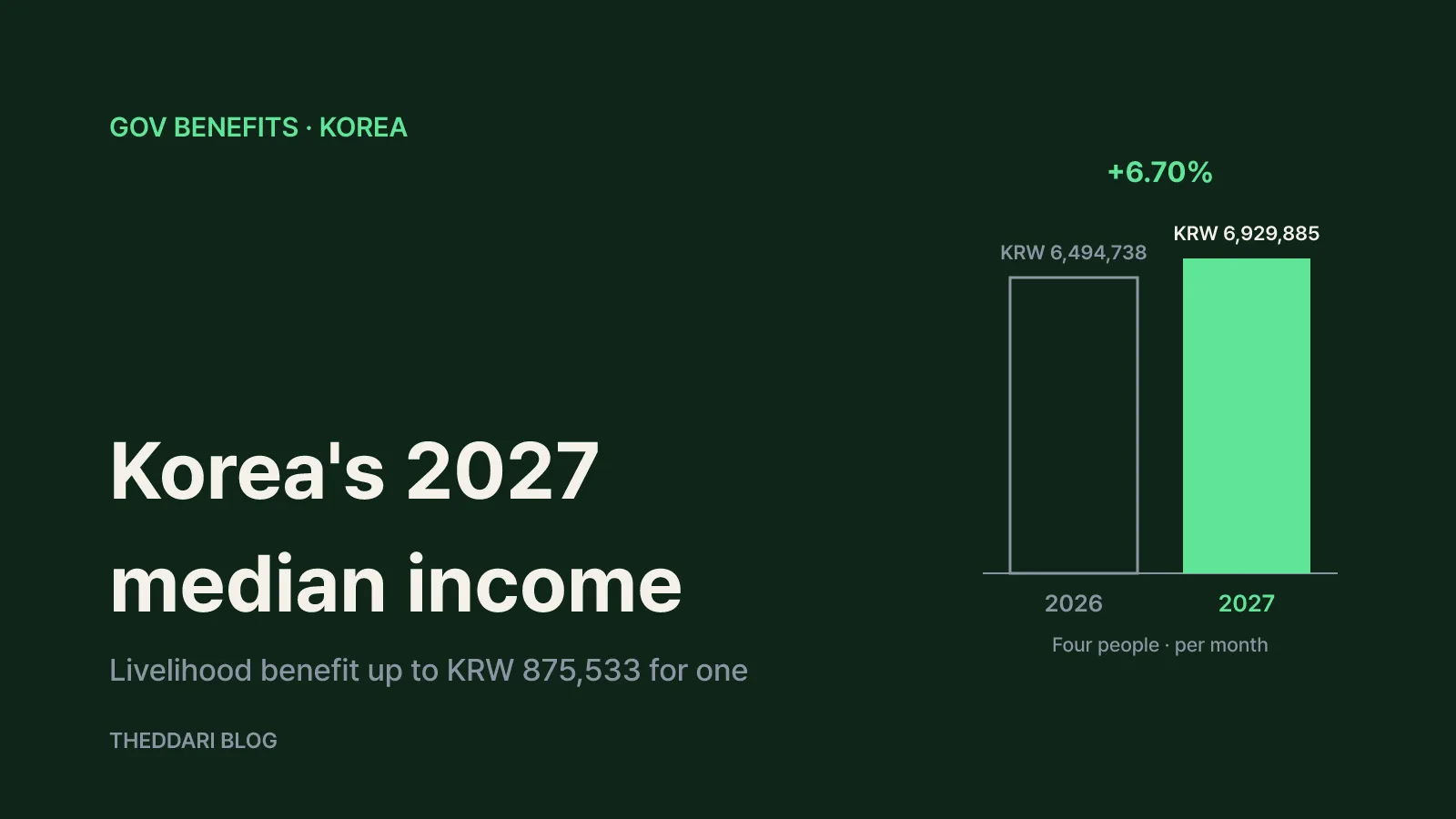
As of October 2026, Korea's standard median income for 2027 is set at KRW 6,929,885 per month for a four-person household and KRW 2,736,042 for a single-person household. That is a 6.70% rise on 2026, the largest increase since the figure was first determined in 2015. Because the four basic livelihood security benefits are pegged to fixed percentages of this number, the 2027 livelihood benefit threshold, which is also the maximum monthly payment, rises to KRW 875,533 for one person and KRW 2,217,563 for four people. The figures below come from the Ministry of Health and Welfare (MOHW) press release of 28 July 2026, issued after the 80th Central Livelihood Security Committee meeting.
All amounts are monthly. The single most common mistake is comparing a salary against these tables: the number that is actually tested is a household's "recognized income", which combines assessed income with a converted value of assets.
What the 2027 standard median income is, by household size
The standard median income (기준 중위소득) is the median household income that the Minister of Health and Welfare announces after review by the Central Livelihood Security Committee. It is the yardstick for the National Basic Livelihood Security System and is used as a selection criterion in 80 welfare programs run by 15 central government ministries. When a Korean benefit notice says "households at or below X% of standard median income", it is referring to this table.
Monthly standard median income, 2026 versus 2027:
- 1 person: KRW 2,564,238 → KRW 2,736,042 (+171,804)
- 2 people: KRW 4,199,292 → KRW 4,480,645 (+281,353)
- 3 people: KRW 5,359,036 → KRW 5,718,091 (+359,055)
- 4 people: KRW 6,494,738 → KRW 6,929,885 (+435,147)
- 5 people: KRW 7,556,719 → KRW 8,063,019 (+506,300)
- 6 people: KRW 8,555,952 → KRW 9,129,201 (+573,249)
The 6.70% rise follows 6.42% for 2025 and 6.51% for 2026. MOHW cited a widening deficit among the bottom 20% of households and a growing income gap as reasons for a large increase.
The calculation method also changed. From 2021 to 2026 the ministry multiplied the previous year's figure by a three-year average growth rate from the Survey of Household Finances and Living Conditions plus an additional catch-up rate. That method has now expired. The new rule starts from the latest three-year average growth rate but allows correction using indicators such as the consumer price index and real GDP growth. For 2027, the committee referenced three-year averages of inflation and real GDP growth because the 2022–2024 survey data had become volatile. The new approach will be reviewed after three years.
Households of seven or more have their own figures; for eight or more, MOHW's recipient selection criteria page explains that each additional member adds the difference between the seven- and six-person amounts.
Benefit thresholds: livelihood 32%, medical 40%, housing 48%, education 50%
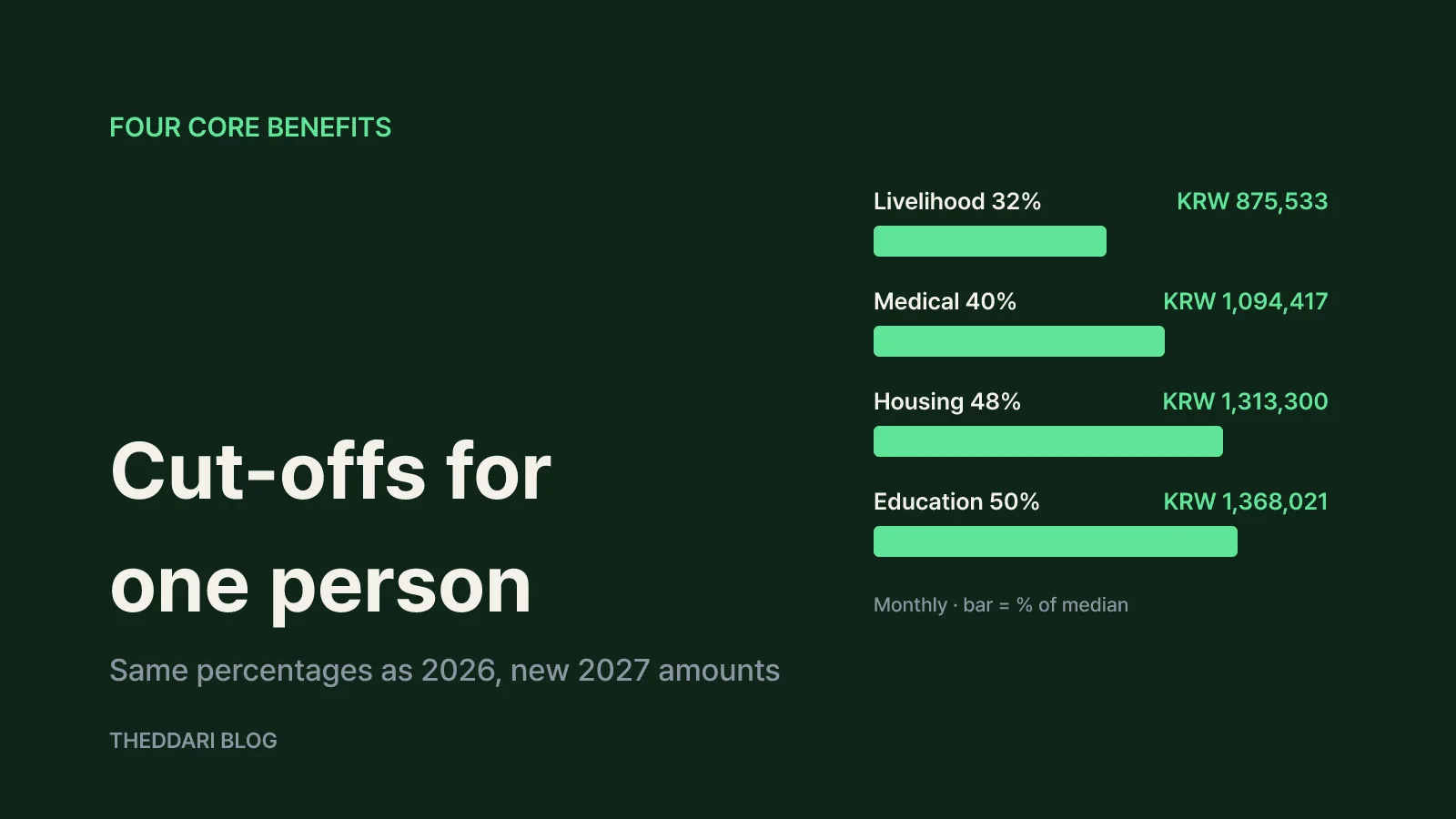
The system has four separate benefits, each with its own percentage of standard median income. The percentages for 2027 are unchanged from 2026, which is why a household can miss the livelihood benefit yet still qualify for housing or education support. Monthly 2027 thresholds, measured against recognized income:
- Livelihood benefit (32%): 1 person KRW 875,533 · 2 people KRW 1,433,806 · 3 people KRW 1,829,789 · 4 people KRW 2,217,563 · 5 people KRW 2,580,166 · 6 people KRW 2,921,344
- Medical benefit (40%): 1 person KRW 1,094,417 · 2 people KRW 1,792,258 · 3 people KRW 2,287,236 · 4 people KRW 2,771,954 · 5 people KRW 3,225,208 · 6 people KRW 3,651,680
- Housing benefit (48%): 1 person KRW 1,313,300 · 2 people KRW 2,150,710 · 3 people KRW 2,744,684 · 4 people KRW 3,326,345 · 5 people KRW 3,870,249 · 6 people KRW 4,382,016
- Education benefit (50%): 1 person KRW 1,368,021 · 2 people KRW 2,240,323 · 3 people KRW 2,859,046 · 4 people KRW 3,464,943 · 5 people KRW 4,031,510 · 6 people KRW 4,564,601
For comparison, the 2026 one- and four-person thresholds were KRW 820,556 and 2,078,316 (livelihood), 1,025,695 and 2,597,895 (medical), 1,230,834 and 3,117,474 (housing), and 1,282,119 and 3,247,369 (education).
For the livelihood benefit, the threshold doubles as the guaranteed minimum, so the maximum payment rises by roughly KRW 55,000 for a single person and about KRW 140,000 for a four-person household. The medical benefit covers recipients' medical costs other than the co-payment portion.
How eligibility is tested: recognized income
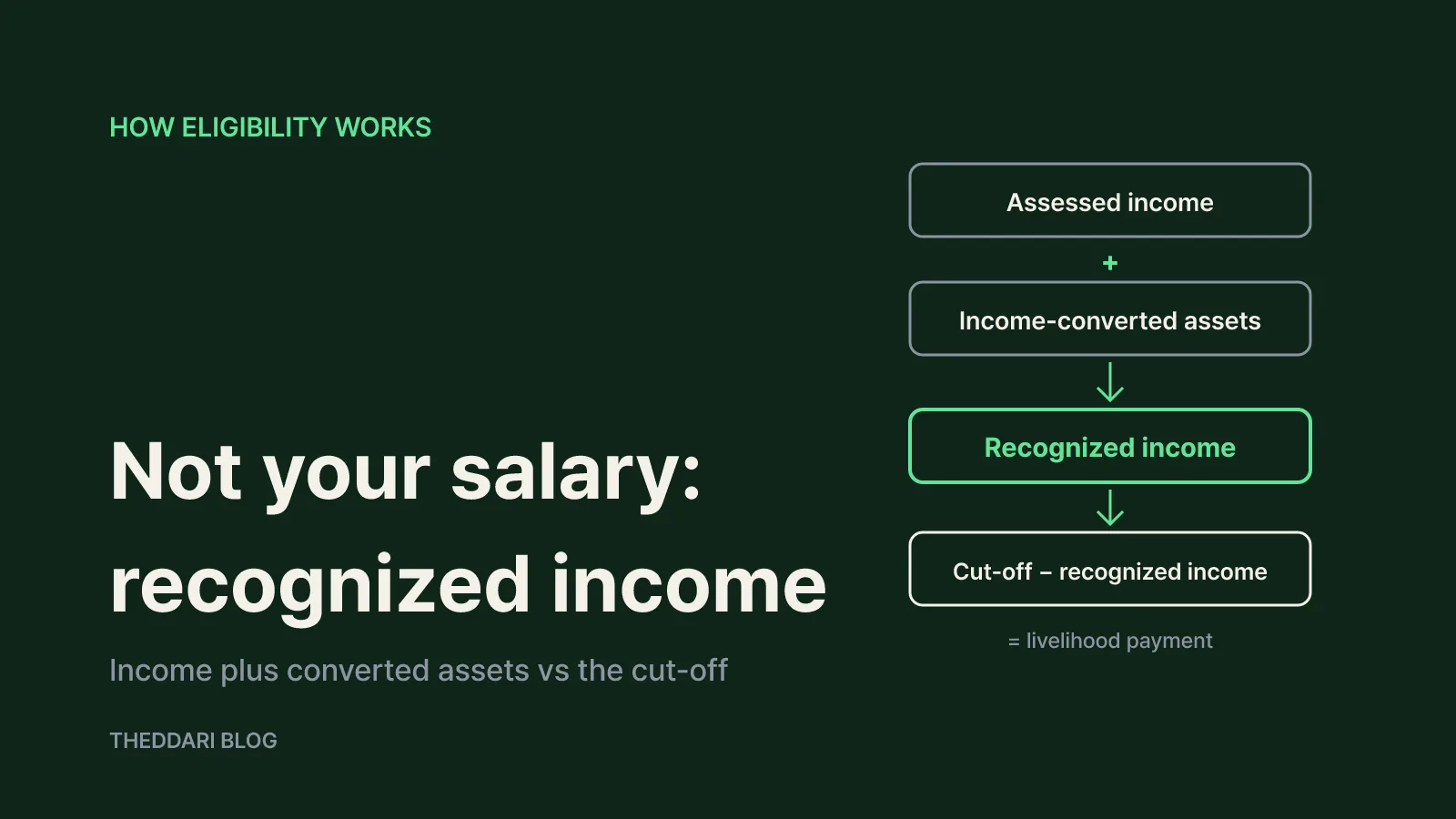
What you compare with the table is not take-home pay but recognized income (소득인정액). MOHW's selection criteria define it as:
- Recognized income = assessed income + income-converted value of assets
- Assessed income = actual income − household-specific expenses − earned-income deduction
- Income-converted assets = (assets − basic asset allowance − debts) × conversion rate
The Government24 livelihood benefit listing adds that a passenger car's value is counted separately and that conversion rates differ by asset type. Two households with the same wages can therefore end up with very different recognized income depending on housing deposits, savings, vehicles and loans.
The livelihood payment is the threshold minus recognized income. Applying the Government24 worked-example method to the 2027 figure, a single-person household with recognized income of KRW 300,000 would receive KRW 875,533 − 300,000 = KRW 575,533 a month. Above the threshold, no livelihood benefit is paid.
Before a consultation, gather each household member's recent earnings and pensions, lease deposits and property, financial assets, vehicle registration details and proof of debts.
Family support obligation rules differ by benefit
Some benefits also test the finances of close relatives, known as the support obligor (부양의무자) rule:
- Housing and education benefits: no support obligor rule. Only the household's recognized income counts.
- Livelihood benefit: applicants are excluded if a first-degree relative living separately, or that relative's spouse, has annual income above KRW 130 million or general assets above KRW 1.2 billion. Government24 expresses the income limit as KRW 10.84 million a month.
- Medical benefit: there must be no support obligor, or the obligor must lack the capacity to support, or support must be unobtainable, for example because of military service, emigration, imprisonment, disappearance or a broken family relationship.
Support obligors are parents, sons and daughters and their spouses, excluding the spouse of a deceased child. Under the medical benefit section, MOHW lists exceptions where the rule is not applied, such as when the obligor's household includes a basic pension recipient or a person with a severe disability, or the applicant is a single-parent household under 30 or a young person leaving care. MOHW said it will review further changes to the obligor system in its fourth basic livelihood security master plan, but nothing has been finalized.
Housing rent caps and education allowances for 2027
Renters receiving the housing benefit are paid up to a reference rent that depends on region and household size. 2027 caps rise by KRW 12,000–50,000 a month. In units of KRW 10,000 per month:
- Tier 1 (Seoul): 1 person 38.1 · 2 people 43.1 · 3 people 51.4 · 4 people 59.6 · 5 people 61.8 · 6 people 73.1
- Tier 2 (Gyeonggi, Incheon): 31.3 · 35.2 · 42.2 · 48.8 · 50.5 · 59.9
- Tier 3 (metropolitan cities, Sejong, special cities outside the capital region): 25.9 · 29.1 · 34.7 · 40.3 · 41.8 · 49.2
- Tier 4 (elsewhere): 23.4 · 26.5 · 31.8 · 36.9 · 38.2 · 45.2
Seven-person households use the six-person cap; eight to nine people add 10%. Homeowners can receive repair support of KRW 5.9 million, 10.95 million or 16.01 million depending on the work required, unchanged from 2026.
Education activity allowances rise by an average of 4.7%. MOHW's proposed 2027 amounts are KRW 513,000 for elementary pupils, KRW 714,000 for middle school and KRW 945,000 for high school, which also covers textbooks, admission fees and tuition.
How to apply and what to bring
Government24 directs applicants to visit their eup, myeon or dong community service center; exact dates can vary by office, and the Ministry's 129 call center handles questions. The livelihood benefit is paid in cash.
Required documents are the social welfare service and benefit application form, a consent form for disclosure of financial information, and identification. Depending on your situation you may be asked for bank details, school enrollment certificates, proof of work capacity, income and asset records, a lease or free-use agreement, vehicle registration, debt records or a statement explaining why relatives do not provide support.
People whose living costs are already guaranteed under other laws, such as residents of homeless self-support facilities or youth shelters, are excluded. Registered foreign nationals can qualify only in specific cases listed by MOHW, including those married to a Korean national who are pregnant or raising a Korean minor child, and recognized refugees.
If you are close to the line, ask at the consultation which year's thresholds will apply at the time your application is assessed.
Using the median income table for other programs
Each of the 80 programs that use standard median income can apply its own percentage and its own way of measuring income, so do not assume the recognized income formula above carries over. Check which year's table a notice uses: 50% of the four-person figure is KRW 3,247,369 on the 2026 table but KRW 3,464,943 on the 2027 table. Confirm household size, look up the 2027 amount for the relevant percentage, estimate recognized income, and then check the support obligor rule where it applies.