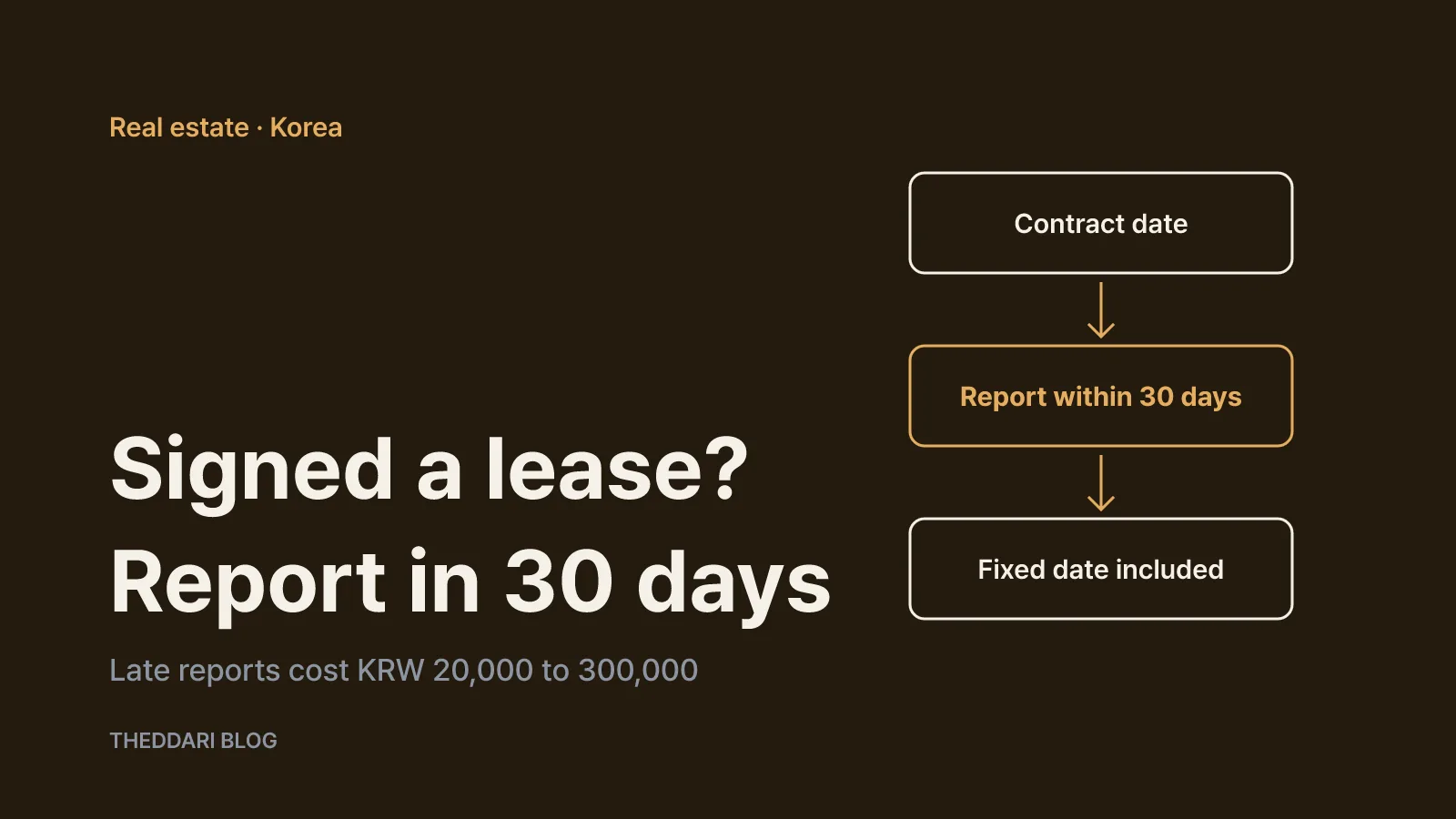
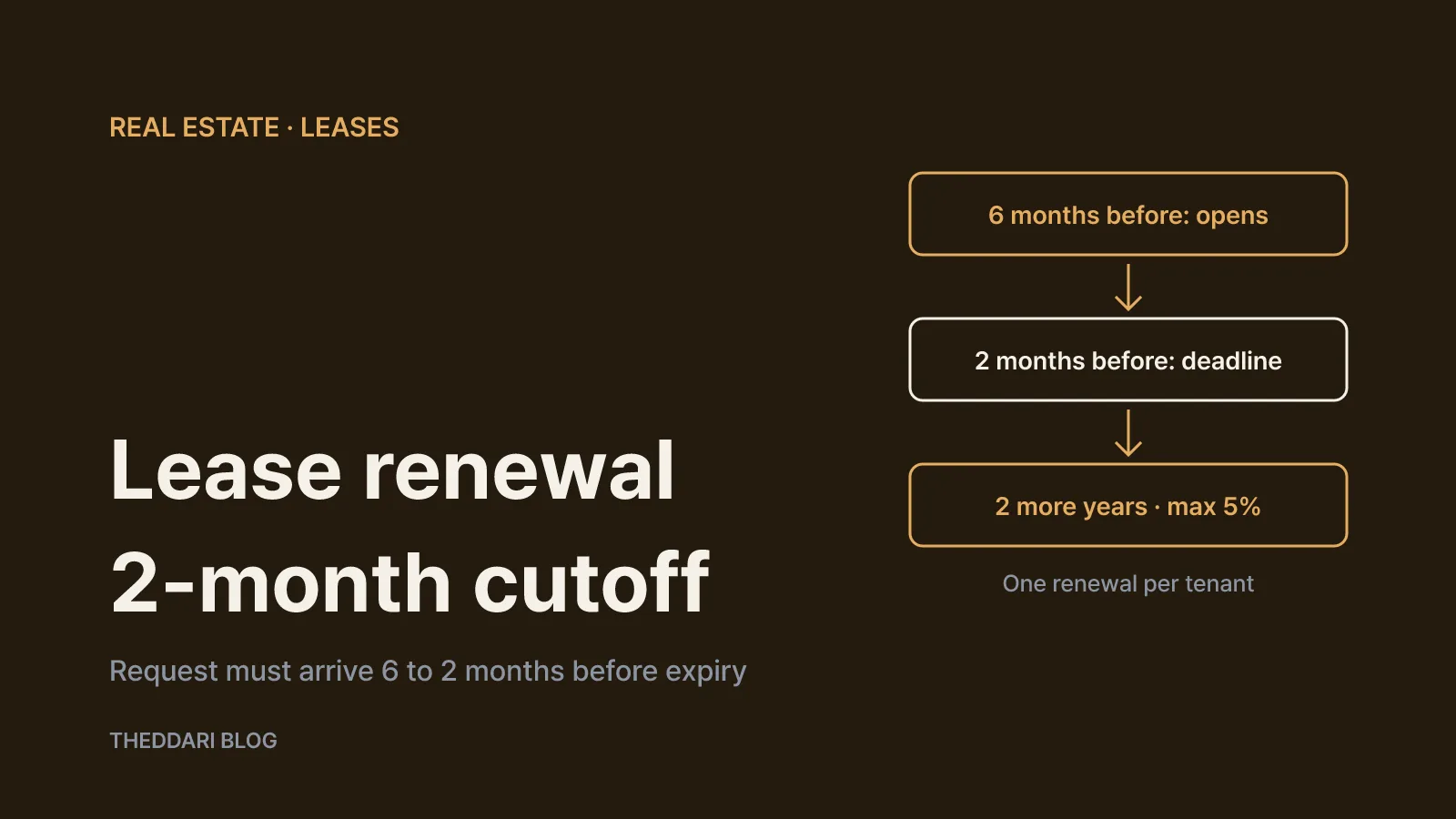
As of October 2026, a residential tenant in South Korea can force one lease renewal by notifying the landlord between six months and two months before the lease ends. The right can be used once, the renewed lease runs for two years, and the landlord cannot raise the deposit or monthly rent by more than 5% (one-twentieth) of the current amount. If your lease ends on December 31, 2026, the government's counting method means your renewal request must reach the landlord by the end of October 30. This guide is based on the current text of Articles 6-3 and 7 of Korea's Housing Lease Protection Act (version in force from January 2, 2026), the Ministry of Government Legislation's plain-language legal guide, and the government's official Q&A on the 2020 amendment. It applies to homes leased in Korea, including jeonse (lump-sum deposit) and monthly-rent (wolse) leases.
When to use the renewal right: six to two months before expiry
Article 6-3 does not state its own window; it borrows the notice period from Article 6(1), which runs from six months to two months before the lease ends. According to the government's legal guide, the two-month cutoff applies to leases first signed or renewed on or after December 10, 2020. Older leases used a one-month cutoff, but any lease signed or renewed today follows the two-month rule. If you are still on a very old contract, check when it was signed and last renewed before relying on either date.
What counts is when your request arrives, not when you send it. The official Q&A explains that the first day is excluded from the count, so the request must reach the landlord before midnight at the start of the corresponding day before expiry. Its example used the old one-month rule: for a lease ending October 30, the request had to arrive before 00:00 on September 30, meaning by the end of September 29. Applying the same method to today's two-month rule:
- Lease ends December 31, 2026: must arrive by the end of October 30
- Lease ends January 20, 2027: must arrive by the end of November 19
- Lease ends March 31, 2027: must arrive by the end of January 30
Do not wait for the last day. Delivery delays or an unread message can turn a valid request into a dispute. A practical habit is to send it at least a week before the cutoff.
If your contract says one year, you are still protected. The Q&A notes that the Act treats any term shorter than two years as two years, so you can stay the full two years and then request renewal within the window before that two-year term ends.
One renewal only, and automatic renewal does not use it up
Under Article 6-3(2), a tenant may exercise the right once, and the renewed lease is deemed to last two years. That is why Koreans often describe the system as "2+2."
Do not confuse it with automatic (tacit) renewal. If the landlord gives no refusal or change-of-terms notice in the six-to-two-month window, and the tenant also stays silent, the lease continues on the same terms. Both the legal guide and the Q&A say this does not count as using the renewal right. A tenant whose lease rolled over automatically can still make one formal renewal demand at the next expiry. The right only counts as used when you clearly state that you are requesting renewal.
There is no required format. The Q&A says a spoken request, text message or email all work, but recommends a method that leaves proof, such as certified-content mail (naeyong jeungmyeong). A clear request includes:
- The property address and current lease dates
- A sentence such as "I request renewal under Article 6-3 of the Housing Lease Protection Act"
- The date and your name
Sending a text first and the same wording by certified mail makes the arrival date easy to prove. A clause in your contract waiving the renewal right has no effect; the Q&A explains that Article 10 voids agreements that disadvantage tenants.
Renewing does not lock you in for two years. Article 6-3(4) applies the automatic-renewal termination rule, so you can give notice at any time and termination takes effect three months after the landlord receives it. You remain responsible for rent during those three months.
How the 5% cap works, plus the one-year rule
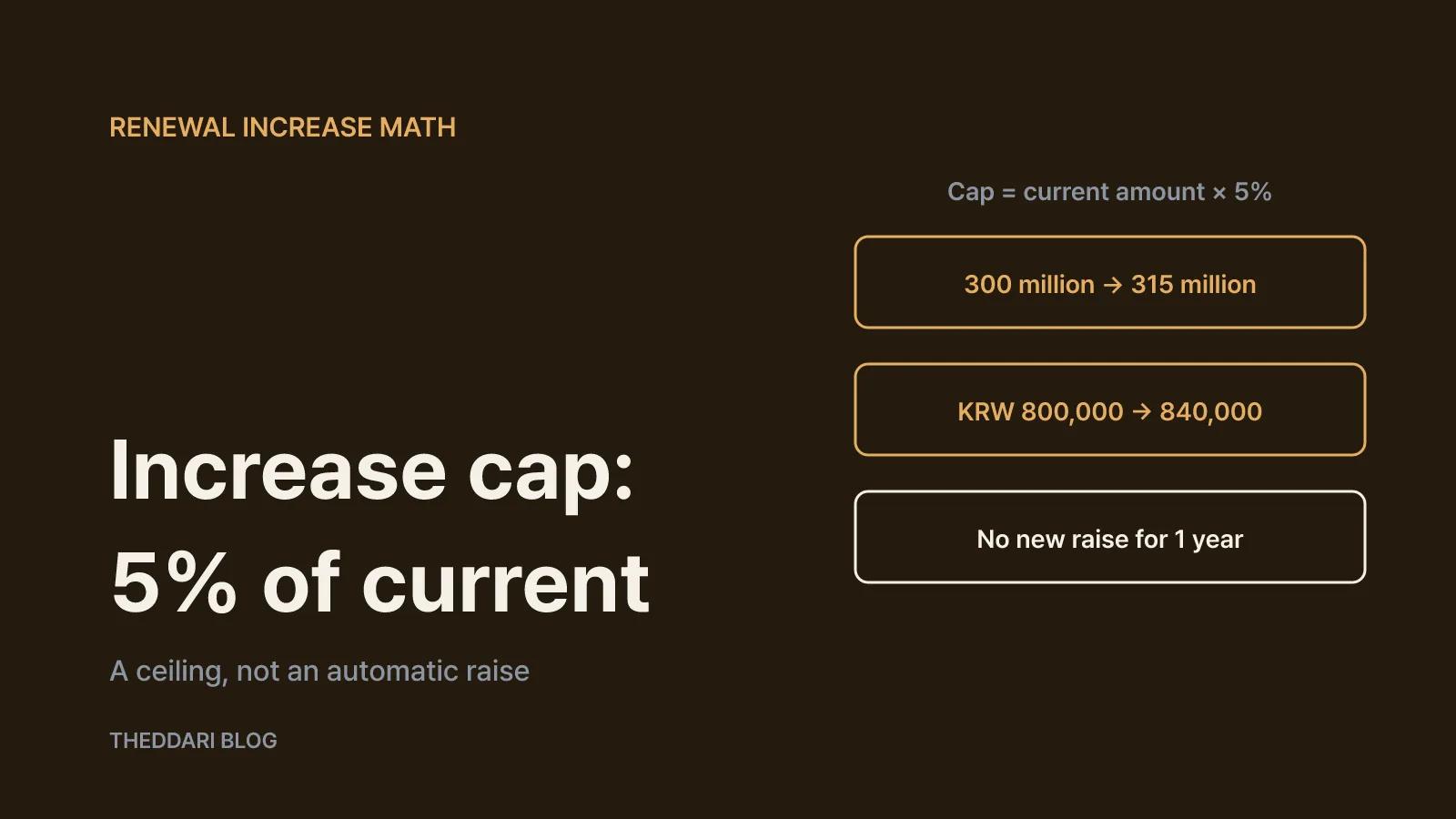
A renewed lease keeps the previous terms, but rent and deposit may change within the limits of Article 7. Article 7(2) says an increase may not exceed one-twentieth (5%) of the agreed rent or deposit. Provincial-level governments may set a lower cap by local ordinance; the legal guide on rent changes says the 5% ceiling applies where no lower local cap exists.
The cap is calculated on the amount in your current contract:
- KRW 300 million jeonse deposit: 5% is KRW 15 million, so the maximum is KRW 315 million
- KRW 800,000 monthly rent: 5% is KRW 40,000, so the maximum is KRW 840,000
Five percent is a ceiling, not an automatic increase. Both government sources say the parties negotiate within that limit. If they cannot agree, either side can apply to the Housing Lease Dispute Mediation Committee or file a rent adjustment claim in court. A tenant can also ask for a reduction if economic conditions make the current rent inappropriate.
Article 7(1) adds a timing rule: no increase may be demanded within one year of the lease or the last increase.
A landlord also cannot unilaterally convert jeonse to monthly rent at renewal, because the renewed lease keeps the same terms. If the tenant agrees to a conversion, the rate cannot exceed the lower of 10% a year or the Bank of Korea base rate plus 2 percentage points.
If a tenant chooses not to use the right and signs a new agreement instead, the Q&A says an increase above 5% is possible and the renewal right remains available for the next expiry. Compare the total cost of both paths before agreeing.
The nine grounds a landlord can use to refuse
Article 6-3(1) lists the only grounds on which a landlord may refuse:
- The tenant has been in arrears for an amount reaching two periods' rent
- The tenant leased the home through deception or other improper means
- The parties agreed and the landlord paid substantial compensation
- The tenant sublet all or part of the home without consent
- The tenant intentionally or through gross negligence damaged the home
- All or part of the home was destroyed so the lease purpose cannot be met
- Demolition or reconstruction requires possession, limited to plans disclosed in detail at signing, safety risks from deterioration, or demolition required by other laws
- The landlord or the landlord's parents, grandparents, children or grandchildren intend to live there
- Other serious breaches by the tenant or grave reasons making the lease hard to continue
Ground 1 refers to arrears that have occurred, so keep rent payments current throughout the lease. Ground 7 has defined conditions; a vague comment that the building may be redeveloped someday does not meet them. The most disputed ground is 8, actual occupancy. If a landlord refuses on that basis, ask for the reason and date in writing and keep it. It is your key evidence if the claim turns out to be false.
Damages when an owner-occupancy refusal is false
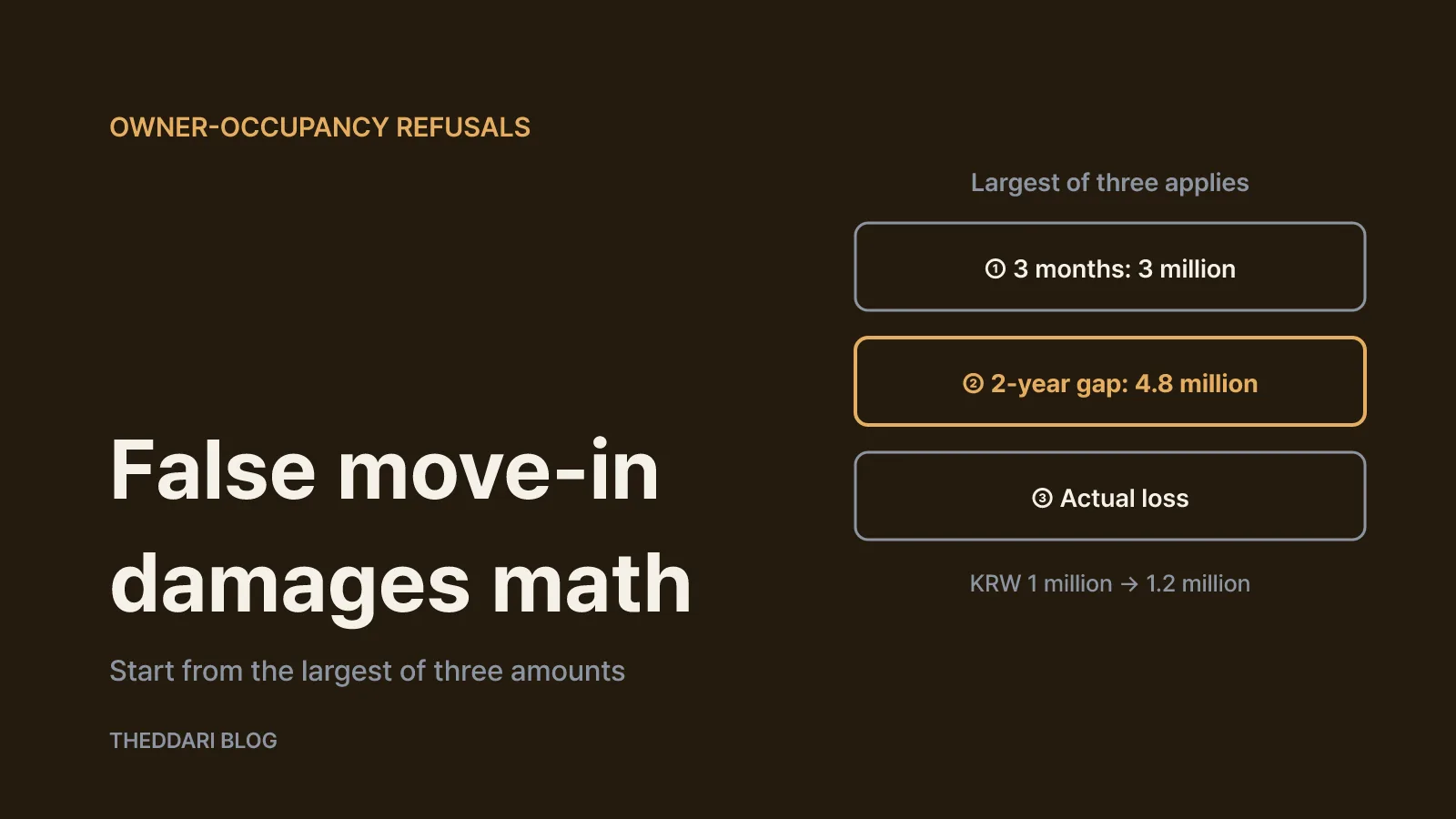
Under Article 6-3(5), if a landlord refuses on owner-occupancy grounds and then, without a justifiable reason, rents the home to someone else before the renewed term would have ended, the landlord must compensate the tenant. Unless the parties agreed on an amount at the time of refusal, Article 6-3(6) sets compensation at the largest of:
- Three months of converted monthly rent at the time of refusal
- Two years of the difference between the new tenant's converted monthly rent and the old converted monthly rent
- The tenant's actual loss caused by the refusal
"Converted monthly rent" means monthly rent plus the deposit converted into monthly rent at the statutory rate. For a simple illustration, assume no deposit and rent of KRW 1 million a month. Item 1 is KRW 3 million. If the landlord re-lets at KRW 1.2 million, item 2 is KRW 200,000 × 24 = KRW 4.8 million. If your real moving and brokerage costs were higher, item 3 could apply. Here the starting point is the largest figure, KRW 4.8 million.
The Q&A defines a justifiable reason as an unforeseeable, unavoidable situation, such as the sudden death of a parent who was going to live there or an unexpected overseas posting. Leaving the home empty can also create liability if the refusal was false, though a short vacancy for repairs before moving in may be excused. Keep refusal messages, moving receipts and your new lease if you plan to pursue a claim.
Before and after renewal: register the deposit increase
A renewal is valid without a new contract, but deposit increases need attention. The legal guide says you should sign a document covering the increased amount and get a fixed date stamp (hwakjeong ilja) on it; only from that date does the increase rank ahead of later creditors. Before agreeing to an increase, pull the property register to check whether a new mortgage has been added. Keep the original fixed date on the existing deposit and add one for the increase only.
A quick checklist:
- Expiry date: mark the lease end date and the two-month cutoff
- Eligibility: confirm the right has not been used before; automatic renewals do not count
- Notice: send by text and certified mail at least a week early
- Amount: negotiate within 5% and check for a lower local cap
- Paperwork: for a deposit increase, check the register and get a fixed date stamp on the increase
- Refusals: get owner-occupancy refusals in writing and keep them
Starting the conversation six months before expiry gives both tenant and landlord time to settle terms without racing the deadline.