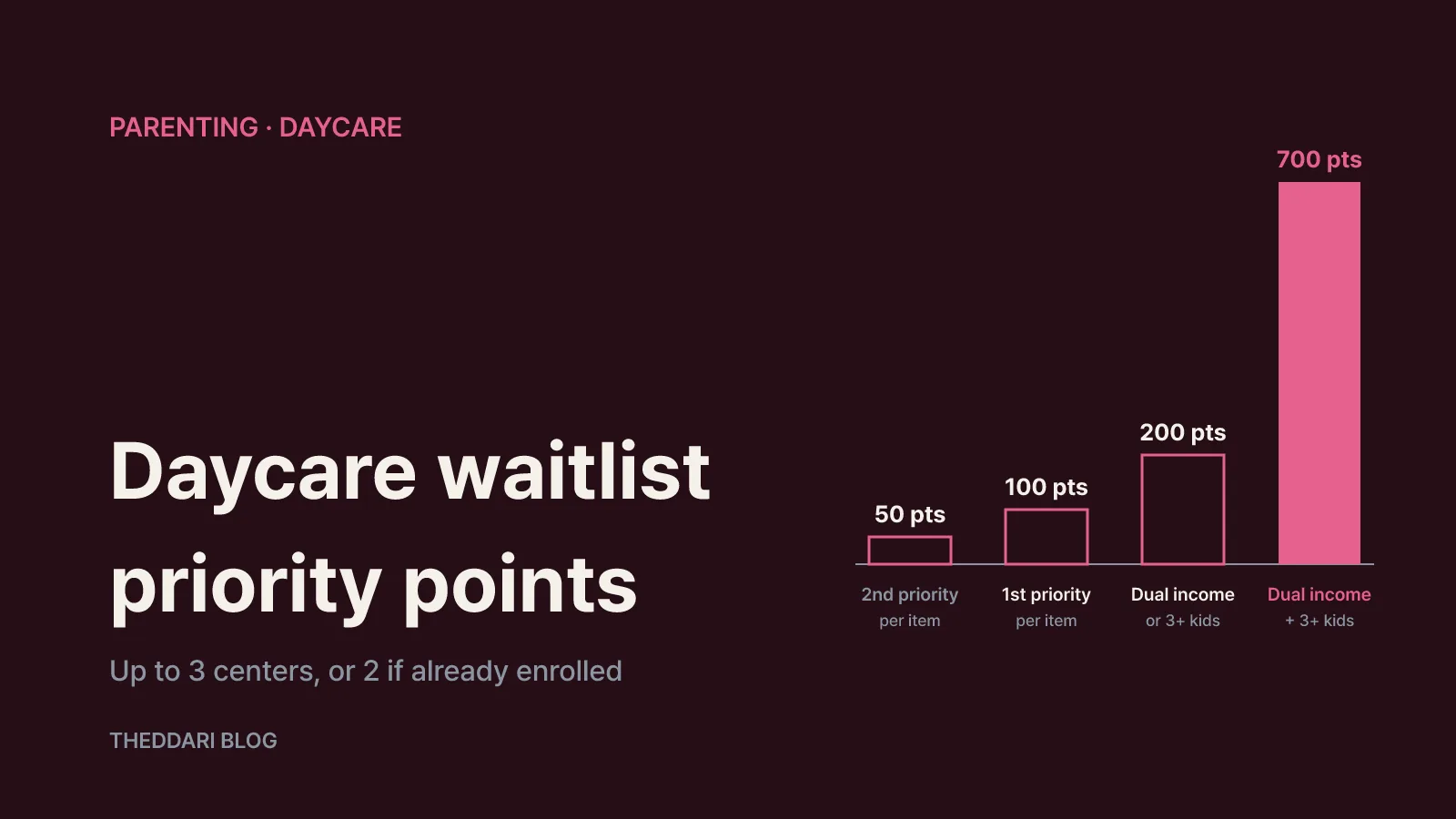
As of October 2026, you can join a daycare (어린이집) waitlist in South Korea at any time of year through the government childcare portal iSarang (childcare.go.kr), where the process is now labelled "registration waitlist" (등록대기). A child who is not attending any daycare can queue for up to three centers, and a child who already attends one can queue for two. What decides your place is mostly a priority score, not how early you applied. Each first-priority item is worth 100 points, except dual-income households and families with three or more children, which earn 200 points each, and households that are both receive 700 points. Second-priority items are worth 50 points, but they only count to break ties between children with the same first-priority score. The rules below come from iSarang's waitlist guide and its priority regulations page.
Who can join a daycare waitlist in Korea, and for how many centers
The waitlist covers every daycare center that applies the national admission priority rules. Workplace daycare centers and parent cooperative centers are excluded. Some workplace centers also admit children from outside the company; those openings are listed separately under iSarang's workplace daycare recruitment menu.
The number of centers depends on your child's current status. According to the iSarang guide, a child currently enrolled somewhere may apply to two centers, while a child not enrolled may apply to three. If your child's current center has filed to close, your child is treated as not enrolled and can apply to three. Eligible ages run from 0 to 5 in Korean childcare age terms, and children with disabilities can be registered up to age 12. The portal assigns the childcare age automatically once your identity is verified.
There are a few exceptions worth knowing. Gyeonggi Province's dedicated infant centers only accept babies up to 18 months old in the month of registration, and a child who passes 18 months while waiting loses eligibility. Children without Korean nationality can join a waitlist but cannot select first- or second-priority items, and because the portal's real-name check does not work for them, families go through the childcare office of their city, county or district.
Your registered address does not need to match where you live; iSarang's FAQ says this causes no disadvantage, and families who are about to move can apply in advance to centers in the new area. Your current daycare also cannot see applications you have made elsewhere.
How the priority score is calculated
The scoring table is short. Each first-priority item is 100 points. Two items are weighted more heavily: a child whose parents are both working or preparing for work (the dual-income item) and a household with three or more children each earn 200 points, and a household that meets both receives 700 points. Each second-priority item is 50 points.
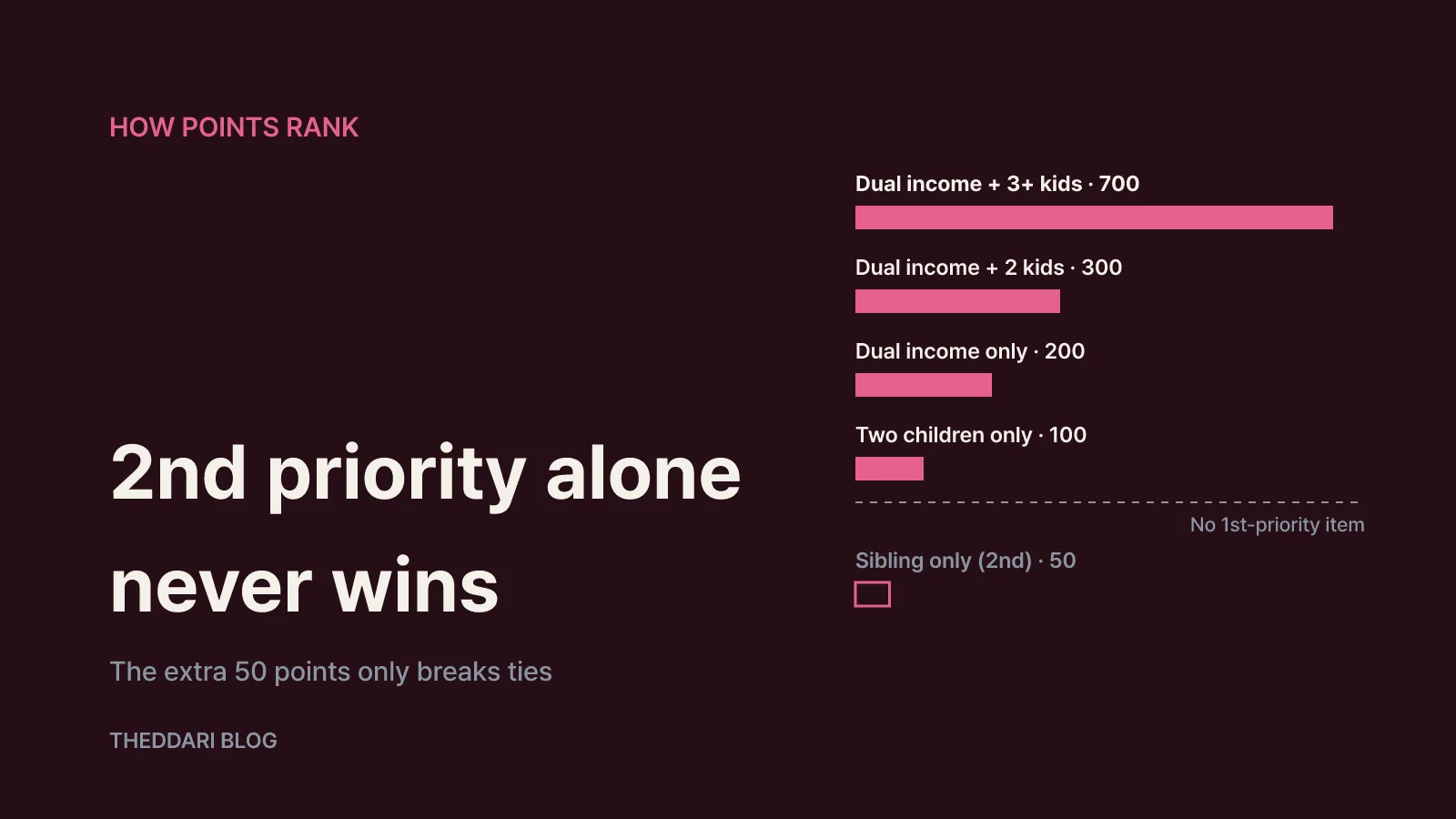
Two rules then shape the queue. First, a child with only second-priority items can never rank above a child with any first-priority item, even if the point totals are equal or higher. Second, second-priority points are added only when first-priority scores are tied. Applying those rules gives results like these:
- Dual income only: 200 points
- Dual income plus a two-child household: 200 + 100 = 300 points
- Dual income plus three or more children: 700 points
- Two-child household only: 100 points
- Sibling already at the same center (second priority) only: 50 points, always behind first-priority children
- Two dual-income children tied at 200, one with a sibling at the center: the extra 50 points moves that child ahead within the tie
Other first-priority items include households receiving basic livelihood benefits, children of single parents eligible for support under the Single-Parent Family Support Act, near-poverty households at or below 50% of the median income, children of a parent or with a sibling who has a severe disability, children of multicultural families, children of a pregnant mother, and children with type 1 diabetes. Items such as benefit recipients and supported single-parent status are linked automatically from government records, so you cannot tick them yourself. Third priority covers every other child.
Dual-income status: the 200-point item and its documents
Because dual income carries the most weight, a paperwork mismatch can cost you a lot of places. The priority regulations define work as at least 60 hours a month for each parent, proven with both an employment document and an income document. For employees that means one of an employment certificate, employment contract or engagement contract, plus one of an employment insurance record, workplace health insurance record, national pension enrolment certificate, earned income withholding receipt or income certificate.
The edge cases are where families get caught out:
- Parents on leave, including parental leave, count as working.
- In a single-parent household, the parent working or preparing for work qualifies as dual income.
- Unpaid family workers do not count as employed.
- Self-employed parents need business registration proof and income equivalent to 60 hours a month; property rental businesses are not accepted. Co-owned couples must both be documented, except in farming and fishing, where one spouse may qualify.
- Job seekers need a single in-person training course of at least three months that is ongoing at the start date, or one completed within six months before it, or a job-seeker registration held for at least three months before the child starts.
- University and graduate students qualify with an enrolment certificate, but students on leave and those at remote universities without regular in-person classes do not. Artists can use a valid artist activity certificate instead of income proof.
One detail matters more than people expect: the dual-income flag does not update itself. The FAQ says parents must switch it on or off themselves in the waitlist child registration screen when their situation changes, for example after returning to work or leaving a job. For questions about eligibility, the portal points to the Ministry of Education's civil complaints line at 02-6222-6060, option 1.
Multi-child, pregnancy and second-priority items
The multi-child item covers households with three or more children or with two children. What matters is timing: iSarang checks priority status as of the registration date, and the Government24 listing describes the same rule as the admission date. In other words, the condition must be true when your child is actually enrolled, not when you apply. A resident registration copy or family relationship certificate serves as proof.
Pregnancy is handled two ways. If the mother is still pregnant when the child starts daycare, use the pregnant-mother item with a doctor's note. If the baby has already been born, choose the two-child or three-plus-child item instead. If a second or later baby is due before the start date and can be registered at birth by then, the multi-child item can be selected with a medical certificate showing the due date.
Second priority has three items: single-parent families not covered by the first-priority category, children in foster care or adopted children, and siblings of a child already enrolled at the same center. The sibling must be attending on the registration date, so it does not apply for a March new-term start if the older child leaves to begin elementary school.
Aiming for the March new term? Set the desired start month
Most families who join a waitlist in October or November are targeting the following March, when the new term begins. The setting to check is the desired start month. Under iSarang's waitlist notes, the regular queue ranks children whose desired start month falls by the following month. March admissions are ranked separately as a new-term queue that includes children whose desired month is any time up to March of that year. If you want a March 2027 place, make sure the month is not set later than March 2027.
The process runs in six steps: register your child, search for centers, submit the waitlist request, the center confirms candidates by queue order, you submit priority documents, and the director verifies anything not linked automatically before enrolling children in order. Documents can be handed to the center or uploaded on iSarang.
Before applying online, sort out your digital certificate. The Government24 listing describes signing up for iSarang, registering a certificate on your account page, consenting to personal data use, then registering your child and applying. Consent only works with the certificate of the account holder, not a spouse's. You can also apply in person at the center.
The 7-day rule after you are offered a place
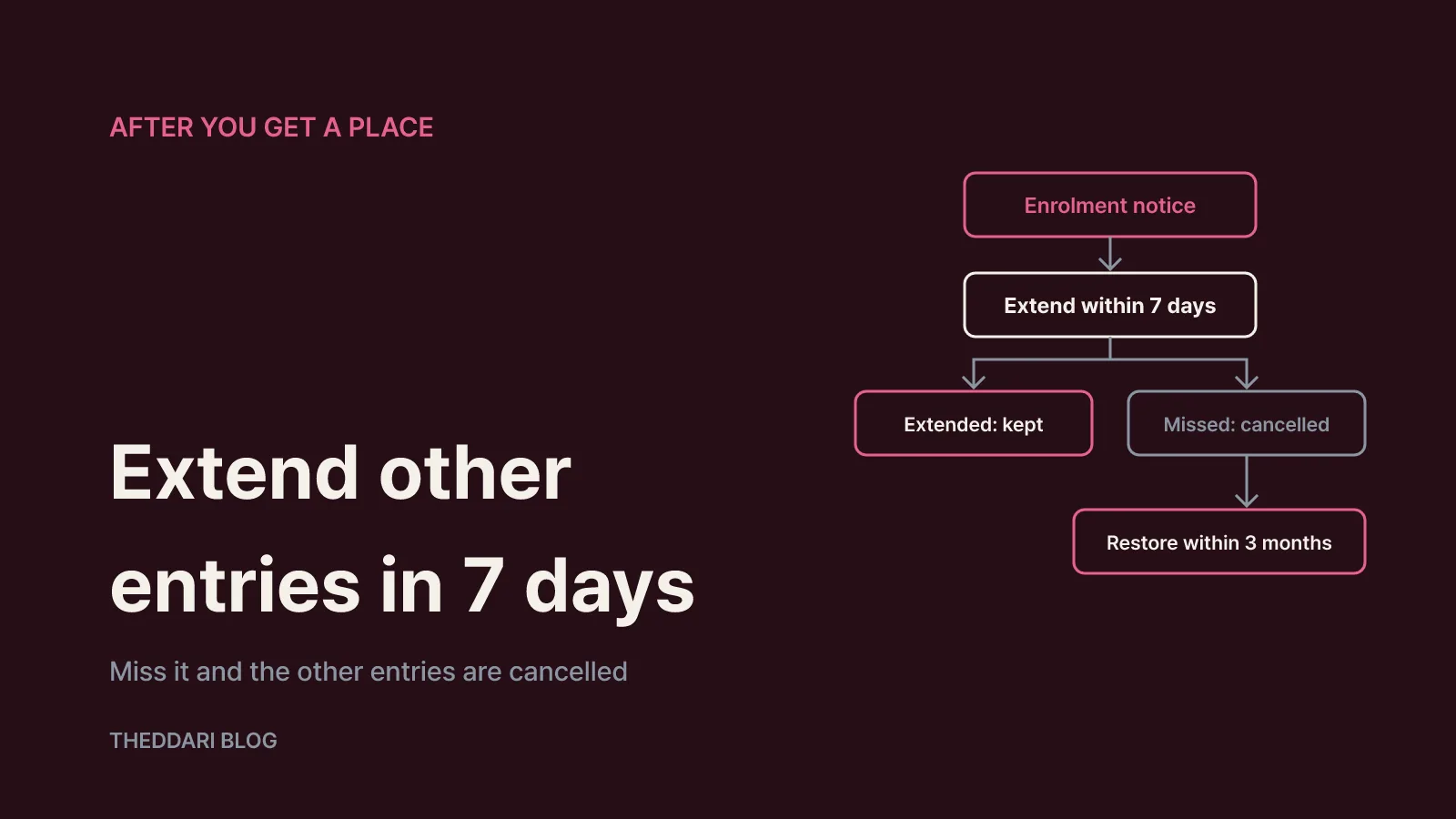
When your child is enrolled at one center, iSarang sends a notice about starting and extending your other waitlist entries. If you want to keep queuing elsewhere, for example for a public center you prefer, you must extend those entries within seven days of the notice in the waitlist status screen. Otherwise the system cancels them automatically.
Cancelled or deleted entries can be restored within three months using the restore button on the cancellation tab, and the original details come back. After three months, contact your local government office.
If both parents applied from separate accounts, neither can see the other's entries. When you see a message saying your child is already on a waitlist, check your spouse's account first. Technical help is available from the iSarang help desk at 1566-3232, option 1.