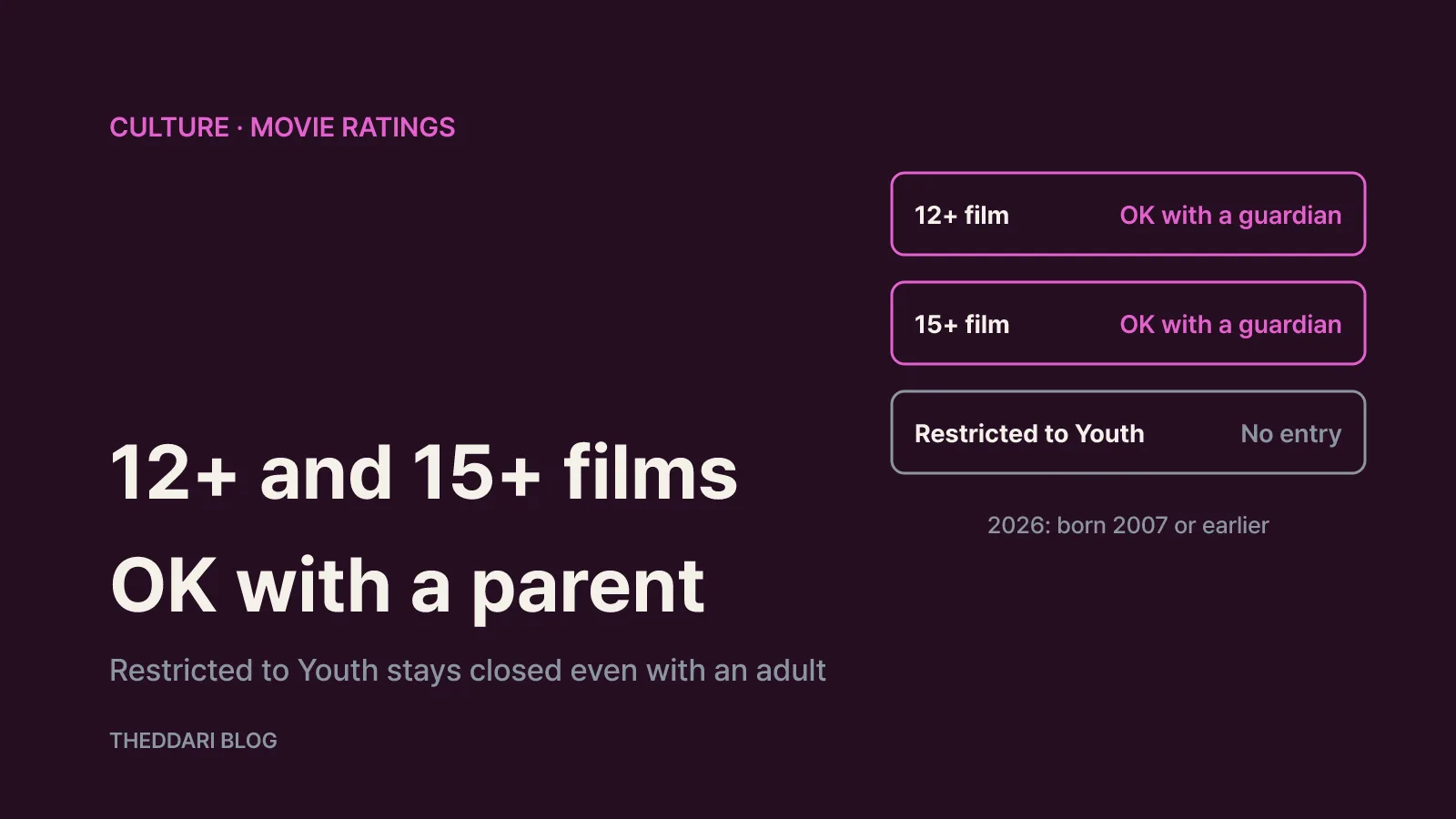
As of October 2026, the short answer is this: in South Korea, a child who is too young for a 12+ or 15+ film may still enter the cinema if a parent or other guardian watches with them. Films rated Restricted to Youth (often shown as 19+) and Restricted Screening are different: young people cannot be admitted even when an adult comes along. These are not house rules that vary by chain. They come from Article 29(4) and 29(5) of Korea's Promotion of Motion Pictures and Video Products Act, which you can read in the National Law Information Center.
If you are a parent living in Korea, a visitor planning a family cinema trip, or a teenager wondering why the box office turned you away, the confusing part is usually not the rating labels themselves. It is how the exceptions work and how age is counted. This guide walks through the official text, the Korea Media Rating Board's own explanation, and guidance from the Ministry of Government Legislation.
The five Korean film ratings and where a guardian helps
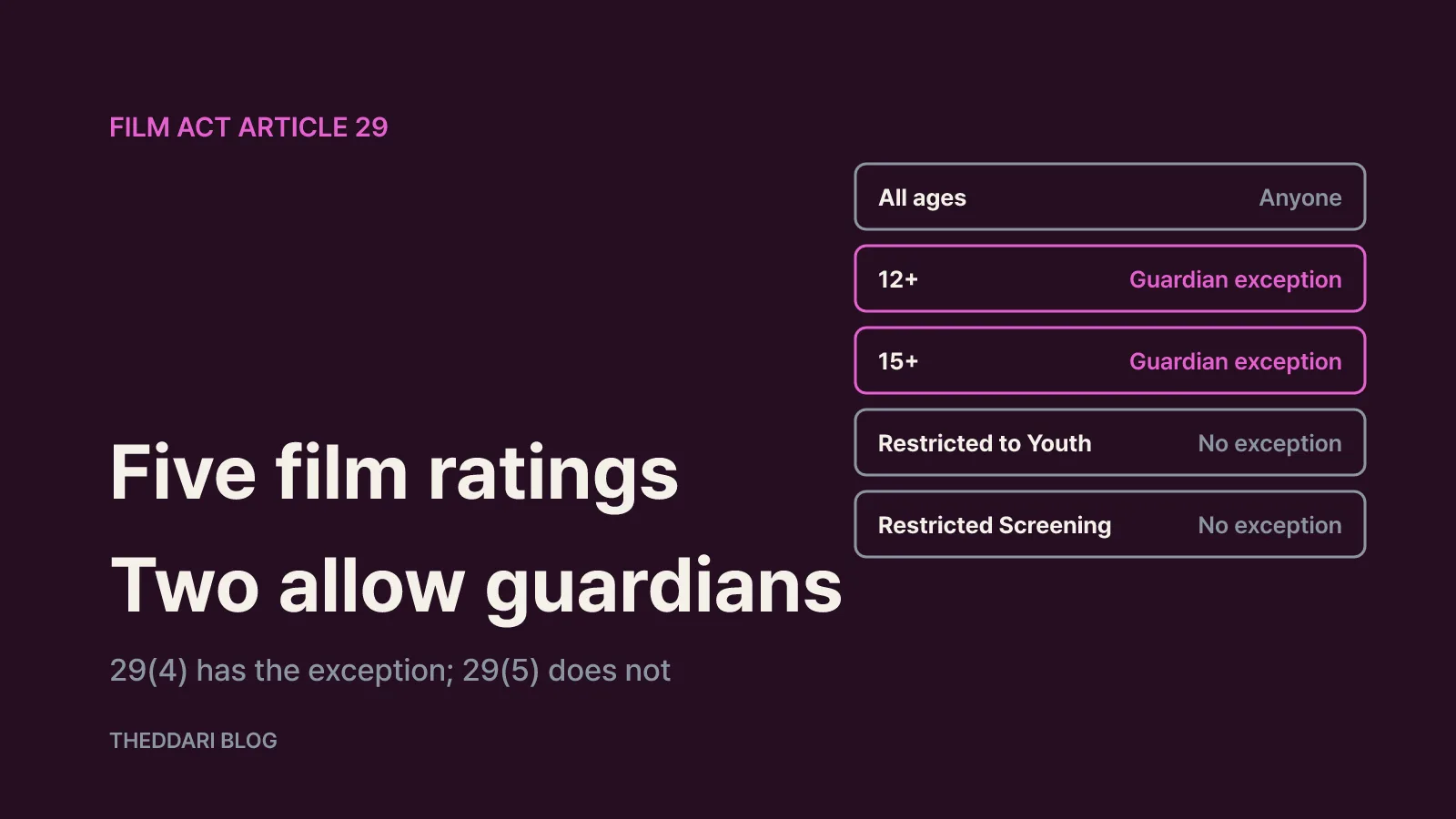
Article 29(2) of the Act, in the version in force since May 12, 2026 (Act No. 21093), sorts films into five classes:
- All ages: anyone may watch.
- 12+: for people aged 12 and over. Younger viewers may enter with a parent or guardian.
- 15+: for people aged 15 and over. The same guardian exception applies.
- Restricted to Youth: young people may not watch. There is no guardian exception.
- Restricted Screening: films whose content is considered extreme enough that screening and advertising are limited. Young people may not be admitted.
The structure of the law explains the difference. Article 29(4) says nobody may admit a person who has not reached the age for a 12+ or 15+ film, and then adds a proviso: this does not apply when the viewer watches accompanied by a parent or other guardian. Article 29(5) simply says nobody may admit young people to a Restricted to Youth or Restricted Screening film. It has no proviso at all. So bringing an adult only unlocks the two middle ratings.
The Korea Media Rating Board (KMRB) describes this as its guardian-accompanied viewing system. Cinemas check ages before entry, and under-age viewers can be admitted to 12+ and 15+ films only when accompanied by a parent or guardian. KMRB separately states that young people are barred from Restricted to Youth and Restricted Screening films.
12+ and 15+ films: under-age kids can go with an adult
The Ministry of Government Legislation's plain-language legal portal, Easylaw (content dated September 15, 2026), uses elementary school students as its example. On their own they are limited to All ages films, but with a parent they can watch both 12+ and 15+ films. The law does not set any minimum age under the guardian exception; it looks only at the rating and whether a guardian is present.
Age for these two ratings is counted in completed years, the international way, so a birthday matters. Theater guidance reflects this. The CINE Q cinema FAQ describes a 12+ film as one that viewers under 12 in completed years cannot watch, and a 15+ film the same way for those under 15, while noting that children may attend both with a guardian. In practice, a 14-year-old whose birthday has not yet come around may be stopped at a 15+ film if they show up with friends rather than a parent. Groups of teenagers should check everyone's age before booking.
What counts as a guardian? The article says "a parent or other guardian" and does not list relatives such as grandparents or adult siblings. Because the wording leaves room for interpretation, cinemas may handle non-parent adults differently. If a grandparent, aunt or adult cousin is taking a child, ask the cinema's customer service before you book.
The guardian also has to watch the film. The proviso covers viewers who watch accompanied by a guardian, so buying a ticket for a child and leaving them at the door does not qualify. The adult should hold a ticket for the same screening and go in together.
Restricted to Youth: it is the birth year that counts
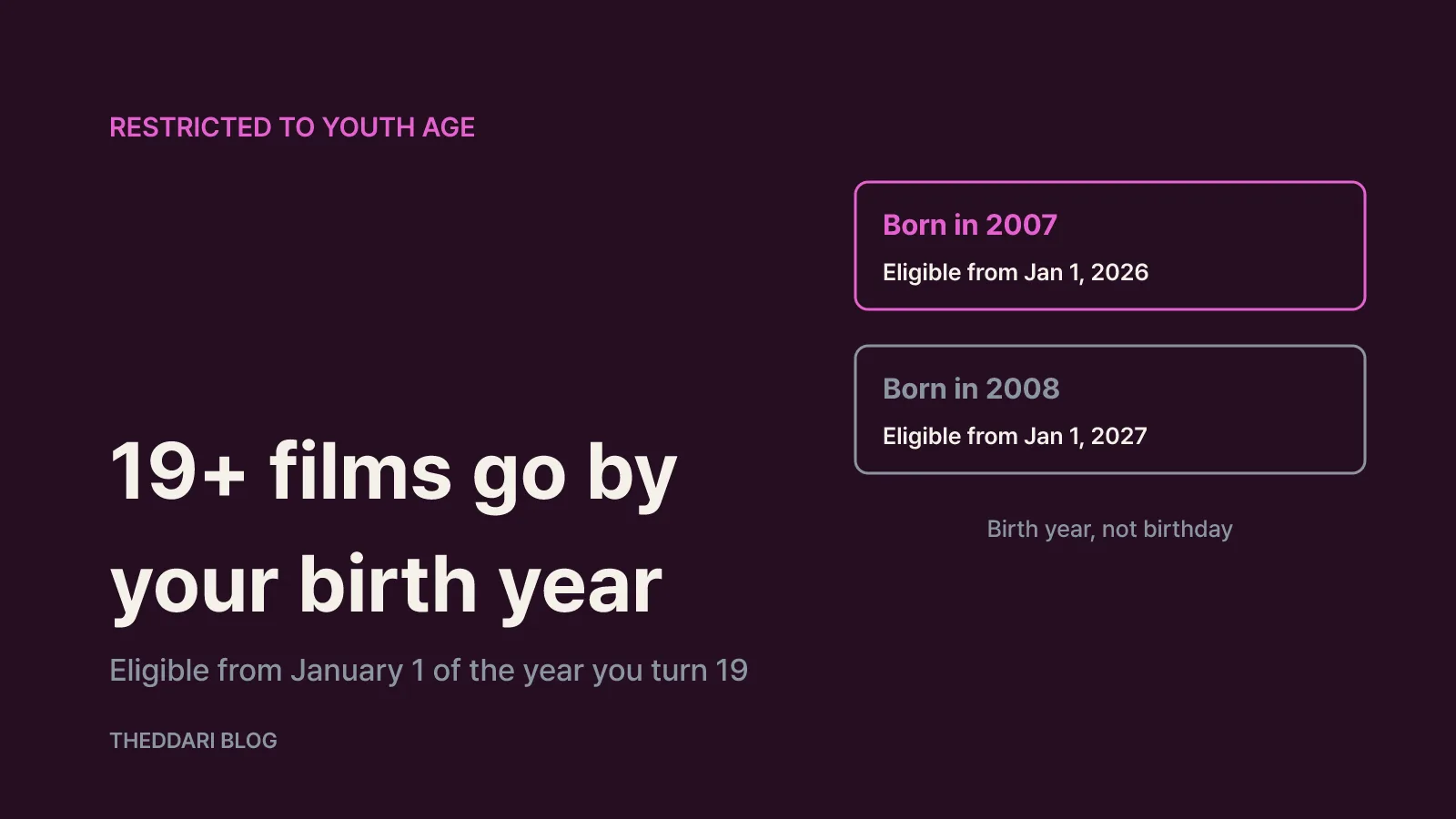
For the Restricted to Youth rating, "youth" has a specific legal meaning set out in Article 2(18) of the Act. According to KMRB, a youth is a person under 19, excluding anyone who has reached January 1 of the year in which they turn 19. That means the test is your birth year, not your birthday.
Applied to 2026: people turning 19 this year were born in 2007. So anyone born in 2007 stopped being a youth on January 1, 2026, even if their birthday falls in December, and may watch Restricted to Youth films. Anyone born in 2008 remains a youth for all of 2026, whether or not their birthday has passed, and becomes eligible on January 1, 2027. The CINE Q FAQ repeats the same January 1 rule.
A simple way to remember it: 12+ and 15+ use your age on the day; Restricted to Youth uses the year you were born.
Can a parent override this? No. In a card-news explainer on Korea.kr, the Ministry of Government Legislation states that young people cannot watch Restricted to Youth or Restricted Screening films even with a guardian, citing Article 8(1) of the Juvenile Protection Act and Article 29(5) of the film act. Parental consent or buying the tickets together does not change what the cinema is allowed to do.
Before you go: ID and booking checks
KMRB notes that cinemas confirm age before entry, and cinema guidance tells viewers to bring identification. Since being refused at the door is hard to fix on the spot, run through these steps first:
- Check the rating on the booking page. If you are unsure, KMRB's website has a rating search where you can look up a title.
- Write down everyone's age in completed years. For 12+ and 15+ films, anyone short of the age needs a guardian booked into the same screening.
- For Restricted to Youth films, check birth years. In 2026, the cut-off is being born in 2007 or earlier. A guardian cannot fix this, so pick a different film if someone in the group does not qualify.
- Carry ID. Young adults watching Restricted to Youth films may be asked to prove their age. Visitors should bring a document showing their date of birth.
- Ask ahead if the adult is not a parent. How cinemas confirm "other guardians" can vary.
Trailers, film festivals and streaming
Ratings are not just for the main feature. Article 29(1) requires trailers and advertising films to be rated before screening. Under the proviso to Article 29(2), advertising films shown before or after a feature can only be rated All ages, trailers can only be rated All ages or Restricted to Youth, and Restricted to Youth trailers may only run before or after Restricted to Youth films. A family at a 12+ screening should not see a 19+ trailer under this rule.
Film festivals need a separate check. Article 29(1) exempts films screened at festivals recommended by the Korean Film Council from the rating requirement, so festival titles may have no KMRB rating at all. If you are taking children, look for the age guidance the organizer gives for each title.
Streaming and TV at home work differently from cinema entry. KMRB uses the same rating names for films and video products, but the guardian proviso in Article 29(4) is a rule about admission to cinemas. At home nobody checks age at a door, so profile age limits and parental controls in streaming apps become the real gatekeeper. For broadcast TV, the Enforcement Decree of the Juvenile Protection Act sets youth-protection hours. According to the Ministry of Government Legislation explainer, these run from 7 to 9 a.m. and 1 to 10 p.m. on weekdays, and 7 a.m. to 10 p.m. on Saturdays, public holidays and school vacations.
The two rules worth remembering: 12+ and 15+ open up when a guardian watches too, and Restricted to Youth opens only when the birth-year test is met.