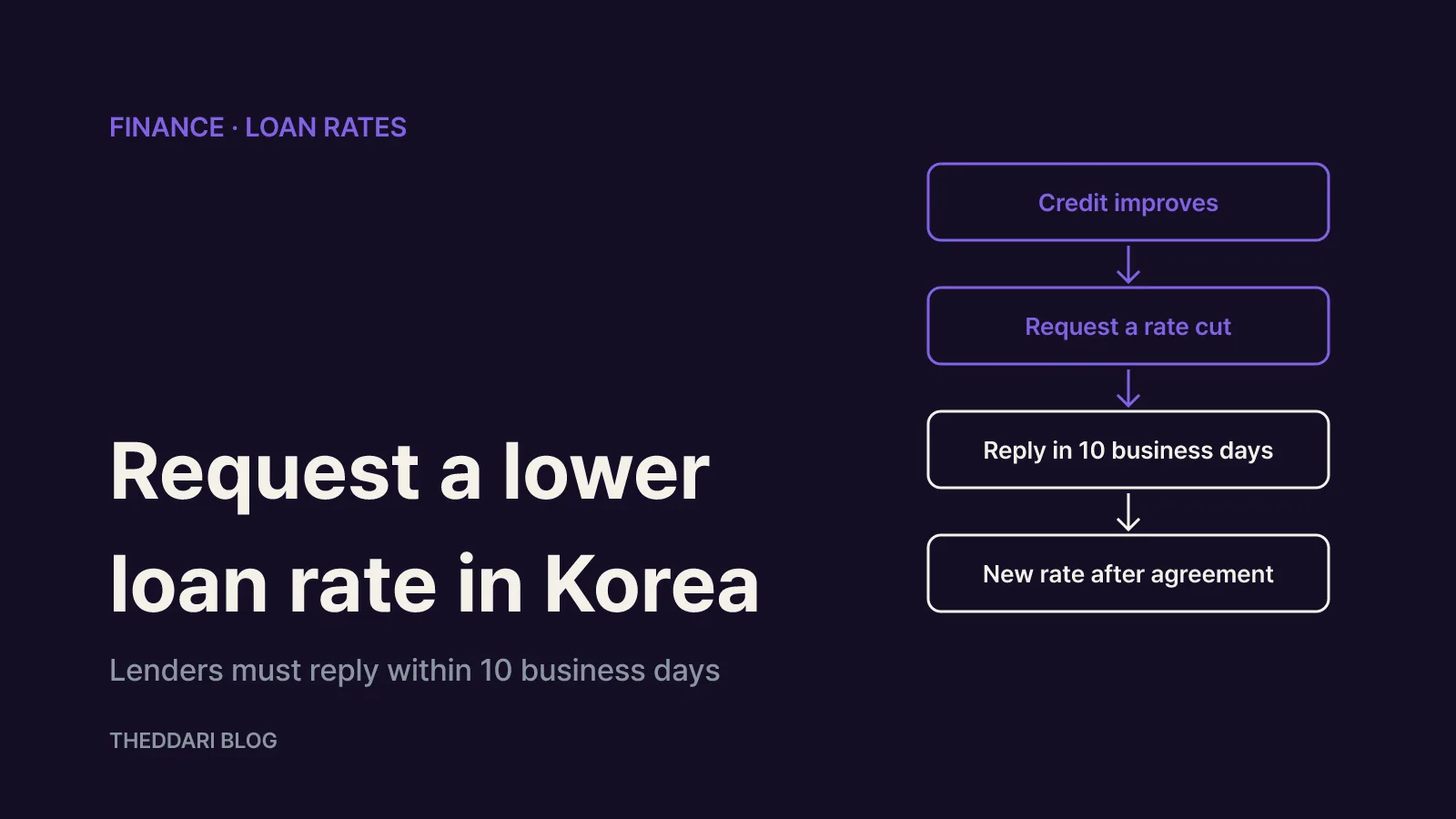
As of October 2026, anyone who borrowed from a Korean bank, card company, savings bank, insurer or credit cooperative can formally ask the lender to lower the interest rate once their credit situation has improved. Korean law calls this the right to request an interest rate reduction (금리인하요구권). Typical triggers are getting a job, a promotion, higher income, more assets, less debt or a higher personal credit score. The lender must tell you whether it accepts the request, and why, within 10 business days of receiving it (Enforcement Decree of the Banking Act, Article 18-4). It is not an automatic discount: the loan has to be priced on your creditworthiness, and the lender's own review has to conclude that your improvement is large enough to change the rate. This guide walks through eligibility, the process, how to read a rejection and how to prepare a stronger request, using the statute and guidance from Korea's Financial Services Commission (FSC) and Financial Supervisory Service (FSS).
Who can use it, and for which loans
The right used to exist only in loan contract terms. It was written into law for banks, insurers, savings banks and specialised credit companies (card issuers and capital firms) through amendments passed in December 2018, extended to mutual finance cooperatives in January 2022, and applied to community credit cooperatives (Saemaeul Geumgo) from May 2023 (FSC, 9 Feb 2023). So the same idea covers a bank credit loan, a card loan or a savings bank loan.
The decree lists the grounds. For an individual borrower, the request is available when an improvement in credit standing is recognised, such as employment, promotion, an increase in assets or a rise in the personal credit score. For non-individual borrowers, including sole proprietors, the grounds are improved financial condition or a higher credit rating or score (Banking Act decree, Art. 18-4). An industry-wide standard for household loans groups these into three buckets: higher income or assets (a new job, promotion, job change, professional qualification, asset growth, debt reduction), a higher score from a credit bureau, and any other change the borrower can show improves their credit (FSC, 1 Nov 2021).
The range of eligible loans is broad. According to the FSC, every loan is covered except those where the borrower's credit standing does not affect the rate. The regulator specifically called out lenders that wrongly told customers partially secured loans were excluded, or that nobody could apply within three months of signing, and said a borrower whose credit has improved may apply regardless of how many times or when (FSC, 2021). The FSS adds that a lender's internal policy and credit scoring system results may still mean no reduction, and that internal rules can restrict use of the right (FSS), so read your lender's own page as well.
In practice, unsecured credit loans and card loans respond most. Mortgages and guaranteed loans are priced with little weight on credit standing, so a modest improvement often changes nothing (FSC, 2023).
The process and the 10-business-day deadline
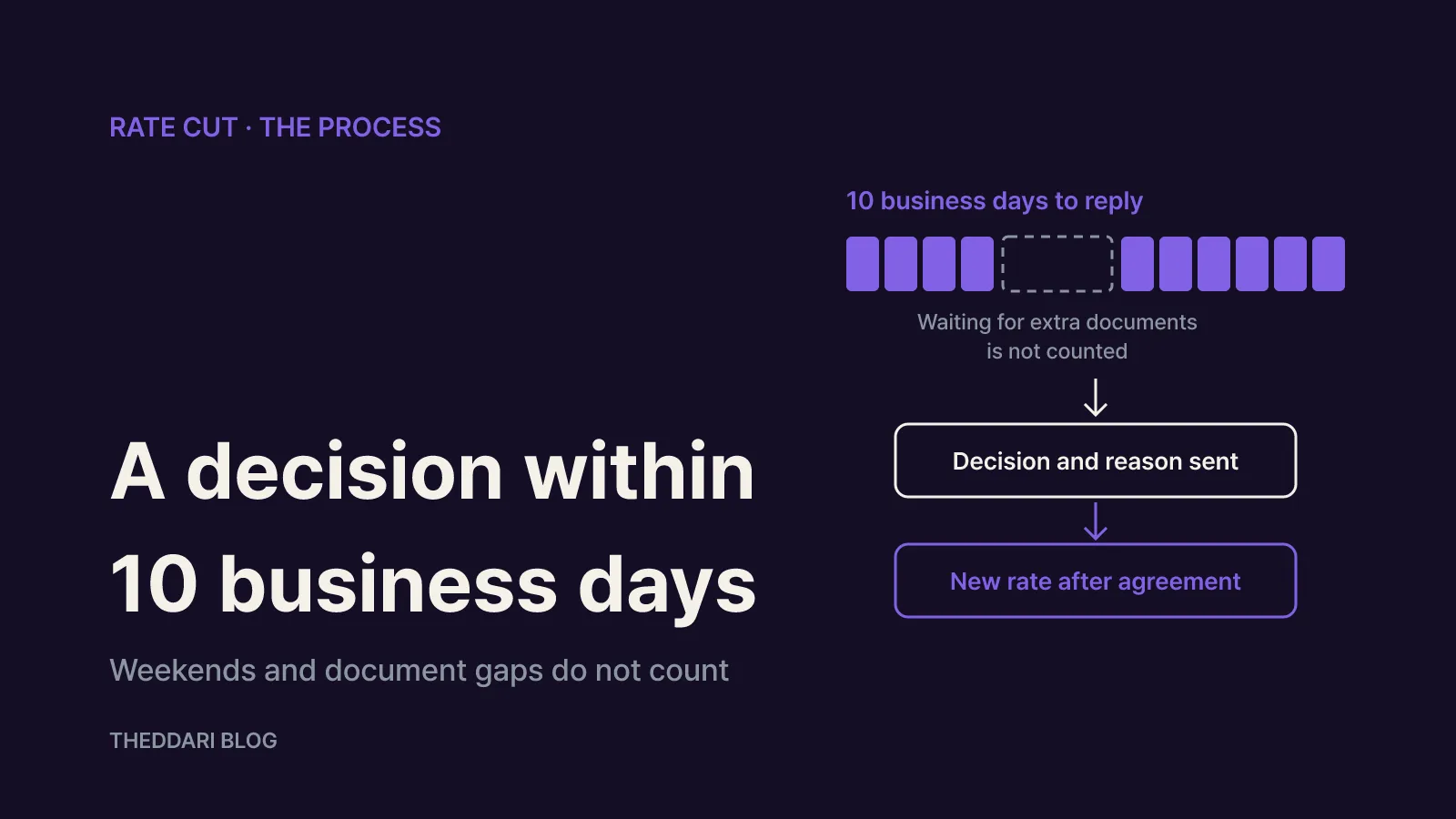
You can apply at a branch or through internet or mobile banking, attaching documents that prove the improvement; the lender then reviews the request (FSS). Evidence depends on the reason: proof of employment and income for a new job, updated income records for a raise, or a payoff record if you cleared another debt. Follow the document list shown in your lender's application screen.
The lender must reply within 10 business days by phone, letter, text message, email, fax or a similar channel. One detail matters: if the lender asks for additional documents, the days between that request and your submission are not counted (Banking Act decree, Art. 18-4). Weekends and public holidays are excluded too, so watch for supplementary-document messages.
Approval alone does not cut your interest. The industry standardised the effective date as the point you sign the rate-change agreement; some insurers that do not use such agreements apply the new rate from the date of the request (FSC, 2021). Refusing or delaying a request without a legitimate reason is treated as an unfair business practice under the Financial Consumer Protection Act and can lead to penalties. Lenders also notify eligible borrowers twice a year, and since 2023 they send extra notices at least once every six months to borrowers whose ratings rose (FSC, 2023). If your banking app says you may qualify, act on it.
Five rejection reasons and what to do next
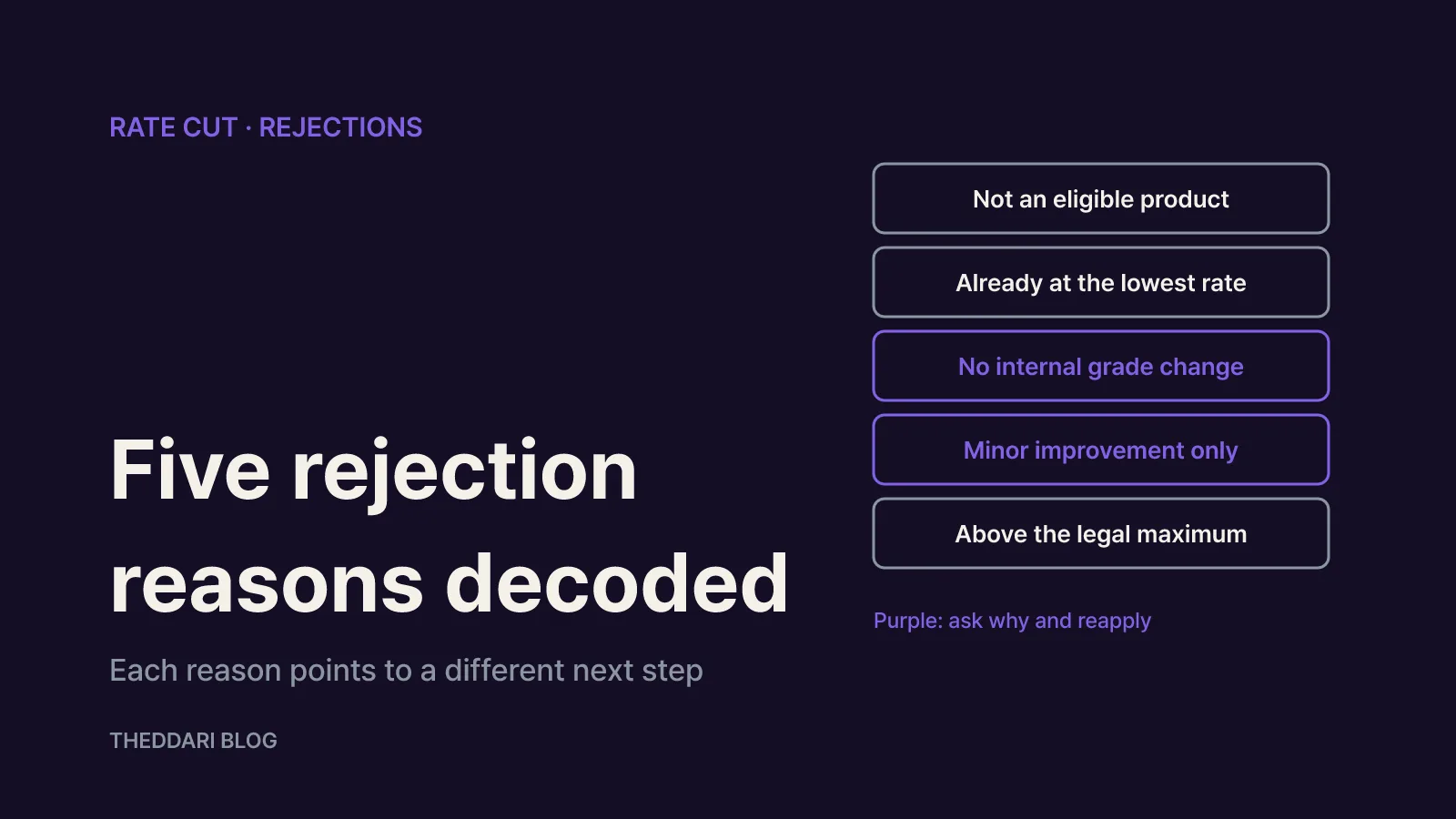
After the 2023 reforms, rejection notices use five categories (FSC, 2023):
- Not an eligible product: the rate does not depend on your credit. Reapplying for this loan will not help.
- Already at the lowest rate: you are in the top internal grade.
- No change in internal grade: an outside score may have risen, but the lender's own grade did not move.
- No change in credit cost (minor improvement): the grade improved, but not enough to reprice; common with mortgages and guaranteed loans.
- Above the legal maximum rate: even after the improvement, the calculated rate would exceed the statutory cap you are already charged at.
The most common outcome is a minor improvement. Under Article 36-2 of the Credit Information Act, you can ask the lender to explain the credit evaluation result, the main criteria and an overview of the data used. If that data is outdated or wrong, such as a repaid loan still showing, you can ask for correction, deletion or a recalculation (FSC, 2023).
Timing matters too. For statistics, regulators treat a request for the same product made within one month of a decision as a duplicate (FSC, 2023). That is a counting rule, not a ban, but it signals that resubmitting identical evidence rarely changes the result. Reapply after something real changes.
How to prepare a stronger request
Preparation shows up in the numbers. Across banks, savings banks, card and capital firms, insurers and cooperatives, the acceptance rate fell from 48.6% in 2019 to 28.8% in the first half of 2022 (FSC, 2023). In 2020, bank household loans requested in person were accepted 76% of the time versus 27% for online requests, which the FSC linked to applications that did not meet the criteria or lacked documents (FSC, 2021). Applying in an app is fine, but attach proper evidence.
Check the criteria your lender actually uses. The FSC asked banks to disclose approval factors such as deposit history, delinquency status, and ancillary transactions like salary deposits (FSC, 2023). Clear any overdue payment first.
Industry associations publish semi-annual comparisons by lender: applications, acceptances, acceptance rate and interest saved, plus, since 2023, breakdowns by loan type, the average rate cut and the share of online applications (FSC, 2021; FSC, 2023). Do not judge by acceptance rate alone; lenders with heavy online traffic can look worse, so compare interest saved and average cut as well.
A pre-application checklist
- Is the loan eligible? Confirm in the product disclosure that the rate depends on your credit and that you are not already at the floor.
- What changed? Name it in one sentence: new job, promotion, higher income, more assets, less debt or a higher score.
- Is the evidence attached? Match the lender's document list, especially online.
- Any delinquency? Settle overdue amounts and check the lender's listed approval factors.
- Watch for the reply. Expect it within 10 business days, answer document requests quickly, and sign the rate-change agreement if approved.
- If rejected, act by reason. For credit-related reasons, request an explanation, fix wrong data and reapply after a genuine change.
The right only works when you use it. A new job, a raise or paying off a large debt is the moment to check whether your Korean loan can be repriced.