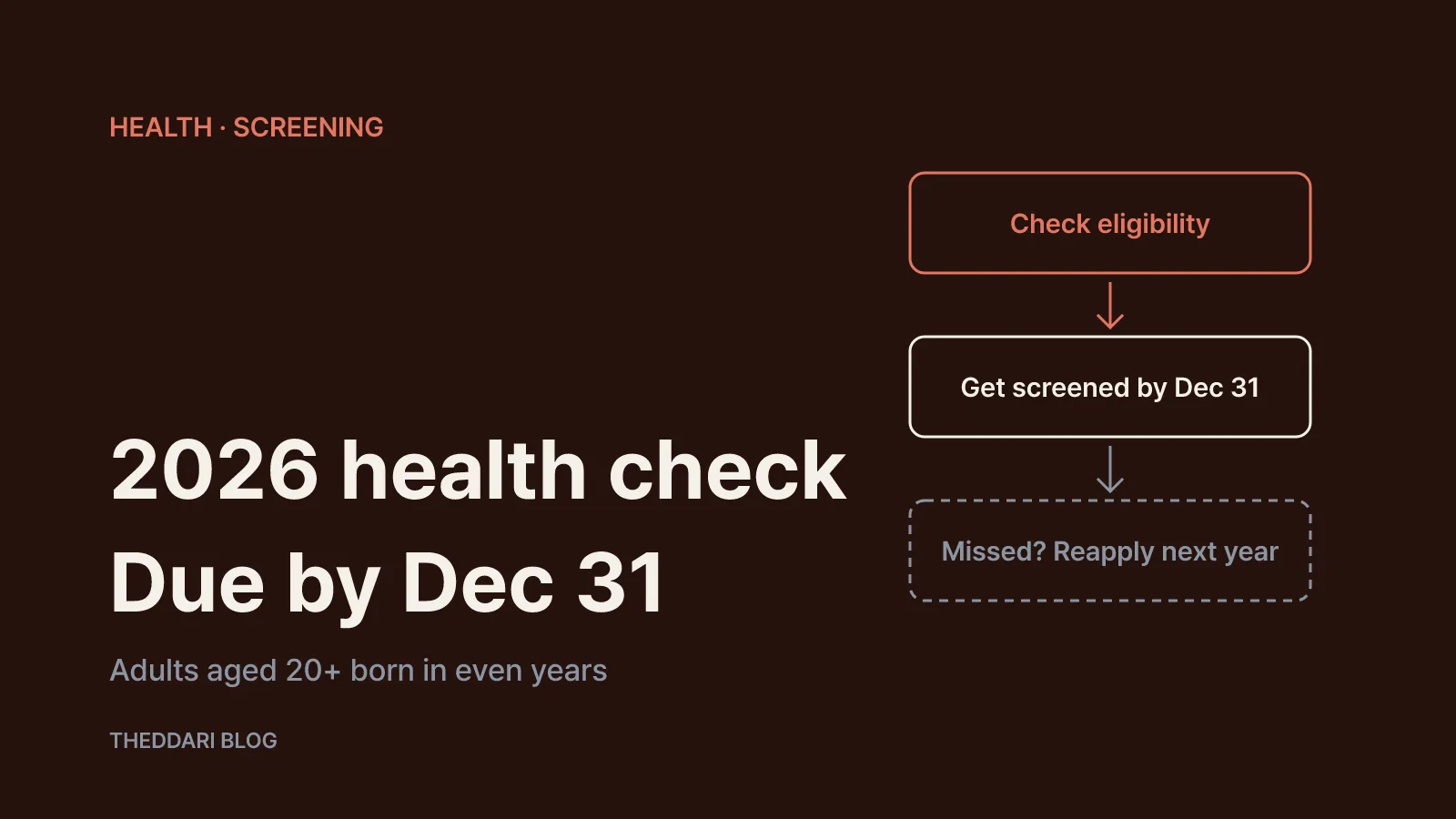
As of October 2026, Korea's national general health screening for this year is aimed primarily at people aged 20 or older who were born in an even-numbered year, and the screening window closes on December 31, 2026. The general checkup costs nothing out of pocket, and anyone who was due in 2025 but missed it can still apply to be added to this year's list until December 31 (Yonhap, October 8, 2026). The National Health Insurance Service (NHIS) has warned that clinics get crowded toward year-end and preferred dates can be hard to book (Dong-A Ilbo).
This guide is written for anyone covered by Korea's National Health Insurance, including foreign residents who are enrolled as employees, regional subscribers or dependents. Eligibility depends on your insurance category rather than nationality, so the same lookup and booking steps apply. The focus here is the program rules and process, not how to interpret individual results.
Who is eligible for the 2026 general health screening
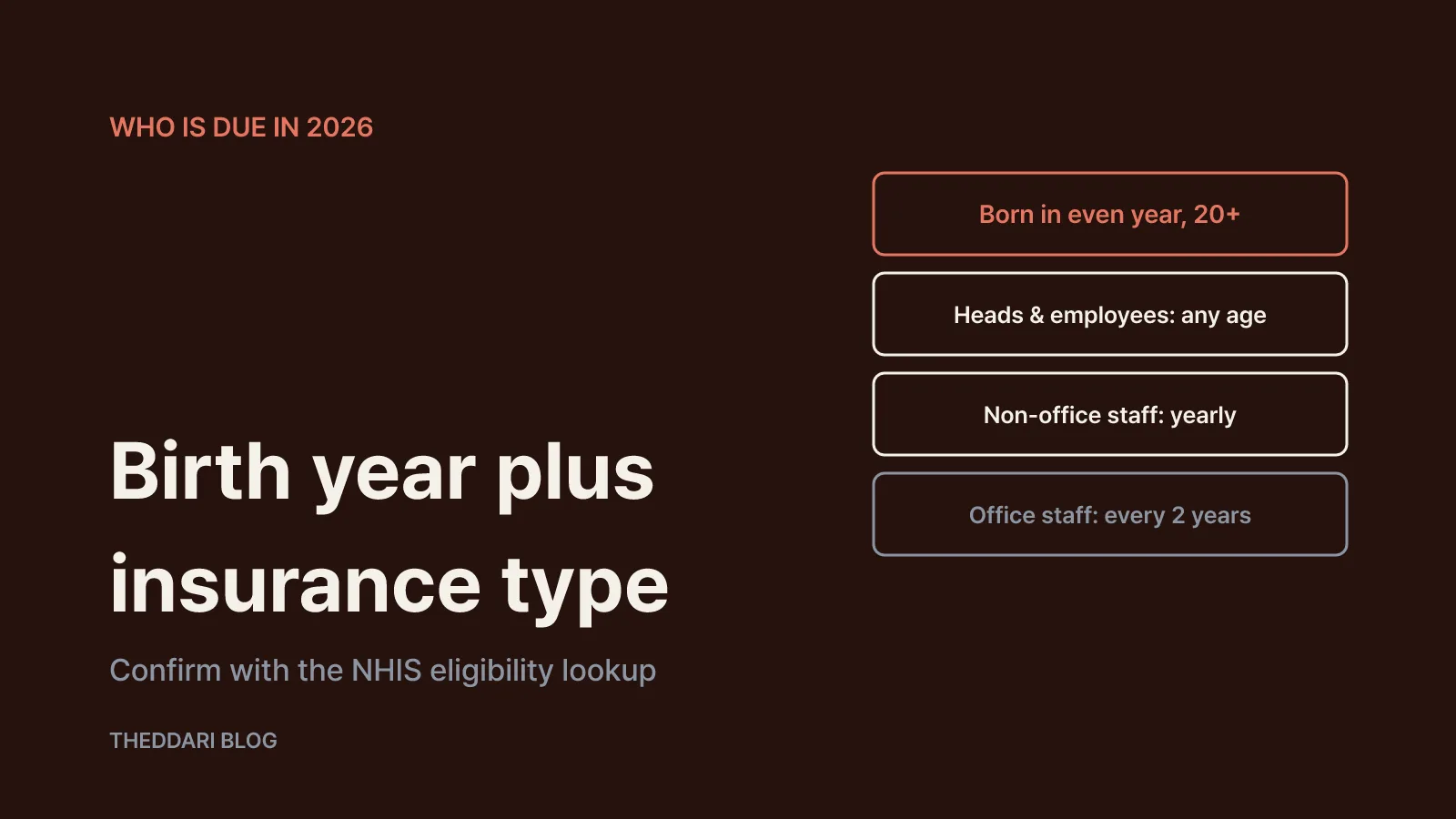
According to the Korea Disease Control and Prevention Agency's National Health Information Portal, general screening runs on a two-year cycle: people born in even-numbered years are usually screened in even-numbered years, and people born in odd-numbered years in odd-numbered years (KDCA National Health Information Portal). Because 2026 is an even year, someone born in 1966 or 1986, for example, falls into this year's default group.
Birth year is only the starting point. Your NHIS membership type changes the rules:
- Regional heads of household and workplace (employee) subscribers are eligible regardless of age (Yonhap).
- Employees in non-office jobs are screened every year, whatever their birth year.
- Employees in office jobs are screened every two years.
- Household members of regional subscribers, dependents of employees and Medical Aid recipients have slightly different age criteria, which KDCA notes vary by membership category.
The practical takeaway: do not rely on the even/odd rule alone. If you changed jobs, left a job, became someone's dependent, or work in a role screened annually, your status may differ. The official eligibility lookup is the answer that counts.
On cost, KDCA states that the NHIS pays the full cost of the general checkup, and that the national and local governments fully cover Medical Aid recipients, so there is no out-of-pocket charge for the standard items. Clinics often offer extras such as ultrasounds or endoscopies; those are separate from the national program, so ask which items are covered before you book.
How to check eligibility and book without the mailed form
You can confirm eligibility through the health screening eligibility lookup on the NHIS website or the NHIS mobile app (called 건강보험25시). KDCA describes the process this way:
- Selection: the NHIS picks each year's group by birth year (even or odd).
- Screening form: regional subscribers and dependents receive it by post at their registered address; employees are notified through their workplace.
- Lost or missing form: you can get a replacement confirmation from the NHIS call center (1577-1000) or a local NHIS branch, or print one yourself from the website after logging in.
- ID is enough: you can also simply bring your ID card to a designated clinic and be screened without the form.
You can use any designated screening clinic nationwide, not just one near your registered address. Search with the clinic finder on the NHIS website or app and pick somewhere convenient, near work or near family.
When you book, confirm three things: which general and cancer screening items apply to you this year, the clinic's fasting and medication instructions, and whether you want results by post or email. If you take medication for diabetes or blood pressure, do not stop it on your own; ask the clinic first.
What the general checkup includes
KDCA lists these common items for every general screening:
- Consultation and physical examination
- Height, weight, waist circumference and obesity index
- Vision, hearing and blood pressure
- Chest X-ray
- Blood tests: hemoglobin (anemia), fasting glucose (diabetes), AST, ALT and gamma-GTP (liver function), serum creatinine and eGFR (kidney function)
- Urine test and dental check
Extra tests are added by sex and age:
← Swipe to see more
| Test | Who gets it |
|---|---|
| Hepatitis B | Age 40 (excluding carriers and immune) |
| Hepatitis C antibody | Age 56 |
| Bone density | Women aged 54, 60 and 66 |
| Lung function | Ages 56 and 66 |
| Cognitive impairment | Every two years from 66 |
| Depression screening | Every two years at 20 to 34, then once per age band |
| Early psychosis screening | Every two years at 20 to 34 |
| Lifestyle assessment | Ages 40, 50, 60 and 70 |
| Physical function (falls) | Ages 66, 70 and 80 |
| Dental plaque test | Age 40 |
KDCA's page was last updated on June 1, 2026 and cites the Ministry of Health and Welfare's 2026 screening standards (Notice No. 2026-6). Medical Aid transition-age screening uses a different item list, so check separately if that applies to you.
Cancer screening: six cancers and who pays
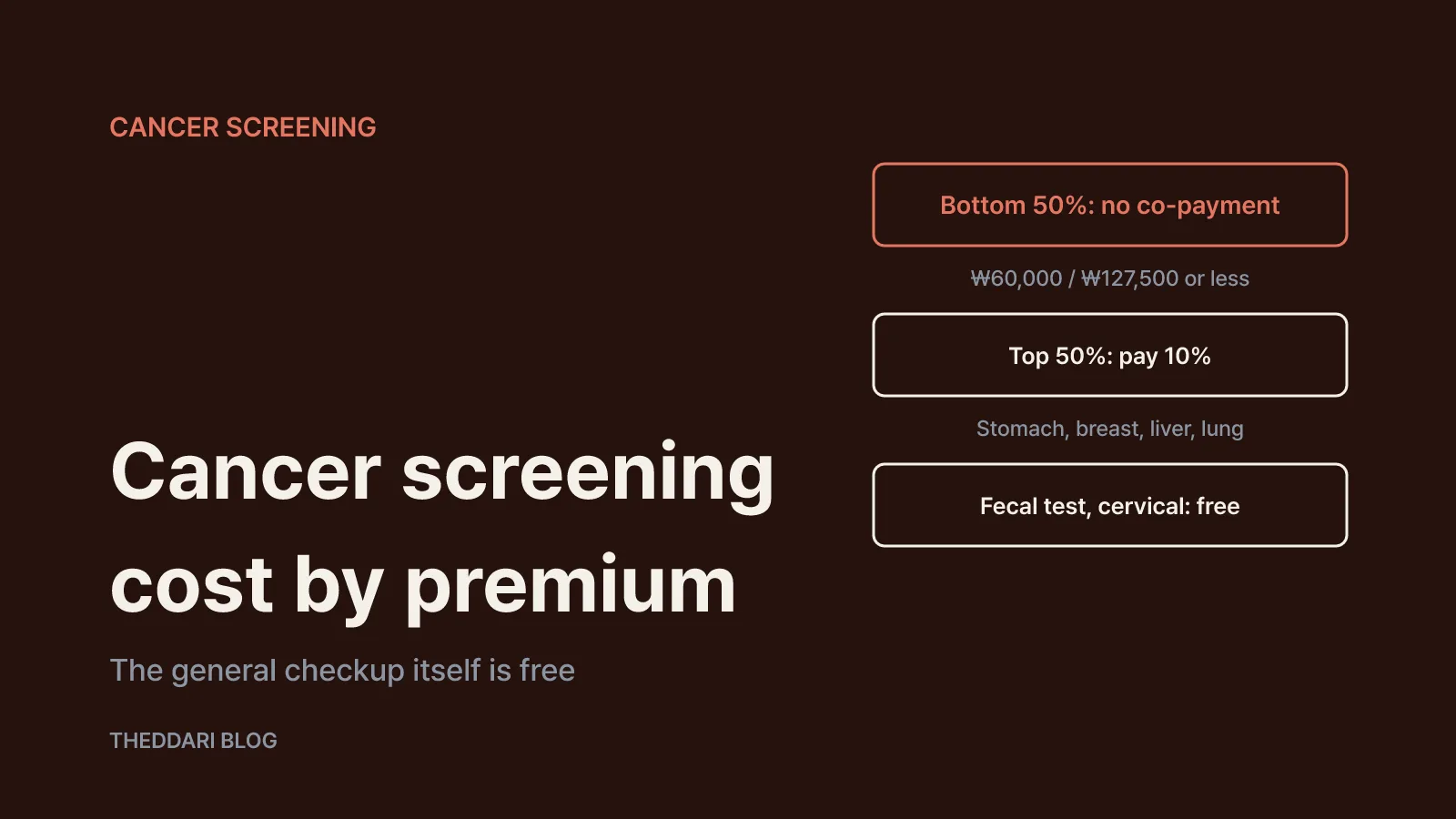
The national cancer screening program covers six cancers: stomach, colorectal, liver, breast, cervical and lung, with ages and intervals that differ by cancer type (Yonhap). Unlike the general checkup, a co-payment can apply depending on your insurance premium:
- Bottom 50% of premiums: no out-of-pocket cost. The NHIS threshold is a monthly premium of ₩60,000 or less for regional subscribers and ₩127,500 or less for employees (Dong-A Ilbo).
- Top 50% of premiums: you pay 10% of the cost of stomach, breast, liver and lung cancer screening.
- Free for everyone: the colorectal fecal occult blood test and cervical cancer screening.
If you are unsure which side of the threshold you fall on, check alongside your eligibility lookup or ask the NHIS call center. Optional add-ons, such as sedation for endoscopy, are separate from the national co-payment.
Missed the December 31 deadline? Reapply the next year
Missing the window does not mean waiting two more years. The NHIS runs a previous-year missed screening application service, and KDCA confirms that there is no extra charge for screening through it.
Right now, this applies to people due in 2025 who were not screened: they can apply by December 31, 2026 and be screened this year (Dong-A Ilbo). There are three ways to apply:
- Visual ARS: call 1577-1000, press 9, open the link sent by text, then choose health screening and the previous-year application and verify your identity.
- NHIS website: under the health menu, open national health screening information and select the previous-year missed screening application.
- NHIS app: under My Health, open screening applications and choose the previous-year option.
If you are due in 2026 and may not make it, the same service in 2027 is your fallback, but check the NHIS notice at that time. December appointments fill up, so booking in November is the more realistic plan. Employees should also confirm any internal schedule or paperwork their company sets.
Results and free follow-up testing
Clinics send general screening results within 15 days by post or email, and you can also view them in the NHIS app (KDCA).
If your results suggest hypertension, diabetes, dyslipidemia, pulmonary tuberculosis, depression, early psychosis or hepatitis C, you can get confirmatory testing or care at a nearby clinic, and the first confirmatory test is free of co-payment. For dyslipidemia, only the first consultation fee is covered, not the test itself. Tuberculosis and hepatitis C can be confirmed at clinics, general hospitals or tertiary hospitals; the other conditions are handled at clinics only. Bring your results sheet and ID. KDCA's FAQ sets the deadline for this follow-up at January 31 of the year after your screening, one more reason not to leave the checkup to late December.
Year-end checklist
- Run the 2026 eligibility lookup on the NHIS website or app.
- Check which cancer screenings apply to you, not just the general checkup.
- See whether your premium falls under the co-payment threshold (₩60,000 regional, ₩127,500 employee).
- Book a designated clinic in November and get fasting and medication instructions.
- Separate national items from optional paid extras.
- If you missed 2025, apply as a previous-year missed case before December 31.
- After results arrive, use any confirmatory testing by January 31 of the following year.
No form in the mail? Bring your ID. One eligibility check today is the simplest way to lock in a free screening before the year closes.