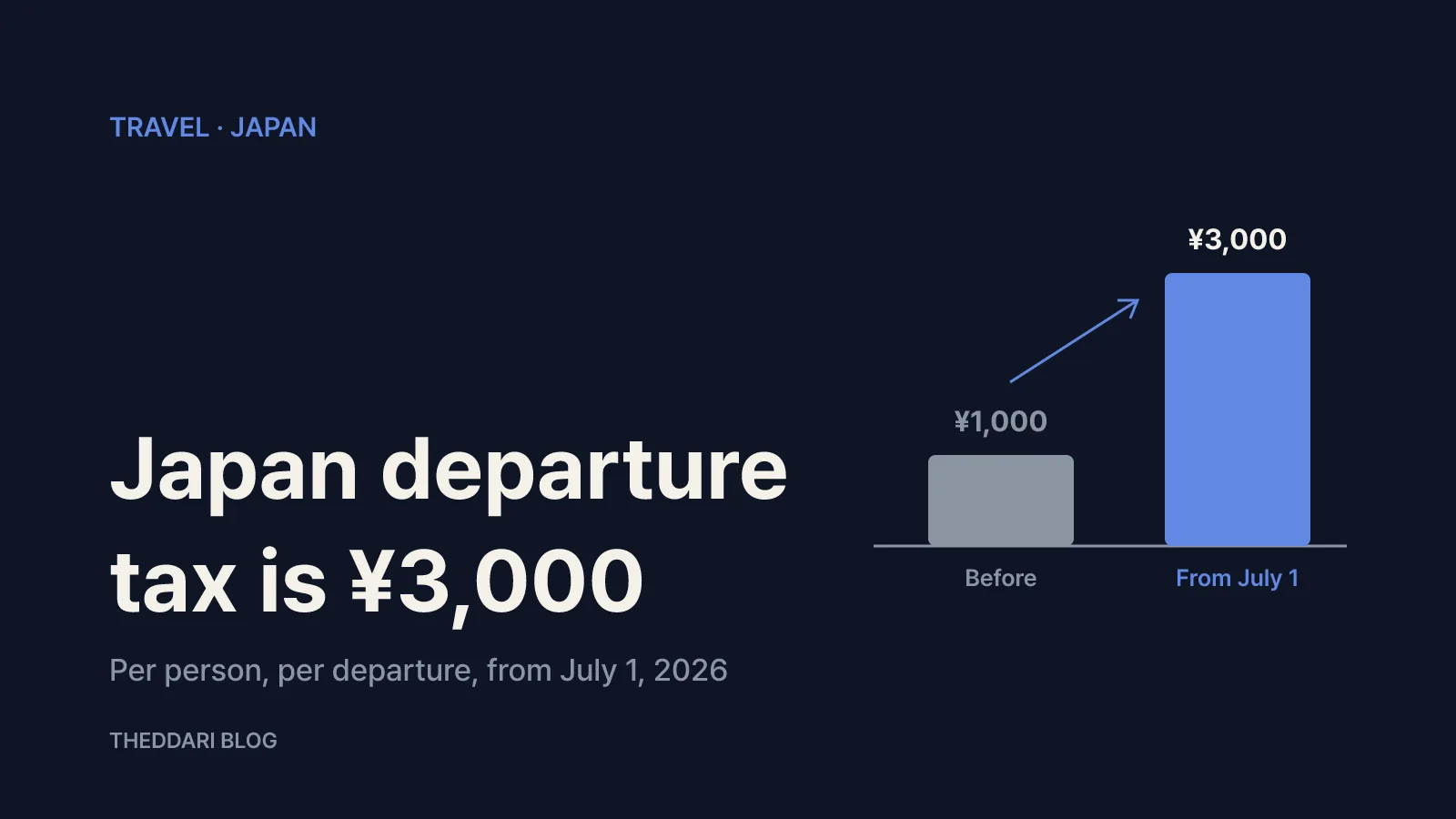
As of October 2026, anyone leaving Japan by plane or ship pays Japan's International Tourist Tax, often called the Japan departure tax, at ¥3,000 per person for each departure. The rate rose from ¥1,000 on July 1, 2026. You do not pay it at a counter: airlines and ferry operators add it to the ticket price and pass it on to the government. Two details matter most when you book: tickets issued on or before June 30, 2026 keep the old ¥1,000 rate, and children under two are exempt.
If you are planning a winter trip to Tokyo, Osaka or Hokkaido and wondering why the taxes on your fare look higher, this guide walks through the rule, the exemptions and how to read your receipt.
What changed with Japan's departure tax
The official name is the International Tourist Tax (国際観光旅客税, kokusai kanko ryokyaku zei). According to Japan's National Tax Agency (Tax Answer No.7195), carriers act as special collection agents: they collect the tax from passengers departing Japan, usually by adding it to the fare, and remit it to the state. The page is written on the basis of laws in force as of July 1, 2026, and lists the rate as ¥3,000 per departure.
The tax itself is not new. It was introduced for departures from January 7, 2019 at ¥1,000. What changed in July 2026 is the amount, which tripled to ¥3,000. The Japan National Tourism Organization (JNTO) says in its notice on the increase that the revenue goes toward easing congestion, tackling etiquette problems with measures such as smart trash bins, streamlining immigration with self bag drop and walk-through gates, and improving tourism resources such as hiking trails and streetscapes.
Despite the word "tourist," the tax is not limited to tourists. The National Tax Agency defines the taxpayer as any passenger leaving Japan by ship or aircraft, whatever the purpose of travel: business, official duties, work, study or medical treatment. Nationality does not matter either, so Japanese citizens, foreign residents and visitors all pay the same amount.
It is charged on the way out of Japan, not on arrival. On a round trip from Los Angeles, London or Sydney, it appears once, on the segment departing Japan. If your itinerary leaves Japan twice, for example a side trip to Seoul in the middle of your stay, you pay it twice because the tax is levied per departure. Adults and children pay the same rate; Air Seoul's notice confirms ¥3,000 per departure for both.
The June 30 ticket rule and what happens if you change a ticket
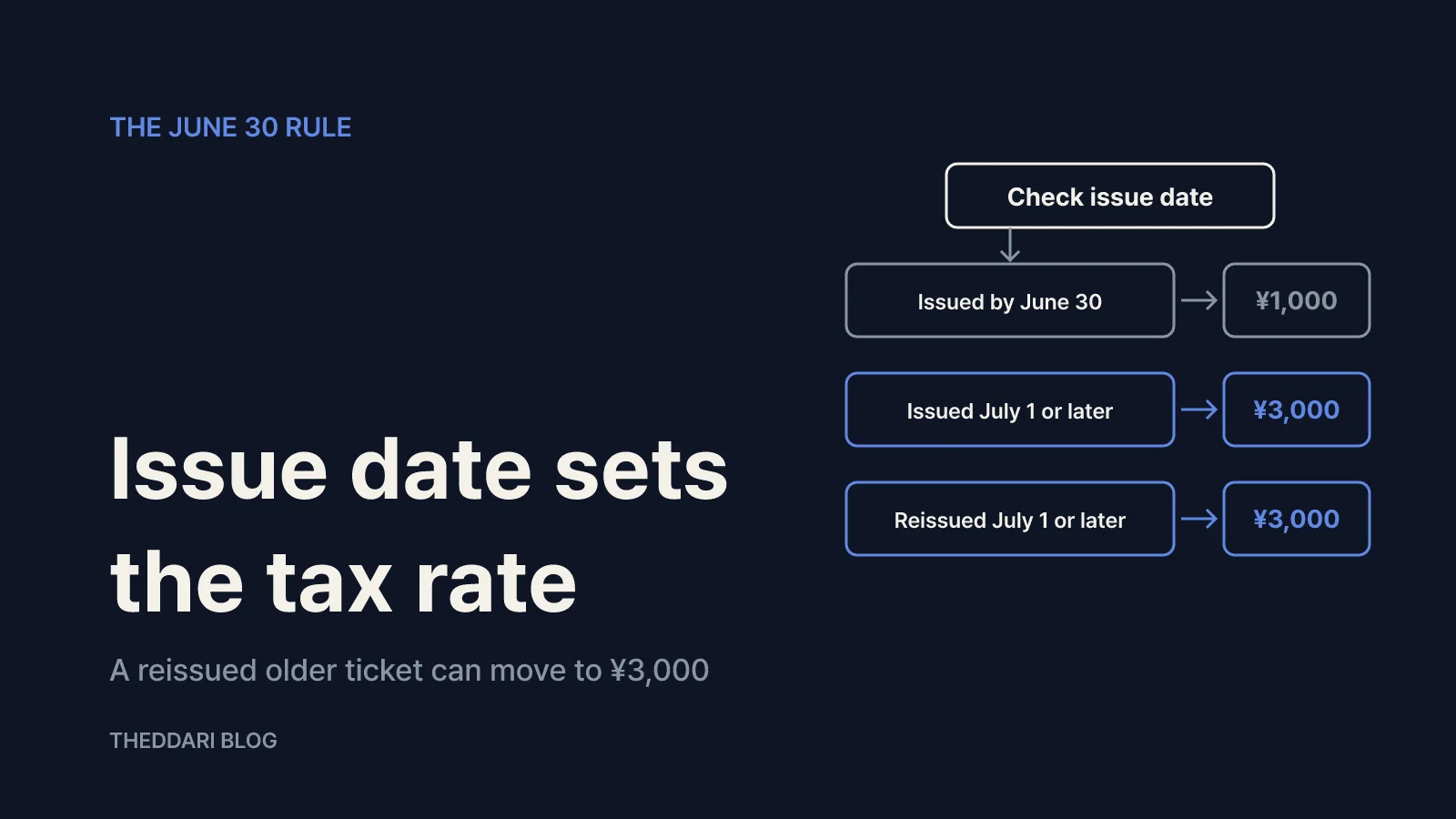
The rate depends on when your ticket was issued, not only when you fly. The National Tax Agency states that departures on or after July 1, 2026 under certain transport contracts concluded before that date are taxed at ¥1,000. JNTO describes the same transitional measure: if you depart using a ticket issued on or before June 30, 2026, the previous ¥1,000 rate applies.
In practice, a December round trip bought in June carries ¥1,000 on the return leg, while any ticket bought from July 1 onward carries ¥3,000 regardless of the travel date. If you are booking a winter trip in October 2026, expect the full ¥3,000. Air Seoul likewise says the rate is determined by both the ticket issuance date and the departure date.
The catch is reissuance. In its Japanese-language notice, Vietnam Airlines lists two cases where the new rate applies: tickets newly purchased (issued) on or after July 1, 2026, and tickets issued by June 30 that are reissued or exchanged on or after July 1 because of a change. So if you move your dates or reroute and the ticket is reissued, you can lose the ¥1,000 rate.
Handling can differ between airlines and booking sites. Before changing an older ticket, ask three questions: what the change fee is, whether there is a fare difference, and whether the ¥2,000 tax difference will be collected. Judge the change on the combined cost rather than the tax alone.
If you cancel instead, remember the tax is owed by passengers who actually depart Japan. Ask whether the tax component is included in your refund, even on a non-refundable fare.
Who pays and who is exempt
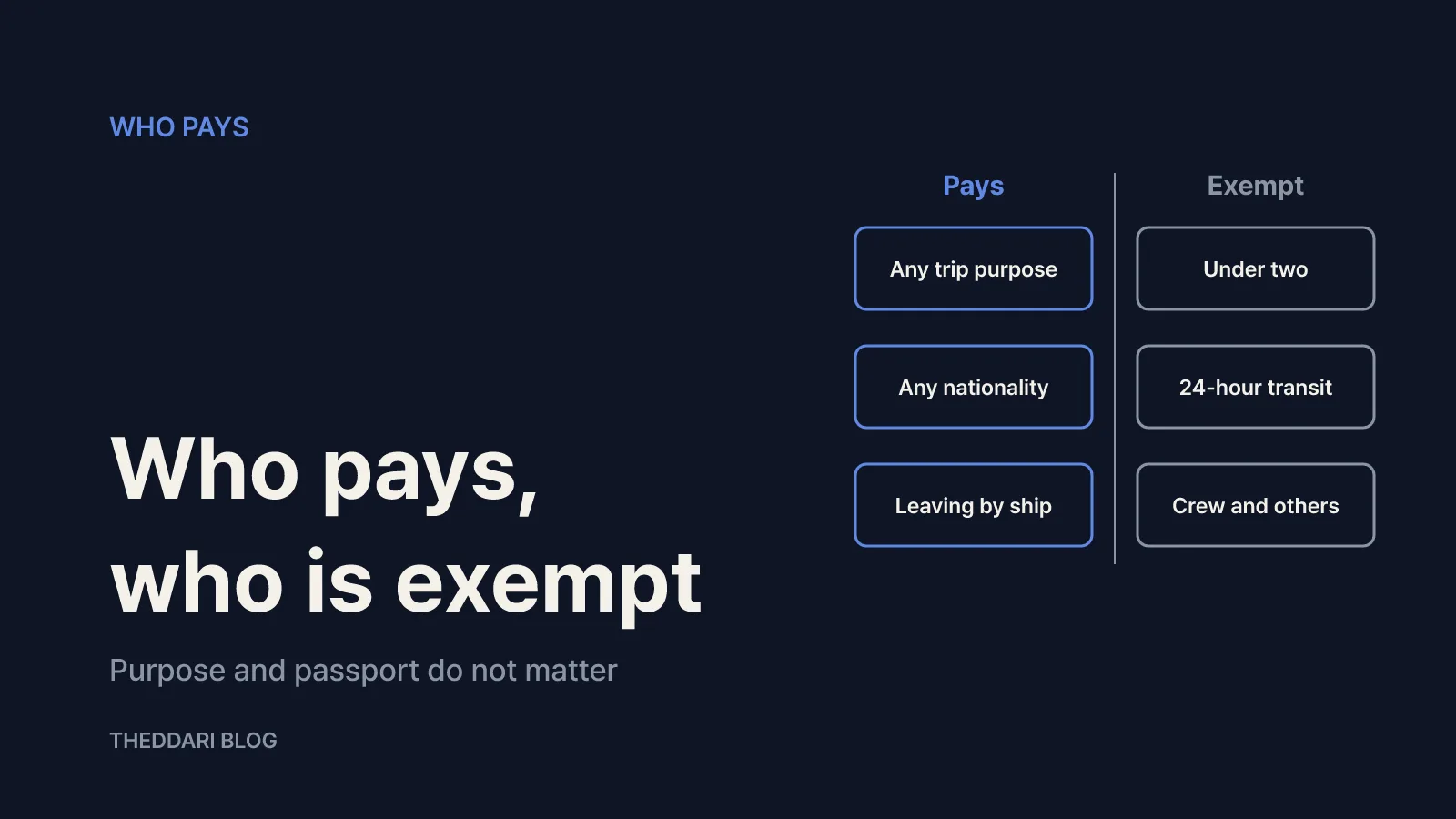
The National Tax Agency describes three groups of taxable passengers. First, people who must go through departure procedures under Japan's immigration law, which covers almost every traveler. Second, people flying from abroad through Japan to another country, except where the airport they flew from before entering Japan and the airport they fly to after leaving are the same. Third, certain people who entered Japan under treaty provisions.
The agency lists ten exemptions. The ones most relevant to travelers are:
- Children under two: exempt on age alone. JNTO's notice also states that infants under two are not taxed.
- Transit passengers: described as passengers who depart within 24 hours of entering Japan.
- Turn-backs: passengers who left Japan but returned without calling at a foreign port because of weather or other unavoidable reasons.
- Diversions: passengers on international ships or aircraft that called at Japan because of weather or other unavoidable reasons.
- Others: crew, deportees, passengers on government aircraft or ships, diplomats and consular officers on official duty, state guests, and US forces or UN forces members on official duty.
Do not read the transit exemption too broadly. The wording assumes a connecting journey, so a short visit is not automatically exempt just because you leave within a day. What matters is whether you are connecting through Japan to somewhere else. On a very short stay, check the fare breakdown before you pay.
Ships count too. Because the definition covers passengers leaving by ship or aircraft, international ferry and cruise passengers departing from a Japanese port are taxable, and the operator collects the tax in the fare. Travelers leaving by private jet, outside a commercial carrier, must pay it themselves at the customs office for the departure port before boarding.
How to spot the tax on your ticket
Because carriers collect the tax before boarding and pay it on your behalf, it is almost always already inside the price you paid. Look in the taxes and fees section of your fare breakdown. Vietnam Airlines identifies the tax with the code TK.
When you open your booking confirmation or e-ticket receipt, check:
- Issue date: on or before June 30, 2026 means ¥1,000; July 1 or later means ¥3,000.
- Tax lines: find the TK line. If you paid in dollars, pounds or another currency, it will show a converted amount rather than exactly ¥3,000.
- Departures from Japan: multi-city trips that leave Japan more than once should show the tax for each departure.
- Lap infants: under-twos are exempt, so make sure no charge was added for them.
- Package tours: the tax may be bundled into a combined taxes line. Ask the operator if it is unclear.
Budget airlines often show the base fare first and add taxes at checkout, so compare final totals, not headline fares.
Budgeting the tax for a winter trip to Japan
The formula is simple: ¥3,000 × number of departures from Japan × travelers aged two or older. A family of four with two school-age children leaving Japan once pays ¥12,000 in total through their fares. Under the old ¥1,000 rate the same family paid ¥4,000, so the increase is most noticeable for families and groups.
A few practical points:
- Compare all-in prices for flights and ferries.
- Factor in change risk if you hold a ticket issued before July 2026.
- Keep it separate from accommodation taxes that some Japanese destinations collect at hotels; that is a different system checked with your lodging.
- Recheck official guidance on the National Tax Agency page shortly before paying.
In short, a traveler booking a new Japan ticket in October 2026 pays ¥3,000 for each departure from Japan, collected in the fare, while children under two and qualifying transit passengers are exempt. If you hold an older ¥1,000 ticket, confirm whether a change triggers the higher rate before you touch it.