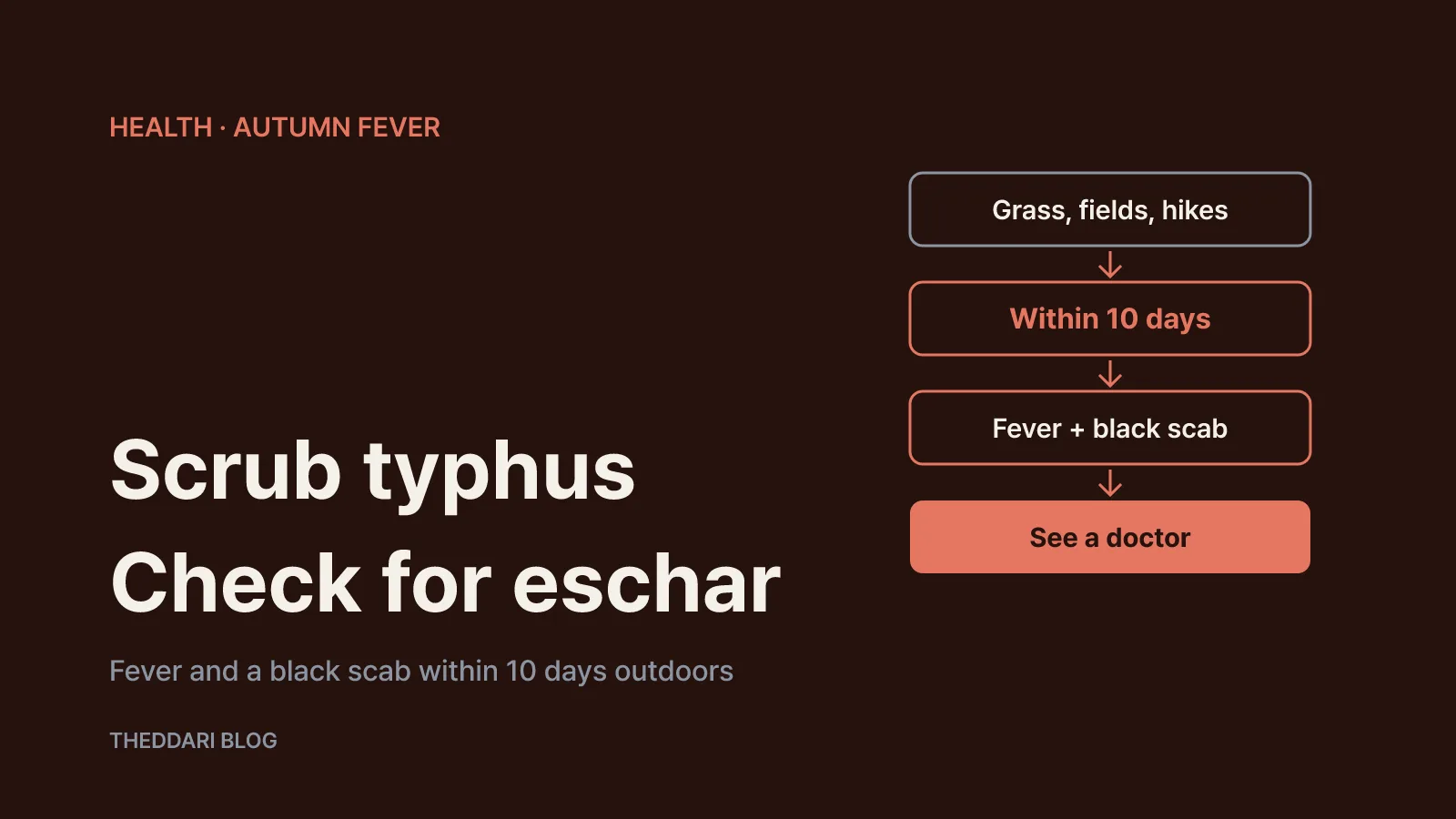
As of October 2026, the practical answer is this: if you spent time in grass, fields or brush in Korea and then develop a sudden fever, chills and headache within about 10 days, check your skin for a small black scab (an eschar) and get medical care promptly. Scrub typhus is the illness to rule out. According to a Korea Disease Control and Prevention Agency (KDCA) press release, Korea records roughly 3,000 to 6,000 cases a year, and cases cluster in October and November. Early antibiotic treatment usually leads to a smooth recovery, but the illness is easy to dismiss as a cold or flu.
This guide is written for residents, students and visitors who hike, camp, pick chestnuts, tend a weekend garden or join a family grave-tending trip during Korea's autumn. It combines KDCA guidance, Korea's Rural Development Administration (RDA) farm-safety advice and the U.S. CDC's public and clinical pages.
Why scrub typhus peaks in Korea in October and November
Scrub typhus is caused by the bacterium Orientia tsutsugamushi. People are infected by the bite of infected larval mites, commonly called chiggers. The CDC clinical overview lists Korea among the countries where the disease is endemic and notes that, in temperate zones, the season is mainly in the fall.
KDCA explains the timing: chiggers feed on people and animals only at the larval stage. Eggs laid in summer hatch from early autumn, and larval density rises as temperatures change. That overlaps with harvest work, grave tending, chestnut picking and fall-foliage hiking. For 2026, KDCA is monitoring chiggers at 18 sites nationwide for 16 weeks, from August 26 to December 16, and publishes weekly results on its infectious disease portal. Eight chigger species that carry the bacterium have been reported in Korea.
KDCA's National Health Information Portal says incidence per 100,000 people is highest in South Jeolla, North Jeolla, South Chungcheong and South Gyeongsang. The RDA, citing KDCA data, reports that 74.3% of mite- and tick-borne disease patients in the three years from 2022 to 2024 fell ill between September and November.
One detail matters for self-checking: chigger larvae are 0.3 mm or smaller. You will almost never see the mite, so "I didn't notice a bite" does not rule anything out.
How to spot an eschar and other key symptoms
The CDC says symptoms usually begin within 10 days of infection; its clinical page describes an abrupt start 7 or more days after the bite. Typical signs include fever and chills, headache, body aches, swollen lymph nodes, a rash and, in severe cases, confusion. KDCA adds that fever can approach 40°C in the first week, often with red eyes.
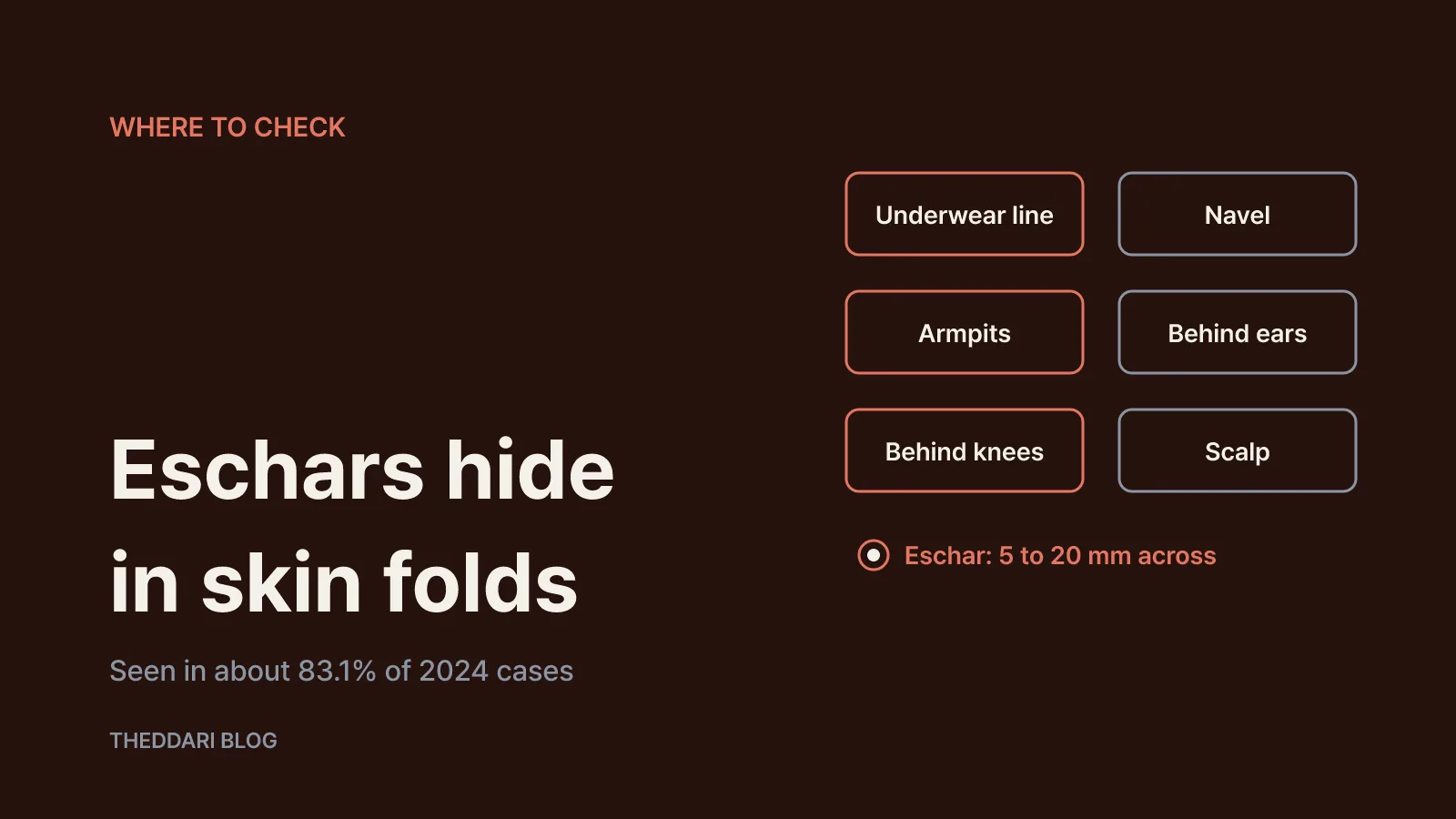
The most useful clue is the eschar. KDCA describes it as a lesion 5 to 20 mm across that progresses from a small bump to a blister and ulcer, then turns into a black crust ringed by redness. It is not always present: KDCA reports it in roughly 50% to 93% of Korean patients, with a detection rate of about 83.1% in 2024. No eschar does not mean no scrub typhus.
Eschars favor warm, moist, hidden skin. Check:
- under underwear and along the waistband, and the groin
- armpits and, per CDC, under the breasts
- behind the knees
- the navel, behind the ears, around the anus and the scalp
KDCA notes that eschars appear more often on the front of the body. Use a mirror or ask someone to check your back and scalp. A non-itchy red rash may also appear 3 to 7 days after infection, starting on the trunk and spreading to the arms and legs. The CDC estimates that 25% to 50% of patients develop a rash.
What to do if fever starts within 10 days of being outdoors
KDCA urges anyone who finds a suspected eschar, or who develops fever or rash within 10 days of outdoor activity, to see a doctor promptly. The RDA advises telling the clinician about your outdoor or farm work. Before your appointment, jot down:
- where and when you were outdoors (trail, field, campsite, grave site)
- the date the fever started and the highest temperature
- where any scab or rash is and when you first noticed it
- any medicines you have already taken
Diagnosis is often clinical. KDCA notes that antibodies usually take 1 to 2 weeks to appear, so early blood tests can be negative. The CDC states that treatment should never be withheld while waiting for test results.
The CDC recommends the antibiotic doxycycline for patients of any age, and it works best when started early. KDCA says fever usually falls within 48 hours of antibiotics and describes adult treatment as continuing for at least 3 days after the fever breaks, typically about 7 days in total. Azithromycin may be considered for pregnant patients and children. Do not stop early because you feel better: the CDC warns that single-dose or short courses can lead to relapse.
Without appropriate treatment, KDCA lists complications such as pneumonia, acute respiratory distress syndrome, myocarditis, gastrointestinal bleeding, kidney failure and meningoencephalitis. Reported fatality without proper treatment ranges from 0% to 30%, while Korea's rate is estimated at about 0.1% to 0.3%. If you are unsure where to go, KDCA's call center at 1339 or a local public health center can help.
Chigger bite prevention: before, during and after outdoor time
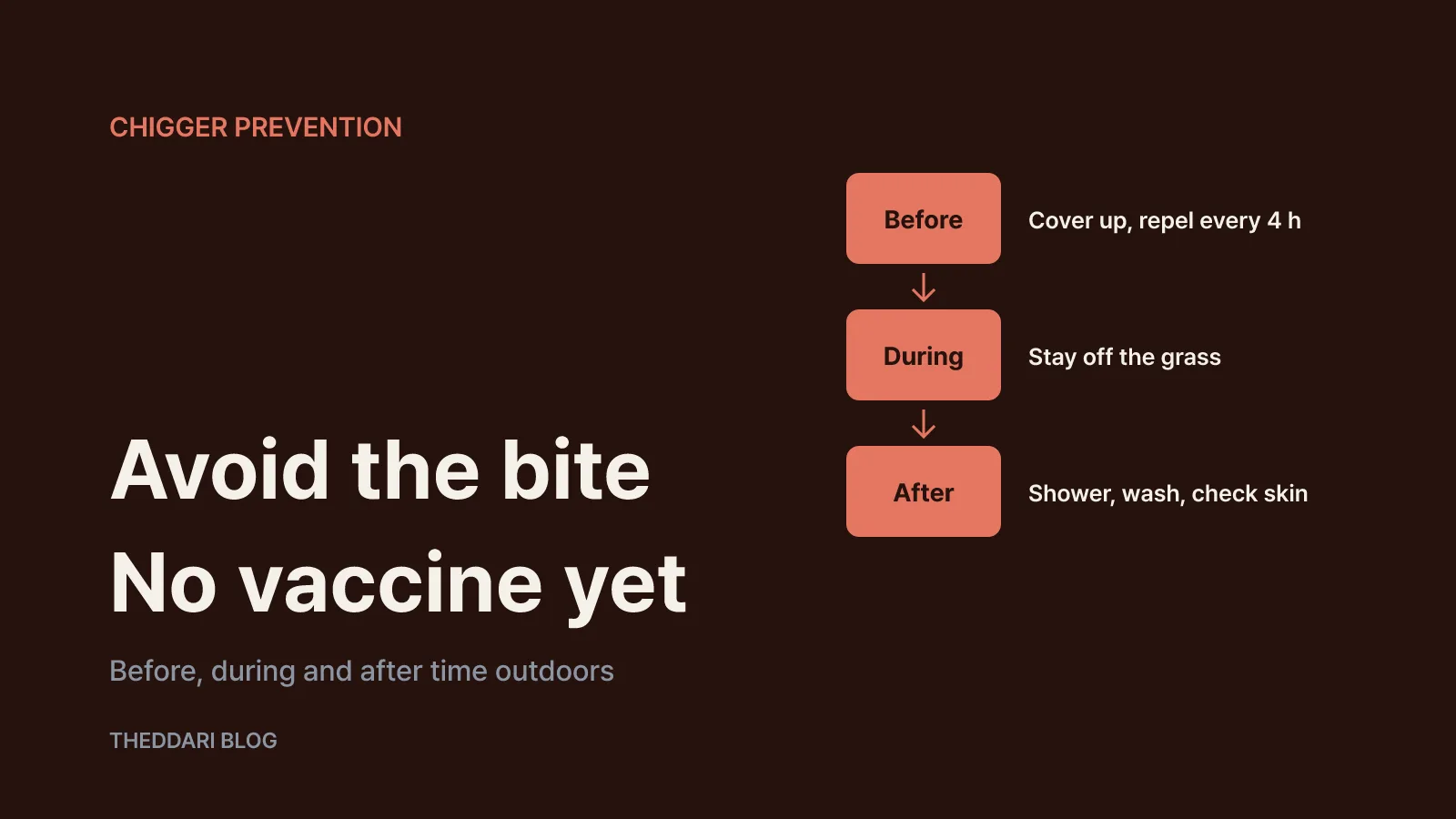
There is no vaccine that covers all scrub typhus strains, and reinfection with a different strain is possible. Avoiding bites is the main protection.
Before you go
- Wear long sleeves, long pants, a hat, gloves, high socks and boots, and tuck sleeves and pant hems closed.
- Apply repellent to shoes, socks and pants. The RDA suggests using it on clothing as a supplement and reapplying every 4 hours. The CDC recommends EPA-registered repellents such as DEET for skin and clothing, and 0.5% permethrin for clothing and gear only, never on skin.
While outdoors
- Stay out of grass taller than your ankles.
- Sit on a mat rather than directly on the grass, and do not leave clothes lying on the ground.
When you get home
- Shower right away and check for bites or black scabs.
- Shake out and wash your clothes, and wash and sun-dry any mat you used.
If you find an attached tick, the RDA says a clinic is the safest place to remove it. Otherwise, wear disposable gloves, grip the head close to the skin with tweezers, lift straight up and disinfect the spot. Do not twist or crush it with bare hands. Because chigger larvae are usually invisible, keep watching for fever and scabs for about 10 days after an outing.
Telling scrub typhus apart from SFTS and other autumn fevers
KDCA lists leptospirosis and hemorrhagic fever with renal syndrome as other common autumn fevers in Korea. They share high fever, headache, red eyes and rash, which is why the eschar is such an important clue. If high fever persists despite antibiotics, KDCA says doctors should consider other infections such as malaria or dengue.
Severe fever with thrombocytopenia syndrome (SFTS) is another mite- and tick-borne illness to know. The RDA says it has a fatality rate of up to 20% and occurs mostly from April to October, overlapping with the scrub typhus season in October. Rather than guessing which illness you have, tell the clinician about your exposure and let them decide on testing and treatment.
A quick recap: think back over the last 10 days of outdoor time, check hidden skin for a scab if you have a fever, seek care even without one, and finish the full antibiotic course you are prescribed.