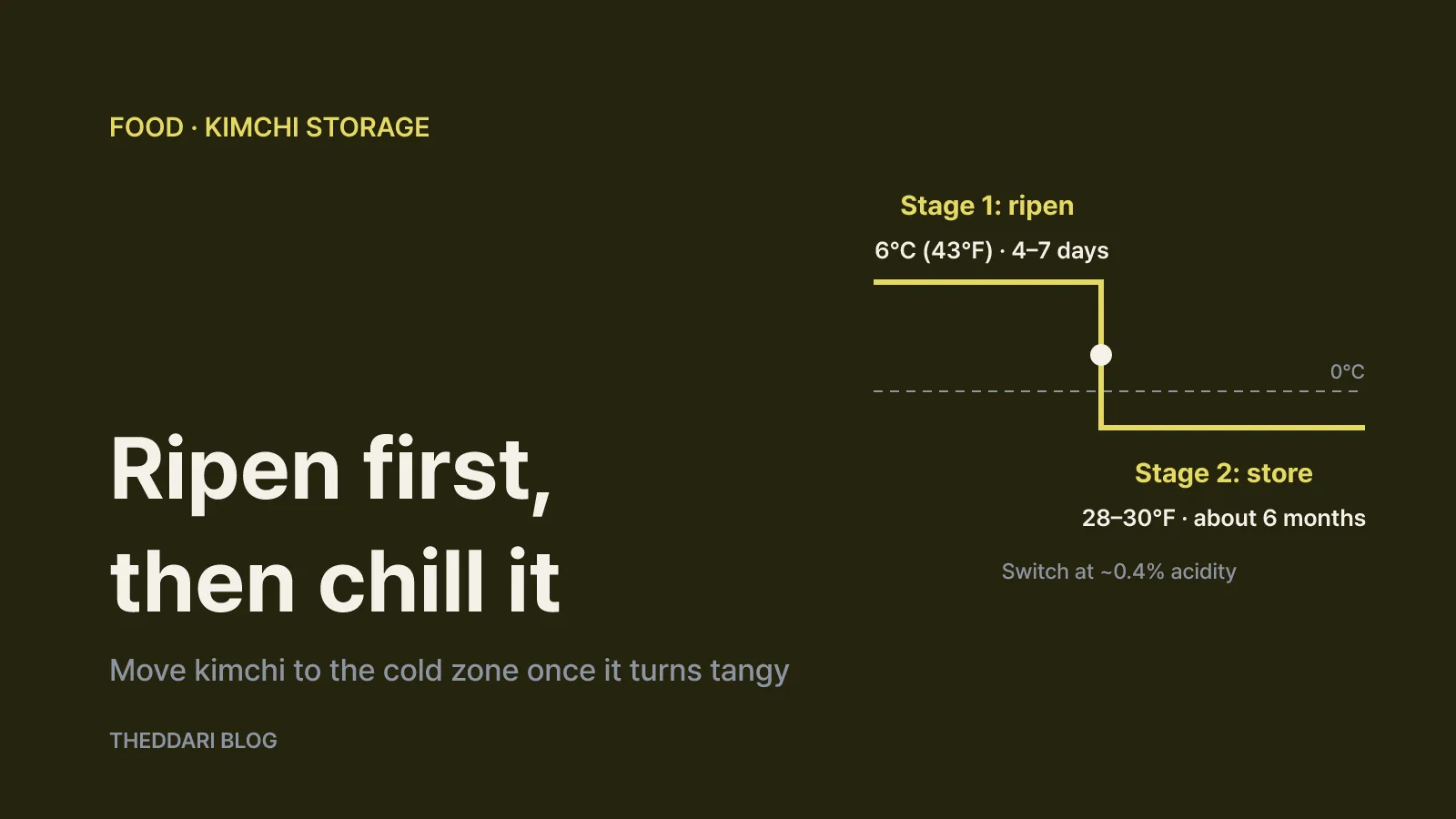
As of October 2026, the clearest answer from Korean research is this: store a big batch of homemade kimchi in two stages. First let it ripen at a cool but above-freezing temperature until it reaches about 0.4% acidity (the point where it starts to taste lightly sour), then move it to roughly -2 to -1°C (28–30°F) to slow fermentation for the long haul. A 2018 study in the Korean Journal of Food Science and Technology found that kimchi ripened at 6°C (about 43°F) for 4–7 days in winter and then held at -2 to -1°C scored higher for overall preference than kimchi chilled from day one. For how long it lasts, guidance from Korea's Rural Development Administration, republished on the government food portal Foodnuri, puts it at about six months in a dedicated kimchi refrigerator and about three months in a regular fridge without a noticeable change in taste.
This guide is for anyone who has just made a large batch of kimchi, whether for the Korean winter tradition of kimjang or simply to stock up, and wants to know whether to refrigerate it right away, what temperature to use and how long it will keep. The figures come from the published study abstracts and the government guidance linked throughout. Appliance menus differ by brand, so everything below is expressed as temperatures rather than mode names.
Why kimchi storage has two stages
Kimchi gets its flavor from lactic acid bacteria. The Rural Development Administration guidance notes that the savory depth of kimchi depends heavily on live lactic acid bacteria, and kimchi only starts to taste right after about two to three weeks at 3–5°C (37–41°F). Freshly made kimchi is essentially under-ripe; it needs time for bacteria to multiply before it turns tangy and refreshing.
The catch is that fermentation keeps going. Left alone, kimchi moves past its best point and becomes very sour. That is why Korean kimchi refrigerators typically do two jobs: ripen at an above-freezing temperature, then hold just below freezing so the kimchi changes as slowly as possible. If you skip the first step and chill everything immediately, it sours more slowly, but it can sit for weeks without developing much flavor.
The 2018 study tested exactly this. Researchers compared kimchi ripened at 6°C before storage at -2 to -1°C with kimchi stored at -2 to -1°C from the start, over 12 weeks. By week 12 both had nearly the same acidity, yet the pre-ripened kimchi kept higher counts of lactic acid bacteria and Leuconostoc, and tasters rated it higher for sweetness, fizz and overall preference. Same sourness, better taste: that is the case for two-stage storage.
Ripening temperature and timing
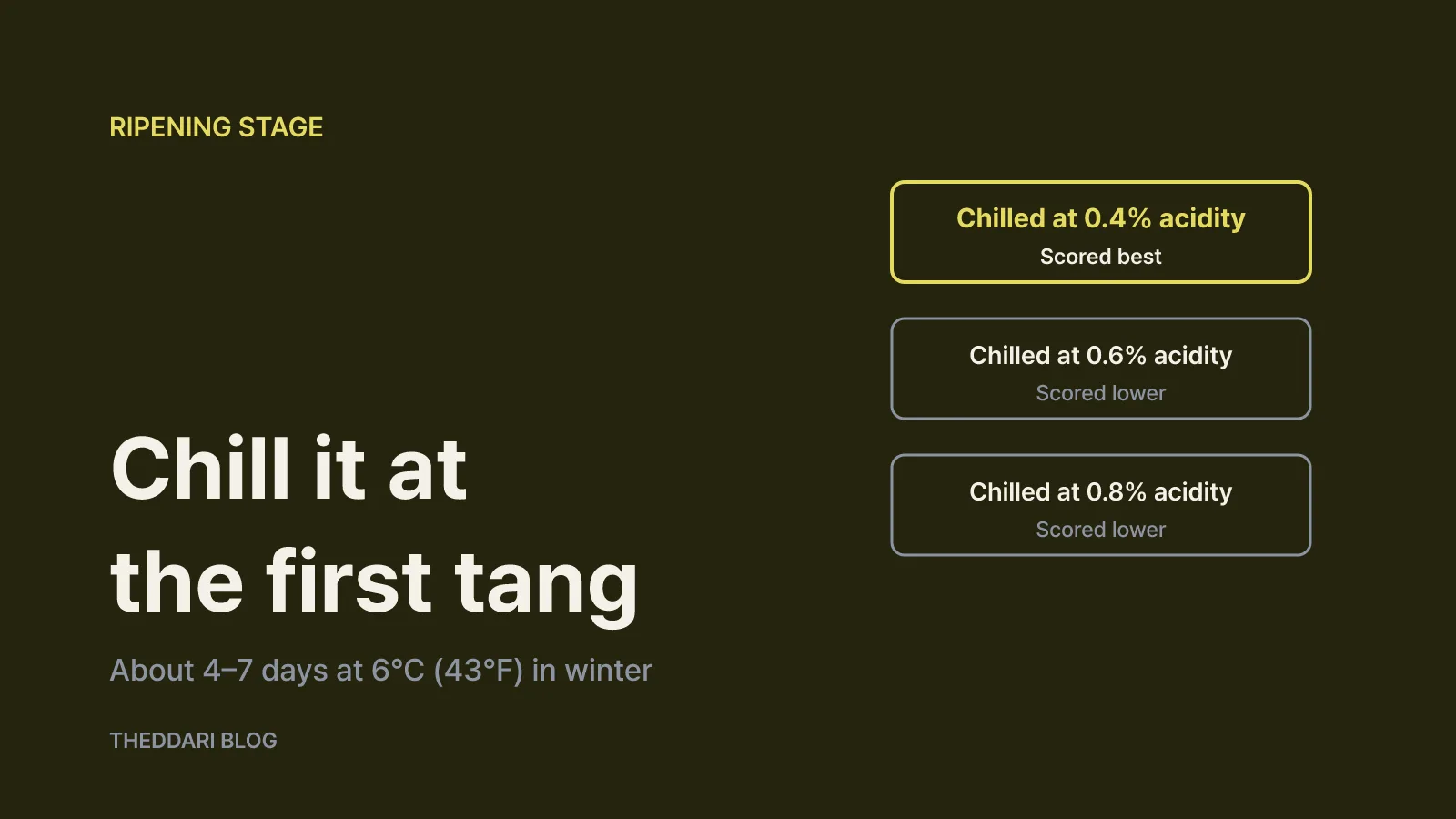
Researchers do not all pick the same ripening temperature, but they agree on the trade-off: warmer ripens faster, and too warm hurts flavor.
- Around 6°C (43°F). The 2018 study compared 5, 6 and 7°C and chose 6°C as optimal, with ripening taking about 4–7 days in winter and 3–5 days in spring and autumn. The mode the researchers programmed ripens at 6°C for 111 hours in winter or 58 hours in spring and autumn, then drops straight to -2 to -1°C. They also reported that near 5°C, Leuconostoc grew 5.3 times faster relative to Lactobacillus.
- 10–15°C (50–59°F). A 2007 study in the same journal compared 5–20°C and concluded that 10–15°C is an appropriate initial ripening temperature for a kimchi refrigerator, while noting that higher ripening temperatures tended to lower overall acceptability.
Both studies use acidity to decide when to switch. The 2018 paper defined the end of ripening as 10^8–10^9 CFU/mL of lactic acid bacteria and about 0.40% acidity. The 2007 paper moved kimchi to -1°C at 0.4%, 0.6% and 0.8% acidity and found that the 0.4% batch scored best, while the 0.6% and 0.8% batches scored lower. In other words, waiting until kimchi is clearly sour before chilling is too late.
At home you probably do not own an acidity meter, so taste instead. Starting a couple of days after making it, try a piece daily. When the raw-cabbage flavor fades and a gentle tang appears, it is time to move it. If it is already distinctly sour, you have passed the 0.4% mark, so chill it immediately. A warm kitchen speeds everything up.
Long-term storage temperature: -1°C or -2°C?
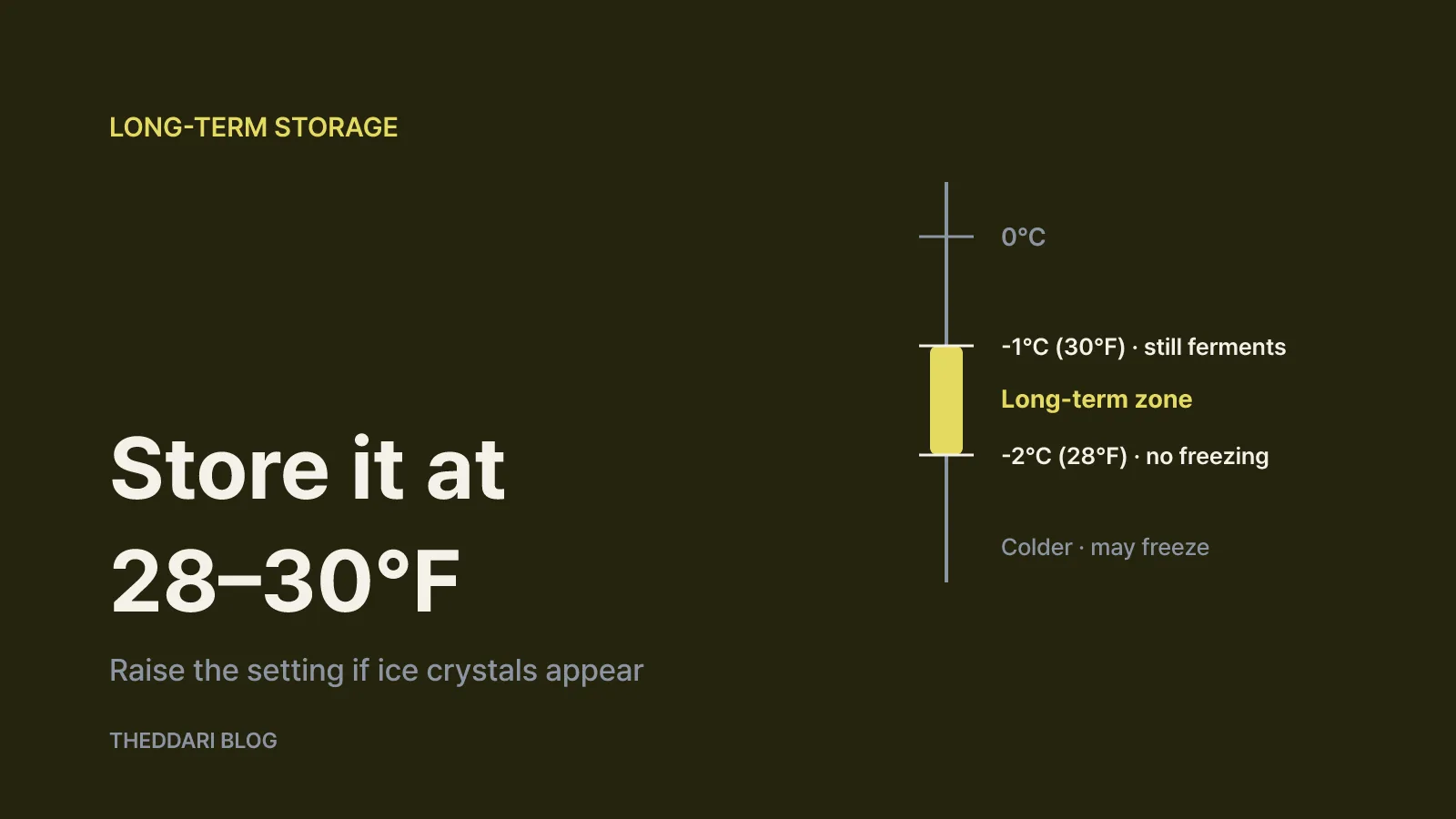
Once ripened, the goal is to slow fermentation as much as possible without freezing the kimchi. The research points to a narrow window of -2 to -1°C (28–30°F).
The 2007 study found that -1°C (30°F), the setting used by kimchi refrigerators at the time, did not fully stop microbial growth, while -2 ± 0.5°C appeared to be the lowest temperature at which kimchi does not freeze. Its recommended program was ripening at 15°C to 0.4% acidity, then switching to -2 ± 0.5°C. The 2018 study likewise stored ripened kimchi at -2 to -1°C.
How to choose within that range:
- Kimchi you want to keep into spring: lean toward -2°C (about 28°F) to slow fermentation further. If you see ice crystals on the surface, raise the setting one step.
- Kimchi you will finish within a month or two, or a low-salt batch: less salt makes freezing more likely, so -1°C (30°F) is the safer choice. Remember that kimchi will keep slowly fermenting at this temperature, so eat these containers first.
If you do not have a kimchi refrigerator, a regular fridge still works, just for a shorter time: the Rural Development Administration guidance says about three months. Keep kimchi on a back shelf rather than in the door, where temperatures swing each time you open it, and keep the ripening stage short because the fridge will not slow fermentation as much.
Packing tips that extend shelf life
Air exposure matters almost as much as temperature. The same guidance lists these packing steps (Foodnuri):
- Pack cabbage halves cut side up so the seasoning paste stays between the leaves.
- Cover the surface with outer cabbage leaves, plastic wrap or an airtight lid to block air.
- Split the batch into small containers. A single large tub exposes all of the kimchi to air every time you take some out.
- Leave seafood and rice-flour paste out of kimchi meant for long storage, since both make it sour faster.
Small containers also make two-stage storage easy. Keep one or two in the fridge you open daily and leave the rest sealed in the coldest section. Each time you open a container, press the kimchi down so it stays under its brine before closing it again. If you made a batch with oysters, label it to eat first; our raw oyster safety guide covers handling them.
Quick storage timeline
← Swipe to see more
| When | What to do | Target |
|---|---|---|
| Day 0 | Pack into small containers, cut side up, surface covered | Minimize air contact |
| Days 1–7 | Ripen around 6°C (43°F) or with a ripening mode; taste daily | 4–7 days in winter, ~0.4% acidity |
| First gentle tang | Move to long-term storage | -2 to -1°C (28–30°F) |
| During storage | Raise one step if ice crystals appear; keep long-term containers closed | Freezing threshold near -2°C |
| Regular fridge | Eat first | About 3 months |
| Kimchi refrigerator | Eat in order | About 6 months |
These durations come straight from the cited research and guidance. Real-world ripening speed depends on the cabbage, salt level, seasoning and room temperature, so the moment kimchi starts to taste lightly sour matters more than any calendar date. All of the studies cited here used napa cabbage kimchi; radish kimchi or watery styles may ripen at a different pace, so apply the same principle but taste on their own schedule.