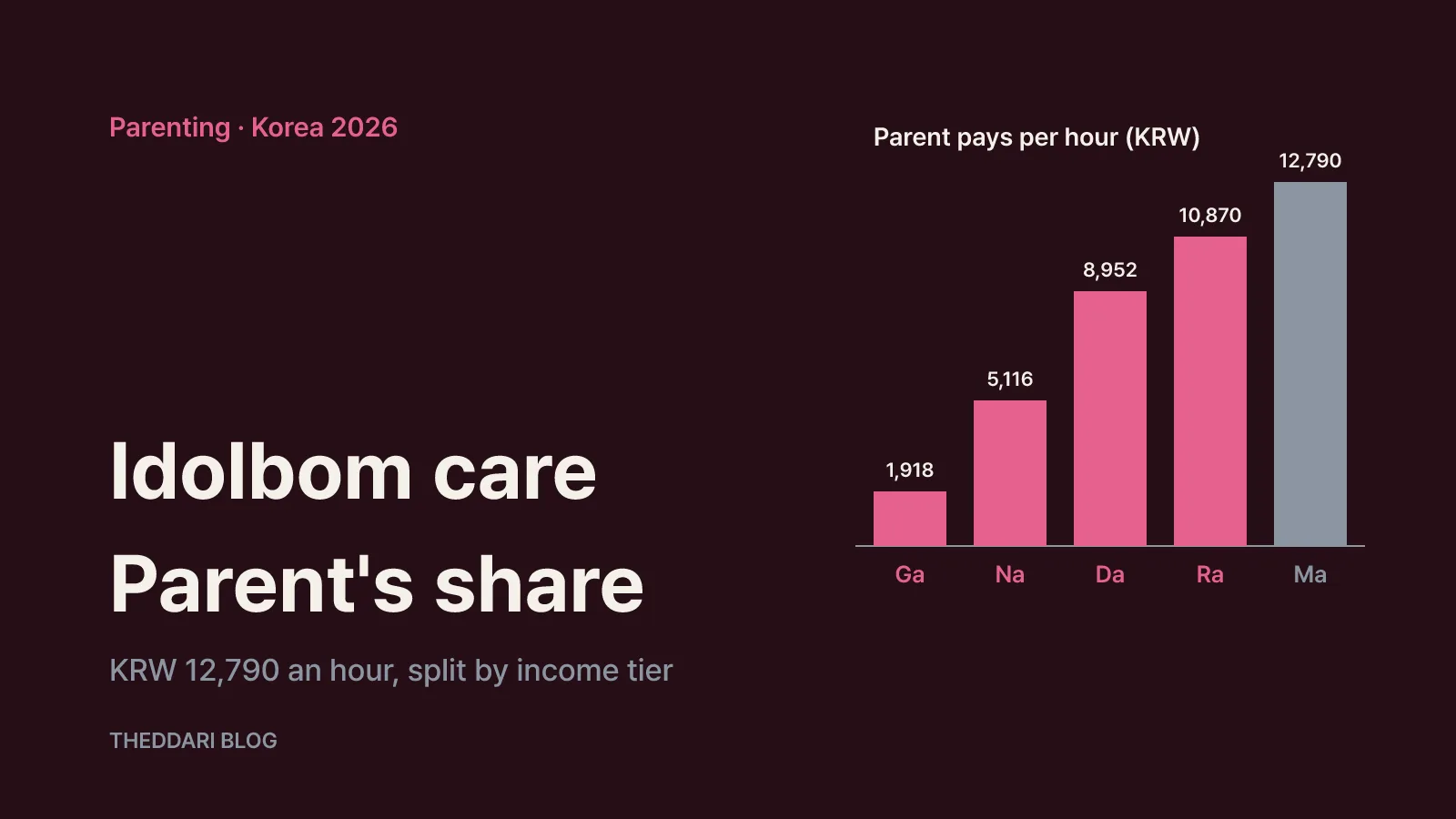
As of October 2026, Korea's government-run in-home childcare service, known as Idolbom (아이돌봄서비스), charges KRW 12,790 per hour for its standard hourly care, and families at or below 250% of the standard median income have part of that paid by the state. For a child born on or after January 1, 2019 (generally not yet in school), the parent's hourly share is KRW 1,918 in tier Ga, KRW 5,116 in tier Na, KRW 8,952 in tier Da and KRW 10,870 in tier Ra. Households above 250% fall into tier Ma and pay the full KRW 12,790. The subsidy covers up to 960 hours of hourly care per year. This guide cross-checks the Ministry of Gender Equality and Family program page with the Idolbom service guide so you can work out which tier applies to your family and what a typical month will cost. Your actual tier is set by the community center that handles your child's registered address.
What the service is and what changed in 2026
Idolbom sends a trained caregiver, now called an aidolbomsa, to your home. There are two main formats. Hourly care covers children from 3 months to 12 years old, booked in blocks of time. Full-day infant care covers babies from 3 months to 36 months. Hourly care comes in a basic version at KRW 12,790 an hour, which is childcare only, and a comprehensive version at KRW 16,620 an hour, which adds child-related housework such as laundry, cooking the child's meals and tidying play areas.
According to the government policy briefing, the 2026 changes were significant. The income ceiling for any subsidy rose from 200% to 250% of the standard median income. The hourly rate went up 5%, from KRW 12,180 to KRW 12,790. Single-parent, grandparent-led, disabled-parent and teenage-parent households now get 1,080 subsidized hours a year instead of 960. The subsidy rate for children aged 6 to 12 increased, and families in designated depopulation areas receive an extra 5% off their share.
One point often gets mixed up: you do not need to qualify for a subsidy to use the service. Families without a subsidy simply sign up on the website and pay the full rate.
Your hourly share by income tier
The subsidy depends on two things: your income tier and your child's birth date. Children born on or after January 1, 2019 are Type A; children born on or before December 31, 2018 are Type B. Here are the 2026 figures for basic hourly care and full-day infant care, using the ministry's thresholds for a four-person household.
← Swipe to see more
| Tier | Share of median income | 4-person household | Parent pays, Type A | Parent pays, Type B |
|---|---|---|---|---|
| Ga | 75% or less | up to KRW 4.871M/month | KRW 1,918 (15%) | KRW 2,558 (20%) |
| Na | up to 120% | up to KRW 7.794M | KRW 5,116 (40%) | KRW 6,394 (50%) |
| Da | up to 150% | up to KRW 9.742M | KRW 8,952 (70%) | KRW 9,592 (75%) |
| Ra | up to 250% | up to KRW 16.237M | KRW 10,870 (85%) | KRW 11,510 (90%) |
| Ma | above 250% | above KRW 16.237M | KRW 12,790 (100%) | KRW 12,790 (100%) |
For a three-person household the cut-offs are KRW 4.019M, 6.431M, 8.039M and 13.398M. Because comprehensive care costs KRW 16,620, the parent's share is higher in every tier: for Type A it is KRW 5,748 (Ga), 8,946 (Na), 12,782 (Da), 14,700 (Ra) and 16,620 (Ma).
Extra discounts can stack on top. Households in tiers Ga to Ra with two or more children aged 12 or under get another 10% off their share. Families in depopulation areas get 5% off their share. Tier Ga single-parent, disabled-parent, disabled-child, teenage-parent and grandparent-led households get an additional 5% of the fee covered, and teenage parents with a child aged 0 or 1 (up to 250%) have 90% of the fee covered.
Who counts as having a care gap
Income alone does not unlock the subsidy. The ministry requires a care gap. If, for example, neither parent works and there is no other qualifying reason, the household is excluded. Qualifying households include:
- Dual-income families and single-parent families, including grandparents raising grandchildren
- Families where a parent has a registered disability, unless the parent at home on leave or full-time is not disabled
- Families with two or more children aged 12 or under
- Multicultural families with two or more children aged 12 or under
- Families of children at risk of abuse, with a care-gap confirmation from a designated official or child protection agency
Other situations also count: a parent's serious or rare illness, a hospital stay of five days or more (one day for single parents), a new birth leaving older siblings without care (from pregnancy confirmation to 90 days after birth), military service or incarceration, and study, job training or job seeking. If the other parent is at home on leave or not working, the gap is not recognized.
How to apply, step by step
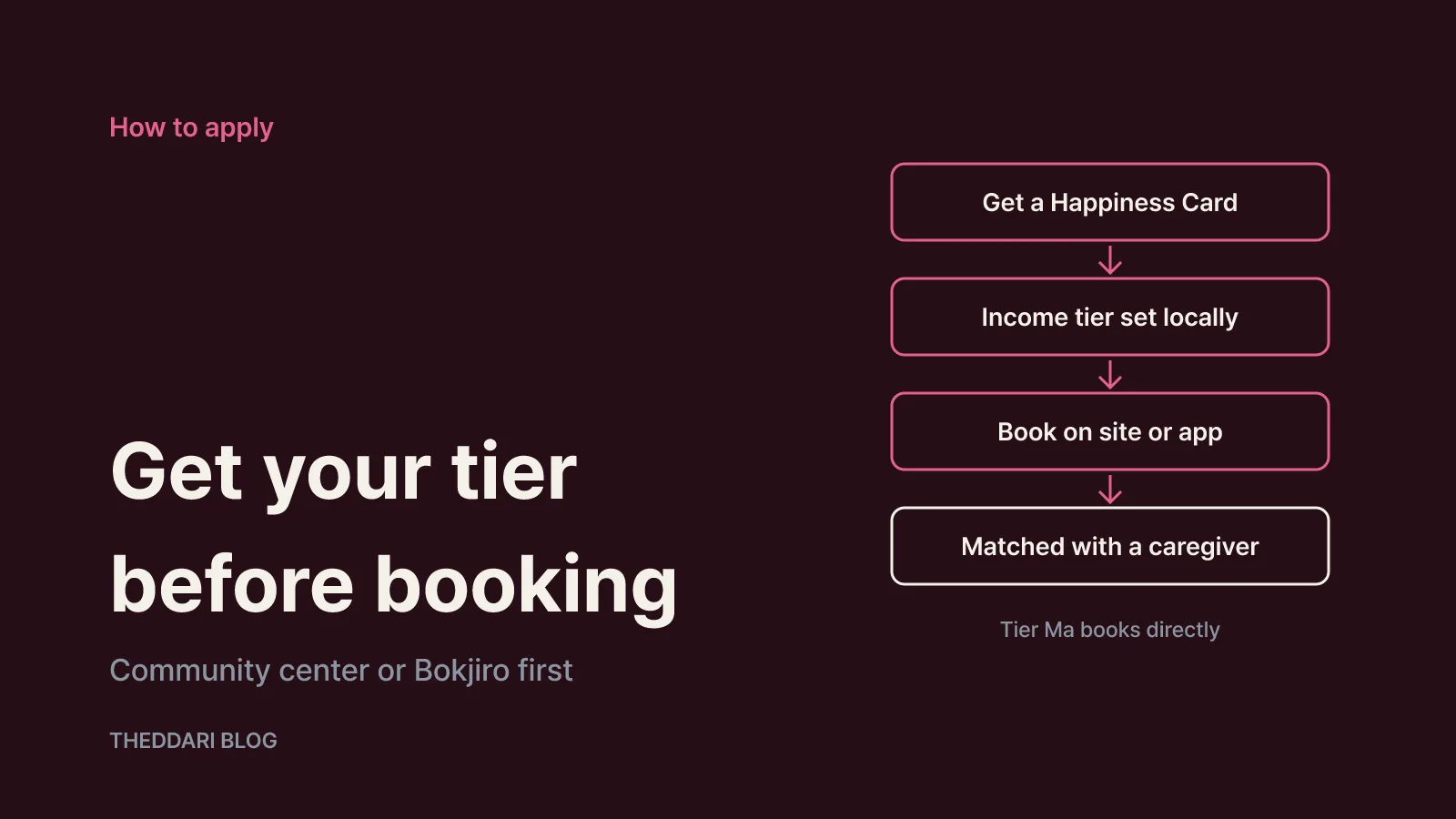
Order matters, because the income tier must be set before you book through the website.
- Get a National Happiness Card (국민행복카드) in the applicant's name from a participating card company.
- Apply for the subsidy and get your tier. Go to the community center (주민센터) where the child is registered. Online applications through Bokjiro are limited to dual-income couples and single parents enrolled in workplace health insurance, using a digital certificate. Bring the social security benefit application form and proof of your care gap, such as employment documents.
- Sign up and book on the Idolbom website or app. The user pledge and emergency treatment consent are completed online when you register.
- Get matched. A local service provider assigns a caregiver. The national helpline is 1577-2514.
Families in tier Ma skip step 2 and book directly.
Overlap with daycare and kindergarten hours
This rule catches many parents. If your child receives a daycare or kindergarten subsidy, hourly care booked during facility hours is not subsidized. The ministry sets those hours at 9 a.m. to 1 p.m. on weekdays for kindergarten and 9 a.m. to 4 p.m. for daycare centers. Book care to start after pickup time to keep the subsidy on every hour.
Full-day infant care is stricter: it cannot be combined with daycare or kindergarten subsidies, the parental allowance, the home-care allowance or subsidized hourly care. Switching between hourly and full-day care converts 80 hourly hours into one month of full-day care, so check your remaining balance with the provider first.
Exceptions apply with paperwork: school breaks, the child's illness or injury, the first month at a new facility and government-ordered closures. If you expect a long winter break, ask the center for its break notice early.
Surcharges, discounts and cancellation fees
Hourly care must be booked for at least 2 hours, then in 30-minute steps; full-day infant care needs at least 3 hours. Nights (10 p.m. to 6 a.m.) and Sundays or public holidays carry a 50% surcharge, and the two do not stack. When one caregiver looks after two children at once, the fee drops 25%; for three children, 33.3%.
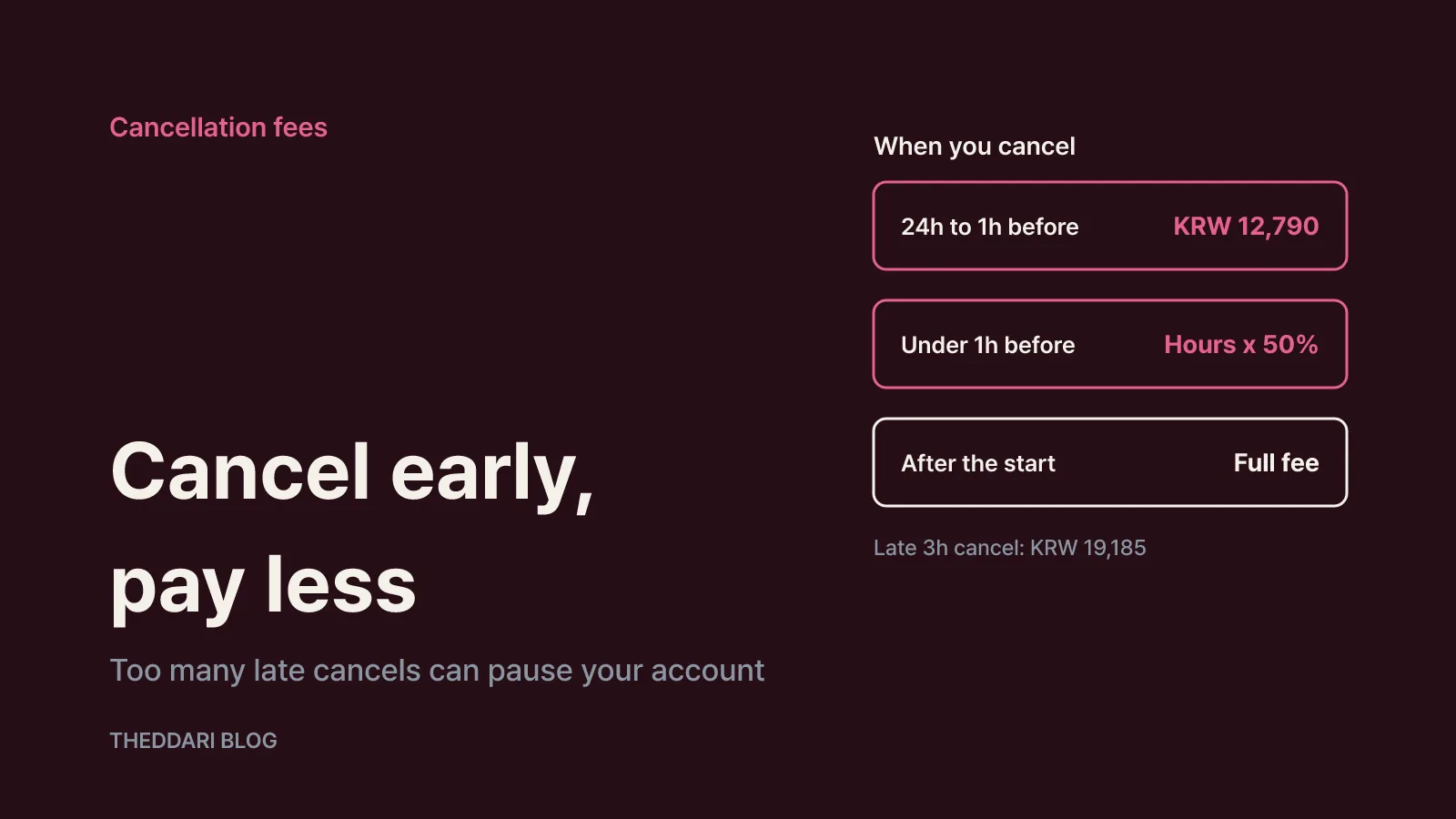
For basic hourly care, the Idolbom guide sets cancellation fees as follows:
- 24 hours to 1 hour before the start: KRW 12,790 per booking
- Less than 1 hour before the start: KRW 12,790 x booked hours x 50%, minimum KRW 12,790 (KRW 19,185 for a 3-hour booking)
- After the start: the full fee for the booked hours
Three or more cancellations within 72 hours of the start time in one month trigger a one-month suspension. Paying an extra amount equal to twice the cancellation fee removes one of those strikes.
A sample monthly budget
Take a dual-income family of four in tier Da with one child born in 2020 (Type A), using 3 hours a day on 20 weekdays, or 60 hours a month.
- Total fee: KRW 12,790 x 60 = KRW 767,400
- Government share: KRW 3,838 x 60 = KRW 230,280
- Parent pays: KRW 8,952 x 60 = KRW 537,120
With a second child aged 12 or under who is not in care, the 10% multi-child discount lowers that to KRW 483,408. A tier Ra family with a child born in 2018 (Type B) would pay KRW 11,510 an hour, or KRW 690,600 for the same 60 hours.
Spread evenly, 960 hours is about 80 hours a month, so heavy use during school breaks can drain the allowance quickly. Check your balance on the website, and request a reassessment at the community center or on Bokjiro if your household size, address or income changes.