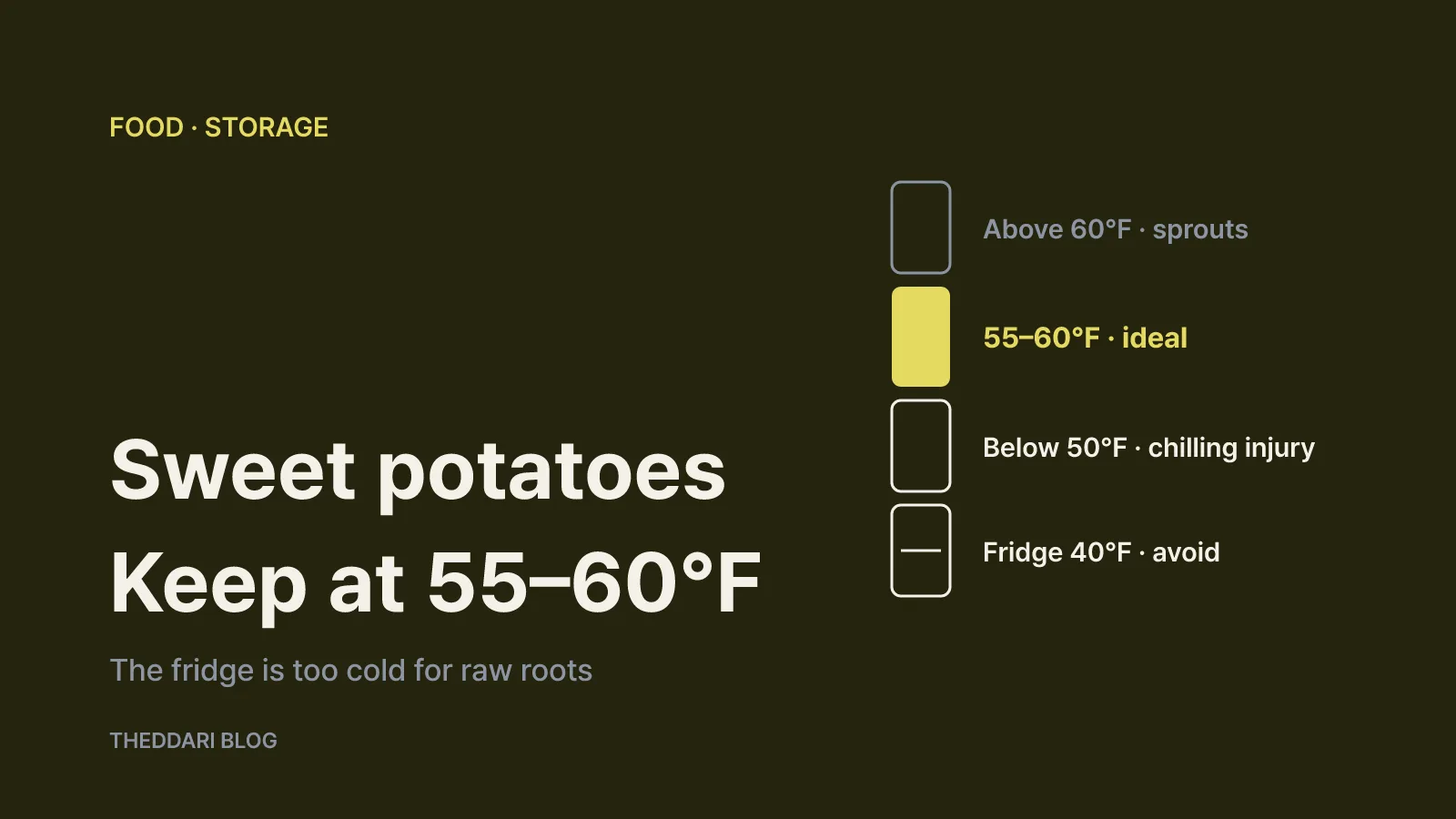
As of October 2026, extension and government guidance agrees on one point: raw sweet potatoes should not go in the refrigerator. Washington State University's sweetpotato curing and storage guide recommends storing them at 55–60°F (about 13–16°C), warns that chilling injury occurs below 50°F, and notes that sprouting starts above 60°F. A refrigerator kept at 40°F or below, the safe setting for perishable food, is far too cold for a raw sweet potato. Once they are cooked, though, the rules flip, and they belong in the fridge or freezer. Here is what each temperature does and how to set up storage at home.
The best temperature: 55–60°F (13–16°C)
The WSU guide sets the target at 55–60°F with 80–90% relative humidity. Korean agricultural guidance lands in nearly the same place: the Rural Development Administration's Nongsaro sweet potato page gives an ideal range of 12–15°C (roughly 54–59°F), and the agency's crop science institute pairs that with 85–90% humidity. Two research bodies on different continents describing the same narrow band is a good sign that the number is not arbitrary.
That band surprises people because most root vegetables like it colder. The Korean horticulture institute's produce storage guide lists radishes, garlic, onions and carrots at 0°C and potatoes at 4–8°C, while sweet potatoes sit apart at 13–15°C. Sweet potatoes are a warm-climate crop, so the habit of tossing every root into the crisper drawer works against them.
Humidity matters, but you do not need a hygrometer to get close. Too dry and the roots shrivel; too damp and mold forms on wet skin. Wrapping each root in paper slows moisture loss, and keeping air moving stops condensation from collecting.
What the refrigerator does to raw sweet potatoes
Cold damage in sweet potatoes is called chilling injury, and it is not always visible from the outside. According to Nongsaro, below 10°C (50°F) the roots' respiration jumps early in storage and they eventually rot. Just 24 hours at 0°C (32°F) is enough to cause chilling injury, and the roots freeze at about -1.3°C. Even one light frost leaves lasting damage.
The most common sign shows up only after cooking. Nongsaro says sweet potatoes cooked after refrigeration develop off-flavors, a changed texture and a hard center. If a baked sweet potato has a stubborn, undercooked-feeling middle even after a generous oven time, the way it was stored is a more likely culprit than the recipe.
The Korean crop science institute's data shows how serious borderline cold can be: roots held at 10°C had rot rates above 50% from chilling injury, whether or not they had been cured. That figure comes from commercial storage, but a home refrigerator at 40°F is colder still.
How to store sweet potatoes at home in 5 steps
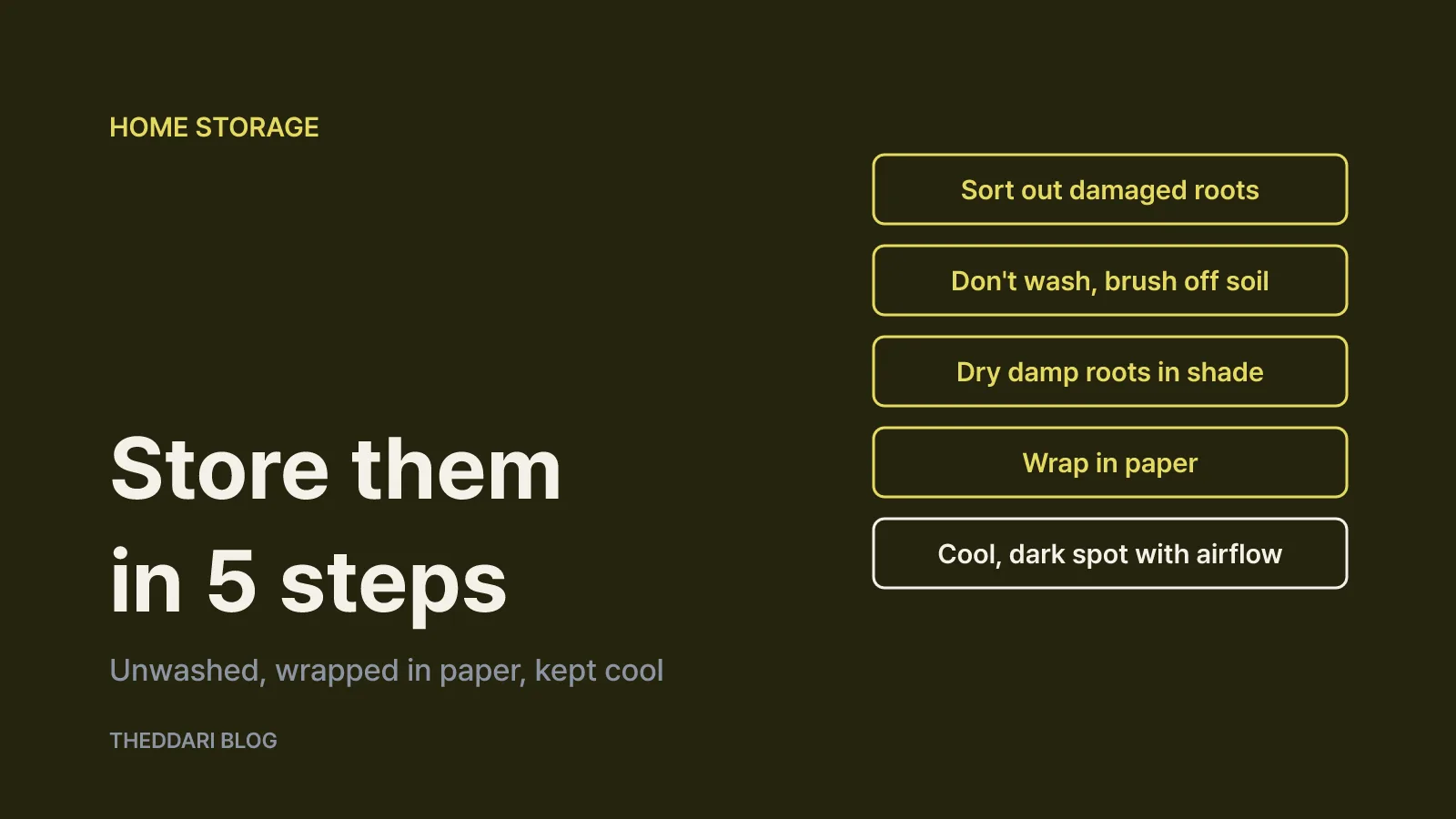
- Sort out damaged roots. Wounds let pathogens in and lead to rot. Set aside any with cuts, peeled skin or soft spots and cook those first.
- Do not wash them. WSU advises storing roots unwashed and washing only right before cooking. Brush off loose soil instead.
- Dry any damp roots. If the bag had condensation or the roots got wet, spread them out in a shady spot until the skin is dry.
- Wrap them in paper. WSU suggests newspaper or a paper bag at home, and Nongsaro gives the same advice. Avoid sealed plastic, which traps moisture.
- Pick a cool, dark spot with airflow. WSU mentions a cool closet, an unheated storage room or a garage. Leave the box open or ventilated rather than packing roots tightly.
The deciding factor is the actual temperature of the spot. An inexpensive thermometer left in a candidate cupboard or closet for a day or two will tell you whether it stays near 55–60°F. In winter, an unheated garage or porch can drop below 50°F overnight, so check again when the weather turns.
Too warm is a problem too: sprouts and dry flesh
Avoiding cold is only half the job. WSU notes that sprouting occurs above 60°F, and hot, dry conditions increase moisture loss and can make some varieties pithy, with dry, fibrous flesh. Nongsaro adds that warm storage speeds up respiration, burning through the root's reserves.
That rules out the top of the refrigerator, the cabinet next to the oven and a sunny counter. A spot that feels pleasantly cool to you, rather than warm, is usually closer to the target.
Cured vs. uncured: why some last months
Curing is a short warm, humid treatment that heals harvest wounds. WSU recommends 80–90°F and 80–90% humidity for about a week. During curing, a protective cork layer forms on the skin, and some starch turns to sugar, which improves flavor.
The payoff is large. WSU says uncured sweet potatoes last only a few weeks after harvest, while properly cured roots stored at 55–60°F can keep for 6 to 12 months or more. Variety matters too: in Korean trials, one cured variety kept rot below 5% after more than 8 months, while another passed 10% rot after 4 months even at 13°C. If you buy a large box from a farm stand or grow your own, ask whether the roots were cured. If you are unsure, or the skin rubs off easily, plan to eat them within a few weeks.
Cooked sweet potatoes belong in the fridge or freezer
Once a sweet potato is cooked, it is treated like any other leftover. The USDA Food Safety and Inspection Service's leftovers guidance says to refrigerate cooked food within 2 hours, or within 1 hour if it is above 90°F, because bacteria grow rapidly between 40°F and 140°F.
FSIS says leftovers keep 3 to 4 days in the refrigerator or 3 to 4 months in the freezer. Divide large batches into shallow containers so they cool quickly, cover them well, and reheat to 165°F. Mashed or roasted sweet potatoes are easy to freeze in single portions, and FSIS notes it is safe to reheat frozen leftovers without thawing first.
How to check stored sweet potatoes
Open the box regularly and look for these signs:
- Soft spots or mold: remove the root right away so decay does not spread, and replace damp paper.
- Darkened patches on the skin: Nongsaro describes these as a sign of an old root and says those areas can taste bitter and may be harmful. If discoloration is extensive, discard the root.
- Shriveled skin: the spot is too warm or too dry. Move the box somewhere cooler.
- Sprouts: storage is likely above 60°F. Cook sprouting roots first and find a cooler place.
- A hard center after cooking: a sign of chilling injury. Recheck where the rest of the batch is stored.
In short: keep raw sweet potatoes unwashed, dry and wrapped in paper at 55–60°F, away from the fridge, and refrigerate cooked ones within 2 hours. Those two habits do most of the work.