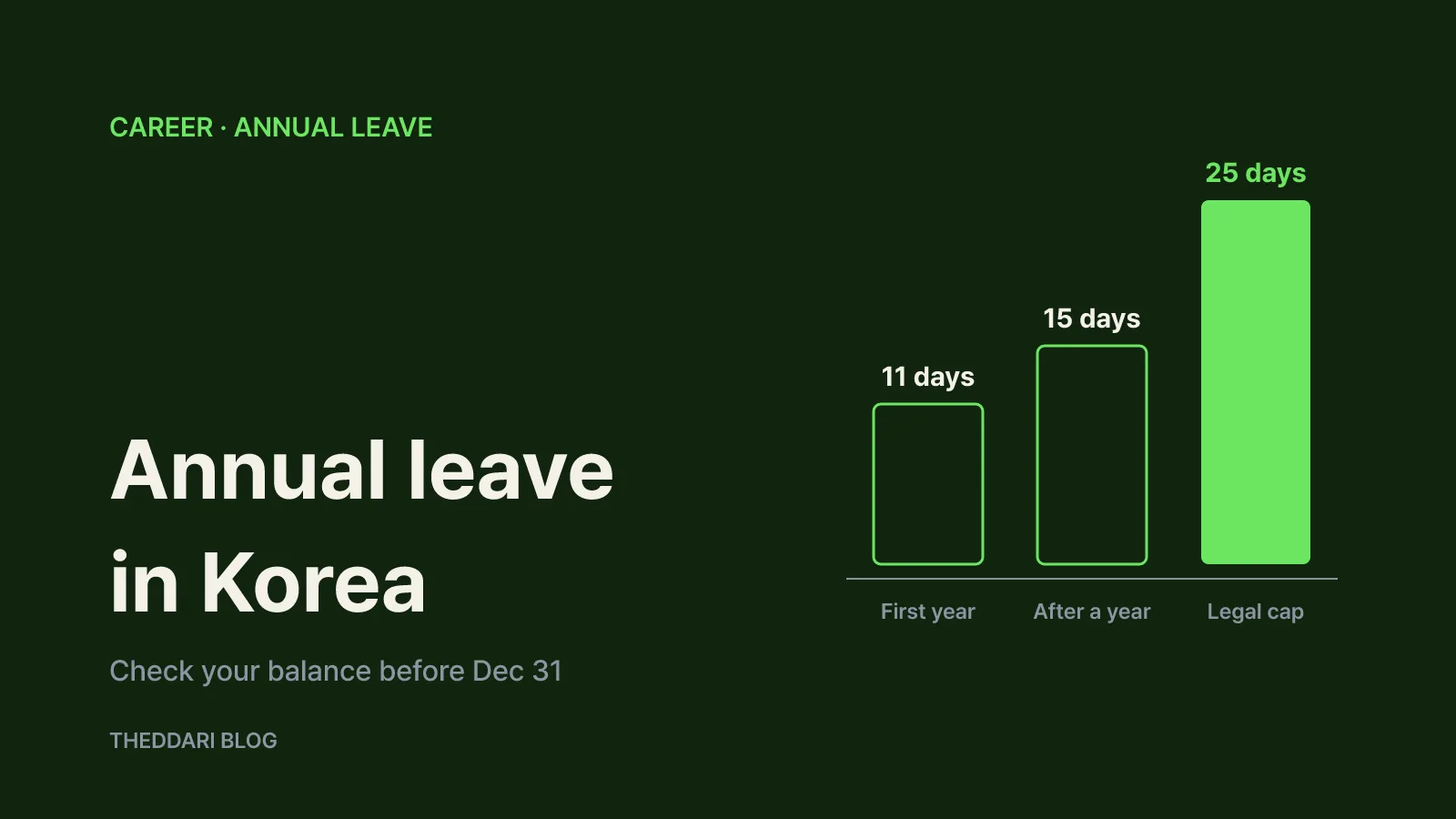
As of November 2026, Korea's Labor Standards Act gives employees up to 11 days of paid annual leave in their first year (one day for each full month worked), 15 days after a year with at least 80% attendance, and one extra day for every two additional years of service, capped at 25 days. Leave you do not use expires after one year, but if your employer did not follow the written leave-use promotion procedure in Article 61, you are generally owed pay for the unused days. Many Korean companies run leave on a calendar-year basis, so for a lot of workers this year's balance expires on December 31.
This guide is based on the text of Article 60 of the Labor Standards Act (version in force from October 8, 2026), answers published by the Ministry of Employment and Labor's 1350 counselling service, and an amendment that takes effect on June 10, 2027. The ministry explains that statutory annual leave applies to workplaces with five or more regular employees and to workers whose scheduled hours average at least 15 per week over four weeks. If your workplace is smaller, or you work fewer hours, check your employment contract and company rules instead.
How many annual leave days you get in Korea
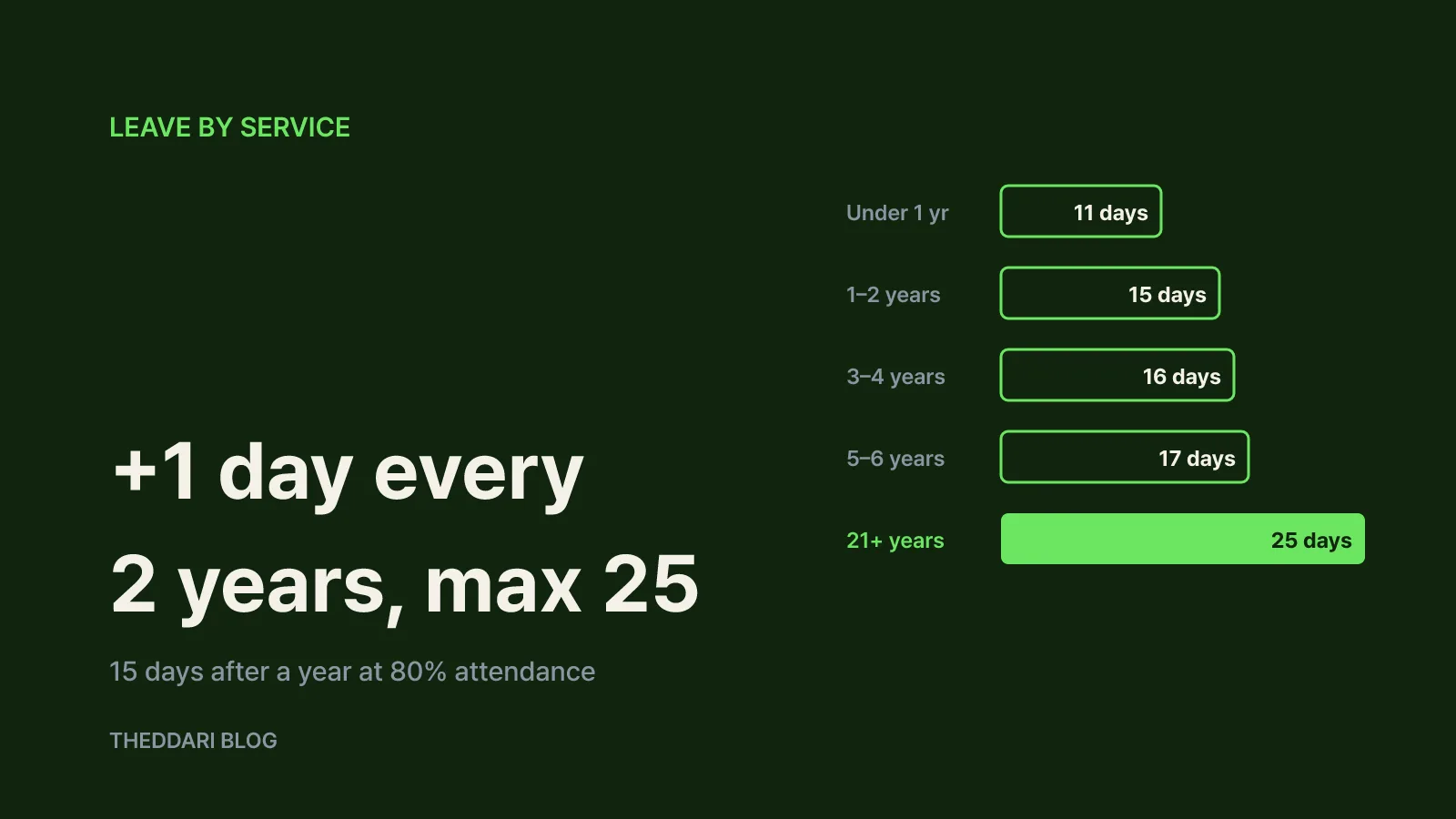
Two questions decide your entitlement: how long you have worked continuously, and whether you attended at least 80% of scheduled working days in the previous year. Article 60(1) grants 15 days to anyone with 80% attendance over a year. Article 60(2) grants one day per fully attended month to workers with less than a year of service, or to those whose attendance fell below 80%. Article 60(4) adds one day for every two years of service beyond the first year once you reach three years, with a ceiling of 25 days including the extra days.
← Swipe to see more
| Years of service | Annual leave | Basis |
|---|---|---|
| Under 1 year | 1 day per full month, up to 11 | Art. 60(2) |
| 1–2 years | 15 days | 80% attendance |
| 3–4 years | 16 days | +1 day every 2 years |
| 5–6 years | 17 days | +1 day every 2 years |
| 21+ years | 25 days | Statutory cap |
A quick formula: 15 days plus the whole-number result of (years of service − 1) ÷ 2, stopping at 25. Seven years gives 15 + 3 = 18 days; 21 years reaches the 25-day cap. The first-year figure is 11 rather than 12 because the twelfth month is when you move onto the 15-day entitlement.
Certain absences count as attendance for the 80% test. Article 60(6) treats time off for a work-related injury or illness, pregnancy-related leave such as maternity leave, parental leave, and hours reduced under childcare or pregnancy reduced-hours schemes as days worked. If your leave was cut after returning from parental leave, this is the provision to raise with HR.
Part-time workers on 15 or more hours a week also earn leave, but it is calculated in hours. According to a ministry counselling answer citing the Enforcement Decree, the formula is: a full-time worker's leave days × (your scheduled hours ÷ a full-time worker's scheduled hours) × 8 hours, with fractions under one hour rounded up to one hour. Someone working 20 hours a week where full-time is 40 hours earns 15 × 20/40 × 8 = 60 hours after one year.
When leave is created and when it expires
The ministry explains that the 15-day entitlement arises on the day after you complete a year of work, and only if you are still employed that day. Its example: a person hired on December 16, 2024 with 80% attendance gains 15 days on December 16, 2025 if still employed; if that same date is their resignation date, the leave does not arise because the last day is excluded from the period of continuous service.
Expiry is set by Article 60(7). Leave earned after the first year lapses if unused for one year. Monthly leave earned during the first year must be used before that first year of work ends, so someone who joined on July 1 has until June 30 of the following year. Leave does not lapse if you could not take it because of the employer.
The law's default is your hiring date, but the ministry accepts companies granting leave to everyone on January 1 through collective agreements or work rules, provided employees are not worse off. In the first partial year, leave is prorated. The ministry's example gives a worker hired on May 10, 2022 about 9.7 days on January 1, 2023 (15 × 236 ÷ 365), separate from the first-year monthly leave. Under this system, leave granted on January 1 must be used by December 31. The law itself only says unused leave lapses, so whether you can carry days over depends on company rules or agreement.
How unused leave pay works
Losing the right to take leave does not always mean losing its value. A ministry counselling answer states that remaining days must be paid as unused leave allowance on the day after the one-year use period ends. Article 60(5) says leave is paid at ordinary wages or average wages as set out in work rules, so check which your employer uses.
- Unused leave pay = daily wage (ordinary or average) × remaining days
- Daily ordinary wage = hourly ordinary wage × scheduled daily hours
As an illustration only: with a daily ordinary wage of KRW 100,000 and four days left when the period ends, the payment would be KRW 400,000. Your actual figure depends on which allowances your company counts in ordinary wages.
The main exception is when your employer completed every step of the Article 61 promotion procedure and you still did not use the leave. If any step was skipped, the duty to compensate remains. The ministry has also said that contracts paying leave allowance in advance within monthly salary can be valid only if the amount and days are clearly written down and you can still take the leave.
The written leave-use promotion procedure
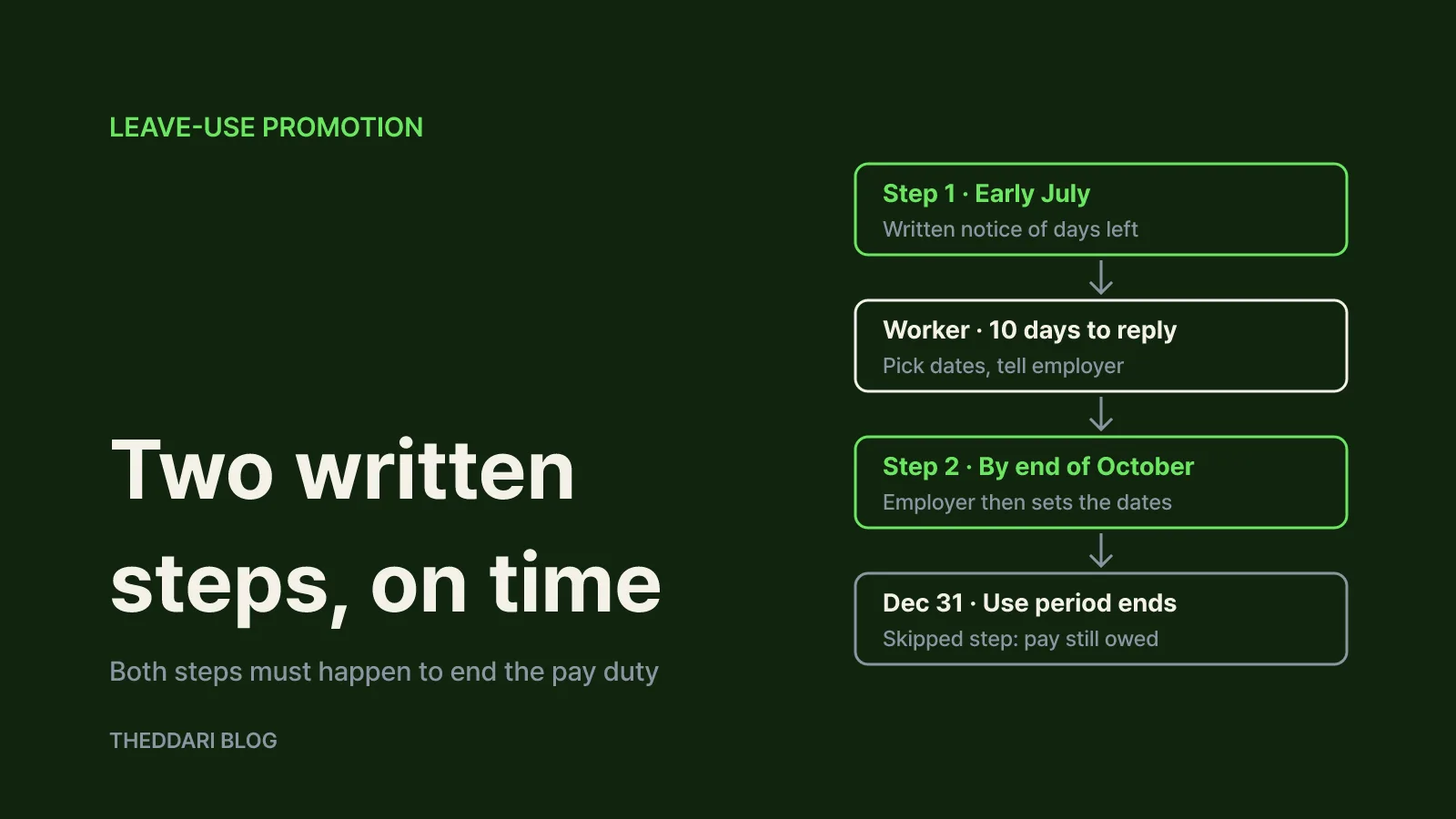
Article 61 releases an employer from paying for expired leave only when it took two written steps. For leave earned after the first year:
- Within 10 days starting six months before the use period ends, the employer tells each worker in writing how many days remain and asks them to choose dates.
- If the worker does not reply within 10 days, the employer sets the dates itself and notifies the worker in writing no later than two months before the period ends.
For calendar-year leave ending December 31, that means a written request in early July and employer-set dates by the end of October. If your first reminder arrived in November, compare the dates with the statute. For first-year monthly leave, Article 61(2) uses shorter windows: a written request within 10 days starting three months before the first year ends, and employer-set dates at least one month before; for leave created after that request, the request must come within five days starting one month before the end, and dates must be set at least 10 days before. Keep copies of any notices you receive.
Leaving a job and the June 2027 changes
When you resign, the ministry says remaining leave must be paid within 14 days of your departure date. If your company used calendar-year leave and that gave you fewer days than the hiring-date method would have, the shortfall must be paid; if the calendar-year method was more generous, it applies. Timing matters too: leaving on your one-year anniversary rather than the day after can decide whether the 15 days ever arise.
Act No. 21784, promulgated on June 9, 2026, takes effect on June 10, 2027. Employers will have to grant leave requested in split units within limits set by presidential decree, with violations punishable by up to two years' imprisonment or a fine of up to KRW 20 million. Dismissal or other unfavourable treatment because a worker requested or used leave will be banned, with fines of up to KRW 5 million. The ministry's draft decree announced on July 13, 2026 sets the unit at half a day and the range at five days a year; confirm the final wording once the decree is promulgated.
Before December 31, check whether your company uses hiring-date or calendar-year leave, recalculate your days from the table above, note your remaining balance and expiry date, and look for written promotion notices. If the numbers do not match, ask HR with the relevant dates in hand, and if that fails, contact the ministry's 1350 helpline or your regional labor office.