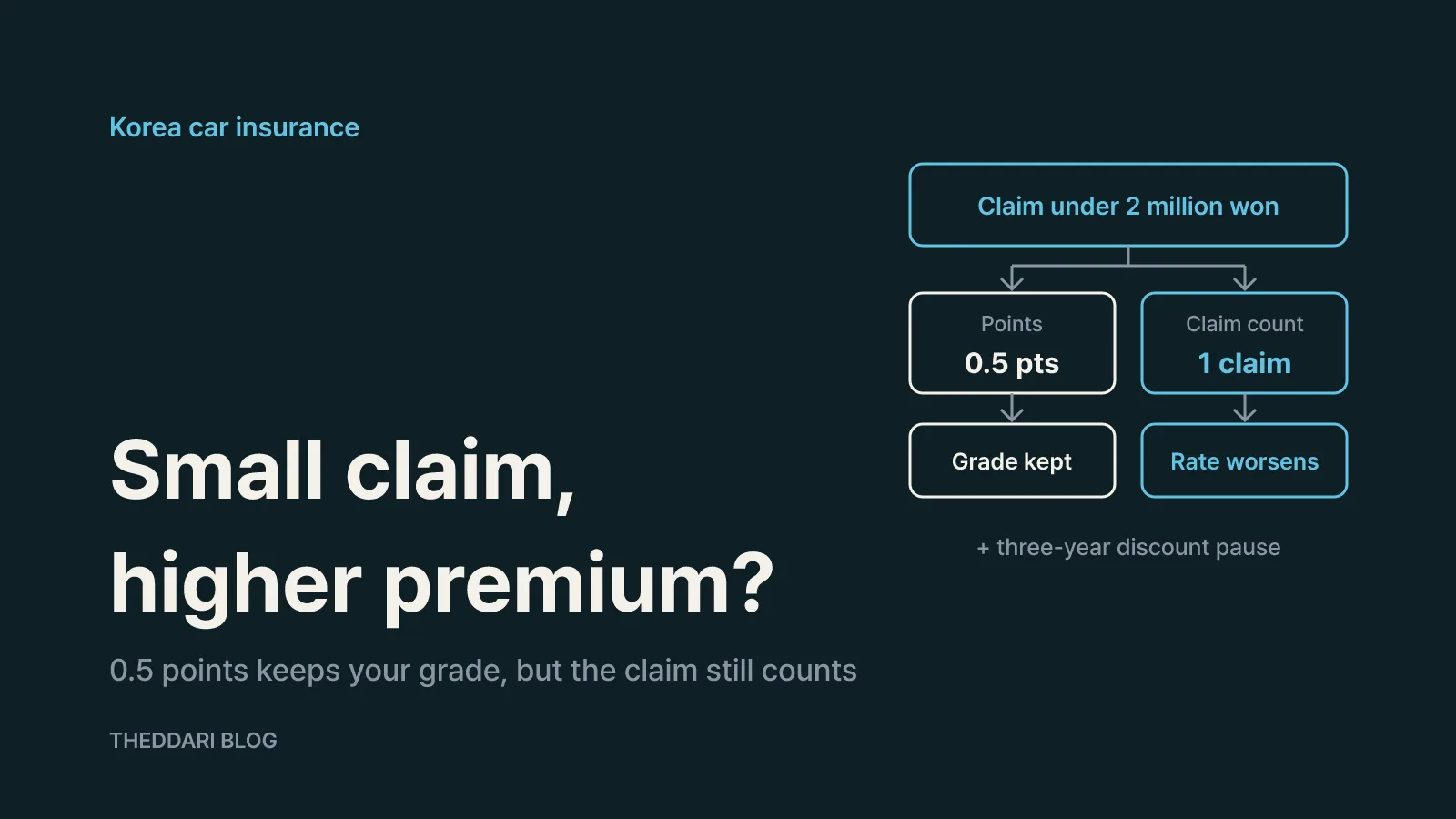
As of November 2026, the short answer for drivers insured in Korea is this: a property damage claim at or below the threshold you chose on your policy (2 million won is the highest option) scores 0.5 accident points, so your discount-surcharge grade does not drop. Your renewal premium can still go up, for two reasons. You lose that year's one-grade no-claim discount, and a separate claim frequency rate, which counts claims rather than money, moves you into a worse group. Two 0.5-point claims in the same evaluation year add up to 1 point, which does cost you a grade.
This guide covers personal auto insurance in South Korea. It is based on the Korea Insurance Development Institute (KIDI) premium calculation guide, an April 2024 Financial Services Commission press release and a Financial Supervisory Service explainer. Insurers apply their own rates on top of these reference rules, so the final number always comes from your insurer's renewal quote.
Two separate mechanisms raise your premium
Korean auto premiums react to accidents through two channels that are easy to confuse.
The first is the discount-surcharge grade. According to the FSC, there are 29 grades and new policyholders start at grade 11. Lower numbers are worse: under the reference pure premium rates for personal policies, grade 1 pays 200% of the base, grade 11 pays 82.8% and grade 29 pays 30%. Each grade you lose adds roughly 7.1% to the premium. Accidents are scored from 0.5 to 4 points, and every full point costs one grade.
The second is the claim frequency rate. The FSS describes it as a matrix of your claims in the last year (0, 1, or 2 or more) and in the last three years (0, 1, 2, or 3 or more), sorted into six groups with different rates. Claims concentrated in the most recent year are rated more harshly. Crucially, this rate ignores the payout size. A scuffed bumper and a near-threshold repair each count as one claim.
That is why the common belief that a claim under the threshold is free is only half true. The FSS gives the example of a driver who made three small claims under the threshold in one year and saw the next premium nearly double.
Other factors can move at the same time. KIDI notes that a traffic violation record can add up to 20%, and insurers may apply a special surcharge of up to 50% for items such as staged accidents. If a small claim seems to have caused a large increase, ask your insurer for a line-by-line breakdown.
The accident points table
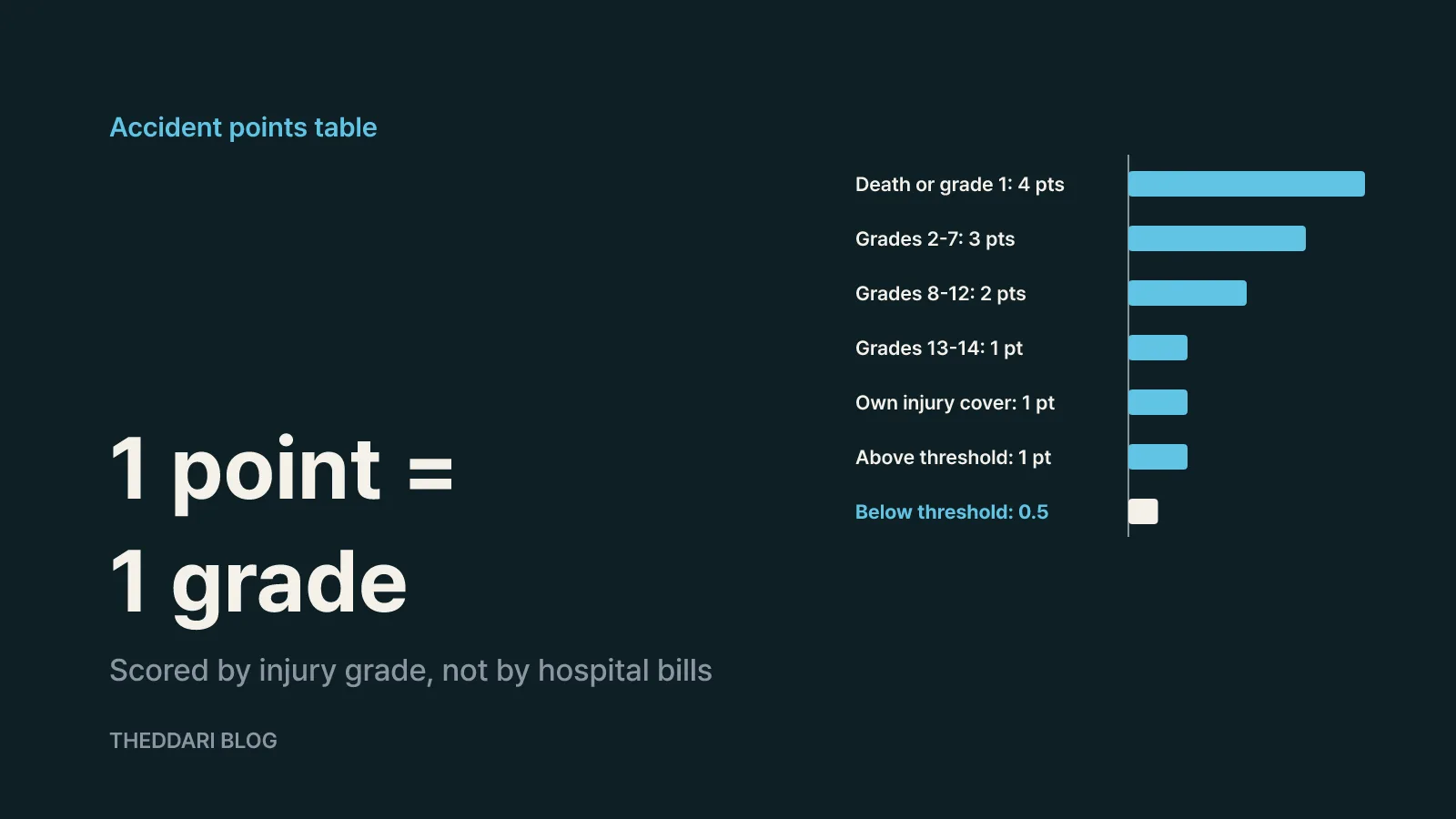
KIDI lists the following scores per accident:
← Swipe to see more
| Type | Detail | Points |
|---|---|---|
| Bodily injury to others | Death or grade 1 injury | 4 |
| Bodily injury to others | Injury grades 2 to 7 | 3 |
| Bodily injury to others | Injury grades 8 to 12 | 2 |
| Bodily injury to others | Injury grades 13 and 14 | 1 |
| Your own injury cover | Any injury grade | 1 |
| Property damage | Above your threshold | 1 |
| Property damage | At or below your threshold | 0.5 |
| At-fault party unknown | 1-point accident | 1 |
The FSC adds one more point when own-vehicle damage exceeds 100 million won. Injury claims are scored by the injury grade (1 to 14) of the most seriously hurt person, not by how much the hospital bills come to, a point the FSS also stresses.
One accident can involve several items. If the other driver has a grade 14 injury (1 point) and the property damage payout exceeds your threshold (1 point), that single accident can total 2 points. Because the way payouts are grouped against the threshold can depend on your contract, ask your insurer for the final point score of each claim.
The 500,000 to 2 million won threshold and the 0.5-point claim
When you buy or renew, you choose a property damage surcharge threshold of 500,000, 1 million, 1.5 million or 2 million won. A claim paid under property damage liability or own-vehicle damage that exceeds it scores 1 point; one at or below it scores 0.5. A higher threshold keeps more small claims at 0.5, but KIDI's premium formula multiplies in a separate threshold rate, so the choice also changes what you pay.
Under KIDI's rules, if your total accident points for the evaluation period are below 1, the renewal keeps your previous grade. You are not surcharged, but you also miss the one-grade discount a claim-free year would have earned. At 1 point or more, the points are subtracted from your previous grade.
So one 0.5-point claim has three effects:
- Your grade stays the same instead of improving.
- Your claim frequency group shifts to one claim in the last year and one in the last three years.
- The FSC states that after a claim you must stay claim-free for three years before the annual discount resumes.
The true cost of a small claim is therefore spread over several renewals, not just the next one.
Evaluation window, discount pause and the low-fault exception
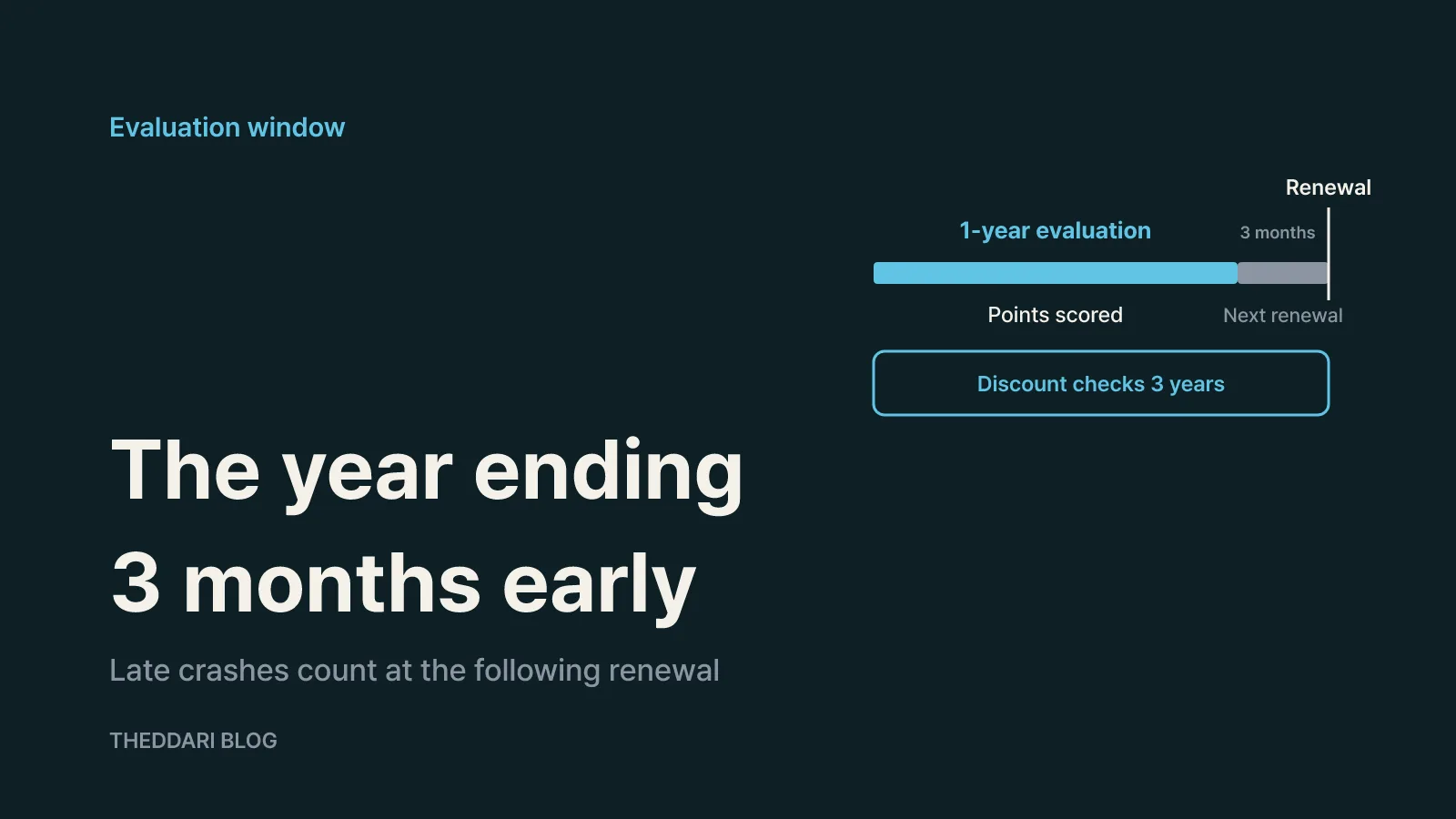
KIDI defines the evaluation period as running from three months before the expiry of the contract before last to three months before the expiry of the last contract. In practice, it is the year that ends three months before your renewal date. A crash in the final three months before renewal therefore shows up one renewal later. Points are scored over that one year, while eligibility for the discount also looks back three years.
Personal policies are evaluated per named insured. If you insure two cars on separate policies, their claims are combined. If both cars sit on one policy with one insurer and matching terms, each car is rated separately and the rates are averaged.
There is relief when you were mostly the victim. KIDI excludes from the point total the single highest-scoring claim where your fault was under 50%. The FSS adds that such a claim is also removed from the one-year claim count but stays in the three-year count, and the three-year discount still does not apply. Claims where your insurer can recover the full payout from the other side are excluded from evaluation altogether.
Claim or pay yourself: a decision sequence
KIDI states that an accident is not counted if you waive the insurance claim. That is the basis for paying small repairs yourself, but decide with numbers:
- Report the accident first. Reporting and receiving a payout are different steps.
- If anyone is or claims to be injured, use insurance. Treatment costs are hard to predict and private settlements invite disputes.
- Ask your insurer for two renewal quotes: with the claim and without it.
- Compare over three years, since both the frequency rate and the discount pause look back that far. If the extra premium exceeds the repair bill, paying yourself is cheaper.
- If a payout was already made, ask before renewal whether you can repay it and cancel the claim. Insurers set their own conditions and deadlines.
Never misreport the driver or hide an accident; that can amount to insurance fraud.
Pre-renewal checklist
- Your threshold: 500,000, 1 million, 1.5 million or 2 million won
- Your renewal date and the evaluation cut-off three months earlier
- Claims paid in the evaluation period and each claim's points
- One-year and three-year claim counts, and any claim with fault under 50%
- Renewal quotes with and without the claim
- Any non-accident surcharges, such as traffic violations
- Whether to change your threshold next term
If you stop driving for a while, note the FSC rule effective for policies starting from August 1, 2024: when you re-enroll more than three years after your own policy ended, grades 15 to 29 come back three grades lower, grades 1 to 8 come back at grade 8, grades 9 and 10 stay as they were, and grades 12 to 14 reset to 11.