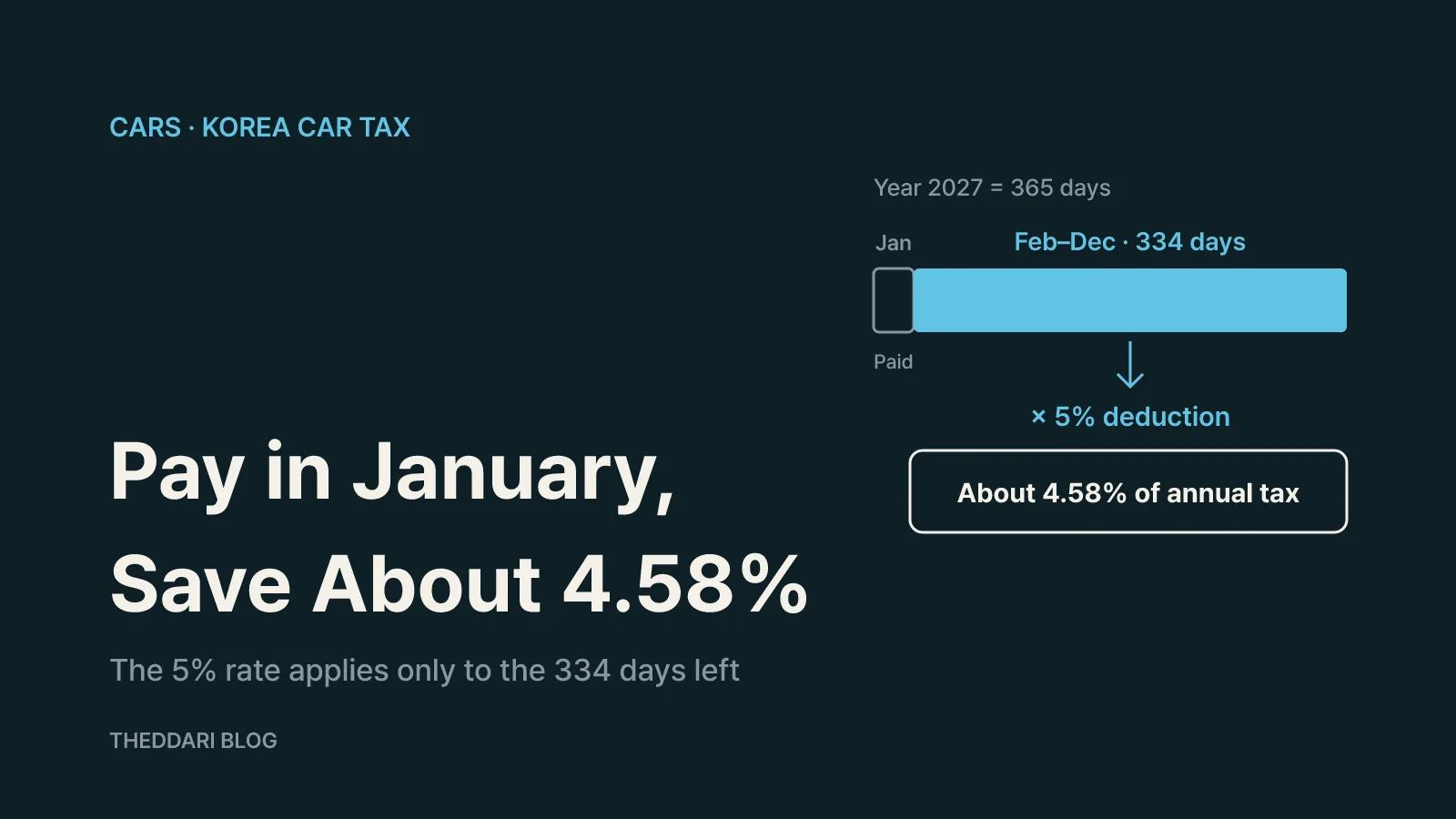
As of October 2026, the best time to prepay South Korea's 2027 automobile tax (자동차세) is January 16 to January 31, 2027. The legal deduction rate is 5%, but because January itself has already passed when you pay, the deduction only covers the remaining 334 days of the year. The real saving is therefore about 4.58% of the annual tax. For a privately used passenger car simplified to 2,000cc and under three years old, that works out to roughly ₩23,790 including the local education tax. This guide explains the rule, compares the four prepayment windows, shows how to estimate your own bill and covers what happens if you sell the car or move.
How Korea's car tax prepayment discount works
Korea's automobile ownership tax is a local tax normally billed twice a year. According to the Seocho-gu Office car tax guide, the first installment covers January to June and is due June 16–30, and the second covers July to December and is due December 16–31. The owner of record on June 1 and December 1 is the one who receives each bill.
The prepayment option lets you pay the whole year at once and get part of the tax back as a deduction. The legal basis is Article 128(3) of the Local Tax Act. It allows a taxpayer to deduct, within a ceiling of 10%, an amount calculated on the tax for the period from the day after the lump-sum payment deadline to December 31. The rate used in that calculation is set by Article 125(6) of the Enforcement Decree at 5/100. That wording was last amended on December 31, 2024 and remains in the version of the decree in force from October 1, 2026.
The important phrase is "from the day after the deadline". If you pay in January, the deadline is January 31, so the deduction applies to February 1 through December 31. In 2027 that is 334 days out of 365. Multiply 5% by 334/365 and you get roughly 4.58% of the full-year tax. That is why you will see both "5%" and "4.58%" quoted online. Neither is wrong: one is the statutory rate and the other is the effective discount on your annual bill.
The rate has changed before. The Seocho-gu table lists 10% through 2022, 7% in 2023 and 5% from 2024. Older articles still mention a planned cut to 3%, but the decree text checked in October 2026 says 5%. Because local tax decrees are often amended at year-end, check the Wetax notice or your district office's announcement in early January before paying.
2027 prepayment windows and how much each one saves
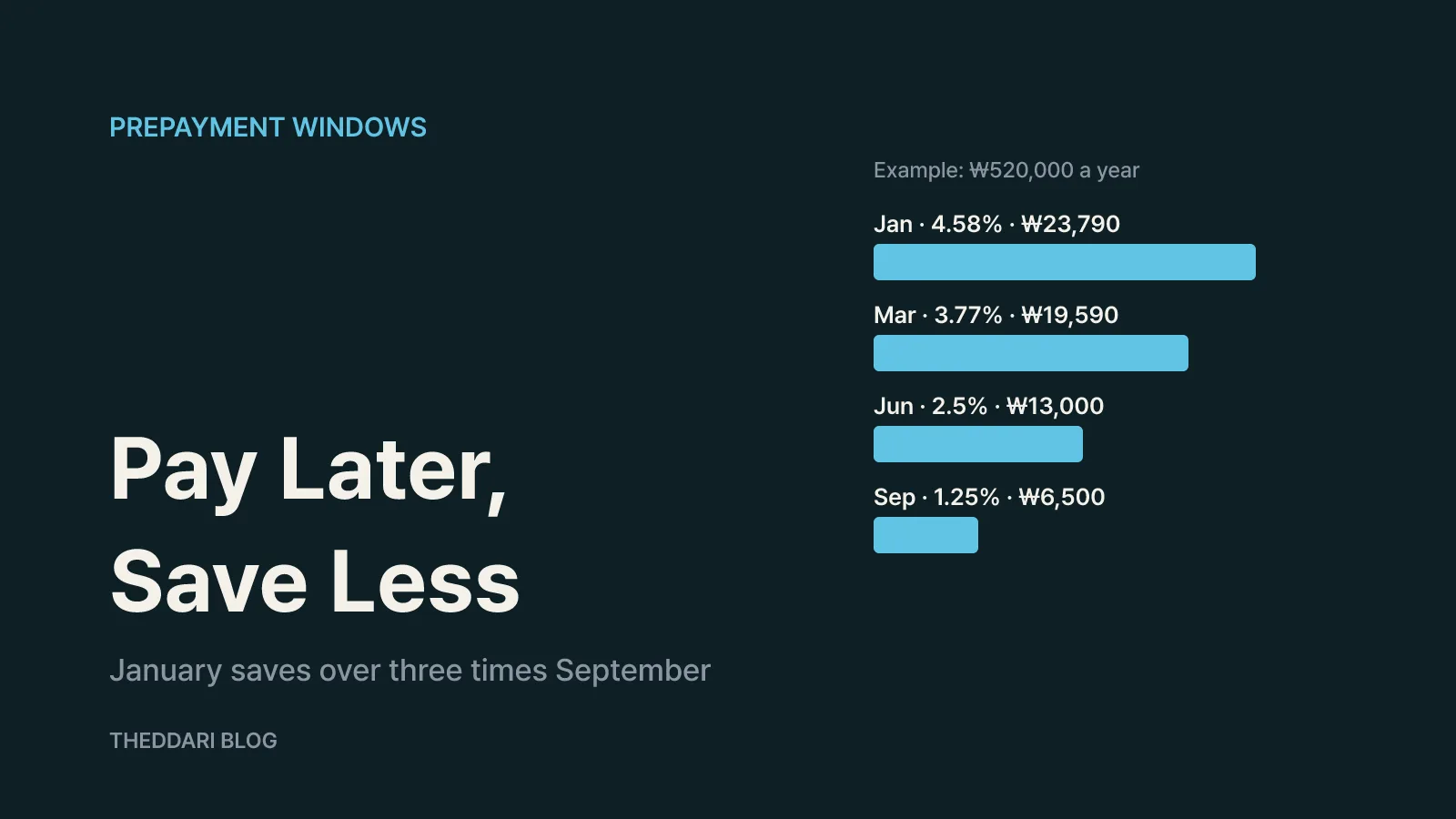
There are four windows each year. The Deokjin-gu Office (Jeonju) notice lists them as January 16–31, March 16–31, June 16–30 and September 16–30. Under Article 125(3) of the decree, January payments are discounted on the tax from the day after the deadline to year-end, June payments on the second-half installment, and March and September payments on the tax from the day after that installment deadline to year-end.
Using a simplified example — a privately used 2,000cc passenger car under three years old with ₩400,000 in annual car tax, or ₩520,000 once the 30% local education tax is added — the savings look like this:
← Swipe to see more
| Window (2027) | Period discounted | Effective discount | Example saving (incl. education tax) |
|---|---|---|---|
| January 16–31 | Feb 1 – Dec 31 (334 days) | about 4.58% | about ₩23,790 |
| March 16–31 | Apr 1 – Dec 31 (275 days) | about 3.77% | about ₩19,590 |
| June 16–30 | Second half (Jul – Dec) | about 2.5% | about ₩13,000 |
| September 16–30 | Oct 1 – Dec 31 | about 1.25% | about ₩6,500 |
The car tax deduction is the discounted portion multiplied by 5%. Because the local education tax is charged at 30% of the car tax, it falls in the same proportion, so the two are added together above. Actual bills can differ by a few tens of won because of rounding and ownership dates. The January saving is more than three times the September saving for the same car.
Watch the calendar in 2027. January 16 falls on a Saturday and January 31 on a Sunday. In 2026, when January 31 was a Saturday, the Ministry of the Interior and Safety announced that the nationwide prepayment deadline had been extended to Wednesday, February 4. The 2027 closing date will be set by January notices, so the safest plan is to finish by Friday, January 29 rather than counting on an extension.
The 2026 prepayment windows closed in September. If you did not prepay this year, pay the regular second-half bill on December 16–31, 2026 and plan to prepay 2027 in January.
Estimating your annual car tax first
To know what the discount is worth, start with your annual bill. Seocho-gu lists the rates for privately used (non-commercial) passenger cars as ₩80 per cc up to 1,000cc, ₩140 per cc up to 1,600cc and ₩200 per cc above 1,600cc. Commercial vehicles pay far less, ₩18–24 per cc. Private passenger cars also carry a local education tax equal to 30% of the car tax.
Older private passenger cars get an age reduction: 5% from the third year, rising 5 percentage points a year to a maximum of 50% from the twelfth year. The formula is: each half-year amount = A/2 − (A/2 × 5/100) × (n − 2), where A is the unreduced annual tax and n is the vehicle age (2 to 12). Age is counted from January 1 for cars first registered between January 1 and June 30, and from July 1 for cars registered in the second half, so the two installments of a second-half car can use different ages.
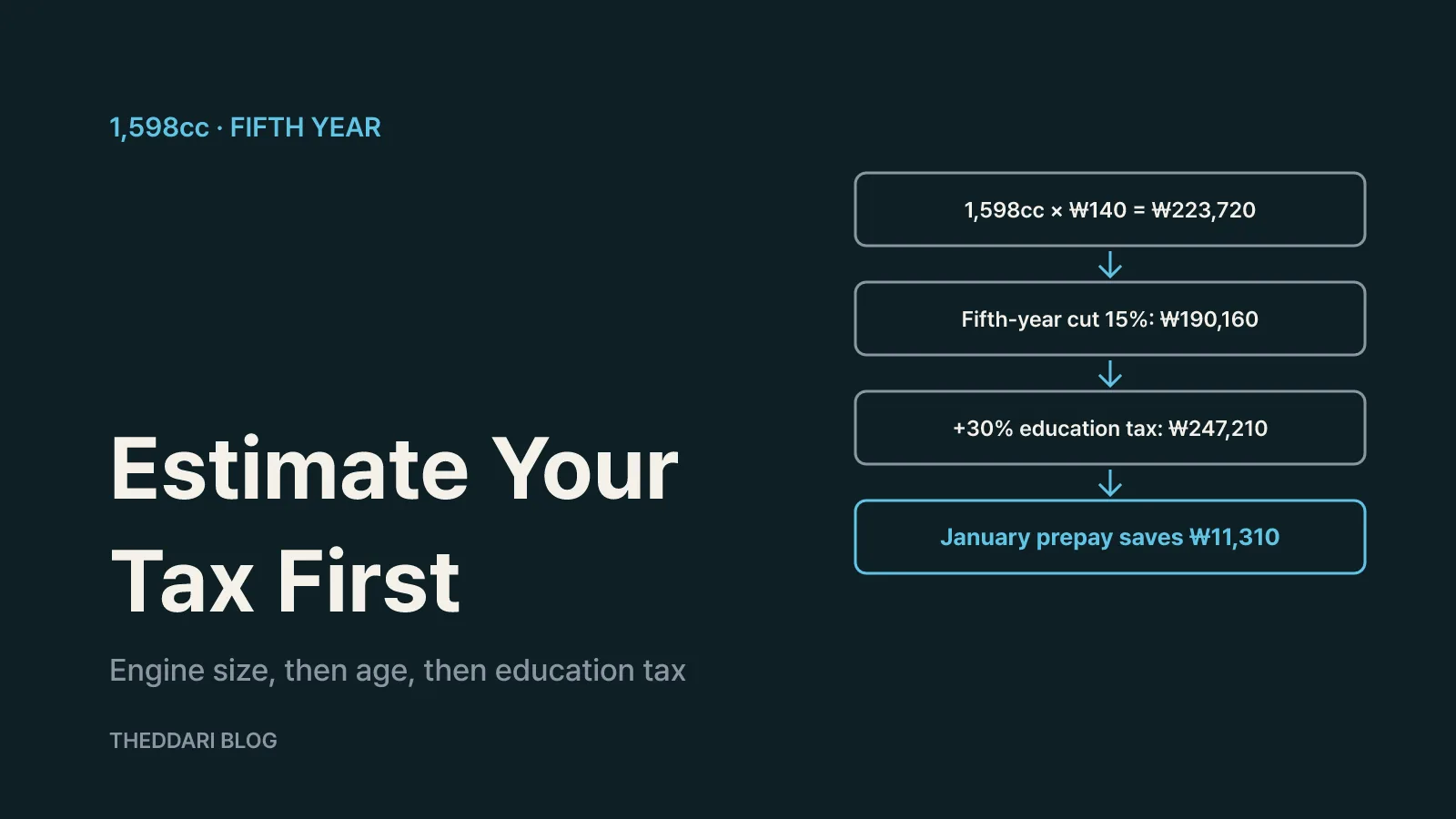
Example: a 1,598cc private car in its fifth year in 2027.
- Unreduced annual tax: 1,598cc × ₩140 = ₩223,720
- Fifth-year reduction of 15%: about ₩190,160
- Add 30% education tax: about ₩247,210 in total
- January prepayment at about 4.58%: a saving of about ₩11,310
Electric cars, vans and trucks are taxed at flat amounts rather than by engine size, so this method does not apply directly. For those, use the preview calculator on Wetax or Seoul ETAX, or add up last year's June and December bills, which already include the education tax.
How to apply on Wetax or at the district office
The Deokjin-gu notice lists three channels: visiting the district office, calling it, or applying online through Wetax (www.wetax.go.kr). Seoul residents can also use Seoul ETAX. Online, the process is:
- Log in to Wetax and choose the annual car tax (lump-sum) filing under the filing menu.
- Look up the vehicles registered in your name, select the car and review the calculated tax and deduction.
- Pay within the same window. The law grants the deduction for filing and paying within the period, so filing alone does not lock in the discount.
- Confirm the payment status and keep the receipt.
A few details catch people out. Some districts have their own cut-offs: Deokjin-gu accepts online applications only until the 20th of the window month because paper payment slips are mailed, and asks later applicants to visit in person. Second, Article 125(2) lets a district mail a lump-sum payment slip the following January to anyone who prepaid before, but payment is still up to you; if no slip arrives, file yourself. Third, a standing auto-debit for regular bills does not trigger prepayment. If you pay by card, treat any card installment or points offer as separate from the tax deduction.
Selling the car or moving after you prepay
Prepayment assumes you keep the car all year. According to Seocho-gu, when a used car changes hands, the tax is prorated by day between seller and buyer based on the transfer date, and a deregistered car is taxed only up to its deregistration date.
The Deokjin-gu notice is more specific about prepaid cars. Unless the parties submit a daily-proration request or a consent form for the buyer to take over the prepaid tax, the seller is refunded the portion after the ownership transfer registration date and the buyer is taxed for the period after it. After selling, confirm the refund and bank account with the district tax office.
Moving is simpler. Article 125(4) states that once the annual tax has been filed and paid, a change in the vehicle's registered location does not trigger the same year's tax again at the new address.
Finally, skipping the regular bills has consequences. Seocho-gu notes that unpaid car tax can lead to added charges, license plate seizure and asset seizure, and that proof of payment is required when transferring a car's registration. Prepaying once a year removes that risk along with saving money.