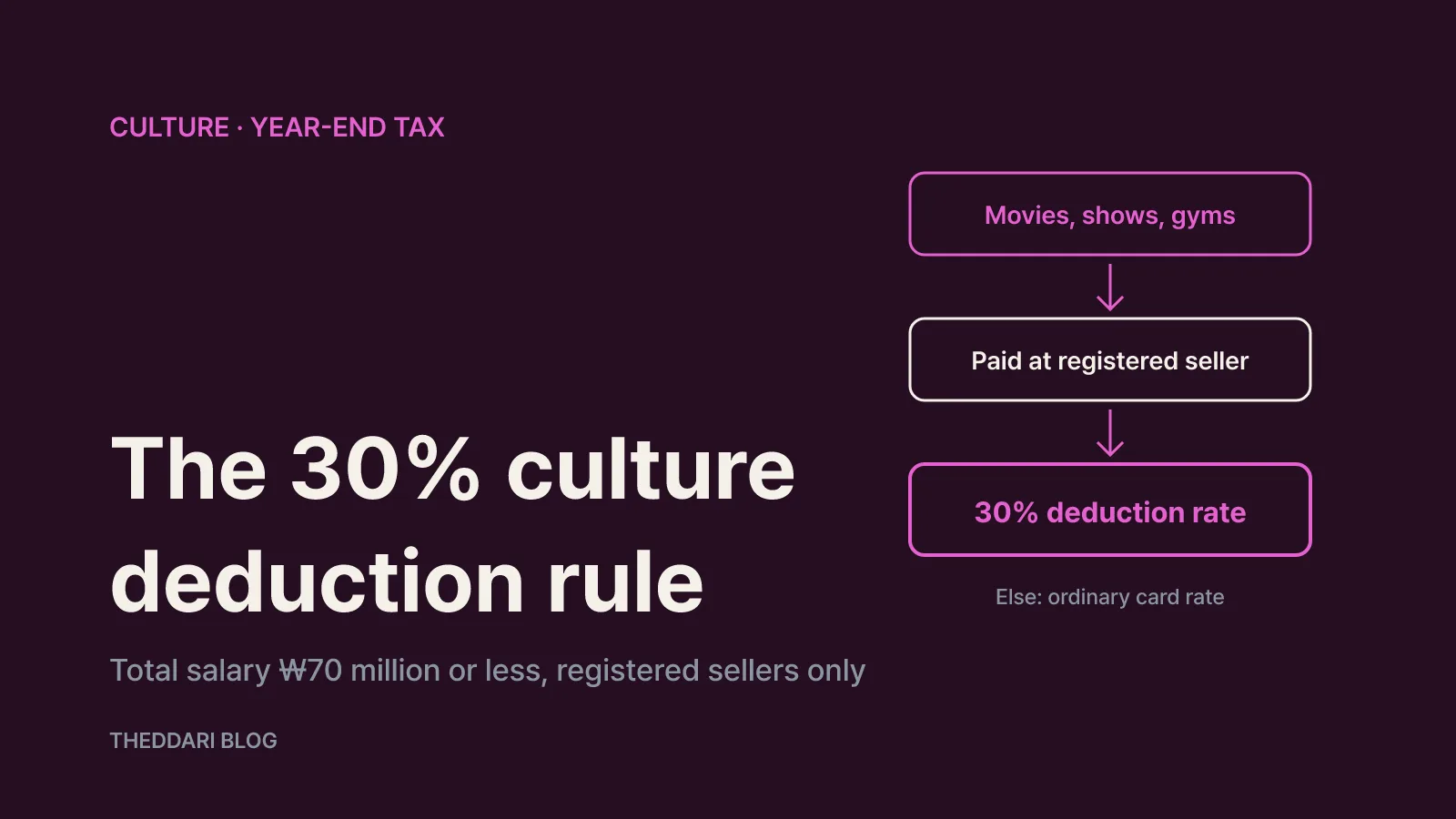
As of November 2026, Korea's culture expense income deduction lets wage earners with total salary of ₩70 million or less apply a separate 30% rate to money spent at sellers registered with the Korea Culture Information Service Agency (KCISA) under the Ministry of Culture, Sports and Tourism. Covered purchases are movie tickets, performance tickets, museum and gallery admission, books, print newspaper subscriptions and, for payments made from July 2025, swimming pool and fitness center (gym) fees. The deduction only starts once your total card and cash-receipt spending passes 25% of your total salary, and the extra allowance it unlocks is capped at ₩3 million a year, shared with traditional market and public transport spending (Korea.kr policy briefing, 2026 checklist).
If you work in Korea and go through year-end tax settlement (yeonmal jeongsan), the practical point is simple: the same concert ticket can land in the ordinary card bucket if the seller is not registered. Anything you pay by December 31 counts toward the 2026 tax year, so the end of the year is the moment to check where you book. This guide draws on the ministry's 2026 checklist, the KCISA program page and a line-by-line summary of Article 126-2 of the Restriction of Special Taxation Act.
Who qualifies for Korea's culture expense deduction
Three conditions must all be true:
- You are a wage earner with total salary of ₩70 million or less. Total salary is your pay minus non-taxable income such as a tax-free meal allowance, so a contract salary slightly above ₩70 million can still fall under the line. Check the total salary figure on your withholding receipt rather than your offer letter.
- Your combined credit card, debit card, prepaid card and cash-receipt spending exceeds 25% of total salary. On a ₩48 million total salary, only spending above ₩12 million enters the calculation.
- You paid a registered culture deduction seller. The ministry's checklist states that the deduction applies only when the place you bought from is registered with KCISA.
The third point is the one most people miss. A book or movie ticket bought from an unregistered seller is counted as ordinary card spending. KCISA handles seller registration on the ministry's behalf and sends the relevant data to the National Tax Service, and the deduction is applied through card company and cash-receipt records (KCISA). The legal basis is Article 126-2 of the Restriction of Special Taxation Act, which currently covers spending through December 31, 2028.
What counts: movies, performances, exhibitions and gyms
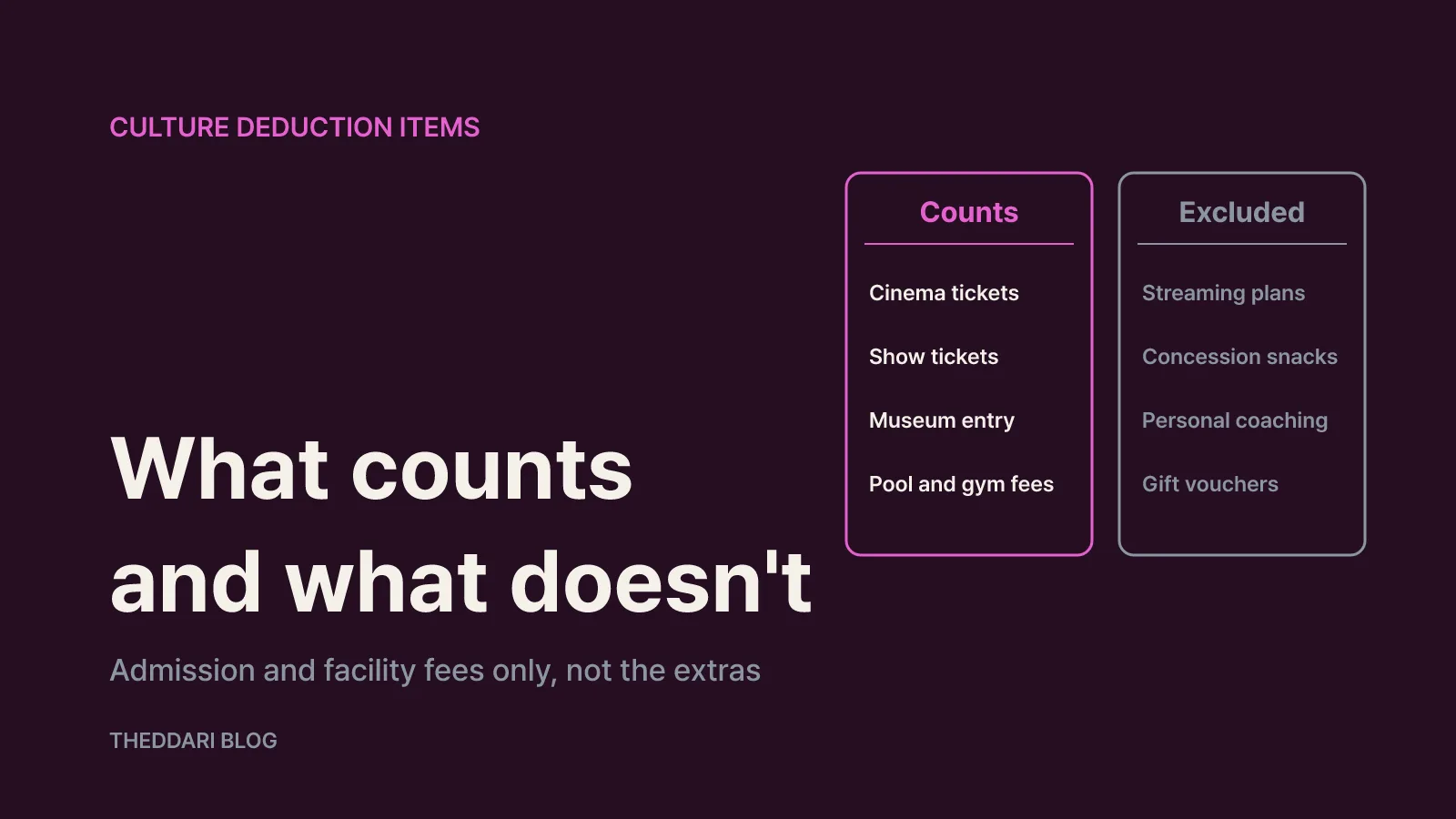
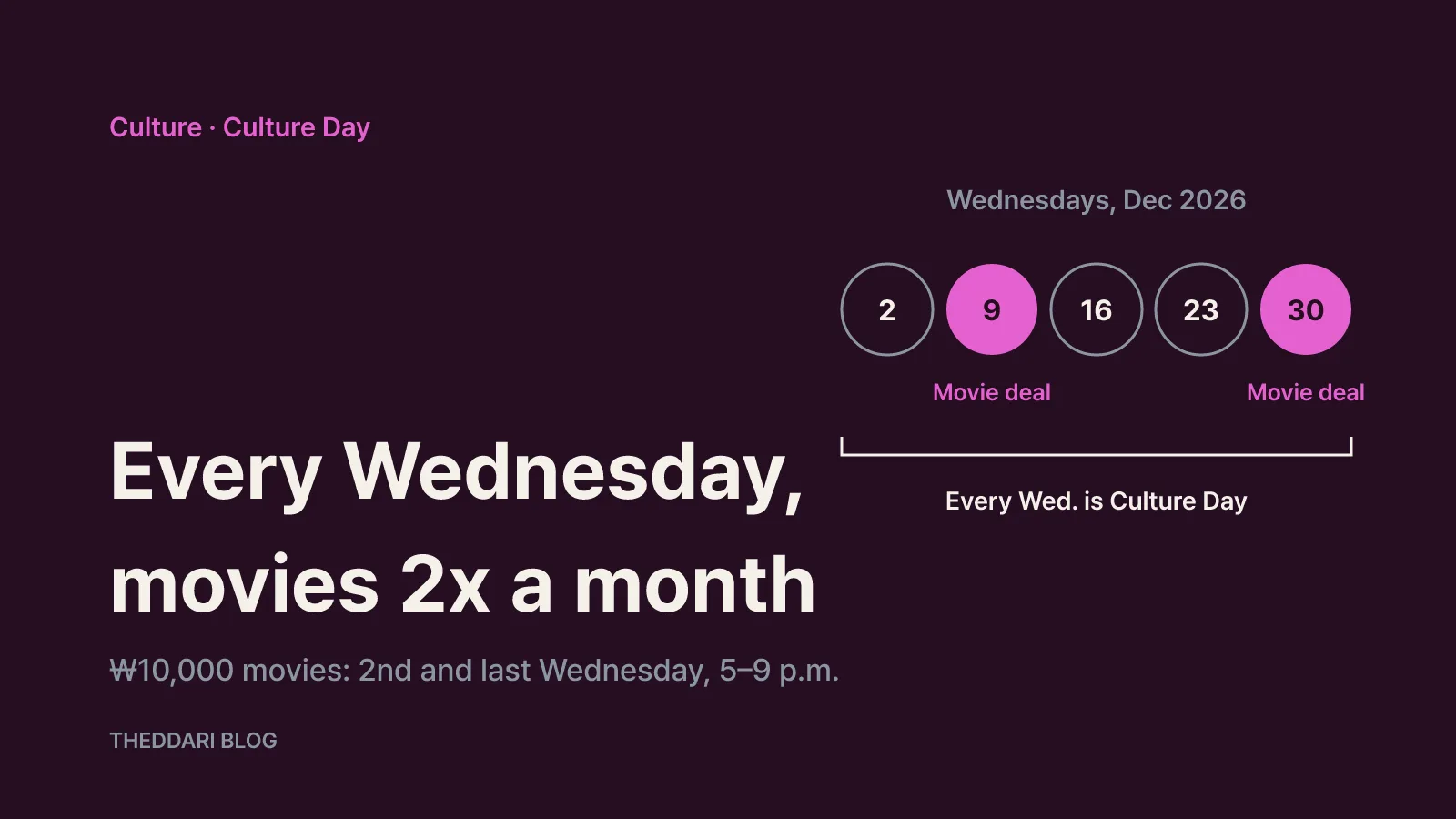
Categories were added in stages. Books and performances have applied since July 1, 2018, museums and galleries since July 1, 2019, print newspapers since January 1, 2021, movies since July 1, 2023, and swimming pools and fitness centers since July 1, 2025. Everything you spend in calendar year 2026 can therefore fall under any of these.
- Movies: cinema admission tickets. Because the deduction covers admission, snacks from the concession stand are not movie admission. Paying for them separately keeps your records clear. Streaming subscriptions are not on the list of covered items, so a Netflix-style plan counts as regular card spending.
- Performances: tickets to watch a performance. For plays, musicals and concerts, what matters is whether the ticketing seller you actually pay is registered, not just the venue.
- Museums and galleries: admission fees. Special exhibitions may be ticketed by a different company from the venue operator, so check the seller on your receipt.
- Books and newspapers: book purchases (excluding harmful publications) and print newspaper subscriptions.
- Pools and gyms: facility fees for swimming pools and fitness centers as defined in the sports facilities rules. Personal coaching fees, membership joining fees and costs not directly tied to using the facility are excluded. If facility use and lessons are billed as one amount that cannot be separated, only 50% counts. A ₩200,000 monthly bundle, for example, contributes ₩100,000 (Gyesankok summary).
One more exception: buying book or culture gift vouchers is treated as buying a monetary instrument and is excluded from card spending altogether. For tickets or books you will use yourself, paying the registered seller directly is easier to verify. For pilates or yoga studios, ask before signing up whether the business is registered as a fitness center, because this varies by studio.
How the 30% rate and the ₩3 million allowance work
If your total salary is ₩70 million or less, culture and sports spending uses the 30% rate regardless of payment method. Ordinary credit card spending is counted at 15%, so a movie ticket charged to a credit card at a registered seller is counted at twice the usual rate.
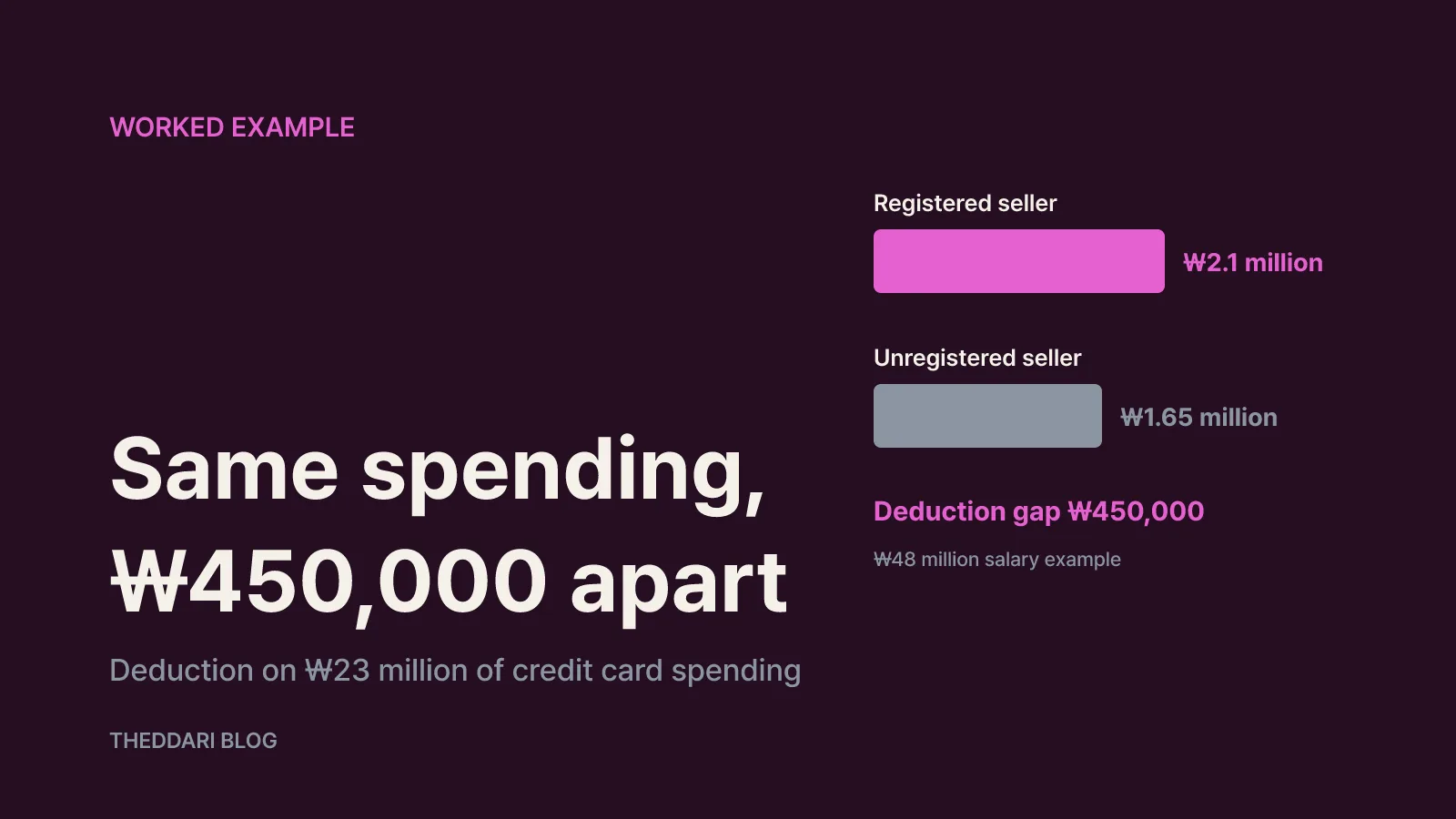
Here is a worked example with my own numbers. Assume total salary of ₩48 million, no dependent children, ₩20 million of ordinary credit card spending and ₩3 million of credit card spending on movies, shows and a gym during the year.
- Threshold (25% of total salary): ₩48 million × 25% = ₩12 million
- Registered sellers: ₩20 million × 15% = ₩3 million, plus ₩3 million × 30% = ₩900,000, for ₩3.9 million
- Threshold adjustment: the ₩12 million threshold sits within ordinary credit card spending, so subtract ₩12 million × 15% = ₩1.8 million
- Deduction: ₩3.9 million − ₩1.8 million = ₩2.1 million
- Same ₩3 million paid to unregistered sellers: ₩23 million × 15% = ₩3.45 million − ₩1.8 million = ₩1.65 million
The choice of seller changes the deduction by ₩450,000. That reduces taxable income, not your tax bill one-for-one; the actual refund depends on your marginal rate.
The ₩3 million allowance is not simply added on top of the basic cap. When your calculated card deduction exceeds the basic cap (₩3 million for someone with no dependent children), you can add the smaller of the excess and your combined traditional market, public transport and culture-sports deduction, up to ₩3 million a year. In the Gyesankok example, someone on ₩60 million who spent ₩25 million on a debit card plus ₩4 million on culture and sports reaches a ₩4.2 million deduction: ₩3 million basic plus ₩1.2 million allowed through the culture allowance. Without the registered culture spending, the same total stops at ₩3 million.
What changes above ₩70 million total salary
Above ₩70 million, culture and sports spending is no longer a separate category. The same concert ticket is counted at 15% on a credit card or 30% on a debit card or cash receipt, and the extra allowance falls to ₩2 million, available only for traditional market and public transport spending.
If you are near the line, confirm your total salary first. Above it, paying for performances, exhibitions and gym fees by debit card or cash receipt gives the better rate. Below it, whether the seller is registered matters more than how you pay. And if your total card spending never passes 25% of total salary, no card deduction arises at all, so it rarely makes sense to spend more just for the deduction.
Year-end checklist before December 31
Payments made by December 31 count toward the 2026 tax year and are settled in early 2027.
- Check the seller. Search the ticketing site, cinema, venue, bookshop, gym or pool on the culture deduction website seller search.
- Separate gym receipts. Look for facility fees and lessons listed separately; bundled plans count at 50%.
- Skip vouchers for your own use. Voucher purchases are excluded from card spending.
- Compare your settlement documents. If the card usage statement you submit to your employer is missing culture and sports spending, you can claim it with receipts or tickets that prove the purchase. KCISA also provides guidance on how to explain omissions.
- Know who to call. The culture deduction help center is 1688-0700, and your employer's payroll team or the National Tax Service (126) can help with the tax calculation.
Keep booking confirmations until settlement is finished. Concert and exhibition bookings are often cancelled and re-paid, so note which seller processed the final payment.