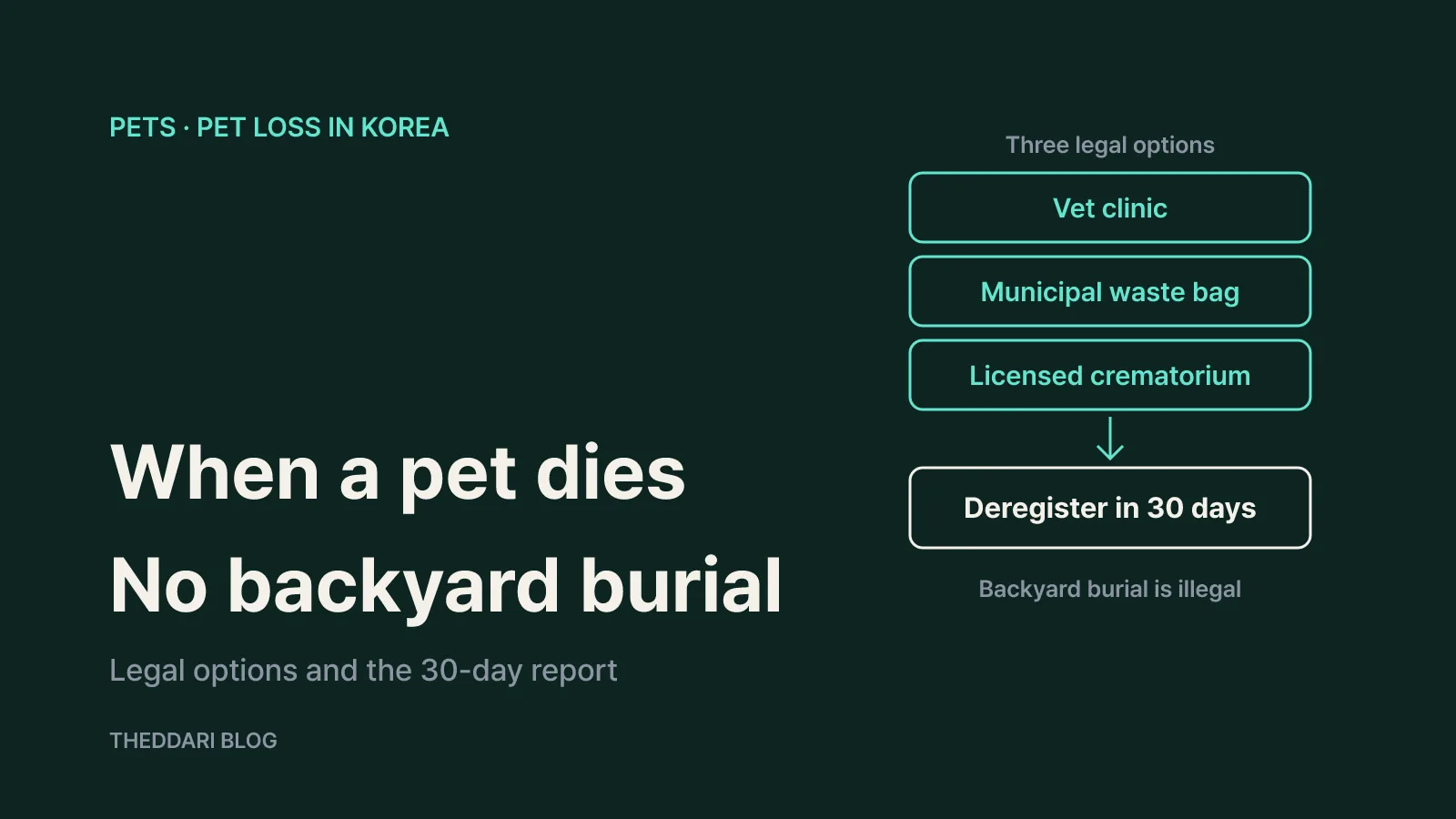
As of November 2026, South Korean law gives pet owners three legal ways to handle a pet's body: hand it to a veterinary clinic, place it in a municipal pay-as-you-throw waste bag, or use a licensed pet funeral and cremation facility. Burying a pet in your garden or on a nearby hillside is not permitted, even on private land. If your dog was registered, you also have 30 days from the date of death to file a deregistration report, or you may face an administrative fine of up to 500,000 won (Korea Easy Law).
This guide is written for anyone living in Korea who has just lost a dog, cat or other companion animal, including foreign residents who may not know that the rules differ from what is common in parts of North America or Europe. It walks through the options in the order you will actually need to decide them.
The three legal options when a pet dies in Korea
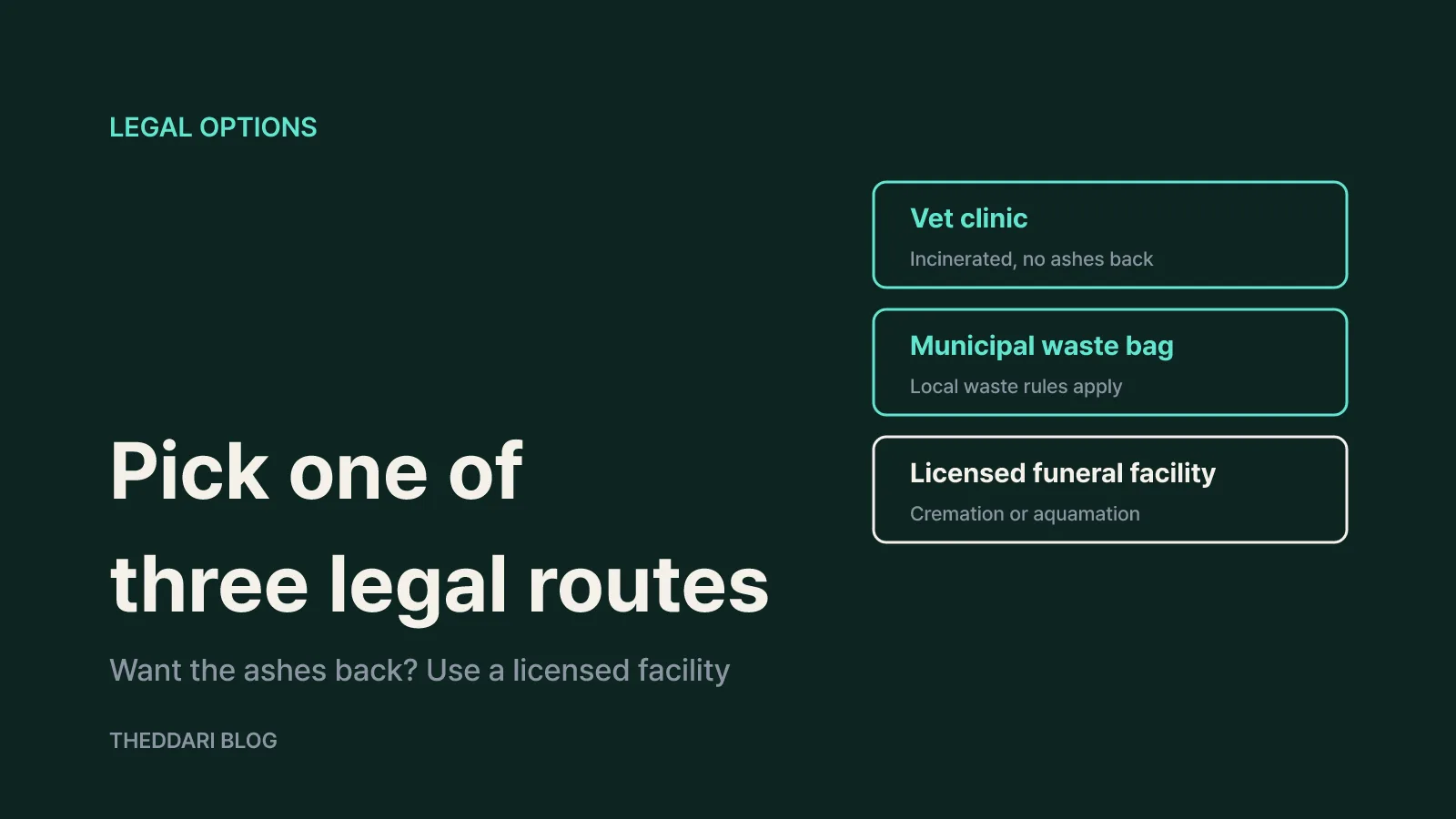
Korean law treats an animal carcass as waste. That sounds harsh, but it determines which routes are lawful: only those covered by the Waste Management Act and the Animal Protection Act. The government's legal information portal lists three.
1. Leave the body with a veterinary clinic. When a pet dies at a vet clinic, the body is classified as medical waste. The clinic either handles it or passes it to a licensed waste contractor. Many owners also bring a pet that died at home to a clinic for this purpose. Because the body is incinerated with other medical waste, you should not expect to receive individual ashes back. According to The Herald Business, a licensed pet funeral business is effectively the only route if you want your own pet's remains returned after an individual cremation.
2. Use a pay-as-you-throw waste bag. If the pet died outside a clinic, the body counts as household waste. Under local ordinances it can be placed in the standard municipal garbage bag and collected by the household waste contractor. Few owners choose this emotionally, but it is legal. Collection rules vary by city and district, so check your local office's guidance first.
3. Use a licensed pet funeral facility. Facilities holding a pet funeral business licence may handle remains by cremation, dry burial processing, or aquamation (alkaline hydrolysis). Aquamation, which breaks down the body with water and an alkaline solution before the bones are collected, was added through a 2021 amendment to the enforcement rules. These facilities can also offer a ceremony and an urn or columbarium niche.
These rules are not limited to dogs and cats. In a Yonhap News fact-check, the Ministry of Agriculture, Food and Rural Affairs said the six species defined as companion animals under the Animal Protection Act (dogs, cats, hamsters, rabbits, ferrets and guinea pigs) follow the same methods, and officials said birds, fish, reptiles and amphibians can be handled the same way.
Why backyard burial is illegal and what the fines are
In many countries, burying a pet at home is normal. In Korea it is not allowed. Waste may only be buried at a licensed or approved waste treatment facility, and burying or burning it anywhere else is prohibited. A ministry official told Yonhap that this applies even on private property.
The penalties break down like this:
- Burying or burning remains yourself: an administrative fine of up to 1 million won under the Waste Management Act
- Dumping remains anywhere: a 50,000 won penalty under the Minor Offenses Act, or a fine of up to 1 million won under the Waste Management Act
The gap between the law and common practice is wide. A Korea Consumer Agency survey of 1,000 people who had lost a pet, published in 2023, found that 41.3% had buried or dumped the body near home or on a hillside. Only 30.0% used a funeral facility, 19.9% left the body with a vet clinic, and 5.7% used a waste bag. Of those who buried or dumped a pet, 75.5% said they did not know it was prohibited.
If you want to keep your pet close, the lawful alternative today is a licensed cremation, after which you can keep the ashes at home or place them in a columbarium. The ministry's Third Animal Welfare Plan (2025–2029) says it will pursue a natural burial system for pets, but that is a plan, not a rule you can rely on now.
How to check a pet crematorium's licence and price
The first thing to verify is the licence. In April 2023, Korea moved pet funeral businesses from a registration system to a licensing system with stricter facility and staffing standards, so an ordinary business registration is not enough to run a cremation service. Operating without a licence can bring up to two years in prison or a fine of up to 20 million won (The Herald Business).
Licensed businesses are listed on the government's Animal Protection Management System under the business operator section for pet funeral services. As of April 2026 there were 86 licensed businesses nationwide, counting funeral, cremation and columbarium operators together. Gyeonggi Province had the most with 31, followed by South Gyeongsang (9), North Gyeongsang (8), South Jeolla (7) and North Chungcheong (5). Seoul has no full-service facility combining cremation and memorial services, so Seoul residents often travel to Gyeonggi or beyond.
Prices vary widely. Reporting based on a ministry survey found funeral fees ranging from 180,000 won to 2.99 million won depending on the business. A basic service for a dog under 5 kg averaged roughly 200,000 to 300,000 won, but add-ons such as memorial stones or a private niche can push the total to two or three times that. The government plans to require businesses to publish separate prices for basic and optional services by 2028.
Questions worth asking before you book:
- Is the licence displayed on site, and do the name and address match the government listing?
- Is it an individual cremation, or are several animals cremated together? Can you witness or confirm the remains?
- What does the basic package include, and what costs extra, such as transport or a niche?
- Are weight-based prices given in writing?
Afterwards, keep the receipt, the cremation certificate, your message history and photos. When a crematorium abroad was accused of dumping animals it had been paid to cremate, the local animal welfare group advised owners to keep exactly these records. They are your basic evidence if a dispute arises.
Filing the 30-day pet deregistration report
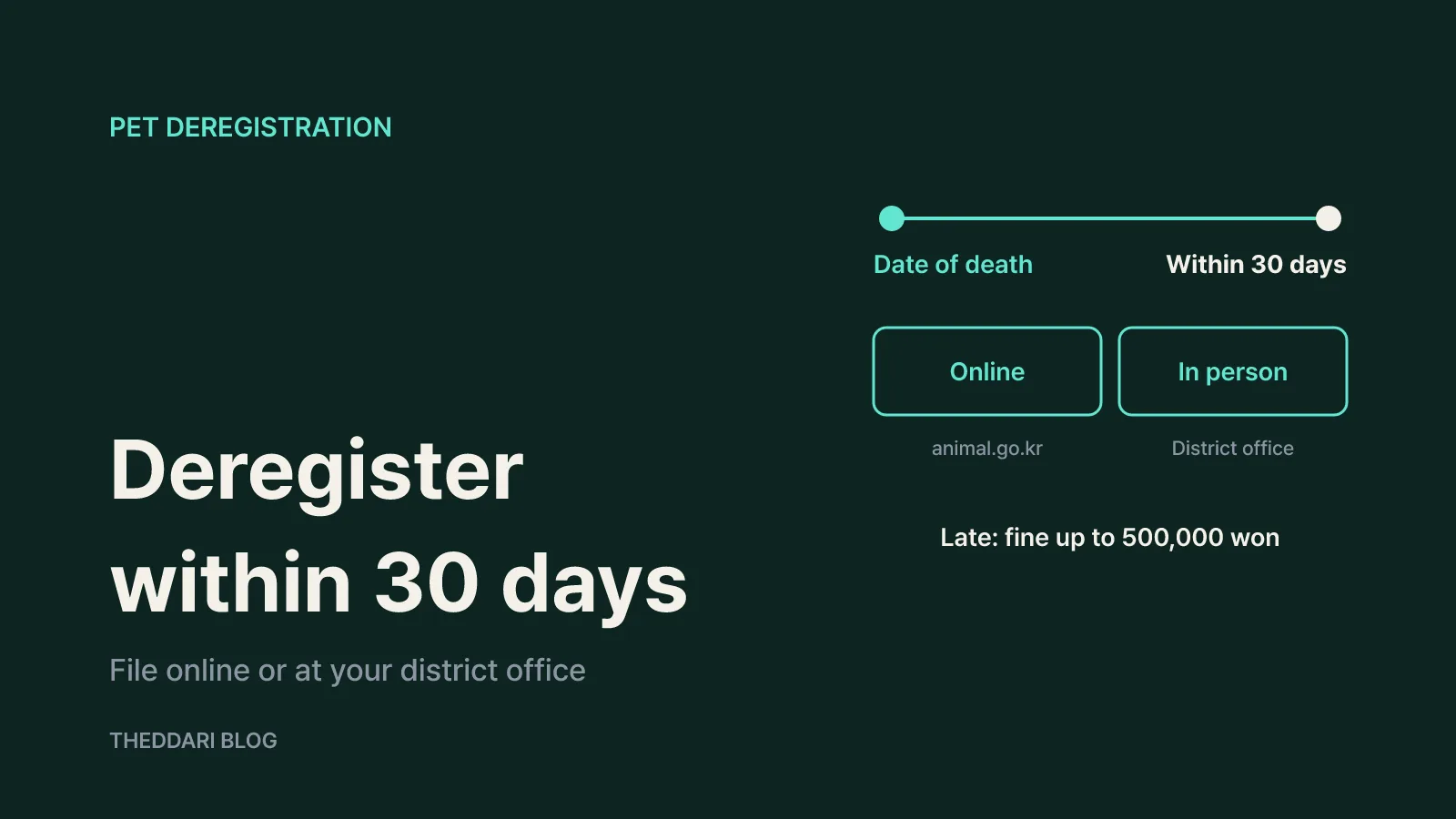
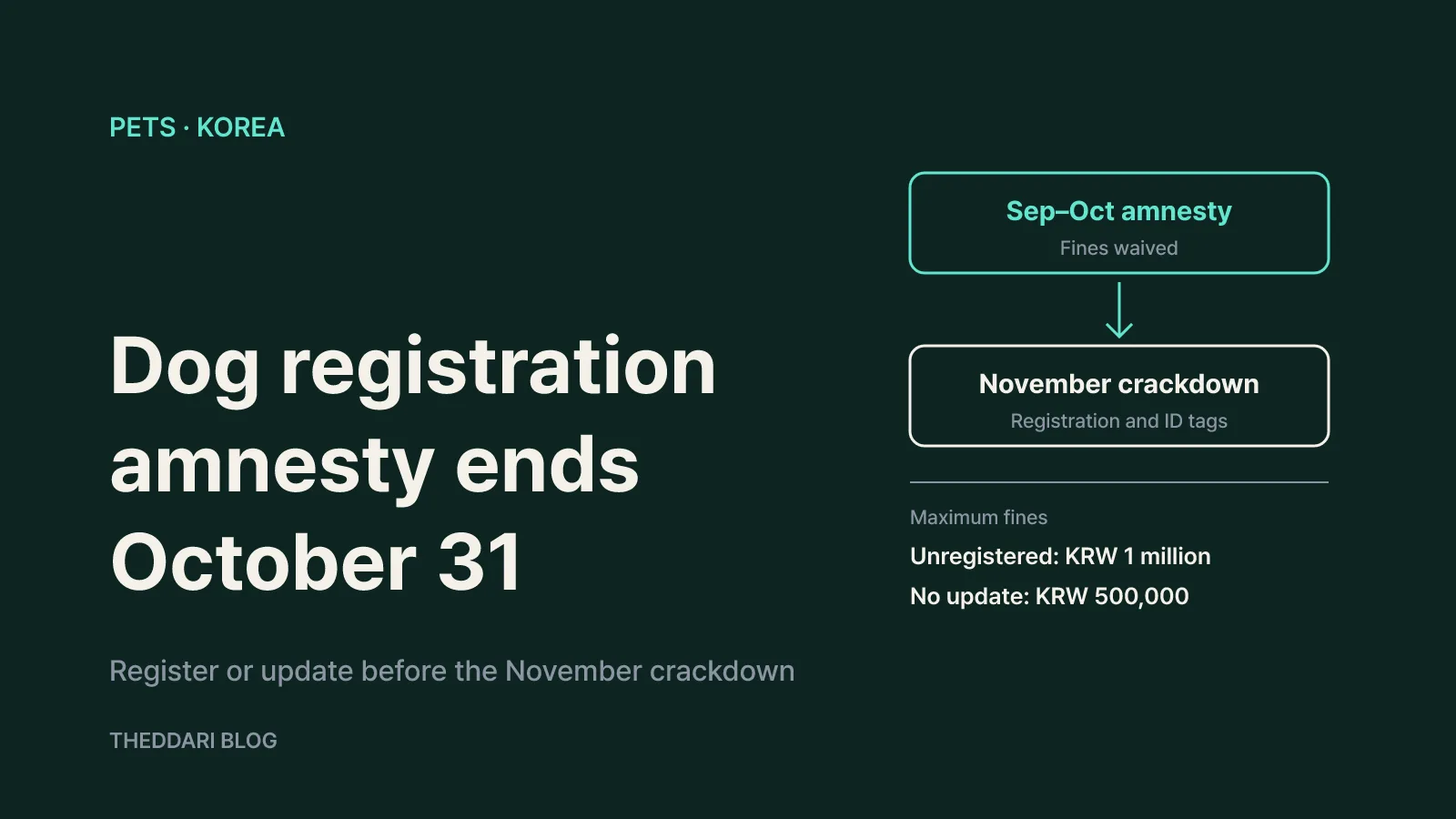
The paperwork is easy to forget. If your dog was registered, you must file a deregistration report within 30 days of the date of death, and missing the deadline can bring an administrative fine of up to 500,000 won (Animal Protection Act, Articles 15 and 101).
You can file in two ways:
- Online: through the registration change menu on the Animal Protection Management System (www.animal.go.kr)
- In person: at the responsible department of your city, county or district office
Many owners skip this. In the same consumer survey, 59.1% said they had not deregistered their pet, and 53.0% of them said they did not know they had to. Registration is mandatory for dogs aged two months or older kept in a house or similar dwelling or kept as a companion, while cat registration is optional. The official guidance is written around registered dogs, but if you registered a cat, updating the record in the same system avoids confusion later, for example when you register a new pet or move.
A step-by-step checklist from day one to day 30
When everything feels overwhelming, work through this list:
- Choose a method: a vet clinic, a waste bag, or a licensed funeral facility. If you want the ashes back, choose a funeral facility.
- Verify the licence: look the business up on the Animal Protection Management System before you hand over your pet, and ask whether it cremates on site or passes animals to another operator.
- Confirm method and cost: get individual cremation, base price, extras and transport arrangements in writing or by message.
- Keep records: save receipts, the cremation certificate, chats and photos.
- Deregister: file online or at your district office within 30 days of the death.
Public support is slowly expanding. In February 2025, Seoul's Mapo District became the first Seoul district to launch a pet funeral support service, and the Seoul city government is building a public pet memorial facility with a crematorium and columbarium together with Yeoncheon County in Gyeonggi, aiming to open in 2028. It is worth asking your own local government whether a similar program exists.
In short: pick one of the three legal methods, check the licence and price if you use a funeral business, and finish the deregistration report within 30 days. Those three steps let you say goodbye without fines or disputes.