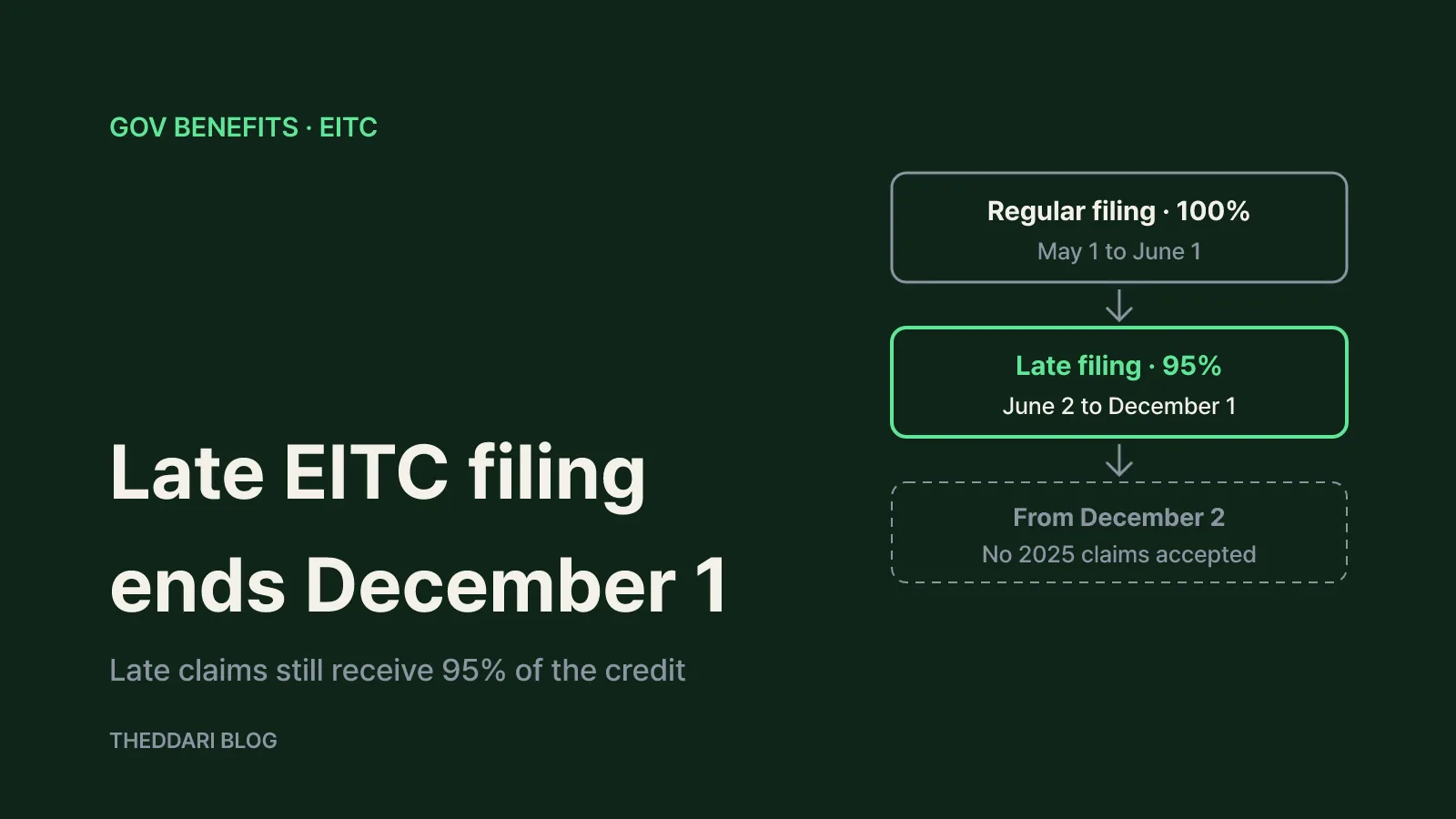
As of October 2026, households in South Korea that missed the May filing window for the 2025 Earned Income Tax Credit (EITC, geunro jangnyeogeum) or the Child Tax Credit (CTC, janyeo jangnyeogeum) can still claim it through a late application that closes on December 1, 2026 (Tuesday). The National Tax Service (NTS) lists the late application period as June 2 to December 1 on its application period and method page. The trade-off is a 5% cut: a late claim is paid at 95% of the calculated credit instead of the 100% you would have received in May. From December 2, no claim for 2025 income is accepted, so eligible households should file now through Hometax or the ARS phone line.
This guide is for anyone working in Korea who wants a clear answer to four questions: am I still eligible, how much does the 95% rule actually cost, how do I file, and when will the money arrive. Every figure below comes from NTS guidance. Actual payments are set during review based on household type and income, so the amounts shown are the maximum possible for each household type.
Who can still file a late EITC claim
The late application exists for households that missed the regular filing window for 2025 income, which ran from May 1 to June 1, 2026. The late window opened the following day, June 2, and runs through December 1. Regular filing covers people with wage income as well as those with business income or income from religious work, so the late window is open to the same groups.
Typical cases include:
- You received an NTS notice in May but did not file in time.
- You never received a notice and did not realize you qualified.
- Your 2025 income dropped after a job change or a gap in work, and you only now checked whether you meet the limits.
A notice letter is not required. If you meet the income and asset tests, you can apply directly on Hometax, Korea's online tax portal. The NTS describes a separate route for applicants without a notice: log in with identity verification, review the income and asset data shown, and submit.
One common source of confusion is semiannual filing. Semiannual filing lets people with wage income only claim based on half-year earnings. The September 1 to 15, 2026 window was for income earned in the first half of 2026, which is a different tax year from the 2025 claim discussed here. If you are not sure whether your 2025 claim is already on file, check the "review progress" (심사진행상황 조회) menu on Hometax before submitting.
How much the 95% rule costs by household type
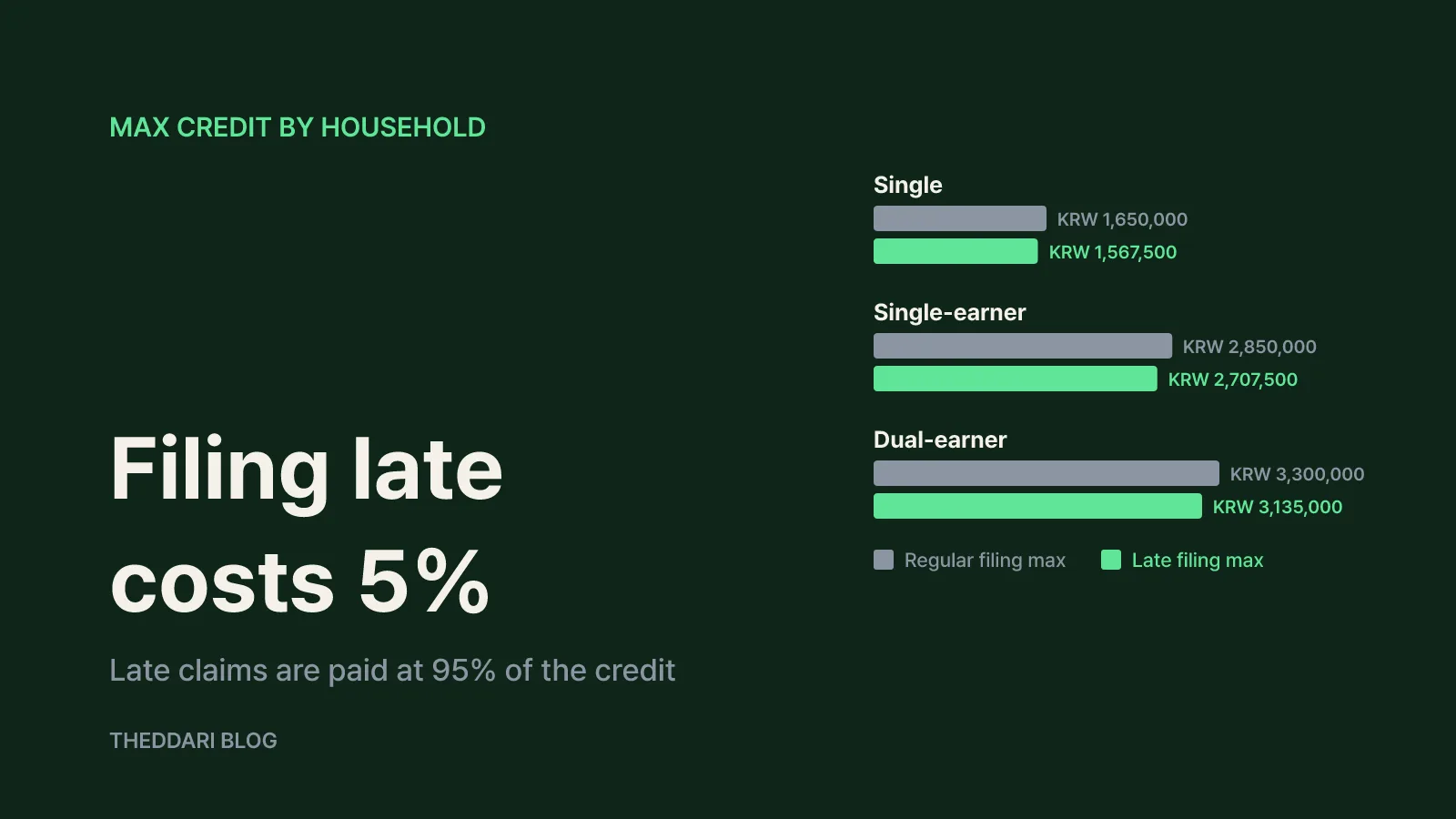
The reduction table on the NTS review and payment page states that late applicants receive 95% of the credit. Applying that rate to the maximum amounts on the NTS EITC overview gives the following:
← Swipe to see more
| Household type | 2025 total income limit | Regular filing maximum | Late filing maximum (95%) |
|---|---|---|---|
| Single | Under KRW 22 million | KRW 1,650,000 | KRW 1,567,500 |
| Single-earner | Under KRW 32 million | KRW 2,850,000 | KRW 2,707,500 |
| Dual-earner | Under KRW 44 million | KRW 3,300,000 | KRW 3,135,000 |
These are ceilings. The actual credit depends on where combined household earnings fall within each band, and it tapers as income approaches the limit. A lower estimate than the ceiling is normal.
The Child Tax Credit works the same way. According to the NTS CTC overview, single-earner and dual-earner households with combined total income under KRW 70 million and dependent children under 18 receive up to KRW 1,000,000 per child (minimum KRW 500,000). With the 95% rule, the late-filing maximum becomes KRW 950,000 per child. Single households are not eligible for the CTC.
Losing 5% can feel frustrating, but missing December 1 means receiving nothing for 2025. If you qualify, the reduction is not a reason to wait.
Income, asset and household rules
The NTS eligibility page sets out the tests for 2025 income.
Household type
- Single: no spouse, no dependent child under 18 and no lineal ascendant aged 70 or older.
- Single-earner: the spouse's wage and business earnings are under KRW 3 million, or there is no spouse but there is a dependent child under 18 or a parent or grandparent aged 70 or older (each with annual income of KRW 1 million or less, registered at the same address and sharing living costs).
- Dual-earner: the applicant and spouse each earned KRW 3 million or more.
Income test (couple combined)
Total 2025 income must be under KRW 22 million for single households, KRW 32 million for single-earner households and KRW 44 million for dual-earner households. For the CTC, the limit is KRW 70 million. "Total income" adds wages, business revenue multiplied by an industry adjustment rate, religious-work income, other income, and interest, dividend and pension income. Non-taxable, retirement and capital gains income are excluded.
Asset test (all household members)
As of June 1, 2025, the combined value of housing, land, buildings, passenger cars, lease deposits, financial assets and similar property must be under KRW 240 million. Debt is not deducted, so a home bought with a mortgage counts at its full assessed value. If assets fall between KRW 170 million and KRW 240 million, the credit is cut to 50%.
Who cannot apply even if the tests are met
- People without Korean nationality on December 31, 2025, unless they are married to a Korean national or support a dependent child with Korean nationality.
- People who were another resident's dependent child during 2025.
- Households where the applicant or spouse runs a professional-services business.
- For the EITC only: a regular employee still employed on December 31, 2025 whose average monthly wage, or whose spouse's average monthly wage, was KRW 5 million or more.
How to file on Hometax or by phone
The NTS application page says the filing service runs from 6 a.m. to midnight. Identity checks and bank account entry can take time, so avoid leaving it to the final evening.
Hometax (PC or mobile)
- Go to the incentives and year-end settlement menu, choose the EITC/CTC section and select "apply."
- If you received a notice, log in with the last seven digits of your resident registration number and the 8-digit individual code on the notice. Otherwise, log in with a certificate or simple authentication app; household and income data will be loaded for you.
- Confirm the eligibility questions and your income and assets, register a phone number and refund account, then submit.
Applicants without a notice can also use the direct-entry option inside the regular/semiannual EITC menu.
ARS phone line 1544-9944
Notice recipients can apply by phone. Press 1 for regular filing, enter your 13-digit resident registration number and the 8-digit individual code, then follow the voice prompts. Calling from the phone number registered with the NTS lets you skip the code.
Mobile notices and QR codes
If your notice arrived through a mobile channel such as Gukmin Biseo, Naver e-documents or a KT text alert, the code is filled in automatically and you can apply without logging in. You can also scan the QR code printed on a paper notice.
If you need help
The incentive call center (1566-3636) and tax office staff can file on behalf of a notice recipient who consents. This service runs on weekdays from 9 a.m. to 6 p.m. and is closed on weekends and public holidays, so arrange it well before the deadline.
When the payment arrives and what can reduce it
Late claims are paid within four months of the application date, according to the NTS review and payment page. A claim filed on November 2 should be paid by March 2, 2027; one filed on December 1 by April 1, 2027. Filing earlier moves the deadline forward.
During review, the NTS matches your application against its own records and may request additional documents, ask for corrections or carry out a field check. You can follow progress in the Hometax review progress menu.
Other reductions can apply on top of the 95% rule:
- Assets between KRW 170 million and KRW 240 million: 50% of the credit. For a single household at the maximum, KRW 1,650,000 × 50% × 95% = KRW 783,750.
- Unpaid national taxes: up to 30% of the refund is applied to the arrears first.
- Claiming both the income tax child credit and the CTC for the same child: the child tax deduction amount is subtracted.
False claims are clawed back with a daily penalty of 22/100,000, and future payments are blocked for two years for intentional or grossly negligent claims, or five years for fraud.
Final checklist before December 1
- Confirm you are claiming for 2025 income, not the first half of 2026.
- Identify your household type and check combined income against the limit.
- Total household assets as of June 1, 2025 without subtracting debt.
- Have a login method and a bank account in your own name ready.
- Contact the call center on a weekday if someone needs to file for you.
- Submit before midnight on December 1 and confirm receipt in the review progress menu.
To avoid missing future windows, you can consent to automatic filing during an application period. The NTS says this files on your behalf whenever you are selected for a notice over the next two years, provided you meet the income and asset tests.