As of October 2026, a tenant in Seoul whose deposit is 165 million won or less can recover up to 55 million won of it ahead of mortgage lenders if the home is sold at a court auction. Korean law calls this priority repayment for small-deposit tenants (소액임차인 최우선변제). It is one of the most useful protections for people renting on jeonse or monthly-rent (wolse) contracts, but it is easy to misread. Which threshold applies depends on the registration date of the earliest mortgage on the property, not on the date you signed your lease. You also need to have moved in and registered your address before the auction is registered, and you have to file a claim yourself. The current figures below come from Articles 10 and 11 of the Enforcement Decree of the Housing Lease Protection Act on Korea's National Law Information Center, in the version effective July 1, 2026.
How priority repayment differs from the fixed-date stamp
Korean tenants generally rely on two separate protections. The first is the ordinary preferential right: once you have taken possession, registered your address (전입신고) and obtained a fixed-date stamp (확정일자) on the contract, you join the queue of creditors by date. If a bank registered its mortgage before your fixed date, the bank is paid first, and you are paid from whatever remains.
The second is the small-deposit rule. According to the Ministry of Government Legislation's Easy Law guide, a qualifying tenant can recover a set portion of the deposit before other secured creditors even when their fixed date is later, provided they established possession and address registration before the auction was registered. In other words, a capped amount jumps to the front of the line regardless of ranking. The legal basis is Article 8 of the Housing Lease Protection Act, with the eligible deposit range in Article 11 of the Decree and the protected amount in Article 10.
The two protections work together. A small-deposit tenant who also has a fixed-date stamp can claim the remainder of the deposit through the ordinary queue. The same guide notes that a claim to this priority amount cannot be seized by other creditors under Article 246 of the Civil Execution Act.
Current thresholds by region (October 2026)
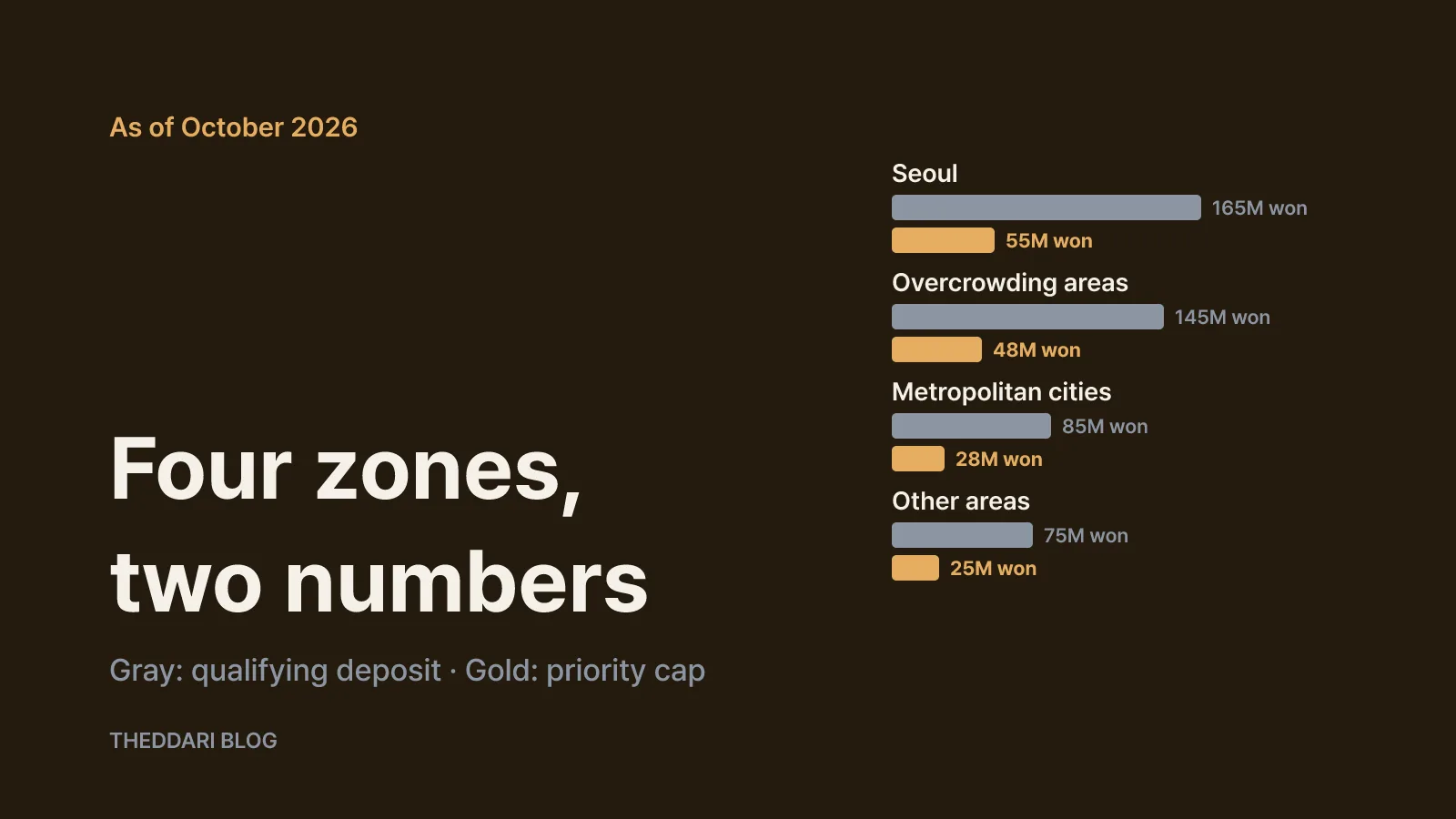
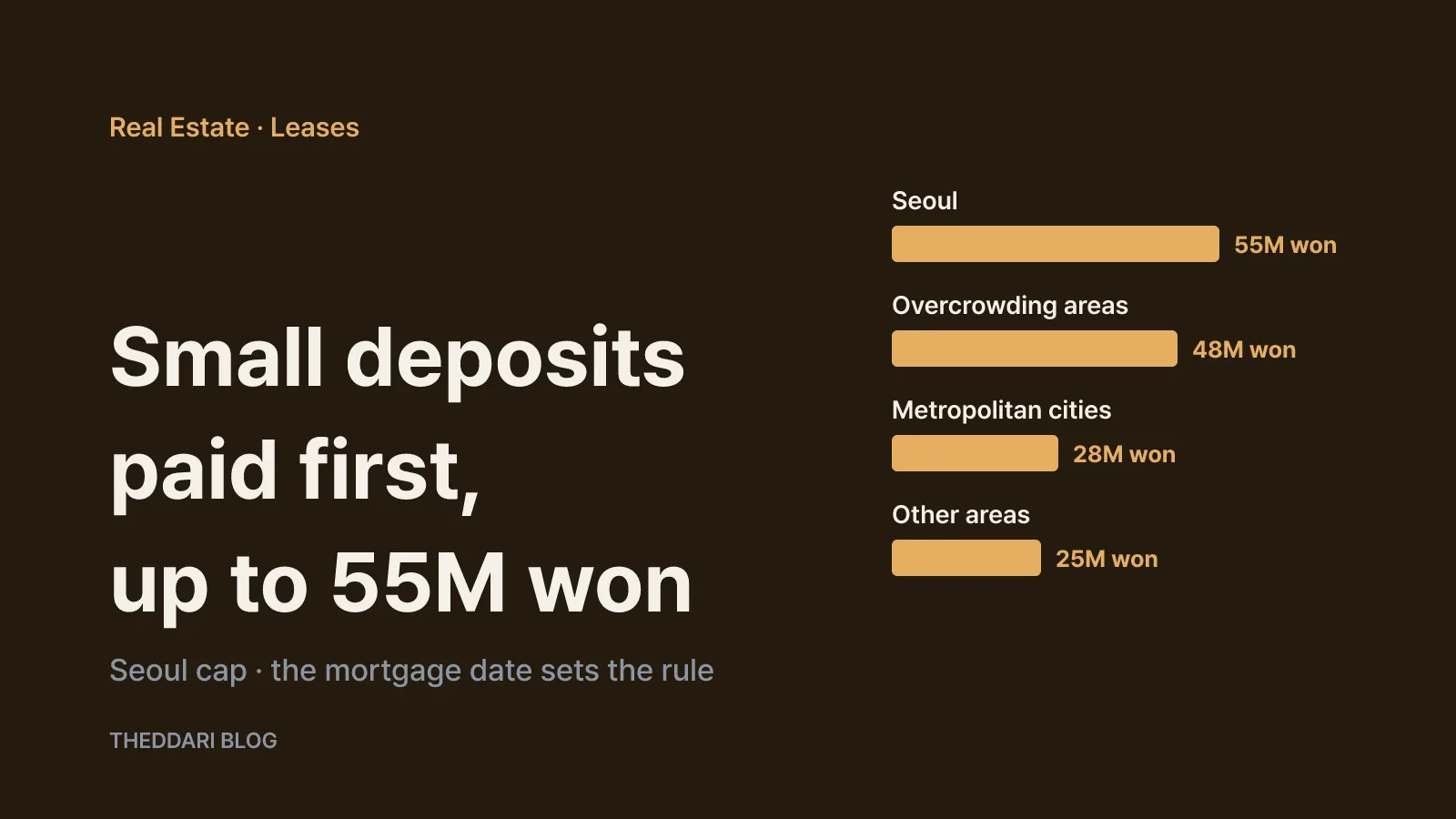
The Decree splits the country into four zones. The first figure is the maximum deposit that qualifies; the second is the maximum amount paid first.
← Swipe to see more
| Zone | Qualifying deposit | Priority amount cap |
|---|---|---|
| Seoul | 165 million won or less | 55 million won |
| Overcrowding control areas outside Seoul, plus Sejong, Yongin, Hwaseong, Gimpo | 145 million won or less | 48 million won |
| Metropolitan cities (excluding overcrowding areas and counties), plus Ansan, Gwangju (Gyeonggi), Paju, Icheon, Pyeongtaek | 85 million won or less | 28 million won |
| All other areas | 75 million won or less | 25 million won |
Keep the two numbers apart. A Seoul tenant with a 120 million won deposit qualifies, but only 55 million won is paid first. A tenant with a 40 million won deposit can claim the full 40 million won, because the deposit is below the cap. A tenant with 170 million won does not qualify at all.
The zone depends on the exact address. Easy Law lists the overcrowding control areas as Seoul; Incheon except Ganghwa and Ongjin counties, parts of Seo-gu, the Incheon Free Economic Zone and the Namdong industrial complex; Uijeongbu; Guri; ten named neighborhoods of Namyangju; Hanam; Goyang; Suwon; Seongnam; Anyang; Bucheon; Gwangmyeong; Gwacheon; Uiwang; Gunpo; and Siheung except the Banwol special area. That means one city can fall into several zones: an Incheon neighborhood inside the overcrowding area uses the second row, other Incheon districts use the third, and Ganghwa or Ongjin counties use the last.
The mortgage date, not your lease date, sets the rules
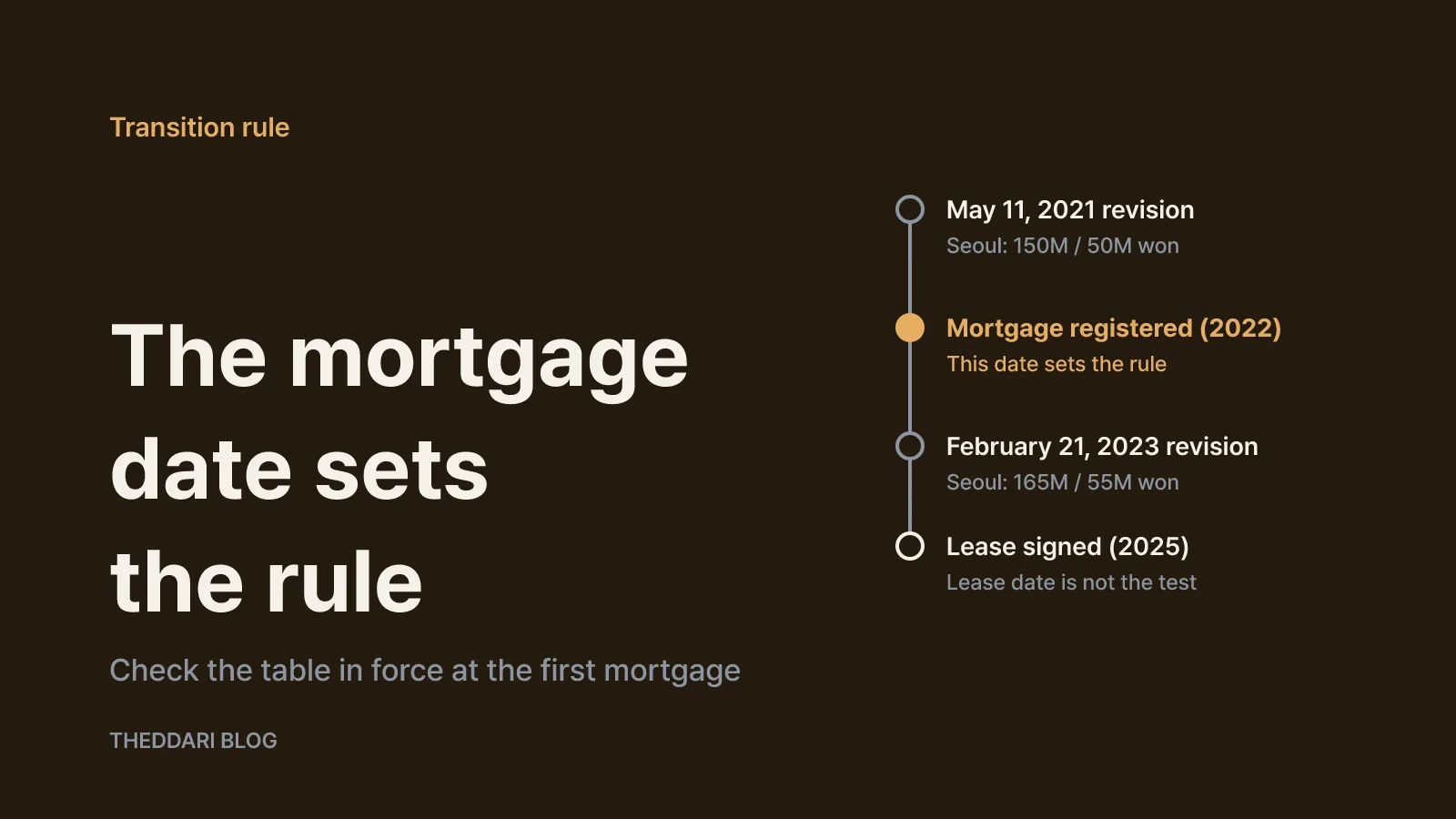
This is where most people go wrong. Every time the thresholds were raised, the amending decree said that creditors who acquired a security interest before the change remain under the old rule. Easy Law states this explicitly for the February 21, 2023 revision (Presidential Decree No. 33254, Addendum Article 2). A lender only has to yield to small-deposit tenants as defined when it lent the money.
So check the registration date of the earliest mortgage in the property register. If it predates February 21, 2023, use the older table. According to Hankook Auction's table by mortgage date, the band that began on May 11, 2021 set Seoul at 150 million won and 50 million won; the second zone at 130 million and 43 million; the third at 70 million and 23 million; and other areas at 60 million and 20 million.
An example: a Seoul villa has a mortgage registered in 2022, and you sign a lease in 2025 with a 160 million won deposit. You meet today's threshold, but against that lender you exceed the 2022 limit of 150 million won, so you cannot claim priority repayment. With a 140 million won deposit you would qualify under the older rule as well, but the amount paid ahead of that lender would be capped at 50 million won, not 55 million. If there is no mortgage, or the first one was registered after February 21, 2023, the current table applies. With several mortgages, the applicable rule can differ creditor by creditor, which is a good reason to get legal advice at the distribution stage.
Four conditions you must meet
Easy Law sets out four requirements. Missing any one of them means no payout, whatever your deposit.
- Your deposit falls within the range, measured against the rule in force when the senior mortgage was registered.
- You took possession and registered your address before the auction was registered. A Supreme Court ruling (95Da44597) requires these to continue until the claim deadline, so moving your registration elsewhere mid-auction can cost you the right.
- The home is sold through a court auction or a tax-delinquency public sale. An ordinary sale to a new owner raises a different question: whether your lease binds the buyer.
- You file a distribution claim. For a court auction you file with the execution court; for a tax sale you notify the tax authority. The claim states the basis and amount and attaches proof such as the lease contract. Missing the court's deadline can exclude you.
A fixed-date stamp is not required for the priority amount itself, but you need it to recover anything above the cap, so get it right after signing.
The half-of-value cap and shared buildings
Under Article 10(2) of the Decree, the priority amount cannot exceed half the value of the home. If a Seoul unit is valued at 80 million won, even a sole tenant receives at most 40 million won this way. Where several tenants share one building, such as a multi-household house (다가구주택), and their priority amounts together exceed half the value, that half is divided in proportion to each tenant's amount. Four tenants each entitled to 55 million won in a building whose half-value is 110 million won would each receive 27.5 million won. Tenants living together as one household are treated as a single tenant with combined deposits, so family members splitting a lease do not each get a separate cap.
When the protection does not apply
Easy Law highlights two cases. If a previous tenant registered a lease right by court order (임차권등기) and you rented the home afterwards, you cannot claim priority repayment even with a small deposit. A lower court has also held that a tenant who qualified at signing but raised the deposit above the threshold on renewal loses the protection. Moving in after the auction was registered, moving out before the claim deadline or simply not filing a claim also leaves you without it.
Before signing, confirm your zone, read the mortgage dates in the register, compare your deposit with the applicable band, add up senior debts and other tenants' deposits against the market value, and register your address and get a fixed-date stamp on moving day. Priority repayment is a floor for the worst case, not a guarantee that your whole deposit is safe.