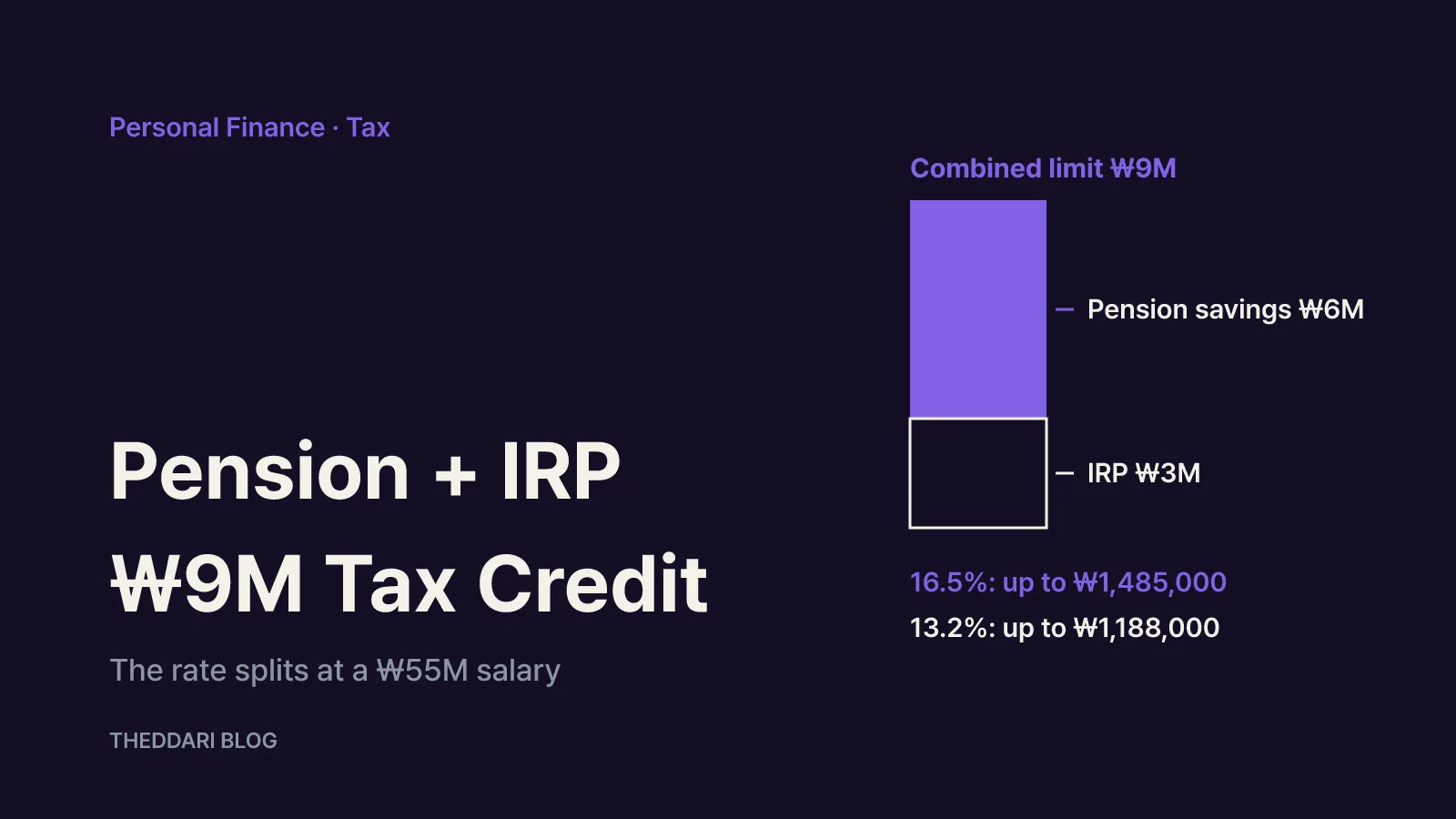
As of October 2026, a resident taxpayer in South Korea can claim a tax credit on up to ₩6 million a year paid into a pension savings account (yeongeum jeochuk), or up to ₩9 million a year when that account is combined with an IRP (individual retirement pension). If your total salary is ₩55 million or less (or your total comprehensive income is ₩45 million or less), the credit is 16.5% of what you contribute; above that line it is 13.2%. Both figures include local income tax. Filling the full ₩9 million therefore cuts your tax bill by up to ₩1,485,000 or ₩1,188,000. These rules come from the National Tax Service (NTS) tax credit guide, cross-checked against the government's Easy Law pension savings page.
Two conditions shape every decision: only money that actually lands in the account by December 31 counts for this year, and if you take the money out before 55 the credited amount is taxed again at 16.5%. This guide walks through the limits, the arithmetic and the deadline so you can plan the final two months of the year, whether you file through your employer's year-end settlement or a May income tax return.
How the ₩9 million limit is split
The most common misunderstanding is that each account gets its own ₩9 million. It does not. The NTS table lists the creditable contribution limit as ₩6 million, with ₩9 million in brackets when retirement pension accounts are included. The ₩9 million is a combined ceiling across both account types.
- Pension savings only: credit applies to ₩6 million. Anything above that in the same account earns no credit.
- IRP only: a single IRP can absorb the full ₩9 million.
- Both accounts: up to ₩6 million in pension savings, with the IRP topping the total up to ₩9 million.
A Maeil Shinmun report from October 13, 2026 cited an NTS consultation case in which an employee earning ₩60 million put ₩9 million into a pension savings account alone and lost the credit on ₩3 million. If you already have pension savings and plan to contribute more than ₩6 million, route the excess to an IRP.
Keep the credit limit separate from the contribution limit. The Financial Supervisory Service's tax-advantaged products table puts the total annual contribution cap at ₩18 million across pension savings and retirement pension accounts combined, counted across all financial institutions. You can deposit up to ₩18 million, but the credit stops at ₩9 million.
Some money never qualifies. The NTS excludes deferred-tax income such as severance pay on which no income tax was withheld, and amounts that arrive because a contract was transferred from another pension account. Defined contribution (DC) plans count as retirement pension accounts, but employer contributions are excluded; only what you add to the DC account yourself is creditable. On eligibility, the FSS lists no restriction for pension savings, while an IRP is open to employees in a workplace pension, people who received severance after changing jobs, the self-employed and members of occupational pension schemes.
Credit rates and refund amounts at the ₩55 million line
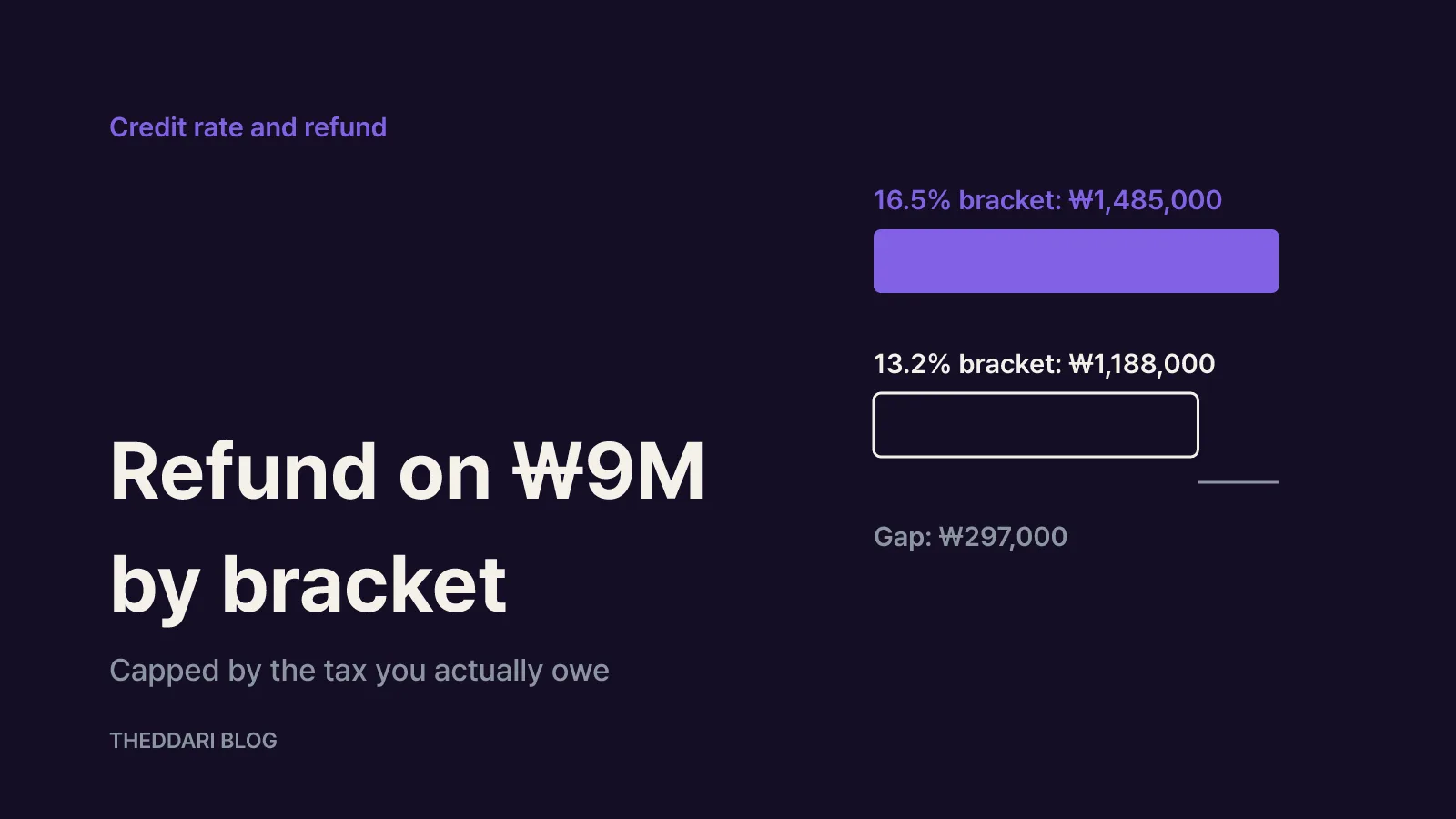
One income threshold decides the rate. With only employment income, the line is total salary of ₩55 million; with other income, it is total comprehensive income of ₩45 million. The NTS table shows 15% and 12%. Adding the 10% local income tax surcharge gives the effective 16.5% and 13.2%.
← Swipe to see more
| Contribution | Salary ≤ ₩55M (16.5%) | Salary > ₩55M (13.2%) |
|---|---|---|
| Pension savings ₩6M | ₩990,000 | ₩792,000 |
| Pension savings ₩6M + IRP ₩3M | ₩1,485,000 | ₩1,188,000 |
| With full ISA rollover bonus (₩12M) | ₩1,980,000 | ₩1,584,000 |
The gap between the two brackets on a full ₩9 million is ₩297,000. If your salary sits near the line, judge the bracket on your final annual pay, including any year-end bonus.
These are ceilings, not guarantees. A tax credit is subtracted from tax already calculated, so if your determined tax is smaller than the credit, you cannot get back more than you owe. Maeil Shinmun made the same point for lower earners. Use the year-end settlement preview on Hometax to estimate your remaining tax after other credits, and size your pension contribution to that figure.
Adding ₩3 million with a matured ISA
If an ISA (Individual Savings Account) matured this year, the limit can grow. The NTS states that when an ISA contract ends and all or part of the balance is paid into a pension account, that amount counts toward the year's pension contributions, and the credit limit rises by 10% of the transferred amount, up to ₩3 million.
To unlock the full ₩3 million you need to transfer at least ₩30 million; moving ₩10 million adds ₩1 million. With the full bonus, the creditable amount reaches ₩12 million, as in the last row of the table.
Two caveats. The NTS says the bonus applies only in the year the matured ISA balance is paid into the pension account. And once the money is in a pension account it follows pension rules, so withdrawing before 55 brings the tax consequences described below. If the ISA money is earmarked for a wedding or a home within a few years, weigh that first.
The December 31 deadline and easy-to-miss conditions
This year's credit is based on this year's deposits, and December 31 may not mean midnight. Maeil Shinmun relayed a case introduced by the Financial Supervisory Service in which a late-night IRP transfer on the last day missed the institution's business cutoff and was booked to the following year. Cutoff times vary by institution and account type, so check yours in advance and aim to deposit before the last week of December.
- Account holder: the credit is based on your own account and your own contributions.
- Proof of payment: in January, confirm that the contributions appear in the simplified year-end settlement data. If not, request a payment certificate from the institution and submit it to your employer.
- IRP restrictions: per the Maeil report, an IRP can hold risky assets such as equity funds up to 70% of the balance, and partial withdrawals are generally not allowed except for statutory reasons, so an urgent need may force closing the whole account.
Separate proposals from current law. The Ministry of Economy and Finance's 2026 tax reform overview lists expanding the retirement pension tax credit for young people as a task, and Maeil Shinmun reported a plan to apply a 15% credit rate to young people's IRP contributions regardless of income, targeted for next year. Tax reform proposals need legislation before they take effect, so money you put in through this December should be calculated under the current rules shown by the NTS.
The cost of early withdrawal
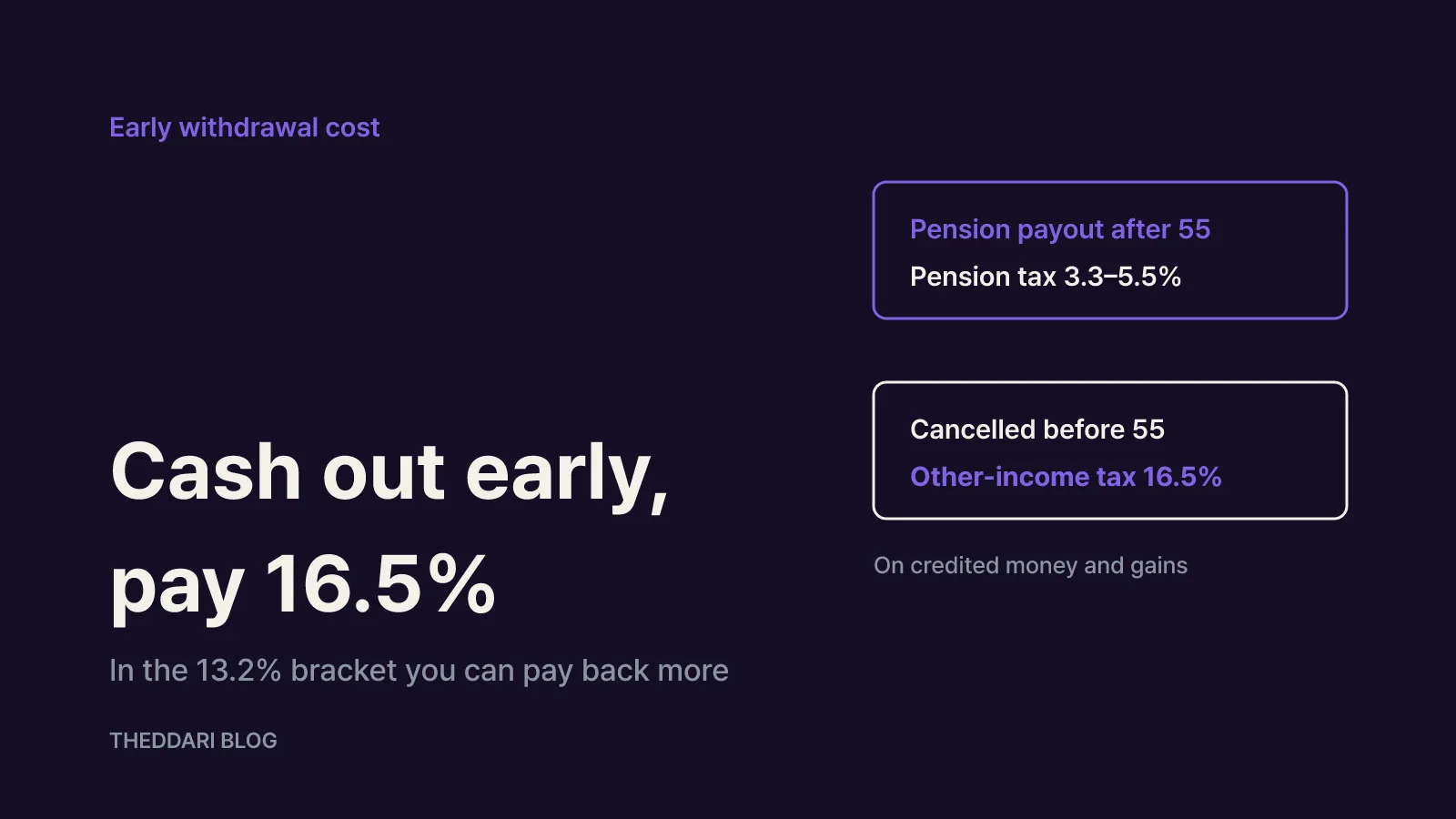
The credit is granted on the expectation that you will draw the money as a pension. According to Easy Law, a withdrawal counts as pension income only if you apply to start payments after age 55, at least five years have passed since the account opened, and each year's withdrawal stays within the annual pension withdrawal limit. Pension savings also carry a minimum five-year contribution period.
Cancel early or exceed the limit, and a 16.5% other-income tax is withheld separately on the credited contributions and investment gains. For someone in the 13.2% bracket, that means getting 13.2% back now and paying 16.5% later. Maeil Shinmun described an NTS case in which a worker in their 30s closed a five-year pension savings account to fund a lease deposit and paid other-income tax on the amount received.
Follow the rules and the rate drops. Easy Law puts pension income tax between 5.5% and 3.3% depending on age at the start of payments and the payout type. If private pension income exceeds ₩15 million a year, you must choose between comprehensive taxation and separate taxation. Contributions above the credit limit still have a use: Easy Law notes that pension savings paid beyond ₩6 million earn no credit but enjoy tax deferral until withdrawal and the lower pension tax rate later, although the money stays locked up for longer.
A step-by-step plan for the last two months
- Total this year's contributions by account, adding any automatic transfers still due before December.
- Identify your bracket: salary of ₩55 million or less (comprehensive income ₩45 million or less) means 16.5%; above it, 13.2%.
- Estimate your remaining tax with the Hometax preview after other deductions and credits. That figure caps what the pension credit can save.
- Allocate the gap: up to ₩6 million in pension savings, the rest in an IRP, no more than ₩9 million combined, plus 10% of any matured ISA transfer up to ₩3 million.
- Test the age-55 and five-year conditions: if you may need the money earlier, contribute only what you are sure you will not touch.
- Deposit before the cutoff, checking your institution's year-end time and avoiding the final evening.
Working through these steps avoids the two classic mistakes: paying in money that earns no credit, and taking a credit that costs more when you withdraw early.