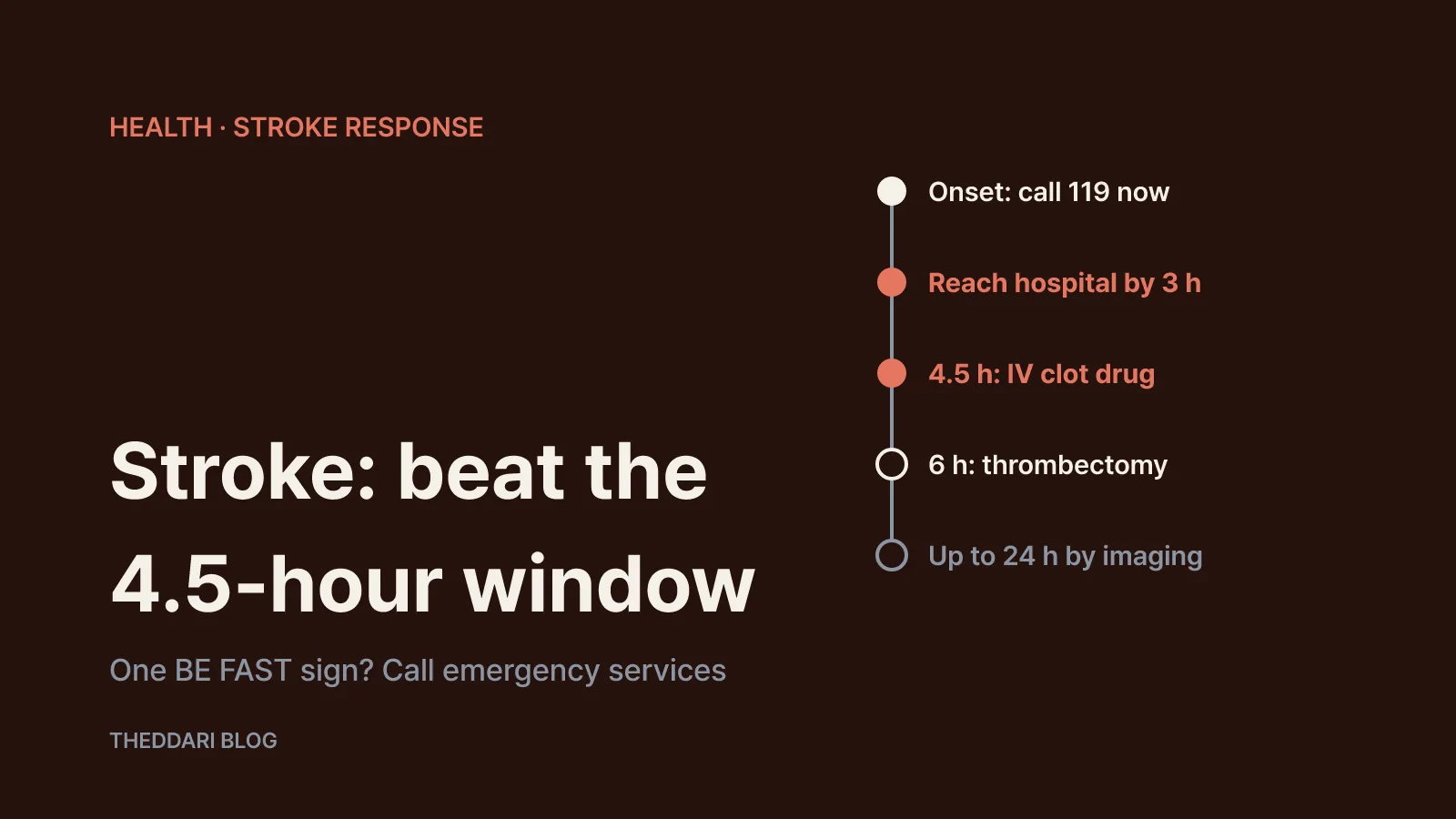
As of October 2026, the advice for a suspected stroke comes down to two actions: if even one warning sign appears suddenly, call emergency services immediately (119 in Korea, 911 in the US), and note the time the symptoms started. The intravenous clot-dissolving drug used for ischemic stroke can only be given within 4 hours 30 minutes of onset, and the Korean Stroke Society says that once scanning and drug preparation are factored in, patients need to reach hospital within about 3 hours. This guide, published around World Stroke Day on October 29, draws on the Korea Disease Control and Prevention Agency (KDCA) stroke page, updated October 23, 2026, the Korean Stroke Society's World Stroke Day briefing and the CDC's stroke signs page.
A stroke happens when a blood vessel supplying the brain is blocked (ischemic stroke) or bursts (hemorrhagic stroke), damaging the brain tissue around it. KDCA counted roughly 110,000 strokes in Korea in 2022, and stroke is the country's fourth leading cause of death after cancer, heart disease and pneumonia. Brain cells rarely recover once they are lost, so the minutes spent recognizing symptoms and getting to the right hospital shape what life looks like afterwards.
Spot a stroke with BE FAST (or Korea's 'E-ut-son-bal-si-seon')
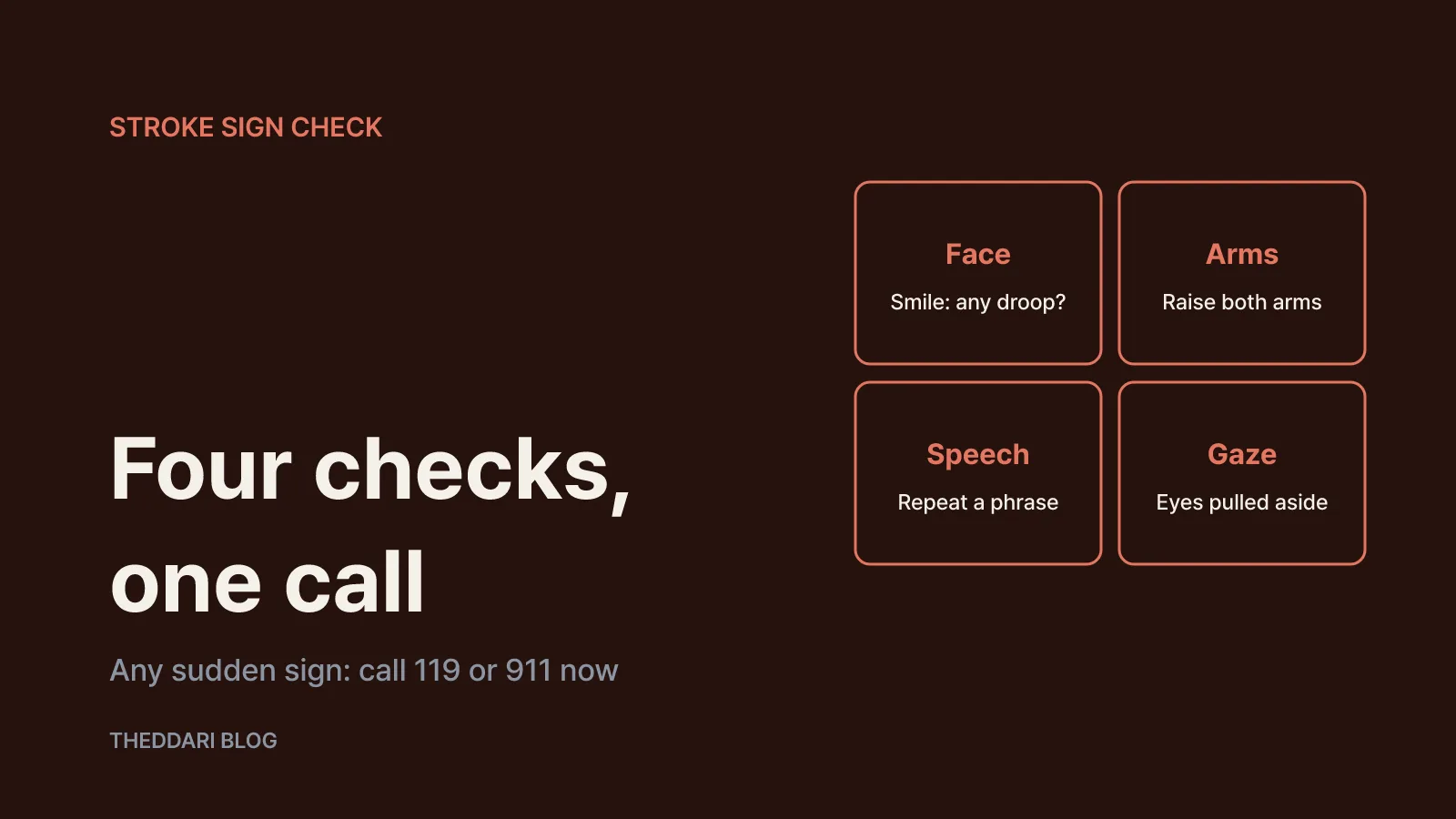
The CDC teaches B.E. F.A.S.T., a quick test that a bystander can run in under a minute:
- B — Balance: Is the person suddenly dizzy or off-balance?
- E — Eyes: Do they have sudden trouble seeing?
- F — Face: Ask them to smile. Does one side droop?
- A — Arms: Ask them to raise both arms. Does one drift down?
- S — Speech: Ask them to repeat a simple phrase. Is it slurred or strange?
- T — Time: If you see any of these, call emergency services right away.
If you live in Korea or have Korean-speaking family, you may hear the Korean Stroke Society's version, '이웃손발시선' (i-ut-son-bal-si-seon). It covers the same core checks: a smile that will not lift on one side (facial palsy), an arm that cannot be held out or one side that is weaker (one-sided weakness), slurred or garbled speech or not understanding words (dysarthria or aphasia), and both eyes pulled toward one side (gaze deviation). Note that the 'bal' here refers to pronunciation, not the foot.
The key word in every version is sudden. A headache you have had for years or long-standing numbness is not what these tools screen for. If someone who was fine minutes ago now shows even one new sign, do not wait to see whether the others appear.
Other sudden symptoms that also count
The checklists capture the most common signs, but strokes do not always look the same. KDCA lists five main symptoms: numbness or weakness on one side of the face or body; difficulty speaking or understanding; loss of vision in one or both eyes; dizziness with loss of balance or coordination; and a severe headache with no known cause. The CDC adds sudden confusion and trouble walking.
The Korean Stroke Society also flags a headache unlike any you have had before, unsteadiness that stops you from standing or walking, and double vision. One type of bleeding stroke, subarachnoid hemorrhage, often shows up mainly as a severe headache with vomiting rather than weakness. Distinguishing a stroke from something else is the job of a brain scan; at home, the rule is simple: sudden, new and neurological means call for help.
Why 4.5 hours means arriving within 3
Treatment for ischemic stroke centres on reperfusion, reopening the blocked vessel, and the benefits are proven only within set time windows.
← Swipe to see more
| Treatment | Time from symptom onset | Source |
|---|---|---|
| IV clot-dissolving drug (tPA) | Within 4 hours 30 minutes | KDCA, Korean Stroke Society |
| Target hospital arrival | Within about 3 hours | Korean Stroke Society |
| Mechanical thrombectomy (large vessel blocked) | Generally within 6 hours | KDCA, Korean Stroke Society |
| Mechanical thrombectomy (depending on imaging) | Up to 24 hours | KDCA, Korean Stroke Society |
The drug cannot be given the moment you arrive. Doctors first scan the brain, usually with CT, to rule out bleeding, because a clot-dissolving drug must not be given to someone with a hemorrhage. Add blood tests and drug preparation and the margin shrinks, which is why the society urges arrival within roughly 3 hours. The CDC's guidance points the same way, noting that the most effective treatments depend on the stroke being recognized and diagnosed within 3 hours of the first symptoms.
The payoff is large. According to the society, IV thrombolysis more than doubles the chance of living independently three months later, and successful thrombectomy makes a good outcome 2.5 times more likely. Yet Korean stroke registry data show fewer than 30% of patients reach hospital within 3 hours, and KDCA reports that only 10.7% of stroke patients receive clot-dissolving drugs and 3.6% receive endovascular procedures.
Missing the 4.5-hour mark is not a reason to stay home. Some patients with a large blocked vessel can still have a clot removed up to 24 hours after onset, depending on imaging, so KDCA advises going to hospital quickly even after the window has passed.
What to do, and what not to do, while help is coming
- Call emergency services. Say you suspect a stroke and describe what you see. The CDC advises against driving yourself or having someone drive you; paramedics can start care on the way and route the patient to a hospital that offers acute stroke treatment.
- Write down the start time. A note such as "3:10 pm, speech slurred" helps the team choose a treatment. If you do not know when it began, tell them when the person was last seen well.
- Gather medication details. Blood pressure and diabetes drugs, and especially blood thinners, matter for treatment decisions. Take the packets or a photo of the prescription.
- Keep the person comfortable. If they are drowsy or about to vomit, lay them on their side so the airway stays clear.
Avoid giving any medicine from the cupboard. Ischemic and hemorrhagic strokes are treated differently and only a scan can tell them apart, and swallowing may be impaired. Do not let the person sleep it off, and do not stop at a local clinic first.
In Korea, it helps to know your nearest certified stroke centre in advance. As of the society's October 2025 briefing, there were 88: 77 offering reperfusion treatment and 11 general stroke centres. Locations are listed on the Korean Stroke Society website.
When symptoms disappear: transient ischemic attack
Sometimes speech slurs or an arm goes weak, then everything returns to normal within minutes. This may be a transient ischemic attack (TIA), often called a mini-stroke, where blood flow drops briefly and symptoms usually resolve within 24 hours.
Treating it as over is the riskiest choice. KDCA notes that 10–13% of people have a stroke within 90 days of a TIA, and about half of those occur within the first two days. A TIA should therefore be investigated and treated as urgently as an acute ischemic stroke. MRI can also reveal brain damage even when symptoms lasted under an hour. The CDC likewise warns that people often ignore TIAs because they clear up, and urges telling a health care team right away.
Lowering the risk of a first or repeat stroke
Stroke often recurs. KDCA cites recurrence after ischemic stroke of 1.7–4% within a month, 6–13% within a year and 19–42% by five years, so managing risk factors and taking prescribed medication consistently is central. The same factors matter for prevention before any stroke:
- High blood pressure is the most common modifiable risk factor. The Korean Stroke Society's primary-prevention targets are below 140/90 mmHg for most people and below 130/80 mmHg for those with diabetes or kidney disease.
- Smoking roughly doubles stroke risk compared with not smoking.
- Diabetes is present in 15–33% of people with ischemic stroke and predicts recurrence.
- Atrial fibrillation lies behind about 20% of ischemic strokes via clots from the heart, and affects an estimated 10% of people aged 80 and over. Do not stop prescribed anticoagulants on your own.
- High LDL cholesterol raises the risk of ischemic stroke.
Three things you can do today: share BE FAST (or the Korean checklist) with your family, look up the stroke centre nearest to your parents, and check your own blood pressure. In an emergency, people remember what they have practised.