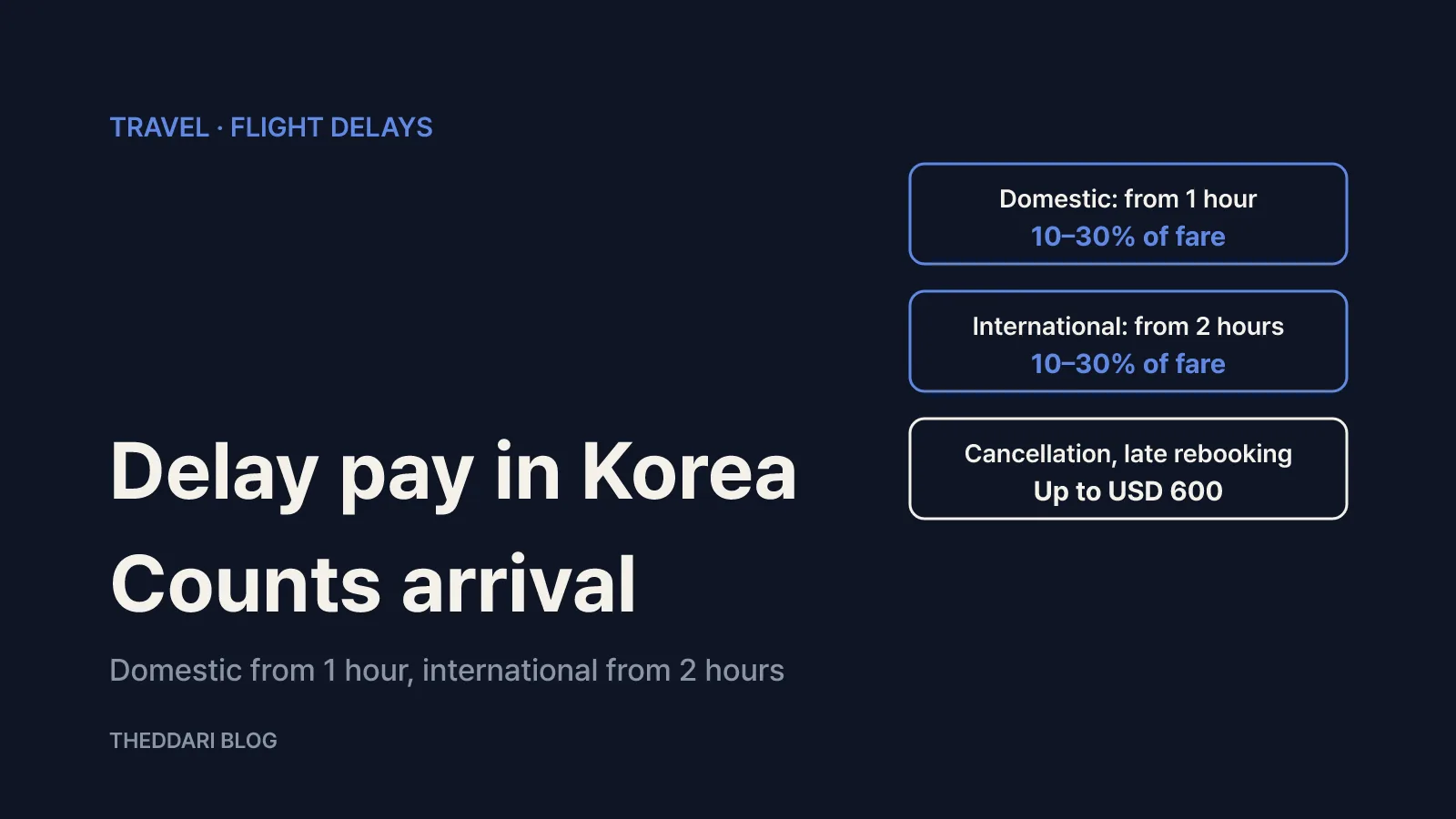
As of November 2026, if your flight to, from or within South Korea arrives late, Korea's benchmark is 10–30% of the fare for the delayed segment, starting at one hour late for domestic flights and two hours late for international flights. If you are bumped or your flight is cancelled, international passengers are looking at USD 200 to USD 600 depending on how late the replacement flight is, or a fare refund plus USD 600 if no replacement is offered. These numbers come from the aviation section of the Consumer Dispute Settlement Criteria, a notice issued by the Korea Fair Trade Commission and last revised in December 2025 (Lawsee legal guide).
One thing travelers used to the EU's fixed payouts should know up front: the Korean criteria are not an automatic cash entitlement. They are the reference point for settlements and mediation, and a mediated outcome only binds both sides once each accepts it (Korea's Easy-to-Find Legal Information service). In practice, the evidence you collect at the airport and the order in which you make your claim matter as much as the percentages. That is worth knowing before the winter peak, when snow and fog regularly disrupt schedules at Korean airports.
Delay compensation is based on when you arrive
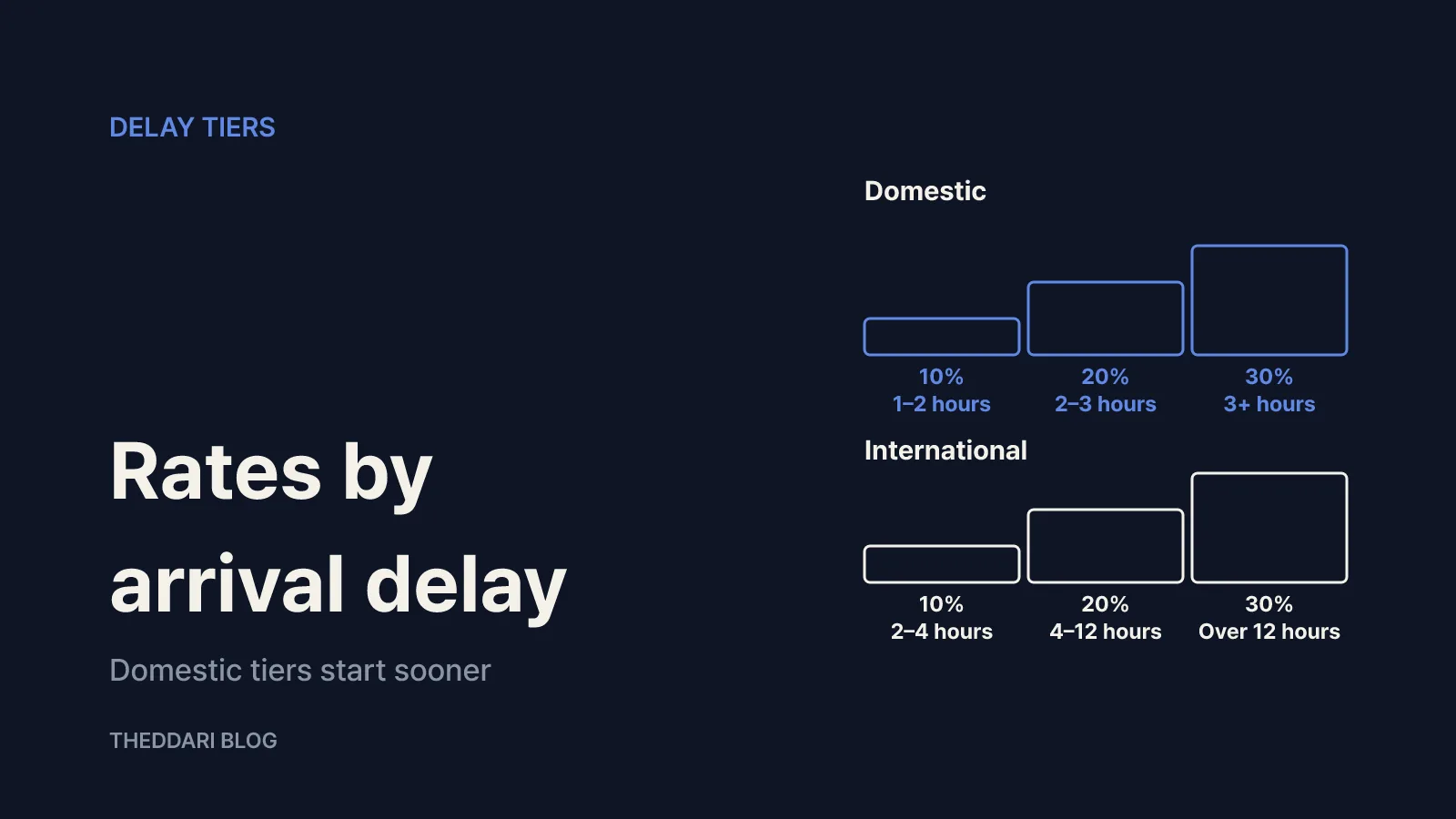
The clock that matters is arrival at your destination, not departure. If you sat at the gate for three hours but the crew made up time in the air and you landed 1 hour 50 minutes late, an international flight falls short of the first tier. If a short departure delay made you miss a connection and you reached your final destination 15 hours late, the over-12-hours tier applies.
← Swipe to see more
| Flight type | Arrival delay | Benchmark |
|---|---|---|
| Domestic | 1 to 2 hours | 10% of the delayed segment's fare |
| Domestic | 2 to 3 hours | 20% |
| Domestic | 3 hours or more | 30% |
| International | 2 to 4 hours | 10% of the delayed segment's fare |
| International | 4 to 12 hours | 20% |
| International | More than 12 hours | 30% |
The domestic tiers are published on the government's legal information page for air travel, and the international 2-, 4- and 12-hour tiers match the figures reported by KBS and the Lawsee guide. The trap is that a 2.5-hour delay earns 20% on a domestic route but only 10% on an international one.
If the delay forces an overnight stay, the airline is also expected to cover reasonable meals and accommodation. Keep the hotel voucher or, if you paid yourself, every receipt. Care during the delay and the fare-based payment are assessed separately.
Cancellations and bumping depend on the replacement flight
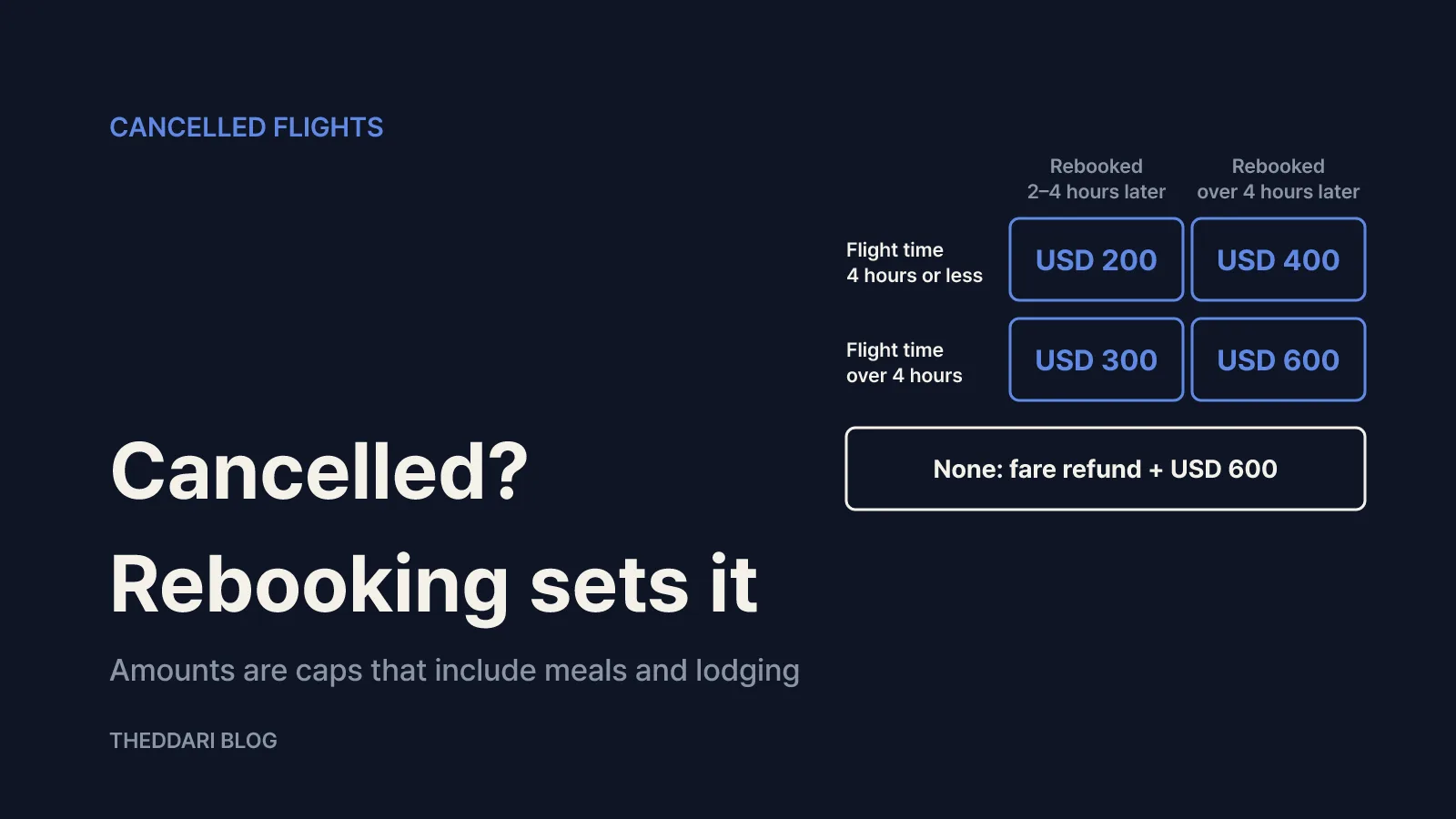
When the flight never operates, or you are denied boarding because it was oversold, Korean rules treat it as non-performance of carriage rather than a delay. The benchmark then depends on when the airline gets you onto a replacement flight.
For international flights, the first question is whether the scheduled flight time is four hours or less, which the criteria treat as equivalent to 3,500 km (Lawsee, KBS).
← Swipe to see more
| Scheduled flight time | Replacement departs | Maximum compensation |
|---|---|---|
| 4 hours or less | 2 to 4 hours later | USD 200 |
| 4 hours or less | More than 4 hours later | USD 400 |
| More than 4 hours | 2 to 4 hours later | USD 300 |
| More than 4 hours | More than 4 hours later | USD 600 |
| No replacement offered | - | Fare refund + USD 600 |
These are ceilings, not fixed sums, and the notes say the cap includes necessary meals and lodging. Passengers who reach the airport after the airline's check-in deadline are excluded. If you turn down the replacement, you still get the segment fare back, with compensation calculated from the earliest replacement the airline could have offered.
On domestic routes, a replacement within 12 hours (on any airline) is the reference. A replacement 1 to 3 hours later means 20% of the segment fare, and more than 3 hours later means 30%. If none is provided within 12 hours, the benchmark is a refund plus a ticket or voucher for that segment.
For flights departing Korea, airlines and the agencies that sold the ticket must notify passengers by text, email or phone without delay once a flight is delayed by 30 minutes or more or cancelled. Screenshot those messages; the time and the stated reason become evidence later.
Weather, maintenance and late inbound aircraft
The standard answer at the counter is "weather" or "maintenance". The criteria exclude compensation only where the airline proves one of the following:
- inspections under maintenance standards approved by the Ministry of Land, Infrastructure and Transport
- weather so bad the aircraft cannot operate
- airport problems such as a runway closure
- a knock-on delay from the previous flight using the same aircraft
- unforeseeable measures taken for safe operation
The burden of proof sits with the airline. Saying "technical issue" is not enough on its own; the airline should be able to show what was inspected and why it could not have been anticipated. A knock-on delay also invites the question of why the earlier flight was late. If other airlines flew the same route at the same time, that is a reason to ask again.
Crucially, an exemption does not cancel your refund. Even when a typhoon justifies the cancellation, the airline still owes you the fare for the segment it did not fly, without a cancellation fee. Do not tap "cancel" in the airline app, because that can be logged as a voluntary cancellation with fees deducted. Ask for a refund because the airline cancelled.
How to calculate what you are owed
The most common mistake is applying the percentage to the total charged to your card. The "fare" in the criteria is the price you paid minus fuel surcharges, airport charges and other fees, and on a round trip only the delayed segment counts.
- Find the segment fare and the taxes and fees on your receipt or itinerary.
- Subtract the scheduled arrival time from the actual arrival time.
- Pick the tier from the domestic or international table.
- Multiply the segment fare by that percentage.
For example, if the one-way international fare after taxes and fees is KRW 400,000 and you land 5 hours late, the 4-to-12-hour tier applies: 20%, or KRW 80,000. A KRW 80,000 domestic fare arriving 1 hour 30 minutes late gives 10%, or KRW 8,000. If your receipt does not split the fare by segment, ask the airline for the breakdown in writing.
Exactly two or three hours on a domestic route, or exactly four on an international one, sits on the overlapping wording of the tiers. Claim the higher tier and get the airline's response in writing.
Evidence to collect and how to file a claim
These claims are won on paperwork. Before leaving the airport, collect:
- delay or cancellation texts and emails, a photo of the departure board, and your actual boarding and arrival times
- a written delay or cancellation certificate stating the specific cause, requested at the counter or from customer service
- receipts for hotels, meals, transport and any replacement ticket, plus non-refundable booking confirmations
- on a round trip, written notice that you still intend to fly the return segment
Be careful with meal vouchers or small credits that come with a form waiving "all further claims". Signing it can give up both the benchmark compensation and any claim for actual losses.
The claim then moves through three stages:
- Claim with the airline. Every airline flying to Korea, foreign carriers included, must run a passenger complaint process and generally reply within 14 days, or within 60 days where there is a special reason. List each item separately (refund, benchmark compensation, meals and lodging, extra ticket cost) and keep proof of the filing date.
- Korea Consumer Agency. If the reply is missing or unacceptable, call the 1372 consumer counseling center and request relief. The agency recommends a settlement, and if none is reached within about 30 days, the case can go to mediation.
- Consumer Dispute Mediation Committee. Parties have 15 days to respond to a mediation proposal; silence counts as acceptance, and an accepted proposal has the effect of a court settlement. If the airline refuses, the remaining route is court.
Missed connections, hotel costs and the two-year limit
The 10–30% or USD 600 is the benchmark. Actual losses, such as a prepaid hotel or tour you could not use, can be claimed separately under the Montreal Convention for most international flights or Korea's Commercial Act for other carriage. The airline escapes liability only by proving it took all reasonable measures to avoid the damage (Lawsee).
On a single booking, the airline should rebook a connection you missed because of its delay, and the delay is measured at your final destination. Separate tickets are separate contracts: the second airline flew on time, so the claim for the missed ticket goes to the first airline and may be disputed as an unforeseeable loss. Leave generous connection times when self-connecting.
Any court claim must be filed within two years of arrival or the date you should have arrived. Emailing the airline does not stop that clock.
Finally, the EU's passenger rights regulation (EU261), with fixed payouts of EUR 250, 400 or 600 by distance, applies to flights departing EU airports and to EU-bound flights operated by EU carriers. It is a separate system, so do not mix its figures with the Korean tables.