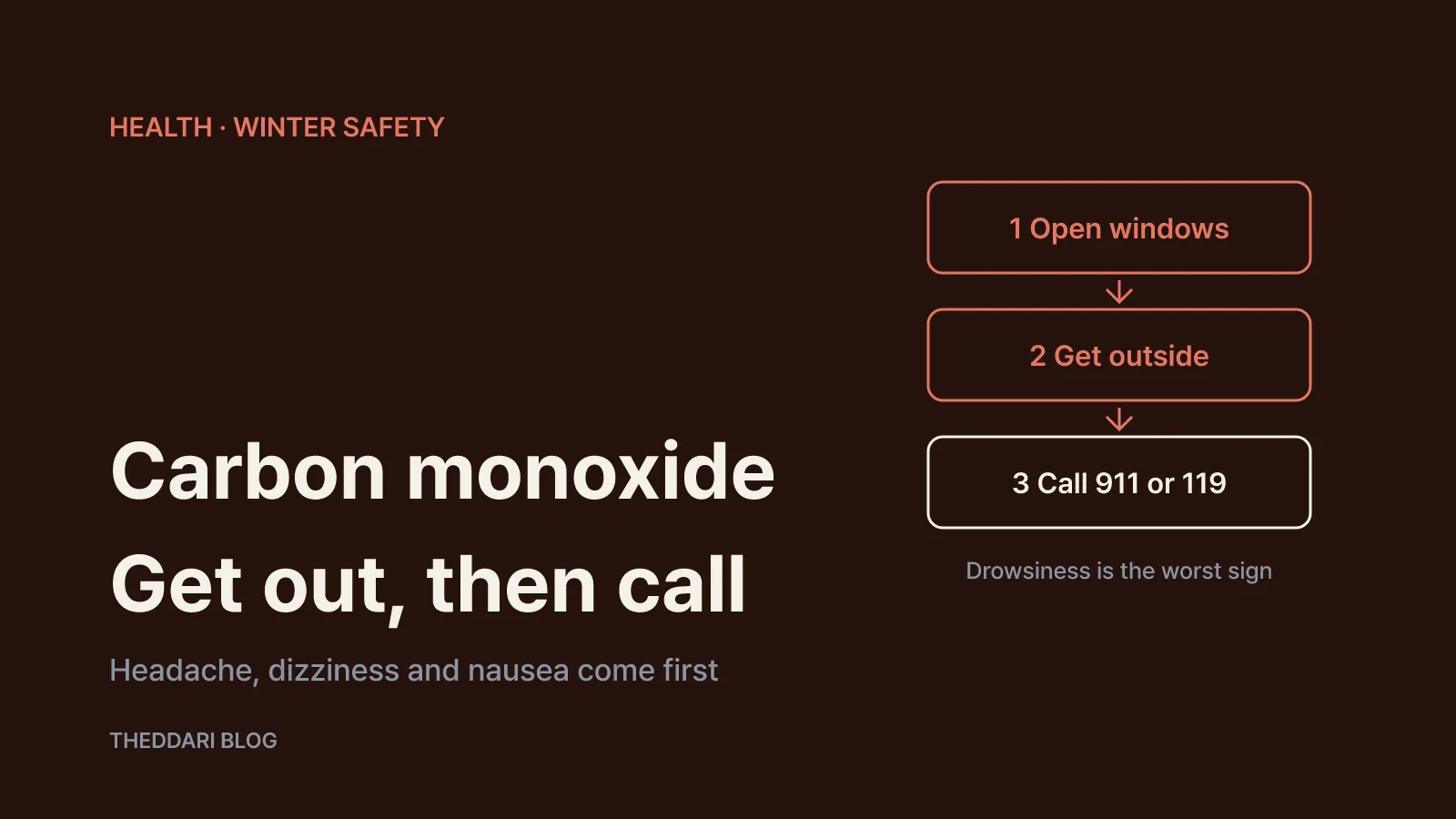
As of November 2026, the short answer is this: if a headache, dizziness or nausea starts after a furnace, heater, stove or charcoal grill has been running, and especially if several people in the same space feel it at once, treat it as carbon monoxide (CO) poisoning rather than the flu. Do not wait to see whether it passes. Open windows and doors, get everyone into fresh air, and call emergency services (911 in the US, 119 in Korea). Korea's National Fire Agency gives the same instruction: ventilate immediately, get the person breathing fresh air and call for help.
CO is colorless, odorless and tasteless. It forms when carbon-based fuel burns without enough oxygen. Once inhaled, it binds to hemoglobin in the blood and stops red blood cells from carrying oxygen, which Asan Medical Center in Seoul describes as a kind of internal suffocation. The CDC says it kills hundreds of people every year and makes thousands more ill, which is why winter, when heating systems restart and cold-weather camping picks up, is the moment to check your setup.
Carbon monoxide poisoning symptoms that look like the flu
According to the CDC, the most common symptoms are headache, dizziness, weakness, upset stomach, vomiting, chest pain and confusion. The agency notes that people often describe them as flu-like. Korea's National Fire Agency lays out how they progress: headache, dizziness and nausea first, then vomiting, shortness of breath, numb hands and feet and general weakness, and finally confusion, drowsiness that keeps returning even when the person is woken, loss of consciousness and death.
The clue that separates CO from a virus is context. Suspect CO when:
- Symptoms began after a fuel-burning appliance, grill or vehicle was running nearby.
- Other people, or pets, in the same room or tent feel unwell at the same time.
- You feel a little better outdoors and worse again when you go back inside.
- There is headache and sleepiness without fever, runny nose or body aches.
Sleepiness is the most dangerous sign. The CDC warns that people who are asleep, drunk or under the influence of other substances can die before they ever notice symptoms. That is exactly the situation of someone who falls asleep in a tent or car with a heater on. Asan Medical Center groups symptoms into mild (headache, dizziness, nausea, vomiting), severe (dulled judgment, weak limb muscles, loss of consciousness) and a stage with a fast pulse, labored breathing and a flushed face. A red face is not a reassuring sign.
How fast CO concentration in the air causes harm
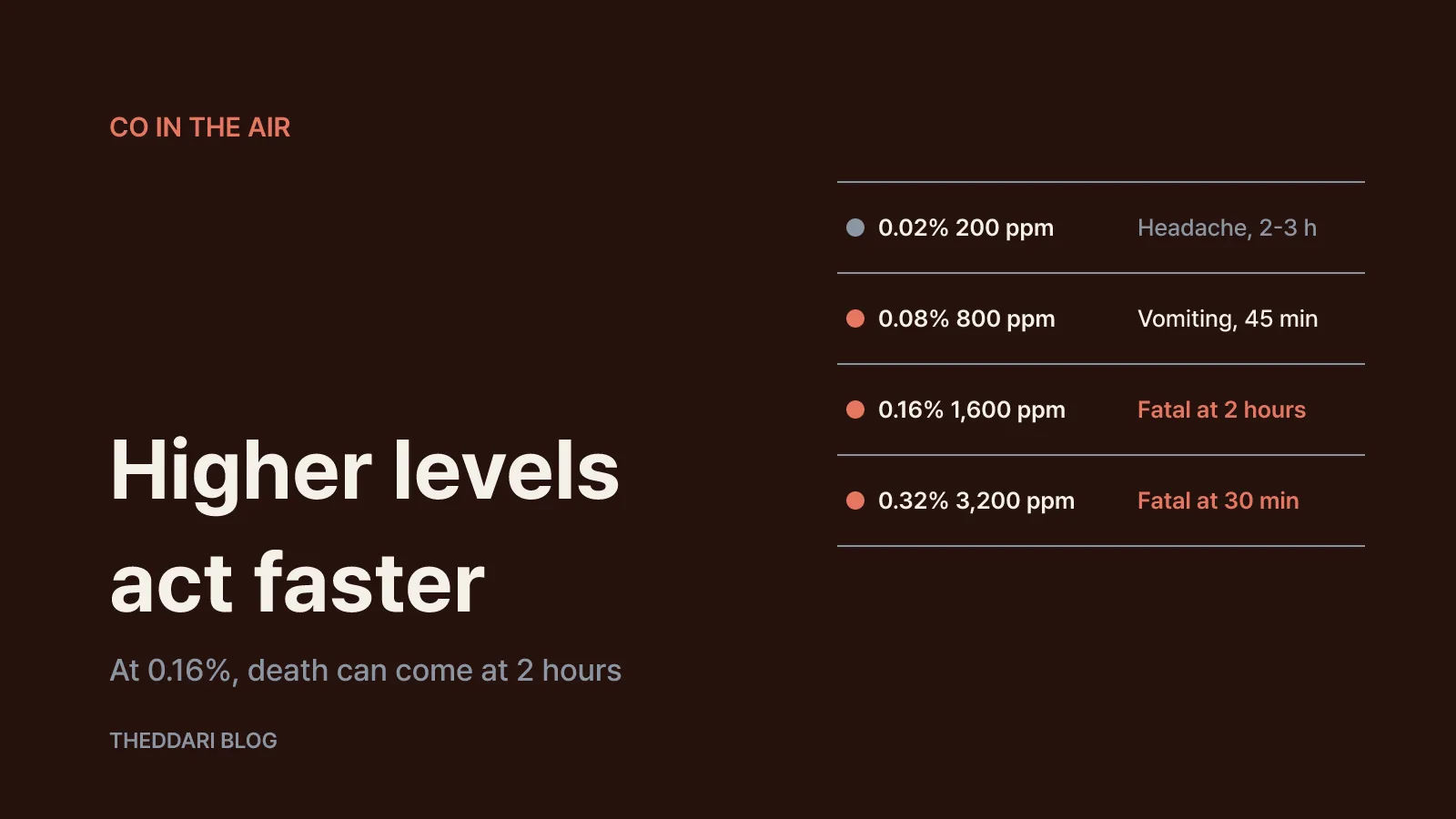
The higher the concentration, the faster and harder symptoms hit. The table below lists the exposure figures published by Asan Medical Center, with parts per million added (0.01% equals 100 ppm).
← Swipe to see more
| CO in air | ppm | Typical effect and timing |
|---|---|---|
| 0.02% | 200 ppm | Mild headache within 2 to 3 hours |
| 0.04% | 400 ppm | Frontal headache in 1 to 2 hours, headache at the back of the head in 2.5 to 3.5 hours |
| 0.08% | 800 ppm | Headache, nausea and vomiting within 45 minutes; collapse within 2 hours |
| 0.16% | 1,600 ppm | Headache, nausea and vomiting at 20 minutes; death at 2 hours |
| 0.32% | 3,200 ppm | Headache and nausea in 5 to 10 minutes; death at 30 minutes |
| 0.64% | 6,400 ppm | Headache and nausea at 2 minutes; death in 10 to 15 minutes |
| 1.28% | 12,800 ppm | Death in 1 to 3 minutes |
Two lessons stand out. First, a level as low as 0.16%, far below 1%, can be fatal in about two hours, and a small closed tent or car cabin fills up quickly. Second, the gap between a first headache and a life-threatening stage shrinks as the level rises. At 0.32%, death can come within 30 minutes, so "let's see if it gets better" is not a safe plan.
For scale, Korea's Environmental Health Portal says indoor CO in public facilities such as subway stations, underground shopping areas and buildings used by children, older adults and pregnant people is managed at 10 ppm or below, and indoor parking garages at 25 ppm or below. The 200 ppm level where mild headaches begin is far above those limits. If your detector shows a number, compare it with your usual reading and act on a sudden rise.
What to do if you suspect carbon monoxide poisoning
The goal is to stop further exposure and get oxygen into the person quickly. Combining the National Fire Agency and Asan Medical Center guidance, the order is:
- Ventilate and get out. Open windows and doors and move everyone into fresh air. Switch off the appliance only if you can do it immediately, and do not linger inside while helping others.
- Call emergency services. Call even if the only symptom is a headache, because consciousness can drop quickly. Tell the dispatcher how many people were in the space.
- Open the airway. If the person is unresponsive, tilt the head back and lift the chin.
- Start CPR if they are not breathing, following the dispatcher's instructions.
- Get to hospital for oxygen. Asan Medical Center says high-concentration oxygen should be given during transport and that hyperbaric oxygen treatment may be needed. Doctors confirm CO poisoning with a blood test that measures CO levels.
Just as important is what not to do. Do not go back into the tent or room to sleep because the headache eased outdoors. Do not restart the heater until it has been checked. Do not drive yourself to the hospital, since your judgment may already be impaired.
Camping, tents and cars: why heaters turn deadly
Korea's National Fire Agency names cooking charcoal and butane-fueled heaters and heated water mats as the main outdoor causes in tents and vehicles, and Asan Medical Center notes deaths among campers who fell asleep with a heater running inside or beside the tent. Practical rules for cold-weather camping and car camping:
- Never burn charcoal or wood inside a tent or vehicle. The CDC stresses that charcoal gives off CO whether it is red, gray, black or white, so embers that look dead are still a hazard.
- Never use a portable gas camp stove indoors, and the CDC adds that portable flameless chemical heaters should not be used indoors either.
- Read the manual before using a butane heater, as the National Fire Agency advises, and ventilate often. Make switching it off before sleep your default.
- Do not sit for long in a car with the engine running. Asan Medical Center lists prolonged time in a running vehicle as a cause. The CDC also says never to run a vehicle in a garage attached to a house, even with the door open, and to open vents or windows when driving with a tailgate open.
- Bring a battery-powered CO alarm and place it near where you sleep.
Home furnaces, water heaters and CO detector placement
At home, the National Fire Agency points to gaps in boiler and stove flue joints, gas leaks from cooking ranges, wood-fired heated floors and tankless gas water heaters. Asan Medical Center adds that new, repaired or long-unused boilers should be checked for leaks and proper exhaust before they are switched on, and that wind, low air pressure and cold can trigger problems in a system that usually works fine.
Before the first cold snap:
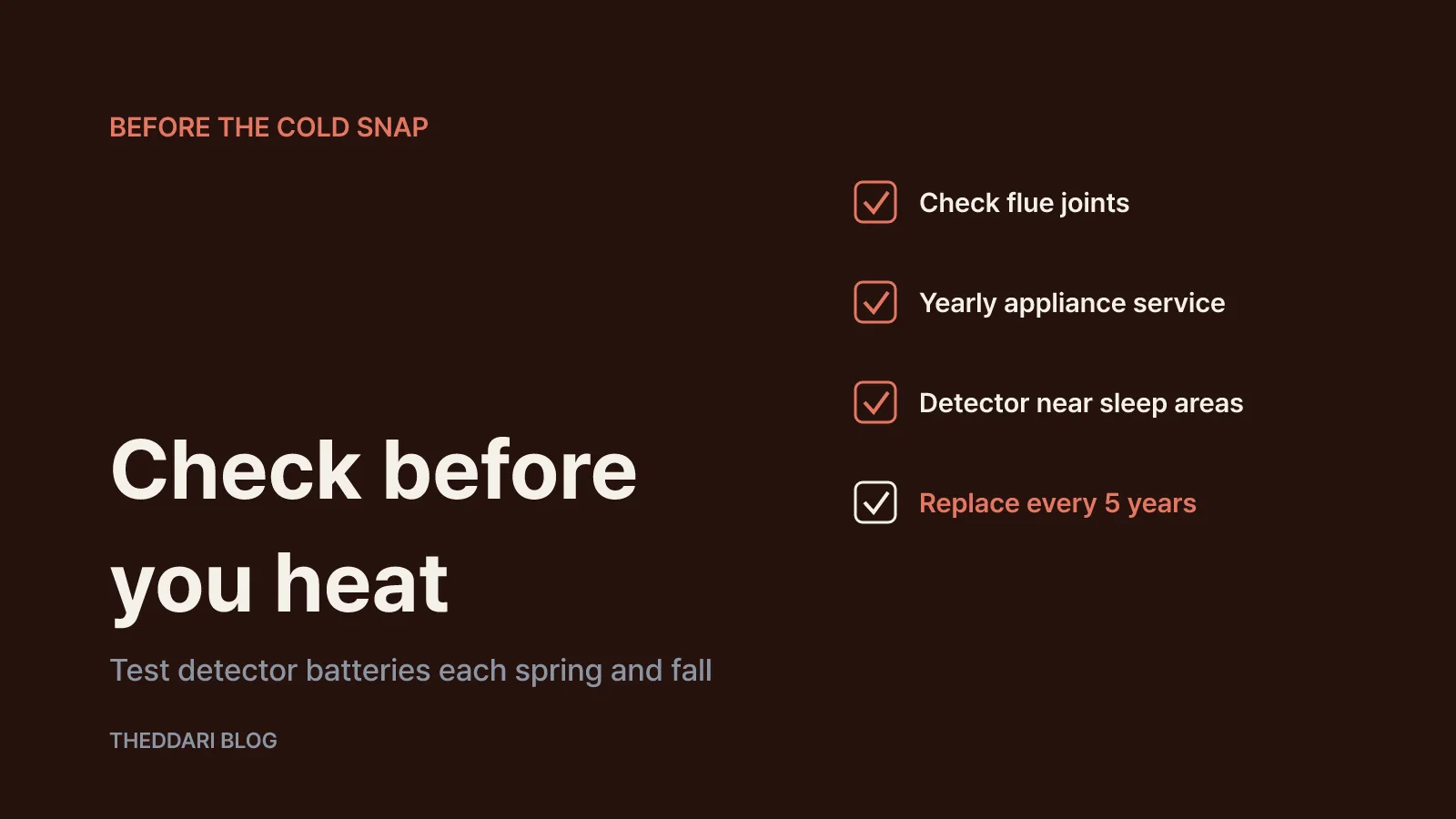
- Have your heating system, water heater and any gas, oil or coal appliance serviced by a qualified technician every year, as the CDC recommends.
- Check that flue and vent joints are tight and that vents run outdoors without dents or blockages.
- Get your chimney checked or cleaned every year.
- Never heat your home with a gas oven or range.
- Run portable generators only outdoors, more than 20 feet from windows, doors and vents, never in a home or garage.
For detectors, the CDC advises installing battery-operated or battery-backup CO detectors near every sleeping area, checking batteries each spring and fall when the clocks change, and replacing the unit as the manufacturer instructs or every 5 years. A model with a digital readout can show the highest level recorded, not just sound an alarm.
Who is most at risk, and the delayed effects to watch
Everyone is at risk, but the CDC says infants, older adults and people with chronic heart disease, anemia or breathing problems are more likely to get sick from CO. Take extra care with detectors and ventilation if you camp with them or live in an older home, and bring pets out too.
Recovery is not always the end. Asan Medical Center reports that even after discharge with no obvious problems, delayed brain injury can appear within a few weeks, including reduced consciousness, cognitive problems, parkinsonism, walking difficulties and loss of bladder or bowel control. Long, low-level exposure can cause dizziness, forgetfulness, irregular heartbeat and speech problems. Report any new memory, mood or movement change to the hospital that treated you.
The CDC counts more than 400 Americans dying each year from unintentional CO poisoning not linked to fires, more than 100,000 emergency department visits and more than 14,000 hospitalizations. Most of those cases are preventable with a working detector and good ventilation.