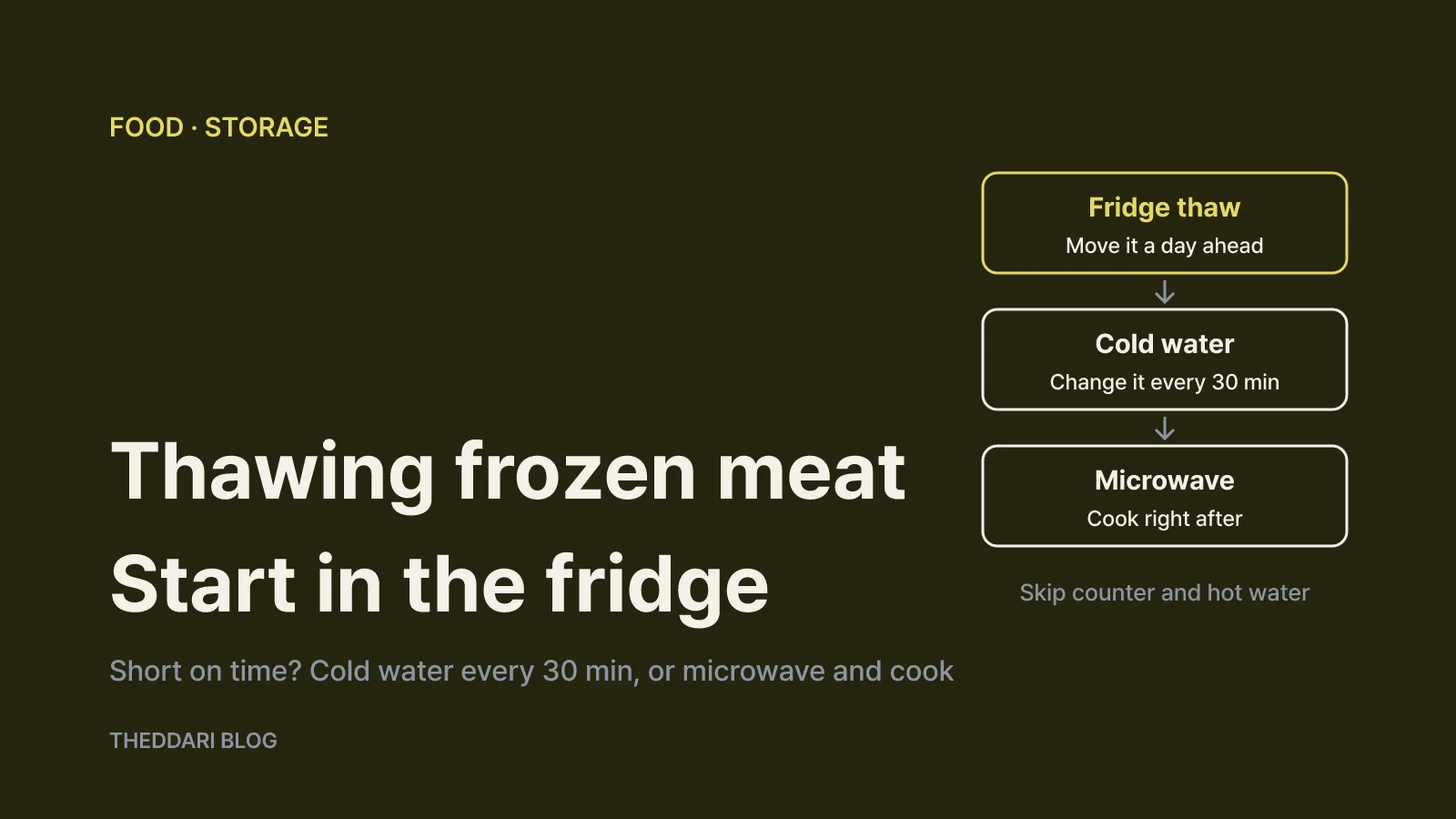
As of November 2026, the safest way to thaw frozen meat is still the slowest one: move it to the refrigerator and let it thaw there. If you are short on time, seal it in a leak-proof bag and submerge it in cold tap water, changing the water every 30 minutes, or use the microwave's defrost setting and cook the meat right away. Do not thaw meat on the counter or in hot water.
This guide is built mainly on the USDA Food Safety and Inspection Service page The Big Thaw — Safe Defrosting Methods, which gives the clearest timings. I also compared it with South Korean public guidance from the food safety ministry (MFDS) and the national animal and plant quarantine agency, because the two countries draw the refreezing line in slightly different places. Where they differ, both positions are spelled out below.
Refrigerator thawing: the safest default
Fridge thawing keeps the whole piece at a steady, cold temperature from start to finish. FSIS says thawing food should stay at 40 °F or below, which is exactly what a working refrigerator provides. South Korea's Animal and Plant Quarantine Agency likewise lists the refrigerator, running water and the microwave as the methods that limit microbial growth during thawing.
The catch is time. According to FSIS:
- A pound of ground meat or boneless chicken breasts needs a full day.
- A large item such as a whole turkey needs at least 24 hours for every 5 pounds.
- A fridge set at 35 °F thaws more slowly than one set at 40 °F, and some shelves run colder than others.
The practical habit is simple: if you know what you are cooking tomorrow, move it from the freezer to the fridge today. Put the package on a plate or in a container on the bottom shelf so drips cannot land on ready-to-eat food.
Once thawed in the fridge, FSIS says ground meat, stew meat, poultry and seafood remain safe and good quality for another day or two before cooking. Beef, pork or lamb roasts, chops and steaks keep for 3 to 5 days. That buffer is a major advantage of this method: plans can change without forcing you to cook immediately.
Cold water and microwave thawing when you are in a hurry
Forgot to plan ahead? Cold water thawing is faster but needs attention. The FSIS method works like this:
- Keep the meat in a leak-proof package or zip-top bag. A leaking bag can let bacteria in, and the meat may absorb water and turn soggy.
- Submerge the bag completely in cold tap water.
- Change the water every 30 minutes so it stays cold and the meat keeps thawing.
- Cook the meat as soon as it has thawed completely.
FSIS estimates that a small package of about a pound may thaw in an hour or less, while a 3- to 4-pound package may take 2 to 3 hours. Resist the urge to add warm water to speed things up; that turns a safe method into hot water thawing.
Microwave thawing is the quickest option, but it comes with a firm rule: cook immediately afterward. Thin edges can warm up or start to cook while the center is still frozen. FSIS warns that holding partially cooked food is not recommended, because bacteria present have not been destroyed and the food may have reached temperatures where they grow well. Remove the store wrapping, use a microwave-safe dish, and turn the meat or separate thawed pieces partway through for more even results.
There is also a third option that people often overlook. FSIS says it is safe to cook meat straight from frozen; it simply takes about 50% longer than cooking thawed or fresh meat. Thin cuts, burgers and ground meat for a skillet dish handle this well. Thick roasts need gentler heat and more time so the center cooks through.
Why the counter and hot water are risky
Leaving a frozen package on the counter feels harmless because the center stays hard for hours. The problem is the outside. FSIS explains that while the core is still frozen, the outer layer can already sit in the Danger Zone of 40 to 140 °F, where bacteria multiply rapidly. Freezing does not kill bacteria; it pauses them. As soon as the surface warms above 40 °F, anything that was present before freezing can start growing again.
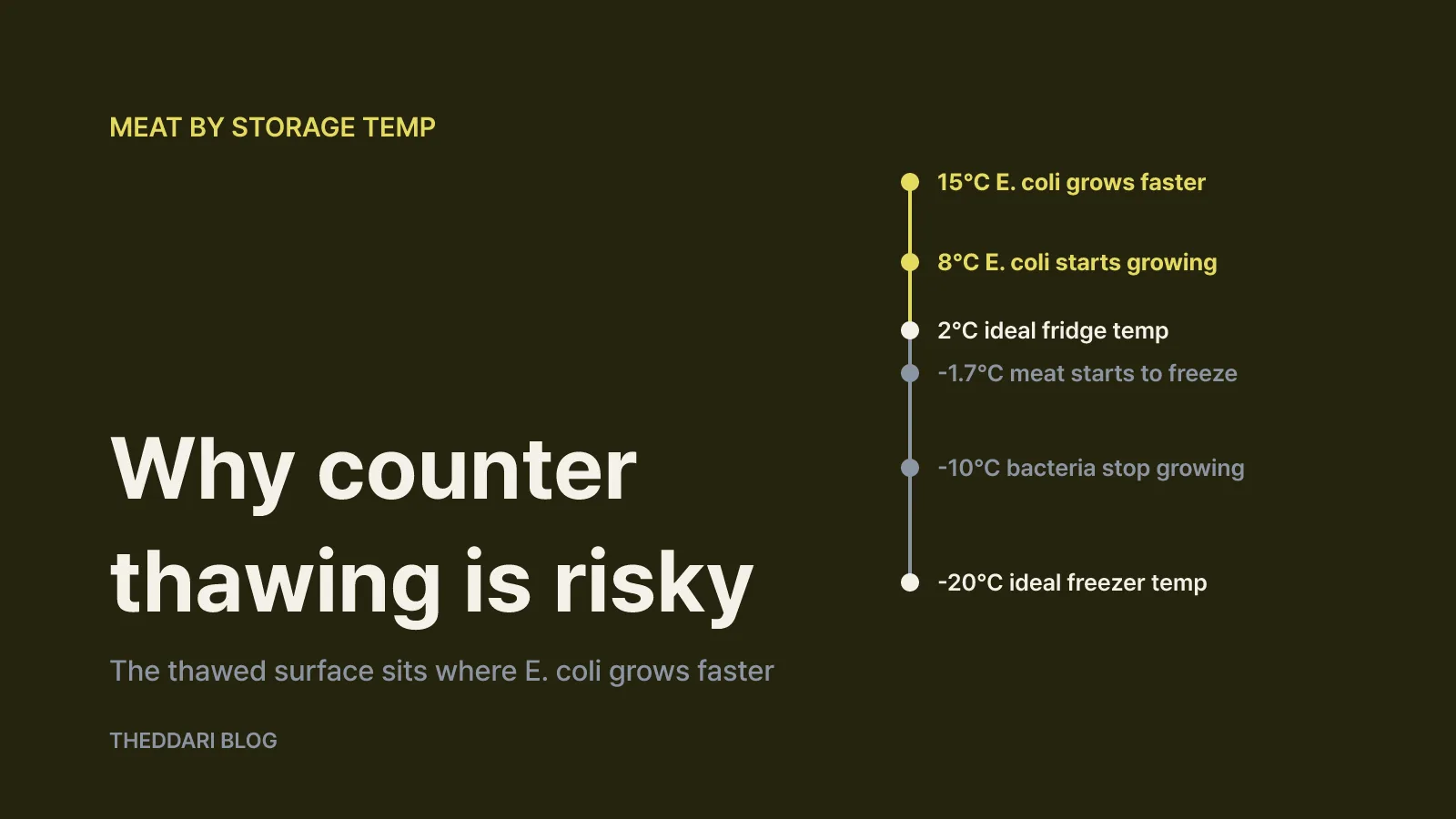
The Korean quarantine agency's temperature table makes the same point in Celsius:
- -20°C: proper frozen storage temperature
- -10°C: bacterial growth stops
- -1.7°C: meat begins to freeze
- 2°C: proper refrigerated storage temperature
- 8°C: pathogenic E. coli starts to grow
- 15°C: pathogenic E. coli grows faster
A heated kitchen is usually well above 15°C, so a slowly thawing surface spends hours in the range where growth speeds up. FSIS says perishable food should never sit at room temperature for more than two hours, and it rules out thawing on the counter, in hot water, or in a garage, basement, car, dishwasher, plastic garbage bag, outdoors or on the porch. A cold porch in winter may seem like a natural fridge, but sun and daytime warming make its temperature unpredictable.
A useful way to choose a method is to ask how long the surface of the meat will spend above refrigerator temperature, not how fast the whole piece will thaw.
Can you refreeze thawed meat?
The answer depends on how it was thawed and whose guidance you follow.
USDA FSIS (United States):
- Meat thawed in the refrigerator can be refrozen without cooking, although some quality may be lost.
- Meat thawed in cold water or in the microwave should be cooked before refreezing.
MFDS (South Korea): Korea's food safety ministry is stricter for households. In its 10-question explainer, it states that the general ban on refreezing thawed frozen food remains in place. A 2022 change allowed only manufacturers, processors and specialist repackers to briefly part-thaw large frozen ingredients, divide them in a clean area and refreeze them immediately. Supermarkets and other retailers may not thaw, split and refreeze products for sale. For home cooks, MFDS says repeated thaw-refreeze cycles are inappropriate and food thawed at room temperature or in a microwave should be used promptly. Its February 2026 holiday food poisoning checklist repeats the same one-line rule: no refreezing after thawing.
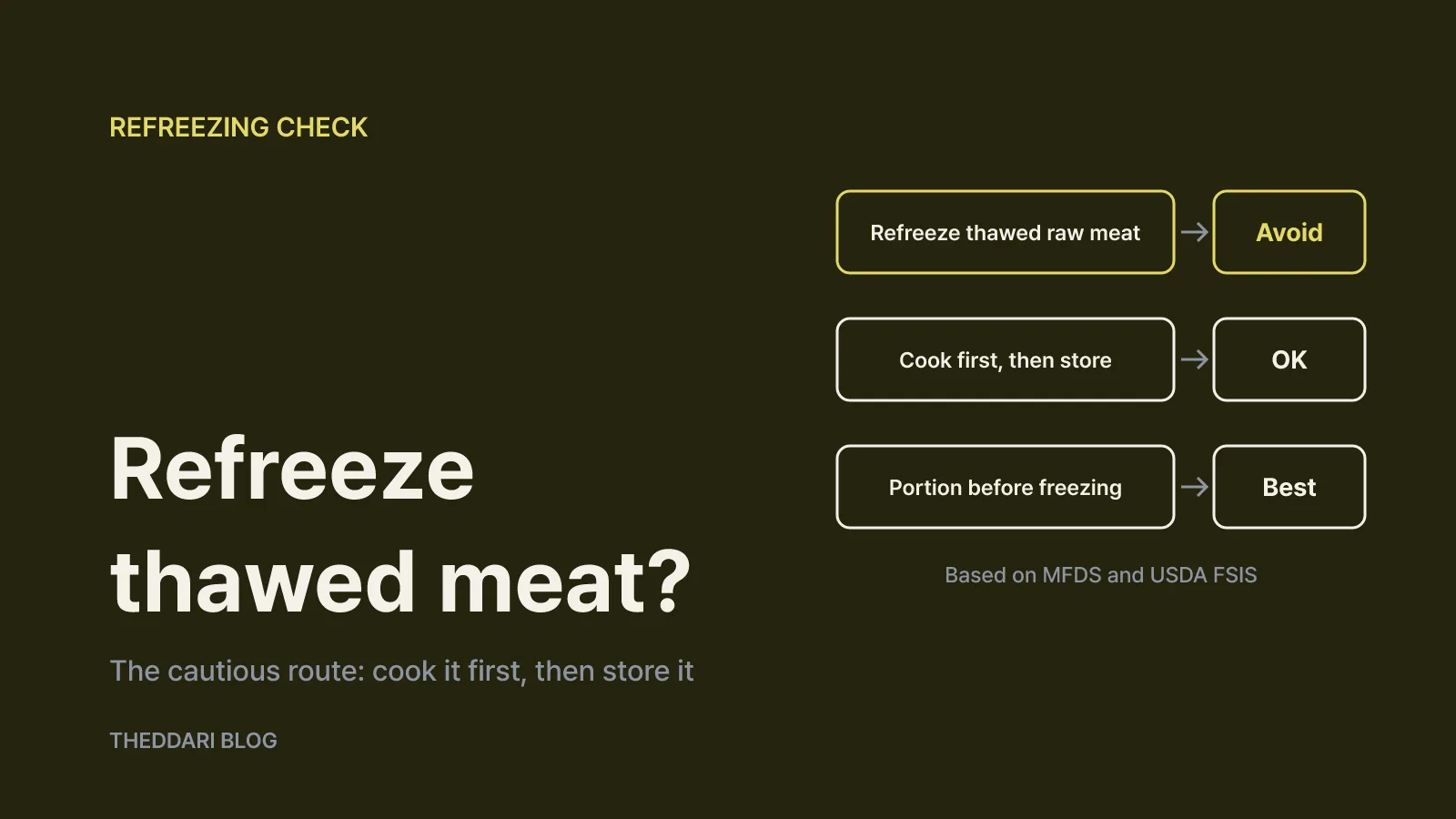
Putting the two together, a cautious home routine looks like this:
- Avoid refreezing raw meat after it has thawed, especially if it was thawed outside the fridge.
- If you have leftovers from a thawed package, cook them first, cool them quickly and refrigerate or freeze the cooked dish.
- Thaw only what you plan to cook, particularly with cold water or the microwave.
Quality is another reason to limit cycles. The Korean quarantine agency notes that even frozen meat can lose weight through discoloration, protein changes and drying, so long storage is best avoided.
Portion before you freeze
Most thawing problems are decided when the meat goes into the freezer. MFDS's own reasoning for allowing businesses to split large frozen blocks is that small frozen portions are safer than keeping a big thawed block in the fridge for days. The same logic works at home.
- Freeze in meal-sized portions. Press the meat flat in its bag. Thin, flat packs thaw much faster in the fridge or in cold water, and you only take out what you need.
- Shop cold food last. The Korean checklist suggests picking up shelf-stable items first, then chilled, then frozen, and finishing grocery shopping within an hour.
- Label each bag. Write the cut and the freezing date so older packs get used first.
- Keep raw meat separate. Wash your hands after handling raw meat and use separate knives and cutting boards for meat and vegetables.
Finally, check the meat once it has thawed. An unusual smell or a sticky surface is a reason not to use it. If dinner tomorrow involves something from the freezer, the easiest safety step is to move it to the bottom shelf of the fridge tonight.