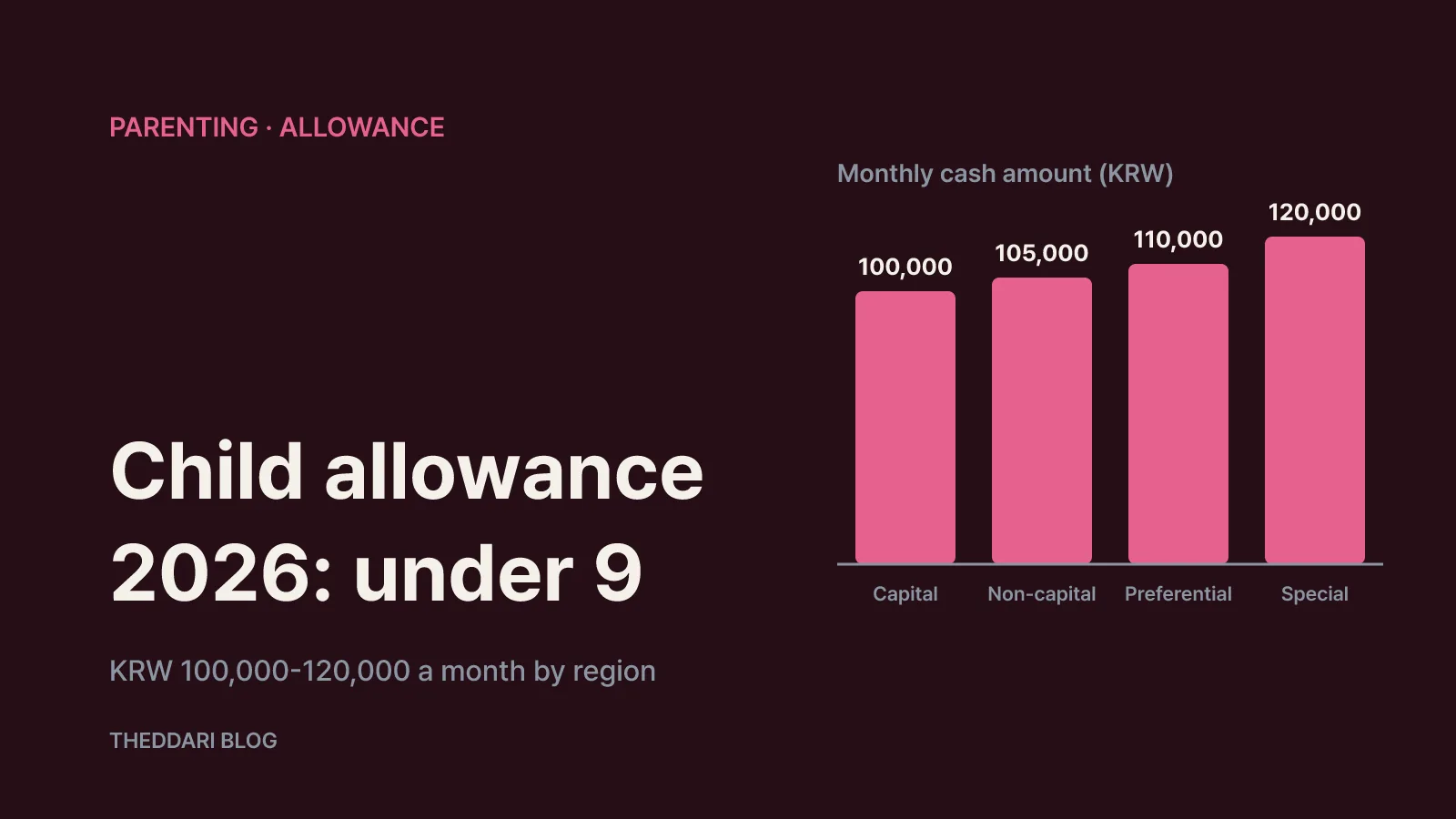
As of November 2026, South Korea's child allowance (아동수당, adong sudang) is paid on the 25th of every month to children under 9, and the monthly amount now depends on where the child lives: KRW 100,000 in the Seoul capital area, KRW 105,000 elsewhere, KRW 110,000 in designated preferential population decline areas and KRW 120,000 in special population decline areas. These changes come from an amendment to the Child Allowance Act promulgated on March 20, 2026, and were applied from the April 24 payment, backdated to January (Ministry of Health and Welfare, April 23, 2026). If you have a newborn, the single most important rule is to apply within 60 days of birth so the payment starts from the month the baby was born.
This guide is based on two Ministry of Health and Welfare press releases and the Government24 benefit page for the allowance. It is written for parents living in Korea, including foreign parents whose child holds Korean nationality.
Who qualifies for the child allowance in 2026
Before the amendment, the allowance paid KRW 100,000 a month to children under 8. The new law raises the age ceiling by one year every year until it reaches 13 (Ministry of Health and Welfare, March 20, 2026):
- 2026: under 9
- 2027: under 10
- 2028: under 11
- 2029: under 12
- 2030: under 13
The ministry described it as the largest age expansion since the program started in 2018 for children under 6, and the first time the payment amount has gone up.
In practice, the children who came back into the program this year were those born between January 2017 and March 2018 whose payments had stopped at their eighth birthday. They received the missed January to March 2026 payments together with the April payment. Of roughly 450,000 children in that birth range, about 430,000 were paid KRW 168.7 billion in back payments; children abroad for 90 days or more and those whose payment details could not be confirmed were left out at that stage. In total, 2.55 million children received KRW 389.2 billion in April.
Age is not the only requirement. According to the Government24 benefit page, the child must hold South Korean nationality and have a properly issued resident registration number. A child of foreign parents qualifies if the child is a Korean national. Dual nationals and children recognized as refugees under the Refugee Act are also covered. There is no income or asset test, and the allowance is paid regardless of whether the family also receives childcare fee support or a home-care allowance.
One caution: when we checked, the Government24 page still showed "under 8" in its eligibility field and listed a last update of February 20, 2026, which predates the amendment. Use the ministry's post-amendment announcements for age and amounts, and Government24 for application channels and documents.
Monthly amounts by region
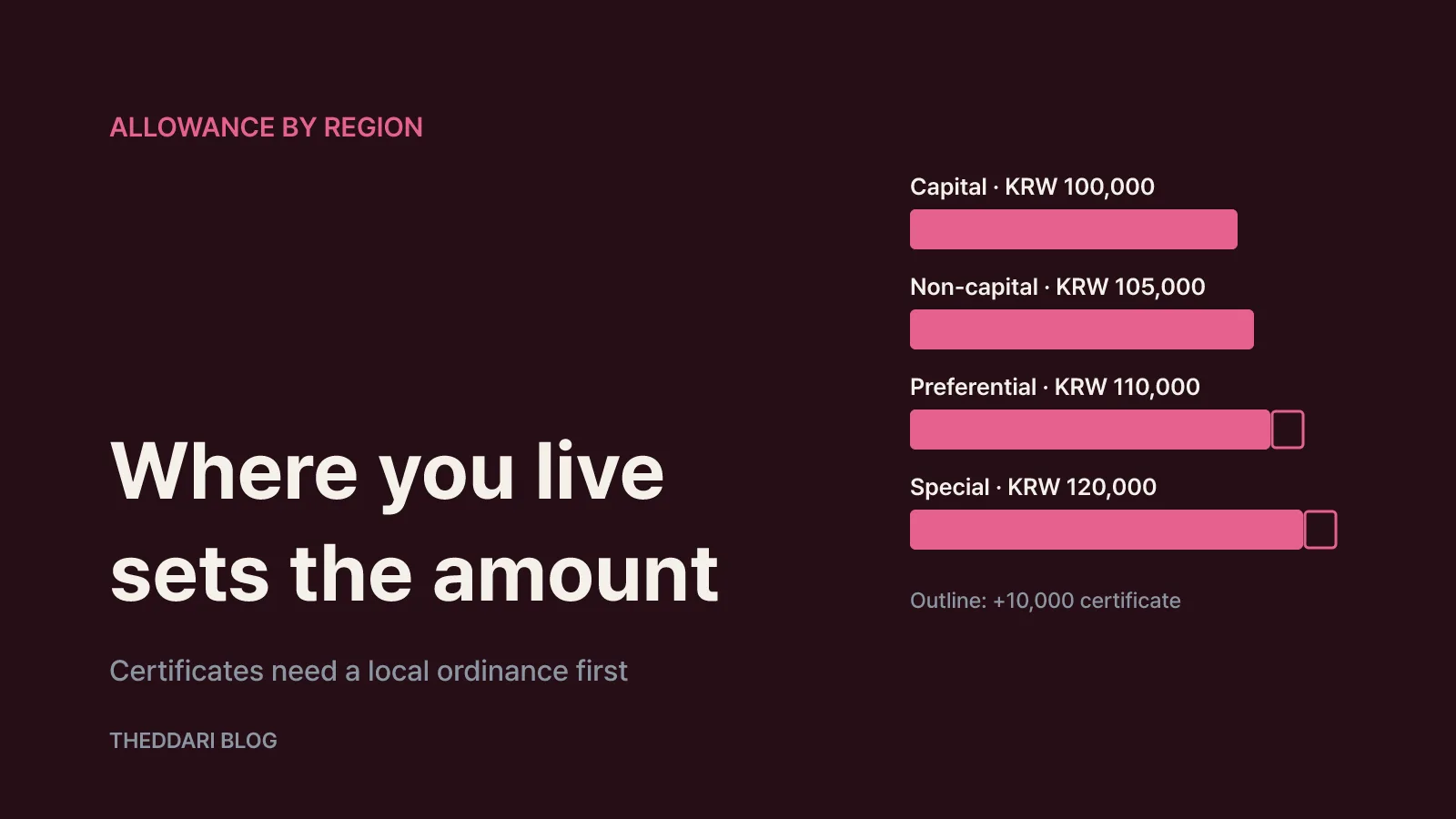
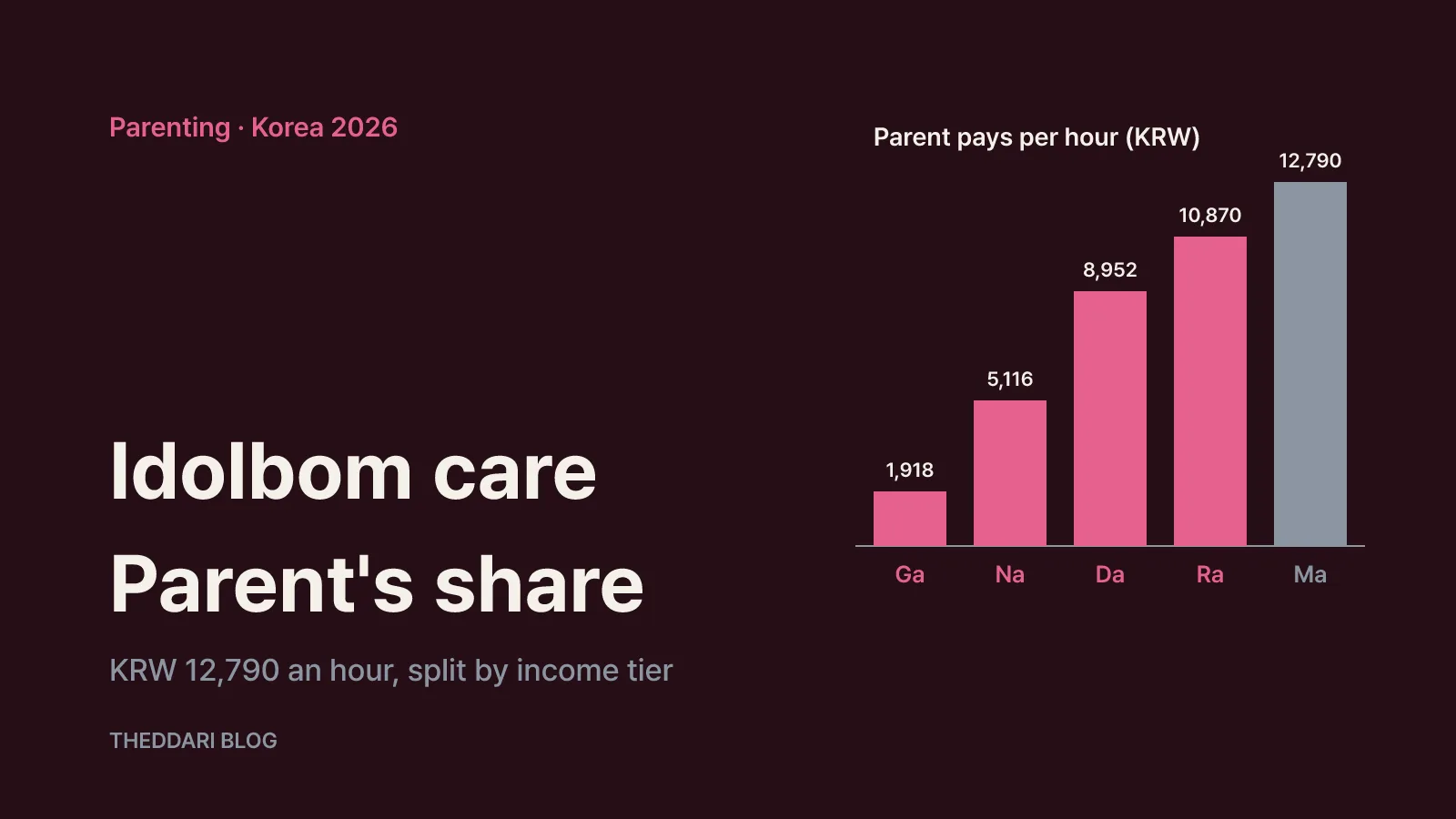
From 2026, the same allowance pays different amounts depending on the child's area of residence. There are four tiers:
← Swipe to see more
| Area of residence | Cash | Local gift certificate |
|---|---|---|
| Seoul capital area | KRW 100,000 | Not applicable |
| Outside the capital area | KRW 105,000 | Not applicable |
| Population decline area (preferential) | KRW 110,000 | KRW 120,000 |
| Population decline area (special) | KRW 120,000 | KRW 130,000 |
The regional top-up ranges from KRW 5,000 to KRW 20,000 a month. In population decline areas, an extra KRW 10,000 is added when the allowance is paid in local gift certificates rather than cash, for a maximum of KRW 130,000. That option is not automatic: each local government has to gather residents' views and pass or revise an ordinance first. Ask your local community service center whether your city or county has started paying in certificates.
The regional top-ups were also backdated to January 2026. In the ministry's example, children born from January 2017 to January 2018 received a base KRW 400,000 in April (four months) plus KRW 0 to 80,000 in regional top-ups, for KRW 400,000 to 480,000 in total. Those born in February 2018 received KRW 300,000 to 380,000, March 2018 births received KRW 200,000 to 280,000, and children born from April 2018 onward received KRW 100,000 to 180,000. The example assumes no change of address between January and April. From May, the amount depends only on the area of residence and the payment method, not the birth month.
Because the figures depend on where the child lives, moving to a different area can change later payments. If a deposit looks wrong after a move, first check that your address change has been reflected.
How to apply
You can apply at any time after registering the birth. There are two routes:
- Online through the Bokjiro portal or its mobile app, or through Government24. Online applications are only available when the child's guardian is a parent.
- In person at any community service center (읍면동 행정복지센터), such as the one for the child's registered address. Grandparents, foster parents and other non-parent guardians must apply in person.
For an in-person visit, bring the application form and the applicant's ID. A proxy needs a letter of authorization, their own ID and a copy of the guardian's ID.
The 60-day rule: if you apply within 60 days of birth, counting the day of birth, payments are backdated to the month of birth. Apply later and payments start only from the month of application, so a delayed application can cost several months of payments.
Families whose payments stopped for children born January 2017 to March 2018 did not need to reapply. The ministry sent text messages based on the latest payment details; parents replied "1" to 044-865-0346 if nothing had changed, or asked their community service center to update the guardian or bank account. Children whose details were not confirmed in April were to receive missed payments once confirmed, so contact your community service center or the 129 welfare call center if you are still waiting.
Payment dates and when payments stop
Payments arrive on the 25th of each month, starting from the month of application. If the 25th falls on a weekend or public holiday, the money is paid the day before. Under that rule, November 25, 2026 is a Wednesday, while December 25 is Christmas Day, so the December payment should arrive on December 24. Payment is in cash by default, though local governments may pay in local currency by ordinance.
The main reason payments stop is time abroad: if a child stays outside Korea for 90 days or more, counting the day of departure, payments are suspended. Families planning a long overseas stay should count the days from departure.
Watch for phishing as well. The ministry says its texts about the allowance contain no links and never ask you to install an app. Ignore any message offering an "expanded allowance application" with a link, and check directly on Bokjiro or at a community service center.
Quick checklist for families
- Was your child born in January 2017 or later? Under the ministry's examples, the child is covered in 2026.
- Which of the four regional tiers applies to where your child lives?
- In a population decline area, does your local government pay in gift certificates with the extra KRW 10,000?
- For a newborn, apply within 60 days of birth.
- Update the guardian or bank account if either has changed.
- Check the 90-day rule before any long trip abroad.
The age ceiling rises to under 10 in 2027. Since the threshold changes every year, check the ministry's notice early each year.