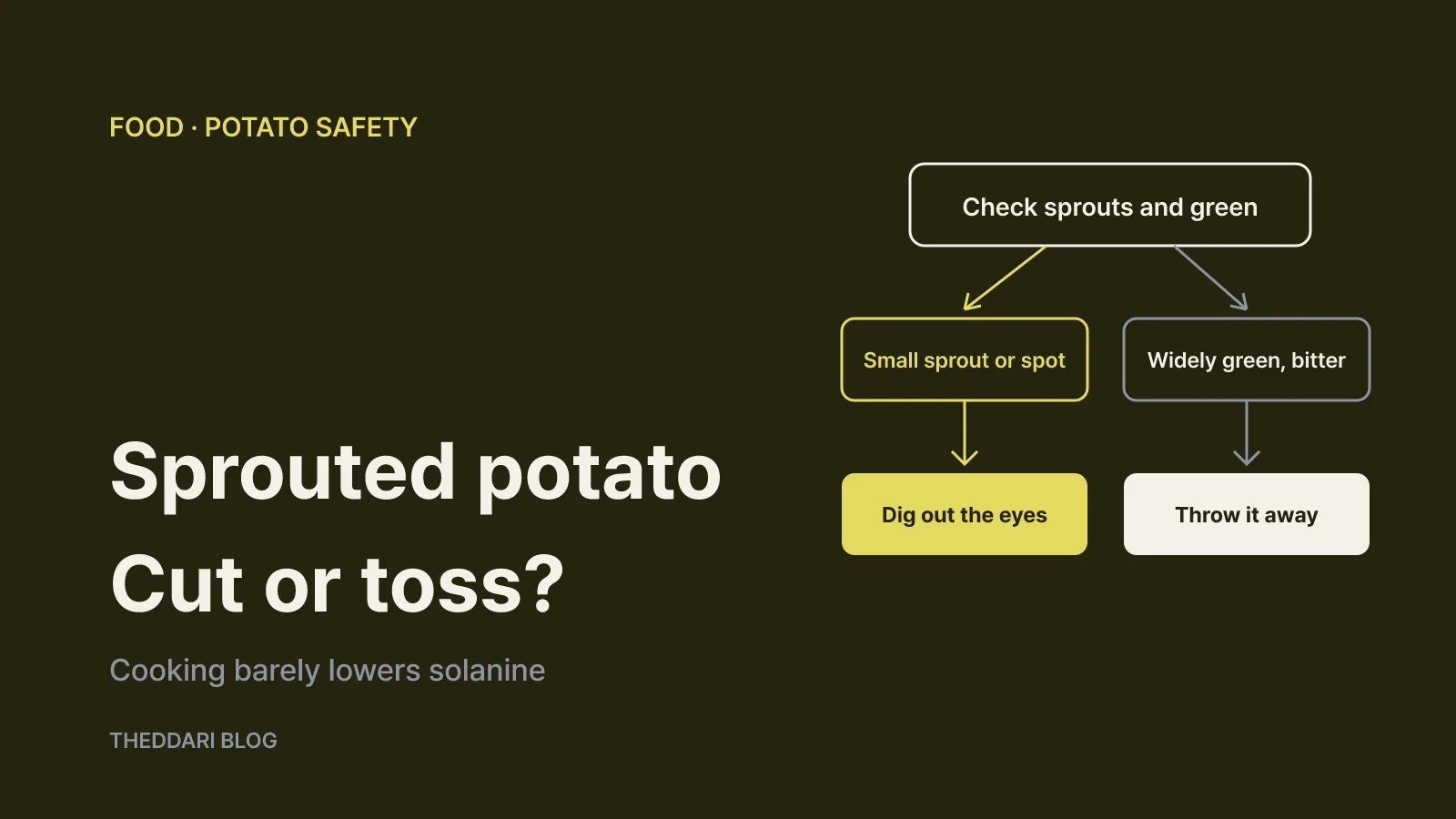
As of November 2026, the guidance from food safety agencies in Korea, Canada and Germany points to the same practical answer. A potato with a few fresh sprouts or a small green patch can usually be eaten once you peel it and cut out the sprouts, the eyes they grow from and every trace of green. A potato that is green over a large area, heavily sprouted, shriveled, rotting or bitter-tasting should be thrown away. The reason is solanine, a natural toxin that cooking does not reliably destroy, so "I'll just boil it longer" is not a fix.
Below I walk through where solanine collects, the limits agencies use, how to trim a potato properly, how to store potatoes so they do not sprout in the first place, and which symptoms matter if someone has already eaten a bad one. Figures are taken directly from the agency documents linked in each section.
Where solanine hides in a potato
All potatoes contain small amounts of natural compounds called glycoalkaloids. Germany's Federal Institute for Risk Assessment (BfR) names the two main ones as alpha-solanine and alpha-chaconine; "solanine" is the everyday shorthand. Plants in the nightshade family make them as a defense against pests and germs. At low levels they simply contribute to the familiar potato flavor.
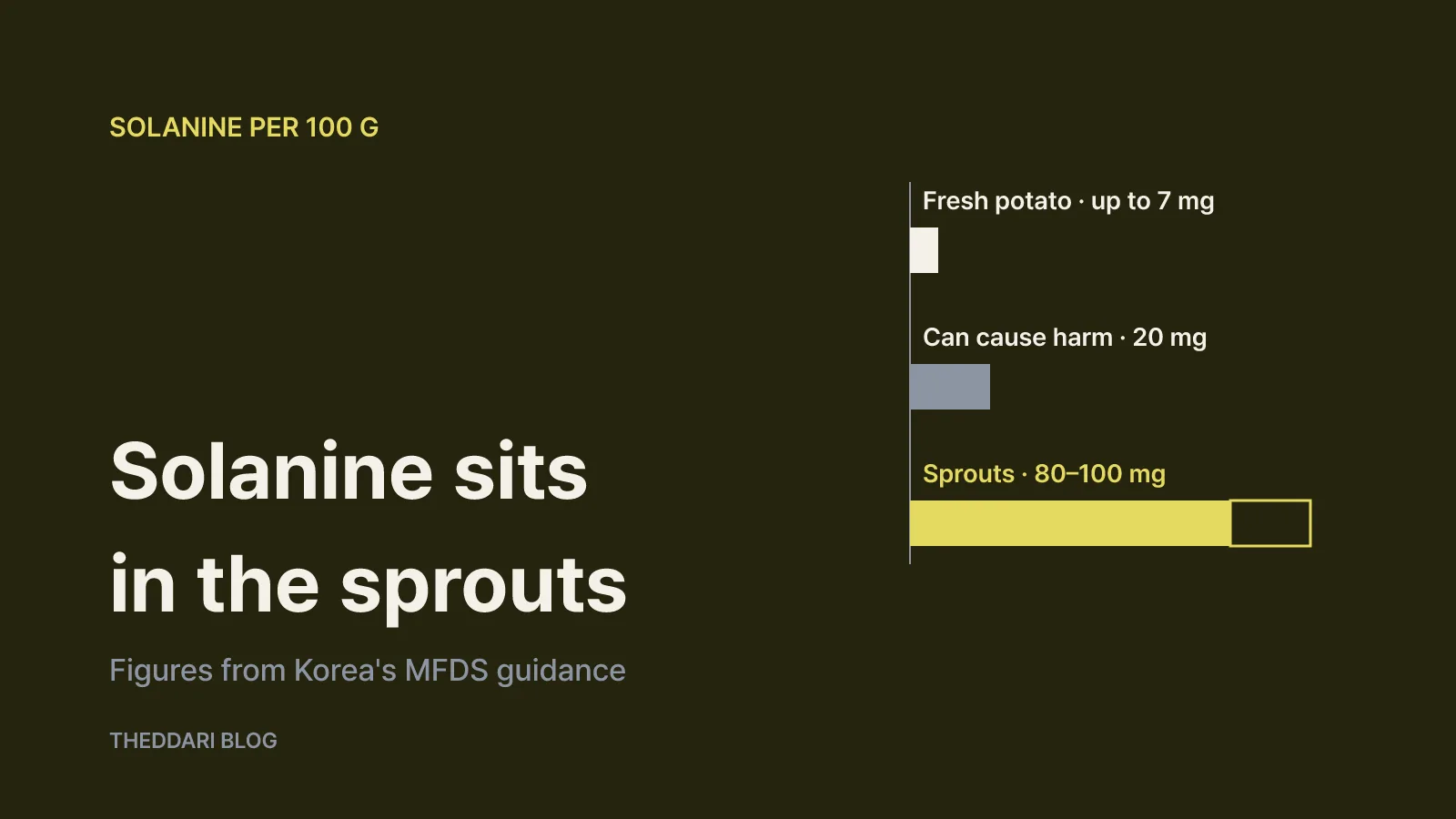
The problem is concentration. Korea's Ministry of Food and Drug Safety (MFDS) explains that solanine is highest in the sprouts, lower in the skin and lowest in the flesh. According to the same guidance, a fresh, normal-sized potato contains up to 7 mg of solanine per 100 g, which is not harmful, while potato sprouts contain roughly 80–100 mg per 100 g. MFDS considers 20 mg or more per 100 g of potato to be a level that can cause harm.
Other regulators draw a similar line. Health Canada sets a health-based maximum of 20 mg total glycoalkaloids per 100 g of fresh potato for all potatoes sold commercially in Canada. BfR notes that up to 200 mg per kg (the same figure expressed per kilogram) has long been considered safe, but it now recommends a stricter provisional target of less than 100 mg per kg for table potatoes. Properly grown, harvested and stored potatoes usually fall between 20 and 100 mg per kg.
In other words, a healthy potato sits well under the limit, while the sprouts sit several times over it. That is why removing the sprout together with its eye is the heart of safe trimming.
Light matters too. Potatoes exposed to sunlight or indoor lighting turn green, and both MFDS and BfR describe green areas as a sign of elevated solanine. Health Canada adds bruising and other physical damage to the list of changes linked with higher glycoalkaloid levels.
Eat, trim or toss: how to decide
Usually fine after generous trimming
- A firm potato with sprouts just beginning to emerge from the eyes
- A small green patch while the rest of the skin looks normal
- One or two minor cuts or bruises
MFDS says a sprouted potato is safe once the sprouts are cut out, as long as no part of the eye is left behind, and that green areas must be removed just as thoroughly.
Better thrown away
- Long, numerous sprouts and a soft, wrinkled tuber
- Green skin over a large area or the whole potato
- Old, dried-out potatoes or any with rot
- Any potato that tastes bitter or causes a burning feeling in the mouth
BfR states that old, dried-up, green or strongly sprouting potatoes are not suitable for eating. Health Canada advises cutting away green, damaged, rotting or sprouting parts and, in severe cases, discarding the entire potato. The wording differs slightly, but the principle is the same: trim small problems generously; toss potatoes where the problem has spread.
Taste is your final check. Both Health Canada and BfR say not to eat raw or cooked potatoes that taste bitter or burn. If a finished dish tastes oddly bitter, stop eating it.
How to cut out sprouts, eyes and green spots
- Wash, then peel. The skin holds more solanine than the flesh, so do not cook a sprouted or greened potato with the skin on.
- Dig out each sprouted eye with the tip of a knife or the scoop on your peeler. Snapping off the sprout alone leaves the eye behind.
- If the flesh under the peel is still greenish, cut that area away thickly until no green remains.
- Remove any soft or discolored spots you find along the way.
If you prefer skin-on potatoes, use only fresh, undamaged ones. BfR recommends that young children in particular eat only peeled potatoes, and it considers snacks made mainly of potato peel unsuitable.
One trap to avoid: green color can fade when a potato is moved back into the dark. Health Canada warns not to assume glycoalkaloid levels have dropped just because the green has faded.
Cooking does not destroy solanine
Health Canada states that baking, boiling, frying and microwaving do not significantly reduce glycoalkaloid levels. Trimming before cooking is the only dependable step.
BfR notes that some glycoalkaloids pass into boiling water, so it advises against reusing the water potatoes were boiled in, for example as a soup base. If you deep-fry potatoes often, it also recommends changing the frying fat regularly.
Prevention starts at the store. Korea's Rural Development Administration (RDA) suggests choosing smooth, firm potatoes with few blemishes and skipping any with green skin. Potatoes that feel light, look dark or are wrinkled have lost moisture and taste worse.
Storage that keeps potatoes from sprouting and greening
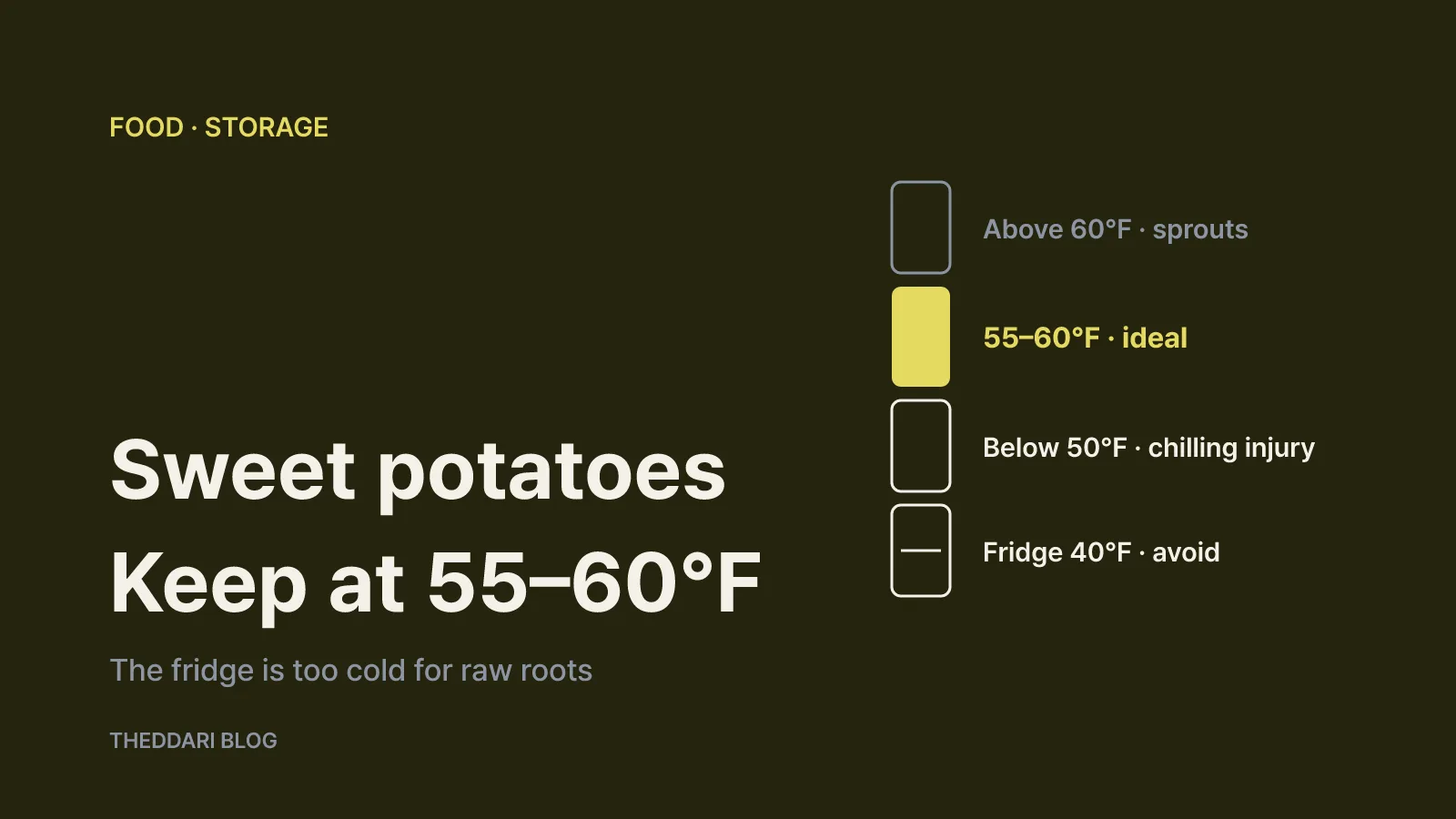
The simplest way to limit solanine is to stop sprouting and greening before they start. Health Canada and BfR both recommend a cool, dry, dark place. RDA is more specific: rather than the refrigerator, keep potatoes around 10°C (50°F) in a cool storeroom or similar space, inside a cardboard box that blocks light.
Why not the fridge? RDA explains that at typical refrigerator temperatures of about 4°C (39°F), starch converts to sugar faster. Those potatoes lose their fluffy texture when boiled and brown quickly when fried. That is a quality issue rather than a toxin issue, but it is why a cool room beats the fridge for longer storage. In late autumn and winter an unheated porch or balcony can get colder than you expect, so check with a thermometer.
- Use a paper box or dark bag to block light and keep humidity steady, and punch a few air holes (RDA).
- MFDS suggests adding an apple or two: ethylene from the fruit helps suppress sprouting, and it says one apple can cover about 10 kg of potatoes.
- Keep potatoes away from onions; MFDS notes that storing them together makes both spoil faster.
- Handle potatoes gently, since bruising is one of the changes linked with higher glycoalkaloids.
- Buy smaller amounts more often so potatoes have less time to sprout.
Symptoms to watch for after eating a bad potato
Serious poisoning is rare. BfR reports that only a few cases from potato dishes have been documented in the last 100 years and no deaths in the last 50 years, possibly because the bitter taste makes people stop eating early. It adds that the real number may be higher because the symptoms are non-specific.
Health Canada describes a bitter or burning sensation in the mouth followed by flu-like symptoms: nausea, vomiting, stomach cramps and diarrhea. Severe cases can involve drowsiness, apathy, restlessness, shaking, confusion, weakness and disturbed vision. MFDS lists vomiting, dizziness and an itchy throat, with breathing difficulty in severe cases, and BfR mentions occasional fever.
If symptoms appear after eating sprouted or green potatoes, keep any leftovers to show a clinician, and seek emergency care right away for trouble breathing or confusion. Because BfR expresses its safety threshold per kilogram of body weight, small children can be affected by a smaller amount than adults.
Quick checklist
- Fresh sprouts: dig out the eyes deeply and peel.
- Small green spot: cut until no green remains.
- Widely green, heavily sprouted, shriveled or rotting: throw it away.
- Bitter or burning taste: do not eat it, raw or cooked.
- Cooking water: do not reuse it.
- Storage: cool, dark and dry, around 10°C (50°F), away from onions.