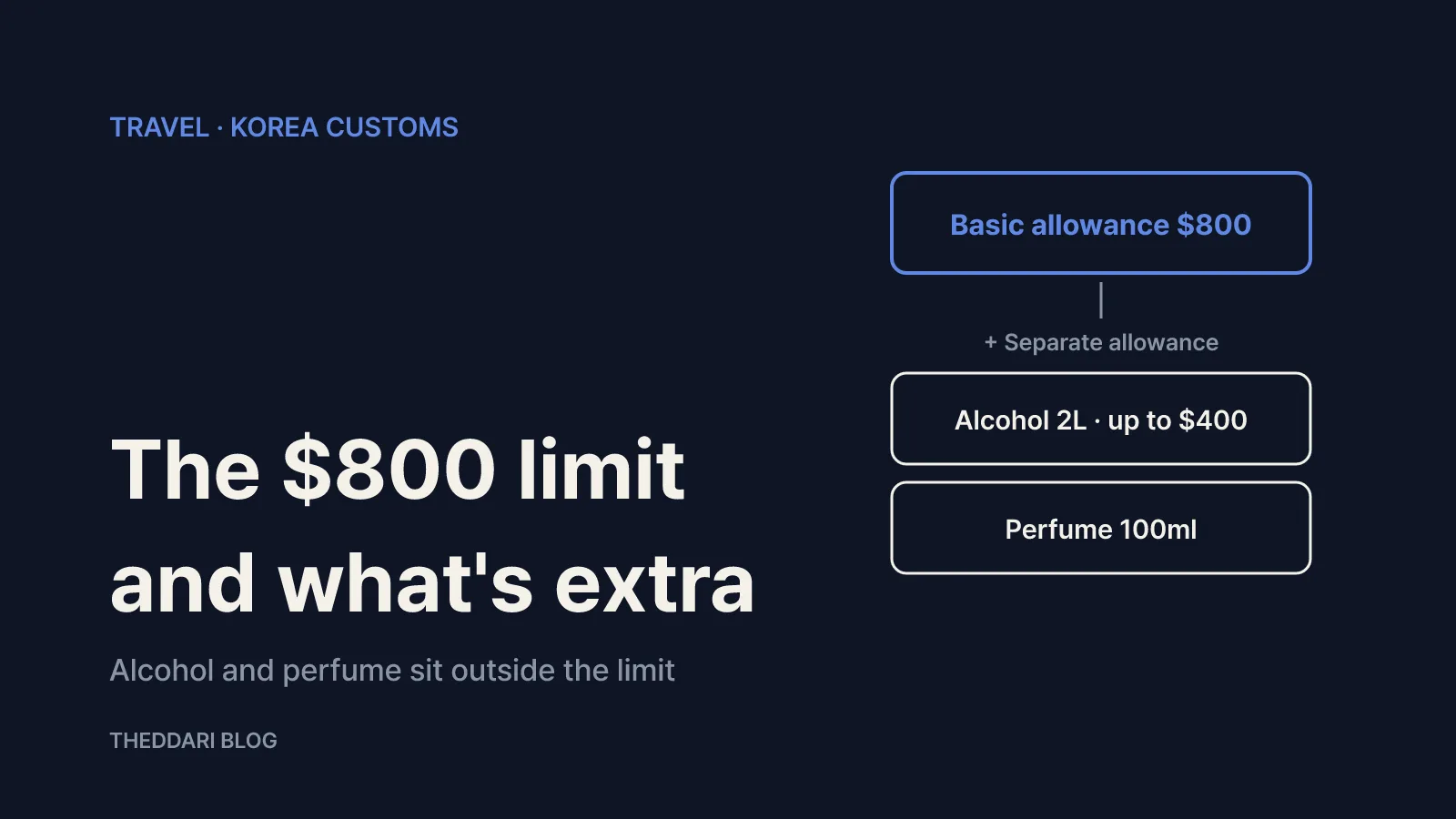
As of November 2026, every traveler arriving in South Korea can bring in goods worth up to US$800 per person without paying duty. On top of that, there is a separate allowance for alcohol (up to 2 liters in total and no more than $400 in total value), 100ml of perfume and 200 cigarettes. If your goods go over these limits you must declare them. Declaring voluntarily cuts the customs duty by 30% (capped at ₩200,000), while being caught without declaring adds a penalty of 40% of the tax owed, or 60% for repeat offenders (Korea Customs Service, Seoul office; KCS tax estimator).
These rules apply to anyone entering Korea by plane or passenger ship, whether you live in Korea and are coming home from a trip or you are visiting. The details below come from the Korea Customs Service (KCS) guidance and the Notice on Customs Clearance of Travelers' Personal Effects, last amended on April 1, 2026 (full text on the National Law Information Center).
What counts toward the $800 limit
The $800 basic allowance is a single total across everything you acquired abroad. Under the Notice, that includes:
- Items bought in shops overseas
- Gifts you received for free
- Items bought at Korean duty-free shops (downtown or departure-area stores) before you left and are now bringing back
- Items bought at the arrival duty-free shop at Incheon Airport
A common misunderstanding is that duty-free shop purchases are already tax-free. They were sold with tax suspended because they were meant for use abroad. Korea abolished the purchase cap for departing residents on March 18, 2022, so you can buy as much as you like, but the amount you can bring back tax-free is still $800 (Easy Law, Ministry of Government Legislation).
The test is the combined value. If you bought three items for $200, $400 and $500, none of them individually exceeds $800, but the total of $1,100 does, so you must declare.
Some things sit outside the limit entirely. Personal clothing and toiletries you took with you are exempt. So are items you registered with customs on departure and are bringing back. For non-residents, cameras, laptops, mobile phones and similar items currently in use are also exempt. Agricultural, livestock and fishery products, including herbal medicine ingredients, count toward the $800, but they have their own caps of 40kg in total and ₩100,000 in overseas purchase value, and they must pass quarantine where required. Meat products and fresh fruit can be refused regardless of value.
Alcohol, perfume and tobacco have their own allowance
Alcohol, tobacco and perfume are excluded from the $800 basket and get a separate allowance instead. That means you can bring $800 of shopping plus a bottle of whisky and a bottle of perfume, and still owe nothing if each stays within its limit. The KCS arrival duty-free page gives the example of a $500 bag, $290 of clothing, $330 of alcohol and $50 of perfume: $1,170 in total, yet allowed, because the alcohol and perfume fall under the separate allowance (KCS arrival duty-free guidance).
← Swipe to see more
| Item | Separate allowance | Watch out for |
|---|---|---|
| Alcohol | Up to 2L in total and up to $400 in total value | Both conditions must be met |
| Perfume | 100ml (or equivalent: 100g, 3.4oz) | Measured by volume, not bottle count |
| Cigarettes | 200 sticks | Only one type of tobacco is exempt |
| Cigars | 50 | Same one-type rule |
| E-cigarettes | 200 heated sticks, 20ml of nicotine liquid, or 110g of other types | Liquid must be under 1% nicotine |
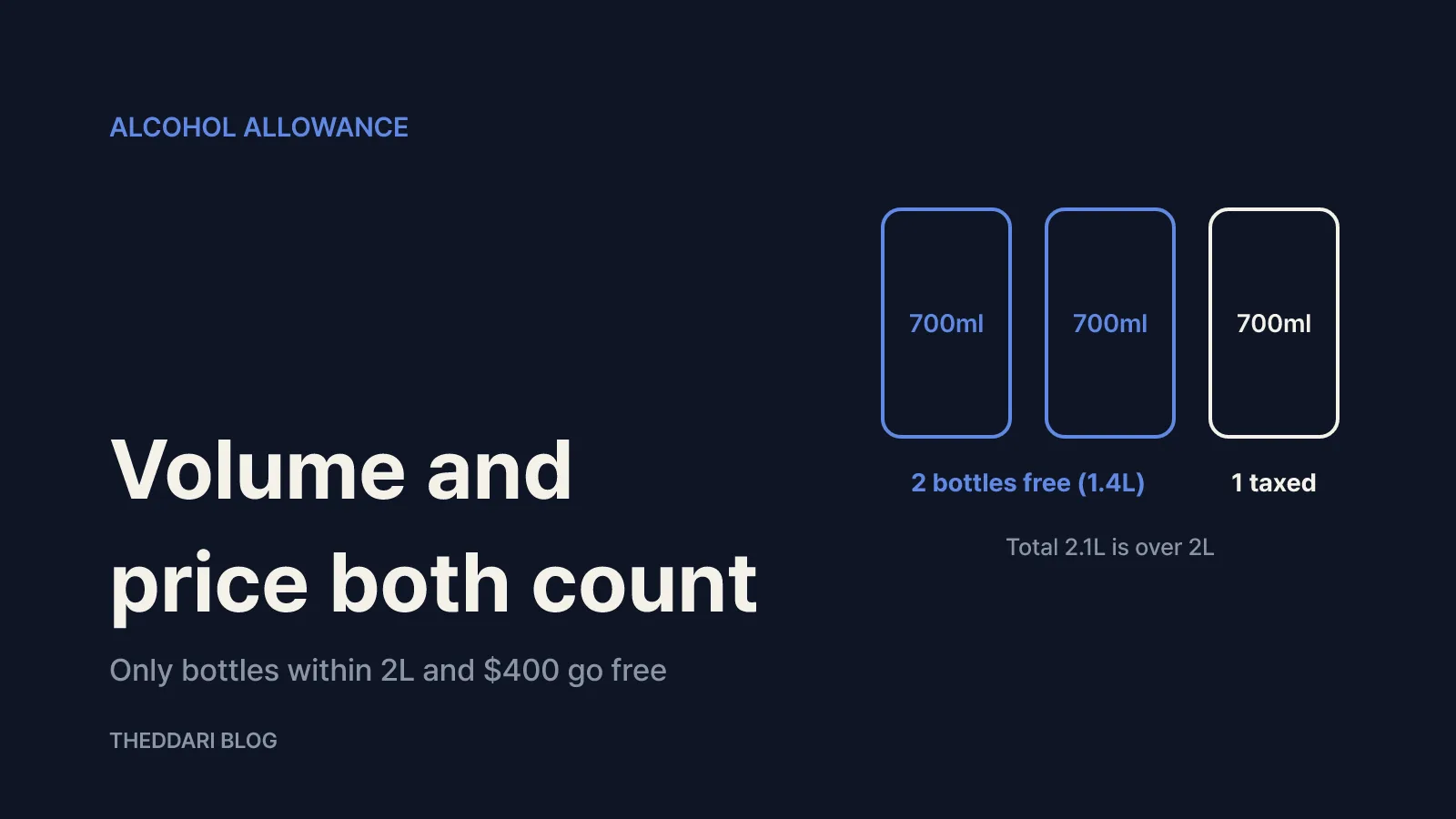
Alcohol is checked on volume and price together. Three 700ml bottles add up to 2.1L, which is over 2L. The Notice says bottles that fit within the allowance are exempt bottle by bottle, and any bottle in the excess band is taxed on its full price. So two bottles (1.4L) go through free and the third is taxed in full. The same logic applies if your bottles are under 2L but together cost more than $400. Free miniature bottles you received as gifts still count.
There is an age rule too. Travelers under 19 get no alcohol or tobacco allowance at all. Korea counts this by birth year: if you have reached January 1 of the year you turn 19, the allowance applies. Any alcohol or tobacco carried by a younger traveler must be declared.
How tax is calculated when you go over
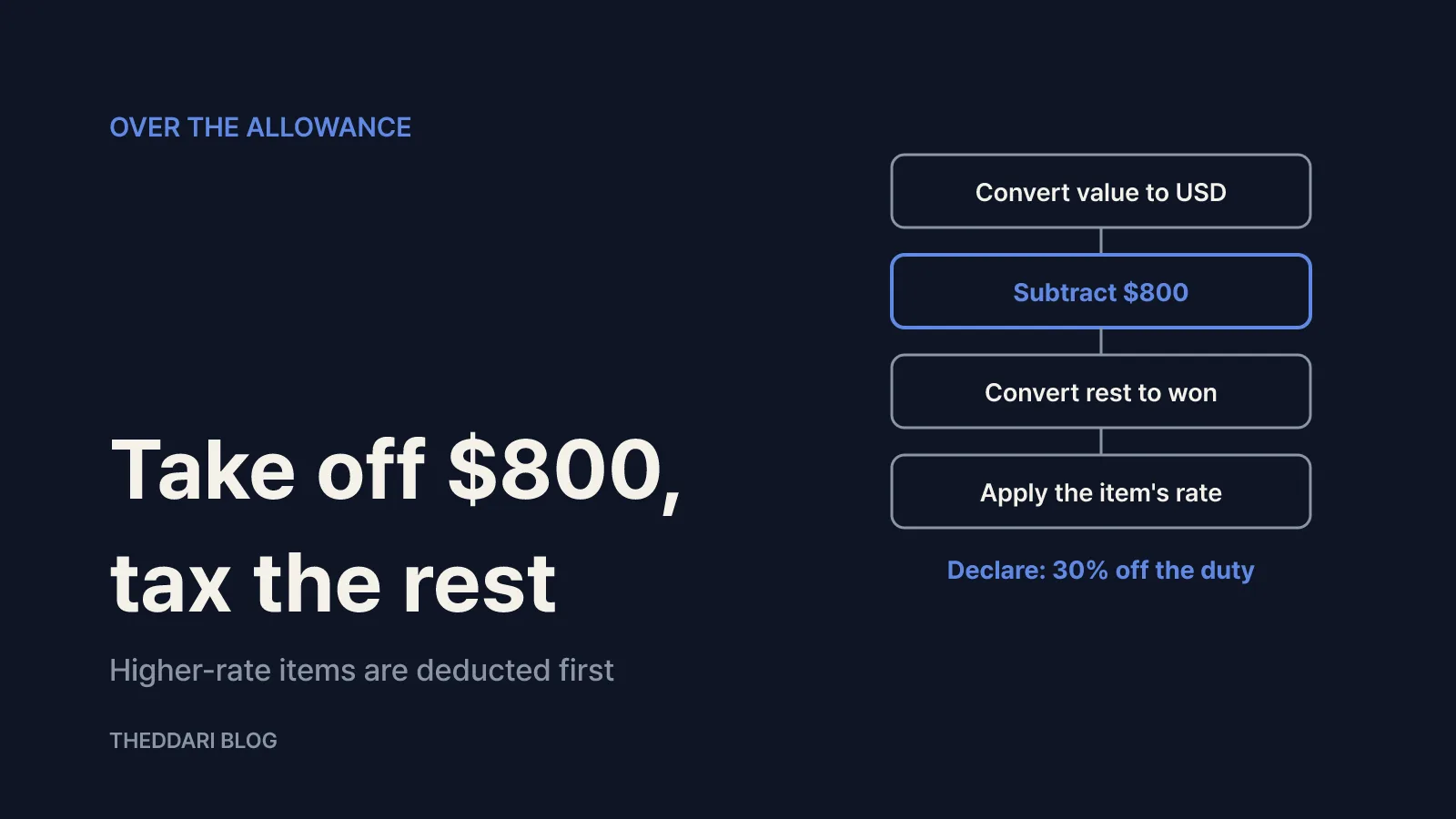
The Notice sets out the order of the calculation: convert the declared value to US dollars, subtract $800, convert the remainder to Korean won, then apply the rate for that type of item. Your receipt price is normally accepted as the purchase price. Even without a receipt, customs generally accepts the declared value unless it looks unusually low, but keeping receipts makes this much easier.
When you carry several items, the order in which the $800 is applied matters. Domestic goods bought at the arrival duty-free shop are deducted first, then items with the highest tax rate. KCS gives this example: a $800 bag from a downtown duty-free shop and $800 of clothing bought overseas. Because the simplified rate is 25% for clothing and 20% for bags, the clothing is deducted first and only the bag is taxed. If you also bought $800 of Korean cosmetics at the arrival duty-free shop, the cosmetics are deducted first and both the bag and the clothing are taxed.
Then comes the reward for honesty. If you declare voluntarily, 30% of the customs duty is waived, up to ₩200,000. The KCS online estimator lets you enter your date of birth, the number of family members and item prices to preview the tax with the $800 deduction and 30% reduction applied. Treat the result as an estimate, because exchange rates and tax rates change.
If you walk through the "nothing to declare" lane and are caught, there is no reduction and a penalty of 40% of the tax owed (customs duty plus domestic taxes) is added. A second offense within two years raises that to 60%.
Can families combine their allowances?
Each person gets their own $800, so a family of four has four separate allowances. What you cannot do is pool them for one expensive item. Under Article 22(3) of the Notice, when two or more accompanying family members bring in a single item or set worth over $800, it is treated as brought in by one person. A $2,000 handbag gets only one $800 deduction, however many relatives are traveling with it.
"Accompanying family" means your spouse, and your or your spouse's lineal relatives and siblings, who live in the same household and arrive on the same flight or ship. One family member can file a single declaration for everyone. Children get the $800 basic allowance, but if they are under 19 they get no alcohol or tobacco allowance, so splitting extra bottles into a child's bag does not help.
How to declare at a Korean airport
If you have nothing to declare, you can skip the form and use the "nothing to declare" lane, though customs can still select you for an X-ray or bag check. If you do have something to declare:
- Declare on your phone. Use the KCS "Traveler Customs Declaration" (여행자 세관신고) app or web form before arrival. Mobile declarations can receive the tax notice and pay it on the phone.
- Or use the paper form. Fill in the traveler's customs declaration handed out on the plane and sign it. One form covers the whole family.
- Choose the right lane. Use the electronic declaration lane or the goods-to-declare lane. Travelers who declare are generally not inspected, although officers can still check bags if the declaration looks inaccurate or the bag carries a customs tag.
- Pay. Pay on the spot, or ask for deferred payment if customs is satisfied with your identity.
Officers compare your declaration with overseas card spending and your answers to their questions, so under-declaring is a real risk. Separately, cash or payment instruments over US$10,000 must be declared. Without the declaration certificate you may be unable to exchange the money at a Korean bank.
Quick checklist before your flight home
- Total value: Overseas buys + gifts + duty-free purchases on departure + arrival duty-free purchases. Is it over $800?
- Alcohol: Under 2L and under $400 in total, including miniatures?
- Perfume and tobacco: No more than 100ml of perfume and 200 cigarettes, and only one type of tobacco?
- Single big-ticket item: Over $800 means only one person's allowance applies.
- Receipts: Kept for every purchase?
- Food and farm products: Checked quarantine rules?
- Declaration: If you are over, declare through the app to secure the 30% reduction.
For item-specific rates or import requirements, the KCS customer center can be reached on 125 from within Korea. Allowances can change when the rules are amended, so check the KCS pages again shortly before you travel.