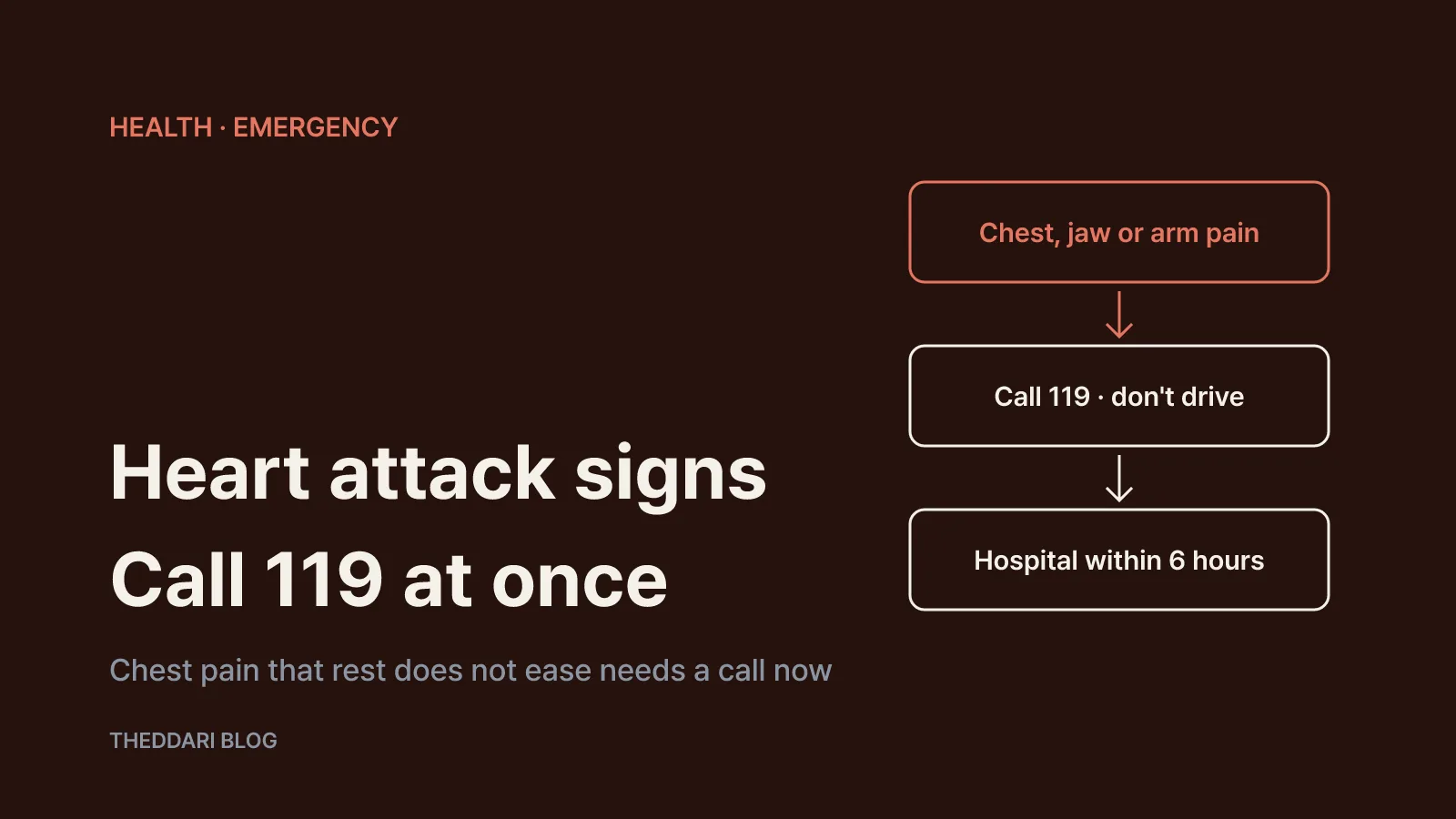
As of November 2026, Korea Disease Control and Prevention Agency (KDCA) lists four early warning signs of a heart attack: sudden severe chest pain, pressure or a crushing feeling; sudden severe pain or tightness in the jaw, neck or back; sudden severe shortness of breath; and sudden pain or discomfort in the arm or shoulder (KDCA press release, 10 February 2026). If any of these appear, the right move is to call emergency services straight away rather than waiting to see whether they fade. In Korea that number is 119. KDCA's National Health Information Portal explains that reaching hospital within 6 hours of onset helps limit heart muscle death, and reaching it within 12 hours makes successful recovery of the heart muscle possible (National Health Information Portal: acute myocardial infarction).
This guide is built mainly on Korean public health guidance, with the UK's NHS used for comparison where its advice adds useful detail (NHS: Heart attack). If you are reading this because someone has symptoms right now, stop and call your local emergency number first.
The four early warning signs of a heart attack
A heart attack (acute myocardial infarction) happens when a coronary artery, one of the vessels supplying the heart muscle, is suddenly blocked by a blood clot. The Korean portal notes that the early death rate is around 30%, and that even with active hospital treatment the in-hospital death rate reaches 5–10%. Recognising the symptoms is the first step of treatment.
KDCA's February 2026 release repeated the four signs:
- Sudden severe chest pain, pressure or a crushing sensation.
- Sudden severe pain or tightness in the jaw, neck or back.
- Sudden, marked shortness of breath.
- Sudden pain or discomfort in the arm or shoulder.
The word that links all four is sudden. Something unusual starting over a short period is the key signal. The portal describes typical pain as a squeezing, tightening or crushing feeling in the middle of the chest that lasts 30 minutes or more and does not improve with rest or with nitroglycerin placed under the tongue. The pain can spread to the neck, jaw, shoulder or left arm, and the person may turn pale and break into a cold sweat.
That 30-minute figure describes how heart attack pain behaves; it is not a waiting period. KDCA's response guidance specifically tells people not to assume symptoms will simply pass. If sudden chest pressure starts, make the call instead of timing it.
Awareness is still limited. The same release reported that in Korea's 2025 Community Health Survey, only 51.5% of adults recognised the early signs of a heart attack, roughly one in two. Talking through the list as a household is worthwhile.
Symptoms that are easy to miss, including indigestion
Not every heart attack begins with crushing chest pain. The Korean portal says symptoms sometimes appear only as breathlessness or dizziness, and that older adults or people with diabetes may feel nothing more than weakness, or have few clear symptoms at all.
The NHS broadens the picture with nausea or vomiting, a burning, full or bloated feeling like indigestion, sweating, and pale, blue or grey skin. On black or brown skin, it notes, colour change may be easier to see on the palms. This is why lying down with an antacid after a meal that "didn't sit right" can cost valuable time. Chest discomfort combined with sweating, breathlessness or a change in skin colour should be treated as an emergency.
People who already have angina and carry nitroglycerin (GTN) have one more reference point. The Korean portal says heart attack pain does not ease with nitroglycerin. If your usual dose does not settle the pain, treat it as different from your normal angina and call for help.
What to do while you wait for the ambulance
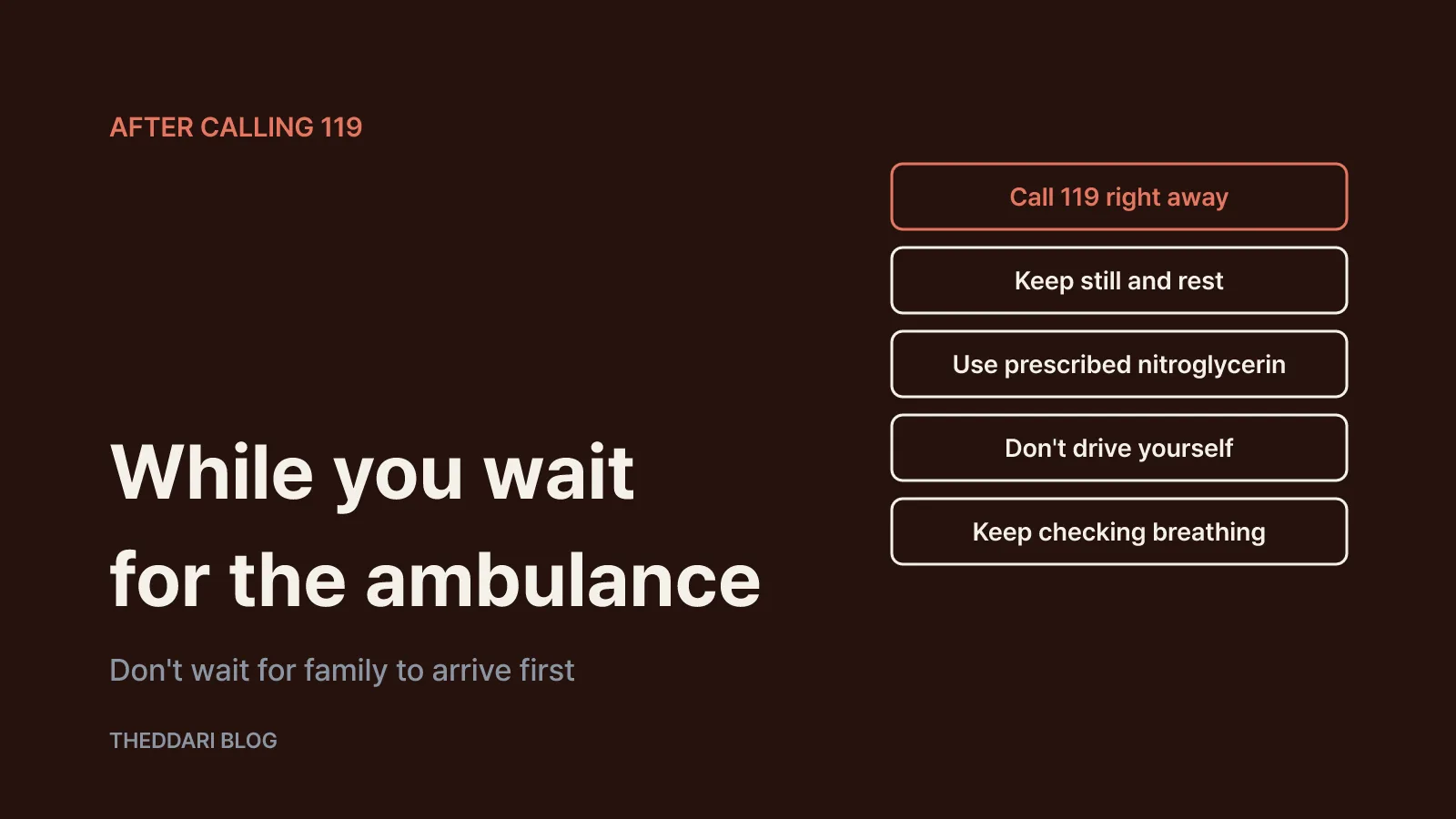
KDCA's response guidance has six points: call 119 without delay; go to a hospital that can provide acute treatment; do not let the patient drive; do not wait for family to arrive; do not assume symptoms will pass; and do not wait for a weekday clinic just because it is night or the weekend. Combined with the portal's self-care advice and the NHS waiting guidance, the steps while help is on the way are:
- Call emergency services immediately. Give the symptoms, when they started and any regular medicines, then follow the call handler. The Korean portal warns against wasting time on ineffective home remedies or detours to a pharmacy, a traditional medicine clinic or a small private clinic.
- Keep still and rest. The portal advises avoiding movement where possible. The NHS suggests sitting on the floor with knees bent and back supported, or on a chair if that is not possible.
- Use prescribed nitroglycerin if you have it. The portal says to use sublingual or spray nitroglycerin straight away if it has been prescribed to you. Borrowing someone else's medicine is a different matter.
- Do not drive. KDCA calls driving yourself dangerous, and the NHS says not to drive yourself to A&E. A patient's condition can change on the way.
- Keep checking responsiveness and breathing. The NHS says to keep checking that the person is responding and breathing. If they stop, move straight to CPR.
Aspirin is where national advice differs. The NHS says to take 300mg of aspirin if you have it, unless you are allergic. KDCA's self-care list does not include aspirin. In Korea, ask the 119 call handler rather than deciding on your own.
If the person collapses and stops breathing
A heart attack and a cardiac arrest are not the same thing. The NHS describes a heart attack as blocked blood flow to the heart, and cardiac arrest as the heart suddenly stopping, with loss of consciousness. Still, the Korean portal notes that cardiac arrest is the most dangerous possible outcome of a heart attack, because severe damage can trigger a serious irregular rhythm.
The portal points out that cardiac arrest most often happens at home or at work, so family and colleagues should know what to do within the critical first 5 minutes. If someone with sudden severe chest pain becomes unresponsive or stops breathing:
- Call 119 and follow the call handler's instructions.
- Place one hand on top of the other in the centre of the chest and push hard and fast, at 100 compressions a minute and 5–6cm deep.
Putting the phone on speaker lets you hear instructions without pausing compressions. If another person is present, one can handle the call while the other gives compressions.
Why arrival time changes the outcome
The longer a coronary artery stays blocked, the more heart muscle is permanently damaged. The Korean portal states that reopening the blocked vessel as quickly as possible, known as reperfusion, is the most important factor in limiting damage and saving life.
Hospital targets continue the countdown. For a heart attack with ST-segment elevation on the ECG, coronary intervention should ideally happen within 90 minutes of arriving at the emergency department. Where that is not possible and clot-dissolving drugs are used, they are recommended within 30 minutes of arrival. For heart attacks without ST elevation and no special risk features, intervention is generally performed within 72 hours. All of these clocks start at the hospital door, so any time spent hesitating at home is lost before they even begin.
If a smaller hospital cannot provide the right treatment, doctors transfer the patient to a tertiary hospital or a regional cardiocerebrovascular centre. That is why KDCA stresses going to a hospital capable of acute care. Korea's portal lets you look up regional cardiocerebrovascular centres in advance.
Risk factors and cold-weather prevention
The Korean portal identifies atherosclerosis as the main cause of heart attacks and lists these risk factors:
- Age: men 45 and over, women 55 and over.
- Smoking, high blood pressure, diabetes, high cholesterol and obesity.
- Family history: a parent, sibling or child diagnosed with coronary artery disease before 55 for men or before 65 for women.
Risk rises with age. KDCA's 2023 incidence statistics show heart attack rates per 100,000 people of 76.6 in people in their 50s, 128.5 in their 60s, 209 in their 70s and 316.7 for those 80 and over.
Season matters too. KDCA explains that cold weather constricts blood vessels and raises blood pressure, increasing risk. In winter, dress warmly before heading out and do not skip prescribed blood pressure medicine.
The portal's lifestyle advice includes:
- Stop smoking and limit alcohol.
- Keep salt to 5g a day or less and eat fibre-rich foods such as vegetables, fruit and whole grains.
- Do aerobic exercise such as walking, jogging or swimming for at least 30 minutes, at least 3 days a week, with about 3 minutes of warm-up first.
- If you have high blood pressure, diabetes or high cholesterol, keep them controlled with prescribed treatment rather than folk remedies.
- After a heart attack, take part in cardiac rehabilitation.
KDCA promotes these habits, along with the warning signs and response steps, through its nine rules for preventing cardiovascular and cerebrovascular disease. Prevention and a fast emergency response belong together: learn the four signs now, and call without hesitation if they appear.