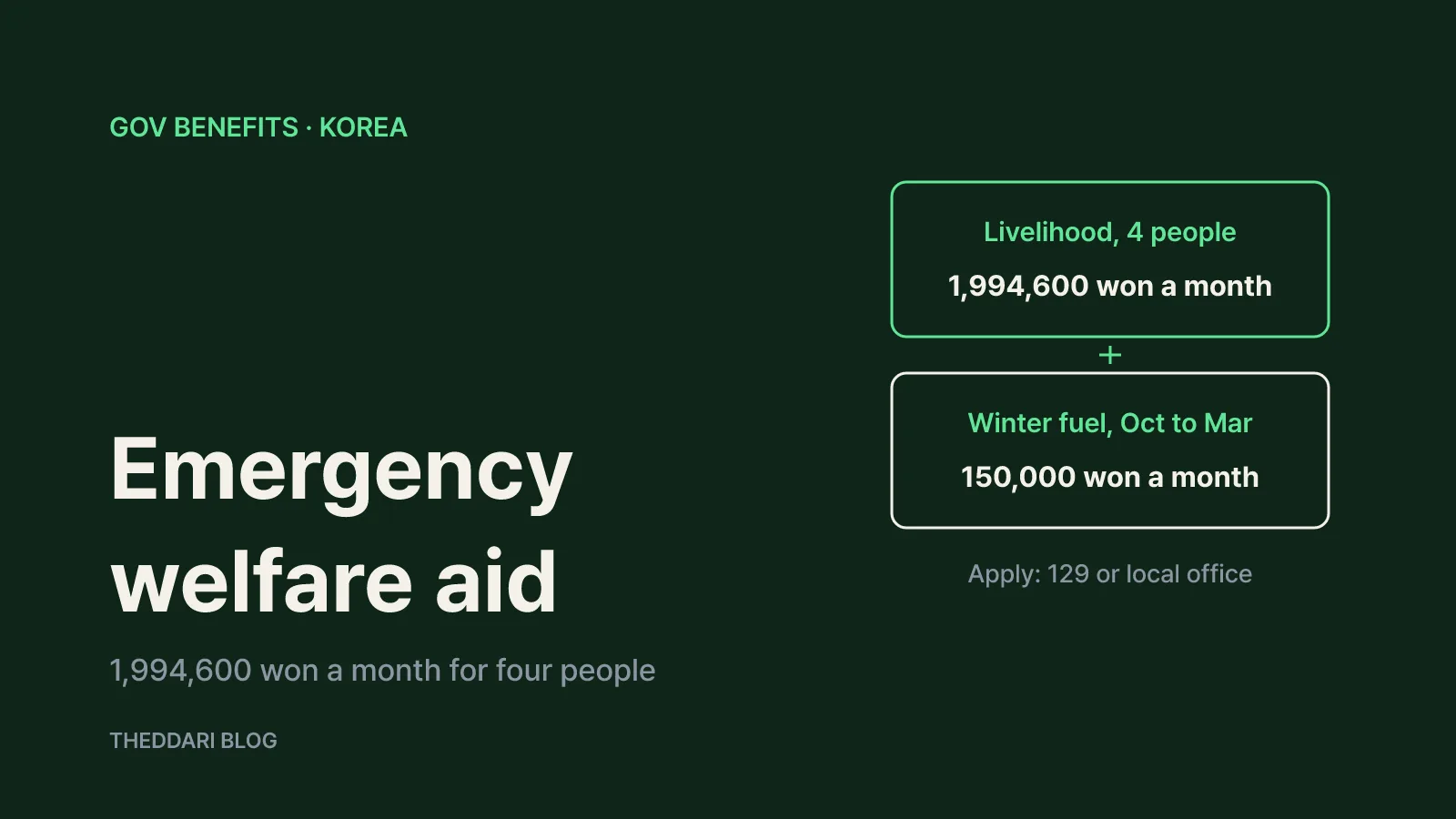
As of October 2026, Korea's emergency welfare support (긴급복지지원) gives low-income households facing a sudden crisis a fixed cash payment based on household size. A four-person household receives 1,994,600 won per month and a single-person household 783,000 won, and between October and March a separate winter fuel payment of 150,000 won per month can be added. Applications are accepted year-round by calling the Ministry of Health and Welfare call center at 129 or visiting the local community service center (eup, myeon or dong office) or the city, county or district office. This guide compares the Gov24 benefit listing with the Ministry of Health and Welfare program page to set out the amounts, who qualifies, what rules you out and what happens after you apply.
How much is emergency livelihood support in 2026?
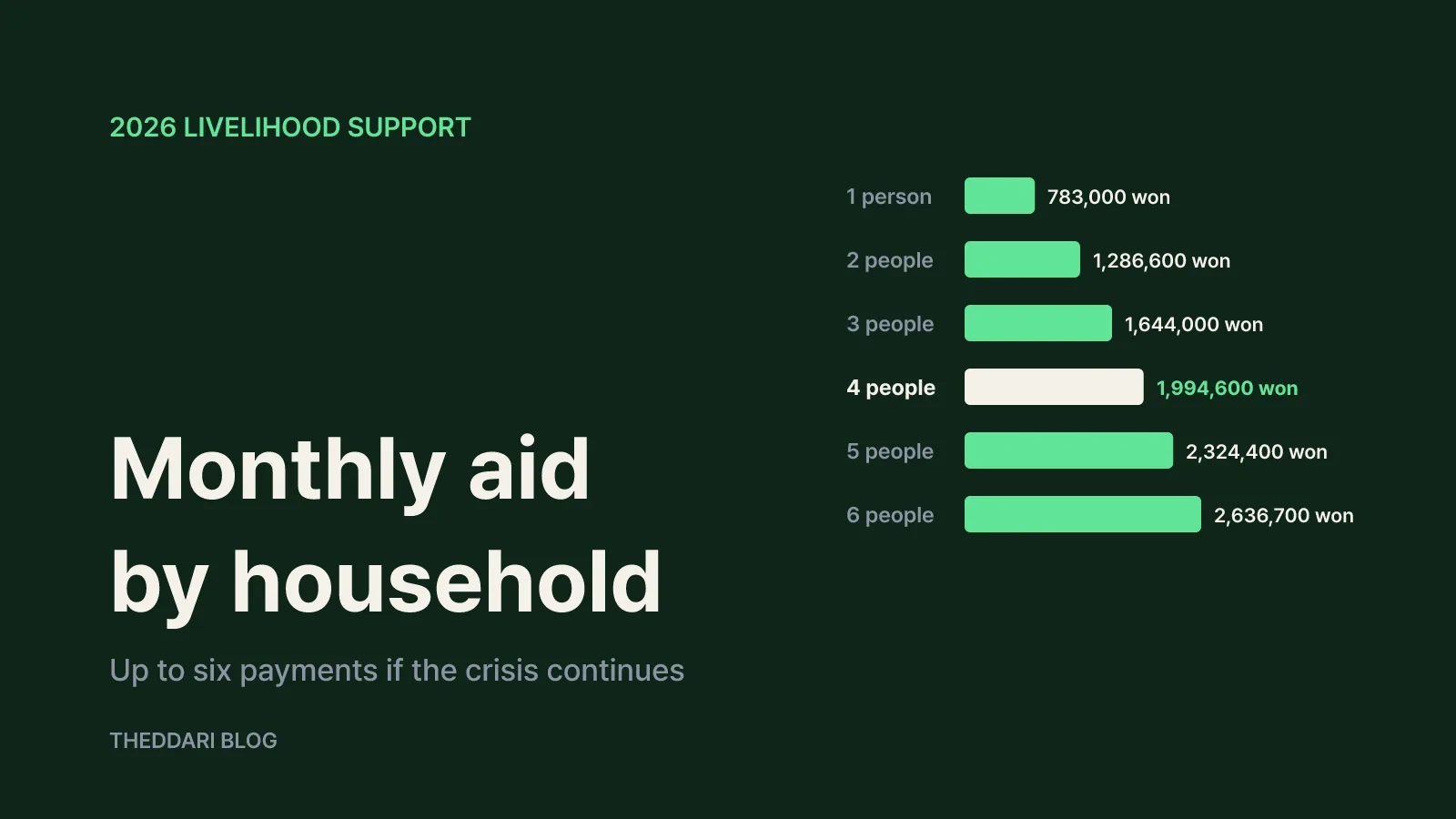
Livelihood support covers everyday costs such as food, clothing and cooling. It is paid as a flat amount per household size rather than being calculated from your actual expenses. The 2026 figures published on Gov24 are:
← Swipe to see more
| Household size | Monthly livelihood support |
|---|---|
| 1 person | 783,000 won |
| 2 people | 1,286,600 won |
| 3 people | 1,644,000 won |
| 4 people | 1,994,600 won |
| 5 people | 2,324,400 won |
| 6 people | 2,636,700 won |
For households of seven or more, Gov24 lists an additional 286,900 won for each extra person. The Busan Metropolitan City guide shows these as monthly amounts and lists a maximum of six payments. Main benefits such as livelihood, medical, housing and welfare facility support are extended only when the crisis continues, so six payments are a ceiling rather than a guarantee.
Who qualifies: a crisis event plus income and asset limits
Low income on its own is not enough. You first need a qualifying crisis, and then your household must fall within the income and asset limits. The main crisis events listed by Gov24 include:
- The main earner has died, left home, gone missing or been detained, causing a loss of income
- A serious illness or injury
- Neglect, abandonment or abuse by a household member, or domestic or sexual violence
- A fire or natural disaster that makes your home unlivable
- The main or secondary earner's business has been suspended, closed or damaged by fire
- The main or secondary earner has lost a job and the income with it
- Other cases set by the minister, such as a sharp income drop after divorce or an electricity cut-off
The Ministry page adds that local governments may recognize further reasons by ordinance, such as having almost no earnings because you care for a family member, water or gas being cut off, or long-term arrears on social insurance premiums or rent. If your situation is not on the list, describe it in detail anyway.
The income limit is 75% of the standard median income. In 2026 that is 1,923,179 won for one person, 3,149,469 won for two, 4,019,277 won for three, 4,871,054 won for four, 5,667,539 won for five and 6,416,964 won for six.
Asset limits depend on where you live: 241 million won in large cities, 152 million won in small and medium cities and 130 million won in rural areas, after a housing asset deduction of 69 million, 42 million or 35 million won respectively. Financial assets such as savings are checked separately and must not exceed 8,564,000 won for one person, 10,199,000 won for two, 11,359,000 won for three, 12,494,000 won for four, 13,556,000 won for five or 14,555,000 won for six. Housing support allows an extra 2 million won.
One key exclusion: Gov24 states that livelihood support cannot be received together with the basic livelihood benefit (생계급여). Households already on that benefit should ask about the other support types instead.
Other support: winter fuel, medical care and temporary housing
Livelihood support is only one part of the program. The 2026 table on the Busan guide lists several other forms of help:
- Medical support: up to 3 million won for tests and treatment, covering co-payments and non-covered items, up to two times
- Housing support: temporary accommodation with actual costs covered up to 398,900 won a month for one person or 662,500 won for four, up to 12 times
- Welfare facility support: admission or service costs up to 552,000 won a month for one person or 1,494,100 won for four, up to six times
- Education support: quarterly school supplies support for students, for example 180,000 won for middle school and 214,000 won for high school, plus tuition and admission fees where needed
- Other support: winter fuel of 150,000 won per month from October to March for up to six months, plus one-off payments of 700,000 won for childbirth, 800,000 won for funeral costs and up to 500,000 won for electricity bills
Because cooling costs are already folded into livelihood support but heating is a separate item, mention heating costs and any unpaid bills explicitly when you call. Counselors can also connect you with private emergency programs run by organizations such as the Community Chest of Korea and the Korean Red Cross.
How to apply through 129 or your local office
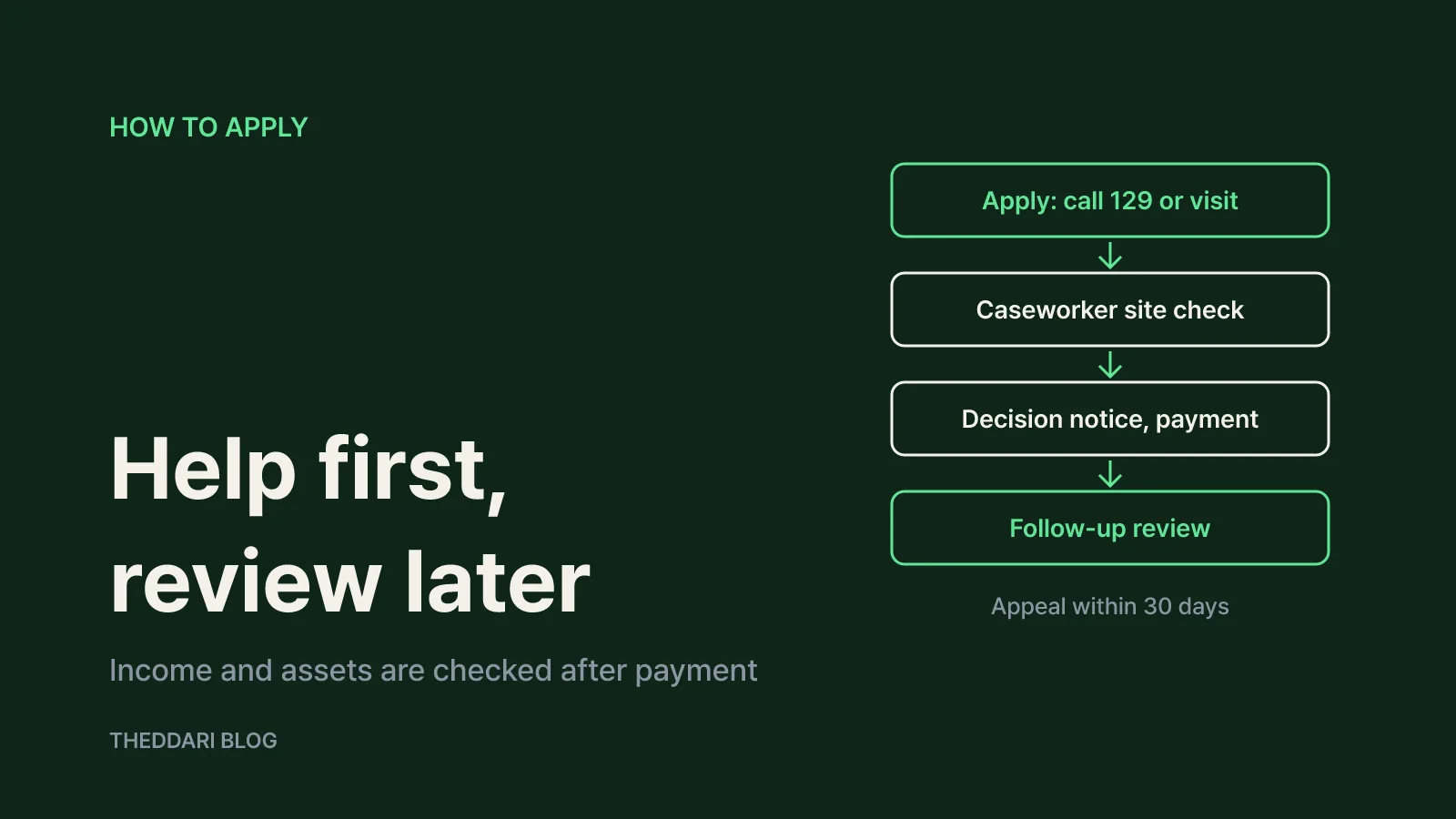
There is no application window. You can either:
- Call 129 and explain the crisis, or
- Visit the community service center or city, county or district office for your registered address.
Gov24 lists the documents you provide as your ID, a consent form for the release of financial information and any other documents the caseworker asks for; officials can check records such as your resident registration themselves. Bringing proof of the crisis, such as a termination notice, a diagnosis or evidence of closure, speeds up the interview.
The Ministry process runs from the support request to an on-site check by a caseworker, a decision notice by letter or text message and then payment. Neighbors or acquaintances can also report a household in crisis to 129 or the local office.
After payment: follow-up review, repayment and appeals
The Ministry notes that whether you actually meet the income and asset limits is judged in a follow-up investigation and an appropriateness review. In practice, help comes first and the detailed means test comes afterwards, with an emergency support review committee deciding the outcome.
If support is found appropriate, it is extended or ended. If it is found inappropriate, the authority can recover all of it, recover part of it or waive repayment, and recovery follows a notice and reminder process. Being accurate about income, assets and household members at the first interview protects you later.
To challenge a decision, file an objection with the city, county or district office within 30 days of being notified. The office forwards it to the province or metropolitan city within 10 days, which replies in writing within 15 days. Note the date you received the decision so you do not miss the 30-day limit.
All limits are tied to the standard median income and change every year, so check the latest Gov24 listing again before you apply once 2027 figures are announced.